Co-composting of Municipal Solid Waste and Faecal Sludge in Kushtia - - PowerPoint PPT Presentation

co composting of municipal solid waste and faecal sludge
SMART_READER_LITE
LIVE PREVIEW

Co-composting of Municipal Solid Waste and Faecal Sludge in Kushtia - - PowerPoint PPT Presentation

Co-composting of Municipal Solid Waste and Faecal Sludge in Kushtia Bangladesh Iftekhar Enayetullah Co-founder & Director Waste Concern, Bangladesh www.wasteconcern.org ESCAP Session: Designing Effective Partnership for Waste to Resource


slide-1
SLIDE 1

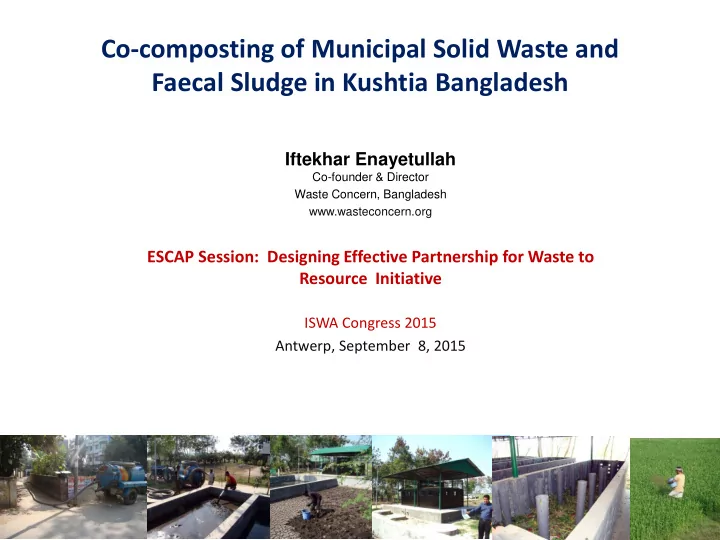
Co-composting of Municipal Solid Waste and Faecal Sludge in Kushtia Bangladesh

Iftekhar Enayetullah

Co-founder & Director Waste Concern, Bangladesh www.wasteconcern.org

ESCAP Session: Designing Effective Partnership for Waste to Resource Initiative

ISWA Congress 2015 Antwerp, September 8, 2015

slide-2
SLIDE 2

Background of Kushtia

Total Area: 27.75 sq.m Estimated Population: 102,988 Total Number of Holdings: 12,907 Total Number of Household: 23,037 Faecal Sludge Generated by the City: 180 M3/ month (estimated)

(equivalent to faecal sludge collected from 90 holdings)

Solid Waste Collected by the City: 20-25 ton/ day (out of this 80% is organic)

www.wasteconcern.org

Kushtia, Bangladesh

slide-3
SLIDE 3

Absence of Faecal Sludge Management

  • Emphasis should therefore be placed on establishing and operating a

sustainable faecal sludge management system that also promotes resource recovery, in order to attain 100% urban sanitation coverage as per set national goal , Promoting private sector participation in faecal sludge collection and treatment as well as NGOs participation in awareness raising is clearly a way forward.

  • National Sanitation Strategy 2005, prepared by the Local Government

Division of the Ministry of Ministry of Local Government, Rural Development & Cooperatives has set-up national sanitation goal to achieve 100% sanitation coverage by 2013.

Problem

slide-4
SLIDE 4
  • Faecal Sludge is a rich source of nutrients such as nitrogen, phosphorus and potassium. In human excreta, most
  • f the organic matter is contained in faeces, while most of the nitrogen (70-80%) and potassium are contained

in urine.

  • Before using faecal sludge as a fertilizer, it must be made safe. Co-composting is the controlled aerobic

degradation of the organics using more than one material (faecal sludge and organic municipal solid waste). Faecal sludge has a high moisture and nitrogen content while bio-degradable solid waste is high in organic carbon and has good bulking properties (i.e. it allows air to flow and air to circulate).

By combining the two, the benefits of each can be used to optimize the process and the output

  • product. Co-composting is a natural process allowing good hygienisation of sludge in a relatively

short time. This is due to high temperature of 50 to 70ºC, which is reached during thermophilic degradation process. Co-composting of pre-treated and thickened faecal sludge with solid waste might be a good solution, even for large sludge volumes.

The Solution: By Combining Faecal Sludge with Organic Waste

+

Combining the two

Faecal Sludge Organic Waste

slide-5
SLIDE 5

Survival Time (in days) of Pathogen by Different Treatment Method

Types of Treatment Bacteria Virus Protozoa Helminths Night soil, faeces at 20-30 C 90 days 175 days 10 days Many months Composting (anaerobic) septic tank/ pit latrine 60 days 60 days 30 days Many months Thermophilic Composting 50-600C 7 days 7 days 7 days 7 days Waste Stabilization Pond Retention time >20days 20 days 20 days 20 days 20 days

Source: IDA (1990)

The Solution: By Combining Faecal Sludge with Organic Waste

www.wasteconcern.org

slide-6
SLIDE 6

Sanitation Situation of the Kushtia Municipality

Total Sample (300) No Toilet 3 (1.0%) Toilet 297(99.0%) Unhygienic 7 (2.33%) Hygienic 290 (96.67) Connected to Drain 55(18.33%) Not Connected to Drain 235 (78.33%)

Pilot Intervention on Faecal Sludge Management in Kushtia

In order to assess sanitation condition of Kushtia Municipality, a sample survey was conducted amongst high, middle, lower-middle and low-income groups. Fig shows 96.67% (290 households

  • ut of 300) of the sample households of Kushtia Pourashava have hygienic toilets. However, 55 of

them (18.33% of the total) have been found having connection with drains.

slide-7
SLIDE 7

Collection and Disposal of Faecal Sludge

From the field survey, it was revealed that 50.33% households have septic tank toilets and 48.67% have ring slab or single pit or twin pit toilets. Although vacuum tug has been used for collection of faecal sludge from the filled up septic tanks or pits of Kushtia Town since a long time, there was no formal or environmentally sound faecal sludge disposal system. Figure shows the frequency of pit/septic tank cleaning in the Municipality.

0.00 5.00 10.00 15.00 20.00 25.00 30.00 35.00 40.00 45.00 Percentage Six Months Yearly Tw o Year Three Year Four Year Five Year Duration Duration Vs Percentage of Pit/Septic Tank Cleaning

Faecal sludge of less than three years is not fully decomposed and contains high pollution load, and hence, needs to be treated properly.

Pilot Intervention on Faecal Sludge Management in Kushtia

slide-8
SLIDE 8
  • In order to tackle solid waste management as well as faecal sludge management

problems, a pilot project has been initiated in Kushtia Municipality, a secondary town in Bangladesh.

  • Project Initiated: November 2012
  • The pilot project has the following Features:
  • 1. Compost plant Capacity = 4 tons/ day
  • 2. Faecal sludge drying bed (with a coco peat filter) to treat = 9 M3/day
  • 3. Land Area: 668 M2 (dedicated by the Kushtia Municipality)

Pilot Intervention on Faecal Sludge Management in Kushtia

The main aim of the project is to develop a sustainable faecal sludge management system having full cost recovery and which can be replicated in secondary towns.

slide-9
SLIDE 9

Pilot Intervention on Faecal Sludge Management in Kushtia

  • The liquid sludge (faecal sludge) is poured into the sludge tank, from where it is passed into the sludge

drying bed by natural gravity. When the drying bed becomes filled up, it is kept there for few days so that sludge gets dried and the percolate is transferred into the connected percolate tank.

  • The percolate is pumped into the coco peat filtration unit for further treatment. The filtered water

coming out from the coco peat has high nutrient, and can be safely released into agricultural land for irrigation purpose.

  • On the other hand, dried layer of the fecal sludge is collected up from the drying bed and is mixed with

the municipal organic solid waste in 1:3 ratios, and compost is produced in the co-composting plant using aerobic theomorphic composting method to be used as organic fertilizer.

slide-10
SLIDE 10

Site Plan of the Co-composting Facility, Kushtia

Pilot Intervention on Faecal Sludge Management in Kushtia 2 1 3 4 2 4 4 3

www.wasteconcern.org

slide-11
SLIDE 11

Co-composting of Faecal Sludge with Organic Waste at Baradi, Kushtia City

Faecal Sludge Collected by Vaccu-Tug and Discharged in the Drying Bed and later Co-composted with Organic Waste to Produce Compost

slide-12
SLIDE 12

Project Partners

Kushtia Municipality

LGED UNESCAP Waste Concern Co-composting Project

 Provided land  operation of the project,  collection of faecal sludge and  collection of fee for the the service  Cost for construction of the compost plant and faecal sludge drying bed along with the cost for the vacuum tugs  UNESCAP provided grant for construction of the coco peat filter.  Technology Provider.  Design of the co-composting facility  Construction supervision.  Monitoring & Evaluation of the facility

  • f the plant.

 Preparation of Business Plan.  Training of municipal staffs

slide-13
SLIDE 13

Test Results of the Co-Compost and Treated Waste Water

Physical Properties

  • Sl. No.

Parameters Actual Concentration Standard * Range 1 pH 7.8 6.0 – 8.5 2 Organic Carbon 11.97% 10 – 25 % 3 Nitrogen (N) 3.08 0.5 – 4.0 % 4 Phosphorus (P) 0.97 0.5 – 1.5 % 5 Potassium (K) 1.08 1.0 – 3.0 % 6 Sulfur (S)

  • 0.1 – 0.5 %

7 Zinc (Zn) Maximum 0.1 % 8 Copper (Cu) 0.0064% Maximum 0.05 % 9 Chromium (Cr) 27.6054 ppm Maximum 50 ppm 10 Cadmium (Cd) 0.00 ppm Maximum 5 ppm 11 Lead (Pb) 26.1172 ppm Maximum 30 ppm 12 Nickel (Ni) 0.00 ppm Maximum 30 ppm

* Compost Standards of Ministry of Agriculture, Government of Bangladesh for use in the agricultural purposes. **All test performed according to procedure described in “Manual for Fertilizer Analysis”, Ministry of Agriculture, Government of the People’s Republic of Bangladesh
Pilot Intervention on Faecal Sludge Management in Kushtia

www.wasteconcern.org

slide-14
SLIDE 14

Laboratory analysis of Compost Produced in the Kushtia Co-Compost Plant Carried Out by The Department of Soil, Water and Environment, University of Dhaka

Parameters Results Faecal Coliform, MPN/g 3.6 Salmonella spp/ 25g Absent Helminth/ g Absent

Pilot Intervention on Faecal Sludge Management in Kushtia

* Compost Standards of Ministry of Agriculture, Government of Bangladesh for use in the agricultural purposes. **All test performed according to procedure described in “Manual for Fertilizer Analysis”, Ministry of Agriculture, Government of the People’s Republic of Bangladesh www.wasteconcern.org

Results of Waste Water from Sludge Drying Bed Before and After Treatment by Coco Peat Filter

Type of Waste Water pH Standard (6.0-8.5)* DO (mg/l) Standard (4.5-8)* COD (mg/l) Standard 400 (mg/l)* Before Treatment ( First Tank) 7.34 1.3 576 After Treatment with Peat Filter ( First Tank) 7.36 4.9 192 Before Treatment ( Second Tank) 7.70 1.6 484 After Treatment with Peat Filter (Second Tank) 7.15 5.5 192

* Compost Standards of Ministry of Agriculture, Government of Bangladesh for use in the agricultural purposes. **All test performed according to procedure described in “Manual for Fertilizer Analysis”, Ministry of Agriculture, Government of the People’s Republic of Bangladesh

slide-15
SLIDE 15

Total O & M including profit Fee Per Year/HH with holding tax Fee Per Year/HH with water charge USD 53,713, with depreciation and 15% profit USD 4.13 USD 8.7 USD 58,161 with depreciation and 20% profit USD 4.5 USD 9.18

Sanitation Fee or Rate per Household The cost for faecal sludge collection and treatment can be imposed with either conservancy tax or as a separate charge as sanitation fee linked with holding tax, subject to approval by the Ministry of Local Government. The other option is to link it with the water charge.

 In order to sustain faecal sludge management services, it is essential to recover the

  • perational costs and make profits.

 In order to sustain the operation, a profit of 15% to 20% should be charged on top of the expenditure.

Financial sustainability of Faecal Sludge Management in Kushtia

slide-16
SLIDE 16

Different Management Options to Run the Facility

Option 1: Municipally Owned and Operated System Option 2: Municipally Owned and Privately Operated System Option 3: Privately Owned and Operated System

Financial Flow for Municipally Owned and Privately Operated Model

slide-17
SLIDE 17

Recommended Options for Operation and Maintenance of Faecal Sludge Collection and Treatment System in Kushtia

  • It is evident that there are three possible options for operation and maintenance (O&M) of the

faecal sludge collection and treatment system. However, considering the present condition of Kushtia Pourashava in terms of availability of skilled manpower and experience in operation and maintenance of such project, municipally owned and operated system could not be

  • recommended. Risks are high for lower quality of services.
  • Fully privately owned and operated system is also not possible at the moment since there is no

regulation or guideline for faecal sludge management currently in place. Since there are no incentives for private sector such as tax holiday for a certain period, nor low interest rates for financing such projects from banks, it is highly unlikely that private sector will be interested to invest capital cost which amounts to USD 135,000 for the Kushtia pourashava. Moreover, private sector would require a concession period of at least 20 years with a provision of land from the pourashava to initiate the project. Since all these issues are not clear at the moment, privately

  • wned and operated system is currently not a viable option.
  • Municipally owned and privately operated model seems to be a viable option. In this model,

Kushtia municipality will invest and own all the infrastructure and they will lease it to the private sector to operate and manage it. Pourashava will pay the private sector a fee based on the number of pits/tanks cleaned per month.

Pilot Intervention on Faecal Sludge Management in Kushtia

www.wasteconcern.org

slide-18
SLIDE 18

Thank You