SLIDE 1 1
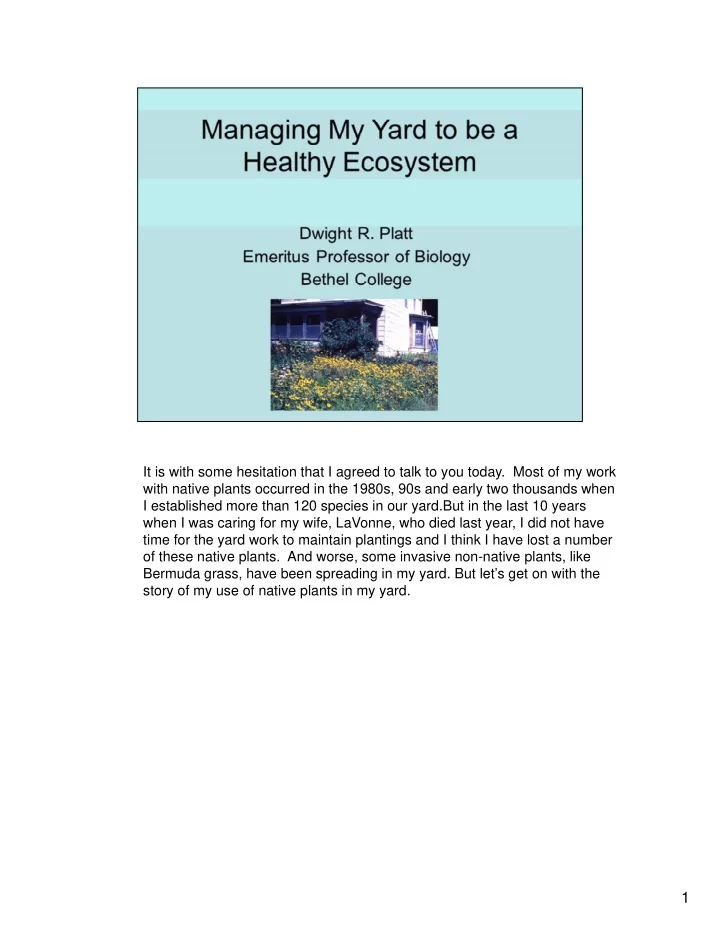
It is with some hesitation that I agreed to talk to you today. Most of my work with native plants occurred in the 1980s, 90s and early two thousands when I established more than 120 species in our yard.But in the last 10 years when I was caring for my wife, LaVonne, who died last year, I did not have time for the yard work to maintain plantings and I think I have lost a number
- f these native plants. And worse, some invasive non-native plants, like
Bermuda grass, have been spreading in my yard. But let’s get on with the story of my use of native plants in my yard.
SLIDE 2 2
I am not a purist. There were beds of iris, peonies and daylilies when my Mother bought our property and they are still here. And I have planted some
- ther irises and crocuses and now and then marigolds, zinnias and other
annual domestic flowers.
SLIDE 3
3
My method to establish native plants was to visit local prairie grasslands and collect seeds of plants that I wanted to establish. Then I had to learn how to germinate those seeds because many of them had dormancy mechanisms that had to be turned off.
SLIDE 4
4
When I learned how to germinate them, I planted the seeds in flats or pots and raised the seedlings. And then I could transplant these seedlings to our yard .
SLIDE 5
5
Here is an area where I was establishing a planting in the year 2000. On the right is a clump of Willow-leaved Sunflower that has been well established. In the left foreground is a planting that is just getting started. And in the back is an area which is prepared for planting.
SLIDE 6
6
This is an area on the east side of my yard. It was planted in 1997 and this photo was taken soon after.
SLIDE 7
7
This is the same planting in May 2003 after six years of growth. Blooming at the time the photo was taken are Plains Larkspur, Ohio Spiderwort, and a clump of Missouri Evening Primrose .
SLIDE 8
8
This is a native flower garden I established on the east side of the driveway turnaround in my yard. The photo was taken in June of 2002. Prominent plants that are blooming are Missouri Evening Primrose, Plains Yellow Evening Primrose and Beardtongue.
SLIDE 9
9
This is the same flower garden later in 2002. Prominent blooming plants are Bergamot Beebalm, Plains Coreopsis, and Black-eyed Susan. Willow- leaved Sunflower and Stiff Goldenrod will bloom later. I included species in a planting that bloomed at different seasons. However my photographs of the plantings are all from Spring and early Summer so I cannot show you the plantings in late Summer and Fall.
SLIDE 10
10
This is a planting on the east side of our house. Ohio Spiderwort and Plains Larkspur are blooming in this photo taken in Spring 1995 .
SLIDE 11
11
So let’s look at some parts of my yard today. The next five slides were taken by my daughter, all in June of last year. In this photo of the west side of the driveway, blooming are Gray-head Prairie Coneflower, Black-eyed Susan, Daisy Fleabane and a few Showy White Evening Primroses. At the back of the front planting is Common Milkweed that is not blooming yet.
SLIDE 12
12
Along the east side of the house American Germander, Ohio Spiderwort and Black-eyed Susan are blooming.
SLIDE 13
13
On the south end of the driveway turnaround, Plains Coreopsis, Butterfly Milkweed and a few Black-eyed Susan and Daisy Fleabane are blooming.
SLIDE 14
14
On the east side of the entrance to the driveway are Upright Prairie Coneflower, Daisy Fleabane and Elderberry shrubs in bloom. In the left background is a large Buttonbush that I grew from seed..
SLIDE 15
15
And here on the east side of the driveway turnaround, Black-eyed Susan, Plains Yellow Evening Primrose and Ohio Spiderwort are blooming. Bergamot Beebalm is about to bloom and Stiff Goldenrod and Willow-leaved Sunflower will come on later. So why did I plant these native plants? First of all, let me say that I was not implementing some overall aesthetic plan for my yard.
SLIDE 16
16
Some of the plantings had a landscape purpose. A pond always formed in the driveway turnaround at the north end whenever there was a big rain.This was not good, so I drained it into the center and started a little rain garden with a Buttonbush, and added other natives.You can see here in addition to the buttonbush, Plains Coreopsis, Black-eyed Susan, Daisy Fleabane and Showy Milkweed.. The milkweed is not yet in bloom.
SLIDE 17
17
I wanted to mark the entrance to my driveway so I planted a Soapweed. or Yucca on the west side of the driveway entrance ..
SLIDE 18 18
In some plantings, I was interested in a particular plant. I was able to grow an interesting plant so I put it in the plot I was planting. This is the Prairie
- Iris. It is not flashy, the flower doesn’t last long when it blooms, but it’s
blooming marks the beginning of Spring and it was an interesting plant in the Iris family..
SLIDE 19 19
Other plants, like Little Bluestem, are important plants in our local prairie
- ecosystem. It is also quite pretty in the Fall when it turns reddish. Then
when frost creates little sculptures on the heads, as in the photo, it become a small aesthetic piece in the landscape. I appreciate these small bits of beauty that can be discovered by looking closely..
SLIDE 20
20
But beauty is in the eye of the beholder. This view of my front yard a few years ago would have some aesthetic interest to many people because of the flashes of color but the organization is quite random and it would not appeal to those who like an orderly neat design.. I appreciate it however.
SLIDE 21 21
Is this an aesthetic view? I suspect many of you would say no. It looks
- messy. But to me it suggests the healthy growth of last year protecting the
ecosystem for winter. And brown is not a bad color. I used to rake leaves and clean up the yard in the Fall to make it look neat. But I realized I was taking the blanket off for all the inhabitants of my yard that had to survive the coming cold weather.
SLIDE 22 22
For me the main motivation in planting my yard was to create a healthy yard
- ecosystem. That meant to use the diversity of native plants to create the
ecological niches that would attract other inhabitants of our local ecosystem.Ecological niche in the sense of the relations to other species and the physical environment that allow a species to survive and reproduce. Let’s consider first the pollinator niches so important to the plants. It meant flowers of many types throughout the season to provide a diversity of niches for pollinators. It meant this Pyrrhopappus flower blooming in the Spring which attracted this Checkered White butterfly.
SLIDE 23
23
And the Butterfly Milkweed in early summer used by many butterflies including this Great Spangled Fritillary. (2007)
SLIDE 24
24
And these Regal Fritillaries.
SLIDE 25
25
And the Buttonbush blooming in later Summer which attracted this Eastern Tiger Swallowtail.
SLIDE 26 26
And in the Fall, the Goldenrods and Asters attract this Bordered Patch
- butterfly. I have a list of 65 species of butterflies that have visited my yard.
SLIDE 27
27
But butterflies need more than flowers to reproduce in a yard. They need food for their caterpillars. This caterpillar of a Monarch butterfly needs Milkweeds to feed on.
SLIDE 28
28
Here is a little patch in my yard with violets and wild strawberries. Many of the fritillary butterflies in order to lay eggs need to find violets, the food for their caterpillars.
SLIDE 29 29
But butterflies are not the only pollinators. In fact, not very efficient
- pollinators. There are also moths and I like this Snowberry Clearwing moth
flying toward its favorite flower in my yard.
SLIDE 30
30
And it found this Bergamot Beebalm flower from which to obtain nectar and pollen,
SLIDE 31
31
We usually think of bees when we think of pollinators. And here is a Large Carpenter Bee visiting Cilantro flowers in my vegetable garden.
SLIDE 32
32
Three small green Halictid bees are poking their snouts into these Goldenrod flowers to suck nectar. There are, of course, many other kinds of local native bees that visit flowers in my yard.
SLIDE 33
33
There are also flies that are pollinators. Here is a Flower Fly or Syrphid Fly visiting Cilantro.
SLIDE 34
34
And look at the long snout and long legs of this Bee Fly that is hovering over the Cilantro flower..
SLIDE 35
35
And even beetles can be pollinators. This is a Soldier Beetle visiting Aromatic Asters. You can find many of these beetles pollinating asters and goldenrods in the Fall. But this species of beetle also occupies another important niche in the ecosystem. The larval beetles feast on insect eggs and soft-bodied insects. This is an example of the predator niches in the ecosystem which help to control insect populations. These predators are important for the healthy functioning of the ecosystem.
SLIDE 36
36
So I need to have room for Spiders, like this Garden Spider, to spin their webs and catch their suppers in this net.
SLIDE 37
37
And I need to attract the Wheel Bug. This one was climbing among the Willow-leaved Sunflowers. It is an important predator on other insects. But you don’t want to play around with it as it can give a painful bite.
SLIDE 38
38
This Wheel Bug has just overpowered a Blister Beetle which will make a nice meal.
SLIDE 39
39
Another predator on other insects that is welcome in my yard is the Praying Mantis.
SLIDE 40
40
And praying mantises must find my yard a good place to live. Here is a couple that are mating.
SLIDE 41
41
This little green Katydid is feasting on a small caterpillar. It likes to take a little meat with its meals of grass.
SLIDE 42
42
The Great Plains Toad is an important predator that feeds on insects in the yard.Other vertebrates are also important predators in my yard, including snakes and various species of birds. Toads also contribute to the auditory environment when they call in the spring near pools of water. And I would miss the vocal contributions of field crickets, tree crickets and cicadas later in the summer if they were not there to sing.
SLIDE 43 43
This Tachinid Fly may come to flowers to drink nectar. The tachina ifly larvae are parasitoids that live inside of and consume the inner organs of cutworms, eventually killing them. This ecologic niche is a little different than that of insect predators, though the results are similar. The ecologic niches I have described are a sample of the diverse niches inhabited by creatures in my yard. These inhabitants of my yard are a sample of the greater diversity that was in the local prairie
- ecosystem. The relationships described contribute to a healthier and more
sustainable yard ecosystem because they have been tested by eons of evolutionary survival.
SLIDE 44 44
Having a healthy yard ecosystem helps in the vegetable garden I have in my
- yard. But I am also concerned to keep the soil ecosystem healthy in my
- garden. The following quotations out of a leaflet from the Natural Resource
Conservation Service of the Department of Agriculture give four basics for keeping the soil ecosystem healthy,: and I quote:: “Here’s how to improve soil health: Disturb the soil as little as possible. Grow many different species of plants through rotations and a diverse mixture of cover crops. Plant cover crops around harvest to keep living roots growing in the soil for as much of the year as possible, and Keep the soil surface covered with residue year round.” unquote So as I have learned the importance of the soil ecosystem I garden very differently than I once did.
SLIDE 45 45
We often consider soil as just a collection of chemicals - nitrogen, phosphorus, potash, etc. But it is really a living ecosystem. This is an illustration of a food web in a soil ecosystem. So to protect that ecosystem, I don’t till or plow my garden anymore. I think the earthworms are happy for
- that. And I use mulches to keep the soil covered.
SLIDE 46
46
And as soon as I harvest the vegetable crop, I plant a cover crop. This is a cover crop growing in my garden consisting of oats, hairy vetch, crimson clover, forage radish and buckwheat.
SLIDE 47
47
And I eat very well all summer on the vegetables and fruits produced and I have been eating well this winter on the produce I froze or canned or stored in the cellar. The ecosystem in my yard not only feeds me and is healthy, sustainable and more stable, but it is also an interesting environment in which to live.