2/1/16 February 1, 20 16 Aspects of electrical activity in a - - PDF document

2 1 16
SMART_READER_LITE
LIVE PREVIEW

2/1/16 February 1, 20 16 Aspects of electrical activity in a - - PDF document

2/1/16 February 1, 20 16 Aspects of electrical activity in a neuron explained by understanding some very basic electrical concepts Introduction to Neuron Models, Course Software 1. Voltage attenuation from a source


slide-1
SLIDE 1

2/1/16 1

February ¡1, ¡20 16

Introduction ¡to ¡Neuron ¡Models, ¡Course ¡Software

Keep in mind: Class participation important Expect assignments on time Review Course policies on Blackboard Review “Expectations”

Aspects of electrical activity in a neuron explained by understanding some very basic electrical concepts

  • 1. Voltage attenuation from a source of current injection
  • 2. Distortion of voltage with distance and time
  • 3. Greater AP conduction speed of large axons
  • 4. Greater AP conduction speed of myelinated axons
  • 5. Repolarization of APs at nodes of Ranvier without IKV
  • 6. Synaptic Integration- Why we can think!

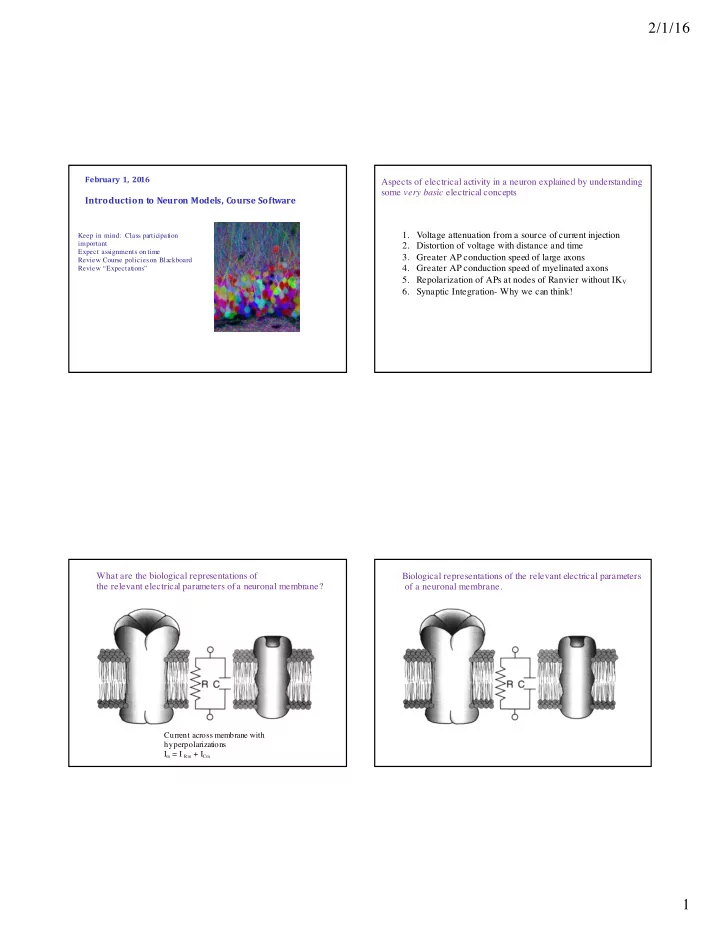
What are the biological representations of the relevant electrical parameters of a neuronal membrane?

Current across membrane with hyperpolarizations Im = I Rm + ICm

Biological representations of the relevant electrical parameters

  • f a neuronal membrane.
slide-2
SLIDE 2

2/1/16 2

Steady-state Vm determined by Rm. How do resistance add in series?- cells connected by electrical junctions How do they add in parallel?? – ion channels in a neuronal membrane Steady-state Vm determined by Rm. How do we categorize ion channels? How do we categorize ion channels? What open or closes them? What is their selectivity? What other important properties can differentiate channels that have the same activators?

slide-3
SLIDE 3

2/1/16 3

Other important properties that differentiate channels. Inactivation kinetics Activation kinetics Opening probability Conductance All can be changed by neuromodulators Only a few equations needed in Neurobiology:

The separation of unlike charge results in a tendency for an electrical current flow. The extent of current flow depends on the conductance (or its reciprocol, resistance)

  • f the medium separating the charges.

What law is this? ¡ ¡

Once a channel is open, what Law does it obey? ! ! ! ! Since!R=!1!/!G! ! ! ! ! I!=!V!/!R! ! V=!I!/!G! ! ! ! ! R!=!V!/I! ! I!=!V!x!G! ! ! ! ! ! ! ! ! ! ! G!=!I!/!V Ohm’s Law V=IR ! The!separation!of!unlike!charge!results!in!a!tendency!for!an! electrical!current!flow.!!The!extent!of!current!flow!depends!on! the!conductance!(or!its!reciprocol,!resistance)!of!the!medium! separating!the!charges.!

How ¡does ¡a ¡separation ¡of ¡specific types ¡of ¡charges ¡occur ¡across ¡a ¡cell ¡membrane?

! ! ! ! Since!R=!1!/!G! ! ! ! ! I!=!V!/!R! ! V=!I!/!G! ! ! ! ! R!=!V!/I! ! I!=!V!x!G! ! ! ! ! ! ! ! ! ! ! G!=!I!/!V Ohm’s Law V=IR ! The!separation!of!unlike!charge!results!in!a!tendency!for!an! electrical!current!flow.!!The!extent!of!current!flow!depends!on! the!conductance!(or!its!reciprocol,!resistance)!of!the!medium! separating!the!charges.!

How ¡does ¡a ¡separation ¡of ¡specific types ¡of ¡charges ¡occur ¡across ¡a ¡cell ¡membrane? Membrane ¡barrier, ¡ion ¡pumps ¡channel ¡permeability

slide-4
SLIDE 4

2/1/16 4

Channels follow Ohm’s law Membrane Cm What is a capacitor? C= Q/V What makes a capacitor stronger or weaker? How does capacitance affect a voltage change? How does capacitance add in series and in parallel? How is capacitance relevant to Neurobiology? Out In Cm on voltage change across the membrane Membrane Cm

slide-5
SLIDE 5

2/1/16 5

This week First Lab: Model Neuron: Membrane resistance, Oscilloscope primer, Time constant, A/D software tutorial- Introduction to Lab Chart