
SLIDE 1
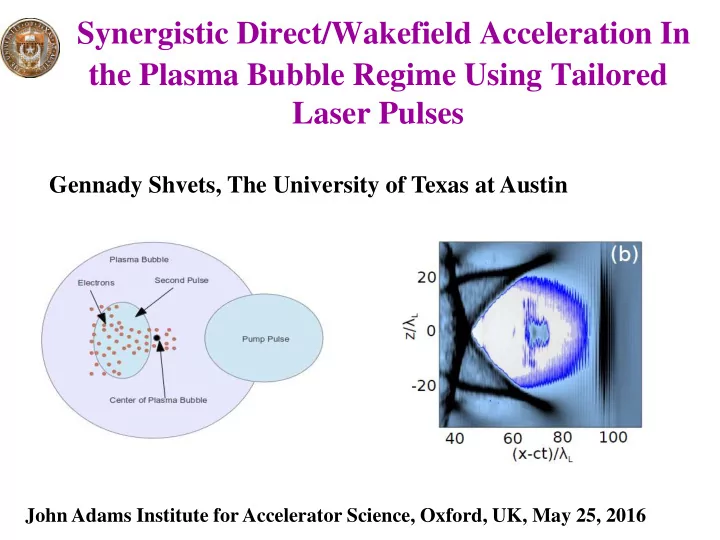
Synergistic Direct/Wakefield Acceleration In
the Plasma Bubble Regime Using Tailored Laser Pulses
Gennady Shvets, The University of Texas at Austin
John Adams Institute for Accelerator Science, Oxford, UK, May 25, 2016
History of Accelerators: Higher Energies from Bright Ideas Fermi - - PowerPoint PPT Presentation
Synergistic Direct/Wakefield Acceleration In the Plasma Bubble Regime Using Tailored Laser Pulses Gennady Shvets, The University of Texas at Austin John Adams Institute for Accelerator Science, Oxford, UK, May 25, 2016 History of Accelerators:
John Adams Institute for Accelerator Science, Oxford, UK, May 25, 2016
“Fermi predicted that future accelerators would grow in power and
earth but around it, and physics laboratories would be in outer space… You may expect that at some future time accelerators will change the aspect
planet Saturn”, Laura Fermi, 1974.
Prediction: 20 TeV CM energy by 1994 at a cost of $170B NB: SSC would have been 40 TeV CM if it was not cancelled in 1993 (!!) “What can we learn with High-Energy Accelerators”, Retiring Presidential Address of APS, Columbia, 1954
*Tevatron: 1 TeV/6km proton/antiproton
huge radius for reasonable magnetic field strength
2 4 4
Major problem: synchrotron radiation LHC: 7 TeV/27km proton-proton
*Bad picture: 3km Main Injector Ring looks larger than the Tevatron!
trap
Courtesy of Dave Whittum
Slow electron photon Fast electron
Cannot stop a photon in vacuum!
possess non-radiative field components due to boundaries (inverse Smith Purcell, PBG, surface wave, plasma wakefield, …)
electrons execute transverse motion in external DC fields (IFEL, inverse CARM, inverse Ion Channel Laser)
Particle advances inside bubble gains energy from low-frequency electric field energy gain is limited by dephasing
𝟑 − 𝛀 → 𝚬𝐪𝐲 = 𝟑𝜹𝒄 𝟑𝚬𝛀
Far-field accelerators (no boundaries, plasmas, etc):
Drawbacks: (a) accelerating gradient reduces with 𝜹, (b) large transverse undulating motion, (c) difficult to maintain resonance condition
IFEL curse
Dave Whittum, Andy Sessler, and John Dawson invent an ion channel laser
The MPQ team proposes and realizes the inverse ion channel laser
Electrons execute betatron motion with frequency 𝝏𝜸 Transverse energy 𝝑⊥is reduced due to the conservation of the action 𝑱⊥ = 𝝑⊥/𝝏𝜸
𝟑/𝟑𝜹𝒏𝒇 + 𝝏𝒒 𝟑𝒏𝒇 𝟑𝒜𝟑/𝟓 Betatron frequency Transverse energy
Betatron motion
Break the adiabatic invariant by introducing an additional resonant laser pulse DLA
A great deal of theoretical work:
Nemeth, et al., PRL’07, PRL; Phuoc, et al., PoP’08, J. L. Shaw et. al., PPCF’14
Dino Jaroszynski produces MeV Gamma rays, possibly via DLA mechanism inside a bubble!!
“In fact, this observation of high harmonic generation could provide the first (albeit somewhat indirect) experimental evidence of DLA, which has so far been elusive.”
Big questions: (a) monochromatic beam? (b) best laser pulse format? (c) best injection approach? (d) major paradigm shift of LPAs in the making??
acceleration: 𝝏𝑴 𝟐 − 𝒘𝒚/𝒘𝒒𝒊 = 𝝏𝒒/ 𝟑𝜹
LWFA is bad for DLA
PRL 114, 184801 (2015)
and GS, PPCF 58, 034011 (2016)
But the benefits of combining the two could be substantial! DLA is bad for LWFA
acceleration or electron injection into the bubble
accelerating gradient experienced inside the bubble
PPCF 58, 034011 (2016)
𝒆𝜼 𝒆(𝒅𝒖) ≈ 𝟐 𝟑𝜹𝒄
𝟑 − 𝟐 + 𝒒⊥ 𝟑/𝒏𝒇 𝟑𝒅𝟑
𝜹𝟑
(a) electron injection with large transverse energy (b) strong overlap between electrons and the laser (c) betatron resonance between electrons and the laser 𝜕𝑒 = 𝜕𝑀 1 + 𝑞𝑨
2 𝑛2𝑑2
2𝛿2 + 1 2𝛿𝑞ℎ
2
𝝏𝒆(𝒚) 𝝏𝜸(𝒚)
Resonance condition:
𝝏𝒆 ≈ 𝝏𝜸
Swarm of initial conditions (𝒒⊥, 𝒔⊥) DLA electron non-DLA electron
Pump pulse creates a bubble Density bump “shakes” the bubble side-injection with large 𝒒⊥ facilitates DLA
n0=1.8×1018cm-3; n1=5.4×1018cm-3 𝝁 = 𝟏. 𝟗𝝂𝒏 I0=6×10¹⁹w/cm2; I1=6×10¹⁸w/cm2 L2 =1.6mm, L3 = L4 = L5 ≈ 𝟐𝟏𝟏𝝂𝒏 delay:80fs Density ramp injection scenario
Self-injected electrons interact with the weaker laser pulse delayed by Dt=80fs
184801 (2015)
after 1cm propagation
Electrons separated into two groups DLA electrons with large 𝒒⊥gain more energy and fall behind the non-DLA ones
Pump: 𝒃𝑴 = 𝟔. 𝟒, 𝝊𝑴 = 𝟖𝟏𝒈𝒕, 𝒙𝟏 = 𝟑𝟏𝝂𝒏 DLA : 𝒃𝑴 = 𝟐. 𝟖, 𝝊𝑴 = 𝟒𝟔𝒈𝒕, 𝒙𝟏 = 𝟑𝟏𝝂𝒏
DLA with DLA pulse w/o DLA pulse DLA non-DLA
184801 (2015)
Phase space bifurcation Two-peak spectrum separated by 400 MeV Bifurcation is absent without DLA pulse
DLA non-DLA
DLA electrons strong correlation between total energy 𝛿𝑛𝑑2 and transverse energy 𝝑⊥ =
𝒒𝒜
𝟑
𝟑𝜹𝒏 + 𝒏𝝏𝒒
𝟑𝒜𝟑
𝟓
Strong bifurcation in (𝝑⊥, 𝜹) phase space Synergy between DLA and LWFA higher energy gain from the wake for the DLA population delayed dephasing!
𝒆𝜼 𝒆(𝒅𝒖) ≈ 𝟐 𝟑𝜹𝒄
𝟑 − 𝟐 + 𝒒⊥ 𝟑/𝒏𝒇 𝟑𝒅𝟑
𝜹𝟑 DLA electrons gain extra 200 MeV from the wake and extra 400MeV from the laser (DLA)
𝑜0 = 4 × 10¹⁸𝑑𝑛−3 𝐽pump = 2.3 × 10¹⁹𝑋/𝑑𝑛2 𝑉ion = 870𝑓𝑊 from 𝑃7+to 𝑃8+ Off-axis or off-peak phase ionization produces DLA electrons!
Electrons after 3mm
𝐽DLA = 𝐽pump/2 𝑄
pump = 96 𝑈𝑋
𝑭⊥ 𝑩⊥
Off-peak ionization phase: electrons leave the laser pulse with finite transverse momentum
𝒒⊥ + 𝒇𝑩⊥/𝒅 = 𝒇𝑩⊥ 𝒖𝒋 /𝒅
Ricochet electron starts out with large 𝒒⊥, interacts with the DLA pulse gains even larger 𝒒⊥ and more energy Phase
𝑶 = 𝟐 𝑶 = 𝟒 𝑶 = 𝟔 Transverse energy growth
𝜕𝑀 1 + 𝑞𝑨
2 𝑛2𝑑2
2𝛿2 =
𝑶 = 𝟒 𝑶 = 𝟐 𝑶 = 𝟔
= 𝑂 𝜕𝑞 2𝛿
Model: constant decelerating field 𝑭𝑿 Multiple DLA harmonics:
𝑓𝐹𝑋 = −40𝐻𝑓𝑊/𝑛 𝑏𝑀 = 2, 𝑤𝑞 = 𝑑
Initial conditions
𝝁𝟐 = 𝟏. 𝟗𝝂𝒏 pulse: 𝑸𝟐 = 𝟐𝟖𝟏TW (𝒃𝟐 = 𝟕) 𝝊𝟐 = 𝟒𝟔fs, 𝒙𝟐 = 𝟐𝟑𝝂m
𝑜0 = 4 × 10¹⁸𝑑𝑛−3 The wake decelerates the electrons, but the DLA accelerates them at more than twice the deceleration rate!
Loss to wake Gain from laser
External injection into the decelerating phase
𝑞𝑦0 = 25𝑛𝑓𝑑 𝑦 − 𝑑𝑢 /𝜇𝑀
plasma is used large-amplitude betatron oscillations are not a problem
makes a bubble) with an ultra-short solid-state laser pulse (“surgical tool” that injects electrons, excites betatron oscillations, provides DLA)
𝟑 ∼ 𝝁𝑴 𝟑𝑱𝑴
𝝁𝟏 = 𝟑𝝂𝒏 pulse: 𝑸𝟏 = 𝟕𝟔TW (𝒃𝟏 = 𝟒. 𝟖) 𝝊𝟏 = 𝟓𝟔fs, 𝒙𝟏 = 𝟒𝟏𝝂m 𝝁𝟐 = 𝟏. 𝟗𝝂𝒏 pulse: 𝑸𝟐 = 𝟒𝟒TW (𝒃𝟐 = 𝟐. 𝟕) 𝝊𝟐 = 𝟒𝟏fs, 𝒙𝟐 = 𝟑𝟏𝝂m Time delay: 𝚬𝒖 = 𝟐𝟑𝟏fs
𝑜0 = 8 × 10¹⁷𝑑𝑛−3
𝑦 = 5.5mm Electrons gain 400MeV from wake and 200MeV from 𝜇 = 0.8𝜈𝑛 laser: 1st harmonic DLA 𝜕𝑀 1 − 𝑤𝑨 𝑤𝑞 = 𝜕𝛾
Pump: 𝝁𝟏 = 𝟏. 𝟗𝝂𝒏, 𝑸𝟏 = 𝟐𝟑TW, 𝝊𝟏 = 𝟑𝟏fs, 𝒙𝟏 = 𝟐𝟏𝝂m DLA: 𝝁𝟏 = 𝟏. 𝟗𝝂𝒏, 𝑸𝟏 = 𝟐𝟏TW, 𝝊𝟏 = 𝟐𝟏fs, 𝒙𝟏 = 𝟐𝟏𝝂m
non-DLA electrons DLA electrons DLA electrons non-DLA
Large number of DLA electrons can be
plasma densities (𝑜0 = 1.5 × 10¹⁹𝑑𝑛−3) Time delay: Δ𝜐 = 24𝑔𝑡 Problem: time delay jitter! Relativistic 𝛿
Destructive interference: 𝜀𝜐 = −𝜇/2𝑑 The bubble is not distorted large number
Few DLA electrons
non-DLA electrons DLA electrons
“Average” interference: 𝜀𝜐 = −3𝜇/4𝑑 The bubble is slightly distorted smaller number of trapped non-DLA electrons More DLA electrons
non-DLA electrons DLA electrons
Constructive interference: 𝜀𝜐 = −𝜇/𝑑 The bubble is strongly distorted small number of trapped non-DLA electrons Many more DLA electrons
non-DLA electrons DLA electrons
Pump: 𝝁𝟏 = 𝟏. 𝟗𝝂𝒏, 𝑸𝟏 = 𝟐𝟑TW, 𝝊𝟏 = 𝟑𝟏fs, 𝒙𝟏 = 𝟐𝟏𝝂m DLA: 𝝁𝟏 = 𝟏. 𝟗𝝂𝒏, 𝑸𝟏 = 𝟐𝟏TW, 𝝊𝟏 = 𝟐𝟏fs, 𝒙𝟏 = 𝟐𝟏𝝂m DLA: 𝝁𝟏 = 𝟏. 𝟓𝝂𝒏, 𝒙𝟏 = 𝟔. 𝟒𝝂m
Reduced 𝜇: no bubble distortion improved DLA and non-DLA electron yields No interference reduced jitter sensitivity