A Slide Rule and a Half Colin Tombeur The Conundrum In some of - - PDF document

a slide rule and a half
SMART_READER_LITE
LIVE PREVIEW

A Slide Rule and a Half Colin Tombeur The Conundrum In some of - - PDF document

January 2018 A Slide Rule and a Half Colin Tombeur The Conundrum In some of Charles N. Pickworths detailed slide rule instruction manuals written specifically for A.W Faber - Castell he refers to models 363 and 380 , yet


slide-1
SLIDE 1

January 2018

  • 1 -

A Slide Rule and a Half

Colin Tombeur

The Conundrum In some of Charles N. Pickworth’s detailed slide rule instruction manuals written specifically for A.W Faber- Castell he refers to models ‘363½’ and ‘380½’, yet this ‘½’ reference is not seen in any official Faber documents

  • r on any of their products. What was going on?

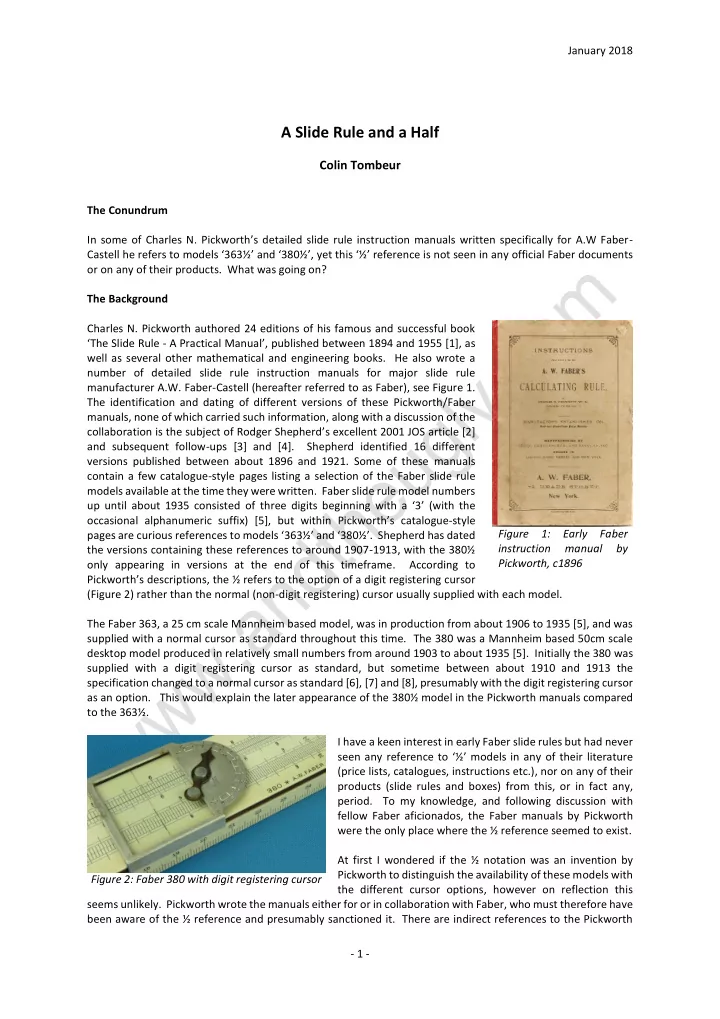
The Background Charles N. Pickworth authored 24 editions of his famous and successful book ‘The Slide Rule - A Practical Manual’, published between 1894 and 1955 [1], as well as several other mathematical and engineering books. He also wrote a number of detailed slide rule instruction manuals for major slide rule manufacturer A.W. Faber-Castell (hereafter referred to as Faber), see Figure 1. The identification and dating of different versions of these Pickworth/Faber manuals, none of which carried such information, along with a discussion of the collaboration is the subject of Rodger Shepherd’s excellent 2001 JOS article [2] and subsequent follow-ups [3] and [4]. Shepherd identified 16 different versions published between about 1896 and 1921. Some of these manuals contain a few catalogue-style pages listing a selection of the Faber slide rule models available at the time they were written. Faber slide rule model numbers up until about 1935 consisted of three digits beginning with a ‘3’ (with the

  • ccasional alphanumeric suffix) [5], but within Pickworth’s catalogue-style

pages are curious references to models ‘363½’ and ‘380½’. Shepherd has dated the versions containing these references to around 1907-1913, with the 380½

  • nly appearing in versions at the end of this timeframe. According to

Pickworth’s descriptions, the ½ refers to the option of a digit registering cursor (Figure 2) rather than the normal (non-digit registering) cursor usually supplied with each model. The Faber 363, a 25 cm scale Mannheim based model, was in production from about 1906 to 1935 [5], and was supplied with a normal cursor as standard throughout this time. The 380 was a Mannheim based 50cm scale desktop model produced in relatively small numbers from around 1903 to about 1935 [5]. Initially the 380 was supplied with a digit registering cursor as standard, but sometime between about 1910 and 1913 the specification changed to a normal cursor as standard [6], [7] and [8], presumably with the digit registering cursor as an option. This would explain the later appearance of the 380½ model in the Pickworth manuals compared to the 363½. I have a keen interest in early Faber slide rules but had never seen any reference to ‘½’ models in any of their literature (price lists, catalogues, instructions etc.), nor on any of their products (slide rules and boxes) from this, or in fact any,

  • period. To my knowledge, and following discussion with

fellow Faber aficionados, the Faber manuals by Pickworth were the only place where the ½ reference seemed to exist. At first I wondered if the ½ notation was an invention by Pickworth to distinguish the availability of these models with the different cursor options, however on reflection this seems unlikely. Pickworth wrote the manuals either for or in collaboration with Faber, who must therefore have been aware of the ½ reference and presumably sanctioned it. There are indirect references to the Pickworth Figure 1: Early Faber instruction manual by Pickworth, c1896 Figure 2: Faber 380 with digit registering cursor

slide-2
SLIDE 2

A Slide Rule and a Half

  • 2 -

manuals in Faber instruction leaflets from around the time of interest and a Faber catalogue from around 1907 [9]. But, other than the Pickworth manuals, was the ½ reference ever used directly by Faber themselves? There seemed to be no evidence that they did, which is peculiar and puzzling. The Discovery The incongruity remained until I examined a newly acquired Faber 380 (Figure 2). The slide rule itself has the ‘380’ model number (not 380½) clearly printed on the front and can be dated by its construction and lack of date stamp to between about 1914 and 1920, after the time that normal cursors became the standard cursor supplied with the model. This specimen has a digit registering cursor, but this could either have been supplied with the rule or possibly added later (digit registering cursors were available to purchase separately for this model while they were the standard cursor [9], it is unclear if this was still the case after the specification changed, although it seems likely). The side rule came to me in a box that is almost certainly the

  • riginal supplied with the rule. Faber boxes of this period are a two-part cardboard design that carry a model

number label on the right hand end. Unfortunately old boxes like this one are often damaged, particularly at the ends, resulting in the model label being missing, damaged or obscured. In fact, the ends of this box had been reinforced with tape by a previous owner, but fortunately the glue had degraded considerably with age and the tape could be removed easily without further damage to what lay beneath. Removing the tape revealed a model label which, though damaged, clearly reads ‘380½’ (Figure 3). The Analysis The 380½ box model label that I found is the first evidence I have ever seen of the ½ identification on an official Faber produced source, other than the manuals by Pickworth. The label was the subject of a debate at a UKSRC meeting as to whether the ‘½’ was handwritten or printed (as the ‘380’ clearly was), with the general consensus that it was handwritten. The consensus was corroborated when I sought expert advice from the Printing Historical Society [10]. Richard Lawrence, a letterpress printer, was of the opinion that the ½ was almost certainly handwritten, mainly due to the faded brown colour of the ink compared to the rest of the printing which has remained very black. This colour fading is characteristic of old handwriting inks, whereas printing inks do not fade in this way due to their different formulation. But what does this mean? It is very unlikely that the ½ identifier was added by a previous owner of the slide rule as, even if they were aware of this designation, they would have had no real reason to write it on the box end model label. Here are some possible scenarios, there may well be others:  The ½ identifier was added by the retailer to identify stock, although this would indicate some knowledge from Faber themselves as to the nature of the identifier.  The ½ identifier was added by Faber to identify stock.  The ½ identifier was added by Faber to identify the piece when a special order for one of these low- volume slide rules was fulfilled and despatched. At the manufactory, the small production volumes of the 363 and particularly the desktop 380 configured with a digit registering cursor may have precluded the setting up of a separate model label print, or even a stamp, so the ½ was simply handwritten on the label. Similarly, any addition necessitated by a retailer would probably have had to have been made by hand. Regardless of when the ½ identifier was applied, and by who, its appearance on this box model label is apparent confirmation that Faber recognised and used it, at least internally, either at the manufactory or at their ‘Houses’ (offices in other countries), despite it not appearing in their own literature. As to why Faber did not use the identifier externally, but accepted Pickworth’s use of it, this remains a mystery. Perhaps Faber’s reasoning was Figure 3: Faber 380 box model label

slide-3
SLIDE 3

A Slide Rule and a Half

  • 3 -

to avoid further complication in an already complicated model range at this time; the availability of the cursor upgrade was sufficient rather than having additional designated models. Pickworth, on the other hand, was only showing a selection of models in his manuals, and perhaps wanted to highlight some available options. The Wider Marketplace Faber were not the only manufacturer to use these bizarre fractional identifiers for slide rule models. Kueffel & Esser (K & E) produced several ½ numbered models in their early years, as evidenced in their catalogues between 1895 and 1906 [11]. Similarly, a 1901 pricelist and a 1916 catalogue from A.G. Thornton show several early fractional products, but Thornton went further using ‘1/8’, ‘¼’, ‘½’ and ‘¾’ in their model numbers [12]. My limited study of both of these manufacturers shows that their use of fractional identifiers appears inconsistent, and that any underlying system from either manufacturer is not obvious, at least to me. I do not know if any of these identifiers appeared on any of the slide rules themselves. My research into the wider marketplace was necessarily brief as it is beyond the intended limited scope of this article other than a cursory mention. I leave any search for additional examples, and investigation of the possible rationale behind the numberings, for other interested readers to carry out. The Open End My discovery of the ½ identifier on a Faber box model number label answers one question but poses many

  • thers. Did Faber only use this curious notification on the box or was it used elsewhere? Exactly how and when

was it applied? Why did Pickworth adopt it in his manuals but Faber did not in their catalogues etc.? We will probably never truly know the answers, but it is unfortunate that there is so little evidence from this period to provide clues. Catalogues and Faber literature are scarce, as are the slide rules themselves, and boxes are often missing or badly damaged. Examples with the optional digit registering cursor will be rarer still, particularly the 50 cm desktop 380. My analysis contains a fair amount of speculation, so I am open to suggestions and will welcome any additional evidence that others can provide (I can be contacted via the UKSRC) - there must be more to discover out there regarding these slide rules and a half… References and Acknowledgements [1] Pickworth (Peter M. Hopp), United Kingdom Slide Rule Circle (UKSRC), Slide Rule Gazette, Issue 6, Autumn 2005, Page 57 [2] The Faber Slide Rule Manuals by Pickworth (Rodger Shepherd), Journal of the Oughtred Society, Vol. 10,

  • No. 1, Spring 2001, page 2

[3] Faber Slide Rule Manuals by Pickworth - A Postscript (Rodger Shepherd), Journal of the Oughtred Society,

  • Vol. 20, No. 1, Spring 2011, Page 4

[4] The Faber Manuals by Pickworth - Revised Chronology (Rodger Shepherd), Journal of the Oughtred Society, Vol. 21, No. 2, Autumn 2012, Page 6 [5] Rechenschieber Slide Rules A.W. Faber A.W. Faber-Castell (Peter Holland), self-publication, seventh revised edition, 2014 [6] Half-Yearly Report: A.W. Faber (A.W. Faber), July 1903 [7] Priesliste über A.W. Faber Rechenstäbe: A.W. Faber (A.W. Faber), year unknown (c1910) [8] Pries-Liste von A.W. Faber: A.W. Faber (A.W. Faber), 1913 [9] A.W. Faber Improved Calculating Rules (A.W. Faber): A.W. Faber, year unknown (c1907) [10] Richard Lawrence, Printing Historical Society, private correspondence [11] K&E Catalogs and Price Lists for Slide Rules (Clark McCoy), http://www.mccoys-kecatalogs.com/KEmain.htm. K & E’s Boucher/Calculigraphe, model 1743½, is listed in catalogues between 1895 and 1899, although their model 1743 was a completely different calculator, the Charpentier. Between 1897 and 1899 the 1746 and 1746½, and 1748 and 1748½ are listed, where the ½ indicates a ‘glass Indicator’ (cursor) variant to the ‘metal Indicator’ model, but other models with a glass indicator are listed that are not numbered ½. In 1899 the 1744 and 1744½ appear. In this case the ½ indicates a 5 inch variant of the 10 inch duplex

slide-4
SLIDE 4

A Slide Rule and a Half

  • 4 -

rule, both of which have a metal indicator (previously this 5 inch version was listed as the 1744B). After this the model numbering changed and the ½ briefly disappeared, appearing later in the 1906 catalogue with the 4069 and 4069½. Again it was used to distinguish between the metal and glass cursors supplied, but only for this model, other models used different numbers without the ½ for versions with the different cursors. After this the ½ appears to have been discontinued completely. [12] Thornton Wooden Slide Rules (David M. Riches), United Kingdom Slide Rule Circle (UKSRC), Slide Rule Gazette, Issue 15, Autumn 2014, Page 125. The 1901 pricelist lists several model numbers with variants ending in ½, and one ending in ¾. For the model 6039, the addition of the ½ and ¾ indicates variants with different cursors, but for the 6068 and 6069, the ½ variants are cardboard data strips, presumably relevant to their parent model’s design. Two

  • ther models described as ‘new pattern’, the 4509½ and 4504½, do not have non-fraction versions and

the only difference between them is their scale length. The 1916 catalogue includes more ½ models, and ‘¼’ and ‘1/8’ models in addition to the ¾ model. The new 6039¼ is an 8 inch scale variant of the 6039 rather than another cursor option, and the 60401/8 is a 15 inch scale variant of the existing 20 inch scale

  • 6040. The catalogue includes the ½ models from the 1901 pricelist with the exception of the 4509½, but

additional ½ models shown add to the ambiguity of the identifier. The 4678½ is a ‘special quality’ version

  • f the 6040, whereas the 4678 is a special quality version of the 6039. The 6079½ is a case (only) for the

new 6079 ‘Kensington’ model, and the 8497½ and 8498½ are the ‘pointed’ and ‘broken line’ cursors (only) from the 6039½ and 6039¾ respectively. Finally, the 4853½ is the 10 inch scale variant of their 5 inch scale cardboard slide rule, the 4853. I would like to thank Trevor Catlow, Peter Holland, Peter Hopp and Richard Lawrence for their support and contributions to this piece.