
SLIDE 1
Transactions of the Korean Nuclear Society Virtual Spring Meeting July 9-10, 2020
A Spectral Optimization Study of Fuel Assembly for Soluble-Boron-Free SMR
Xuan Ha Nguyen, Seongdong Jang, and Yonghee Kim* Korea Advanced Institute of Science and Technology (KAIST) 291 Daehak-ro, Yuseong-gu, Daejeon, 34141, Republic of Korea
*Corresponding author: yongheekim@kaist.ac.kr
- 1. Introduction
Water-cooled small modular reactors (SMRs) are an attractive nuclear power plant option because of economics, sitting flexibility, integrated and simplified
- design. For simplicity and enhanced safety, a soluble-
boron-free (SBF) operation for SMRs is desirable. It is because the SBF system eliminates several drawbacks
- f soluble boron (SB), e.g. complication of chemical
and volume control system, possibly positive moderator temperature coefficient (MTC), etc. Moreover, the SBF
- peration was demonstrated to be beneficial for passive
frequency operation and power maneuvering as the coolant temperature variation is minimized with a highly negative MTC available in the SBF system [1, 2]. The SBF operation for SMRs has been successfully achieved in recent studies [3, 4] with innovative burnable absorber designs. However, the neutron economy is quite low with discharge burnup of <30 GWd/tU with single batch fuel management (FM) since FA design, particularly for SBF condition, has never been investigated and optimized yet. It is mainly because SMRs are currently utilizing standard 17x17 PWR fuel assembly (FA) that was optimized for three- batch FM with SB. As SMRs mostly accompany with single batch FM for a long cycle length, enhanced fuel utilization and improved inherent safety are essential. Hence, a spectral optimization study of FA for high- performance SBF SMRs is investigated in this paper. To perform parametric study for the optimization of SMR FA, the continuous-energy Monte Carlo Serpent 2 code [5] is used with the nuclear library ENDF/B-VII.1 as the Serpent 2 is capable of simulating interaction physics without major approximations, providing accurate nuclide depletion as well as on-the-fly cross- sectional temperature treatment. The FA parametric study is investigated in terms of cycle length, temperature coefficients, pin peaking factor (PPF), and neutron spectrum with respect to hydrogen-to-uranium (H/U) number ratio. Moreover, the SBF SMR, named ATOM (autonomous transportable on-demand reactor module), is also analyzed with the optimal H/U obtained from the parametric study. The core performance are investigated in terms of cycle length, discharge burnup, radial power, and temperature coefficients.
- 2. Parametric Study on 17x17 Fuel Assembly
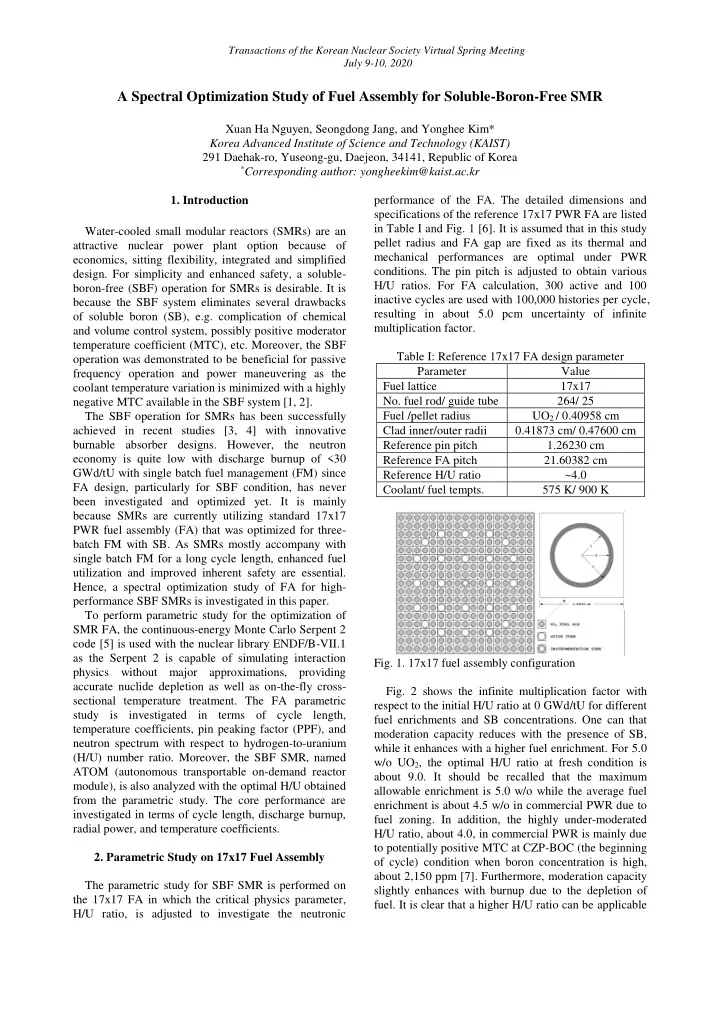
The parametric study for SBF SMR is performed on the 17x17 FA in which the critical physics parameter, H/U ratio, is adjusted to investigate the neutronic performance of the FA. The detailed dimensions and specifications of the reference 17x17 PWR FA are listed in Table I and Fig. 1 [6]. It is assumed that in this study pellet radius and FA gap are fixed as its thermal and mechanical performances are optimal under PWR
- conditions. The pin pitch is adjusted to obtain various
H/U ratios. For FA calculation, 300 active and 100 inactive cycles are used with 100,000 histories per cycle, resulting in about 5.0 pcm uncertainty of infinite multiplication factor. Table I: Reference 17x17 FA design parameter Parameter Value Fuel lattice 17x17
- No. fuel rod/ guide tube
264/ 25 Fuel /pellet radius UO2 / 0.40958 cm Clad inner/outer radii 0.41873 cm/ 0.47600 cm Reference pin pitch 1.26230 cm Reference FA pitch 21.60382 cm Reference H/U ratio ~4.0 Coolant/ fuel tempts. 575 K/ 900 K
- Fig. 1. 17x17 fuel assembly configuration
- Fig. 2 shows the infinite multiplication factor with
respect to the initial H/U ratio at 0 GWd/tU for different fuel enrichments and SB concentrations. One can that moderation capacity reduces with the presence of SB, while it enhances with a higher fuel enrichment. For 5.0 w/o UO2, the optimal H/U ratio at fresh condition is about 9.0. It should be recalled that the maximum allowable enrichment is 5.0 w/o while the average fuel enrichment is about 4.5 w/o in commercial PWR due to fuel zoning. In addition, the highly under-moderated H/U ratio, about 4.0, in commercial PWR is mainly due to potentially positive MTC at CZP-BOC (the beginning
- f cycle) condition when boron concentration is high,
about 2,150 ppm [7]. Furthermore, moderation capacity slightly enhances with burnup due to the depletion of
- fuel. It is clear that a higher H/U ratio can be applicable