ADVANCES IN WOMENS BACKGROUND HEALTH: A CRITICAL REVIEW OF THE - - PowerPoint PPT Presentation

advances in women s
SMART_READER_LITE
LIVE PREVIEW

ADVANCES IN WOMENS BACKGROUND HEALTH: A CRITICAL REVIEW OF THE - - PowerPoint PPT Presentation

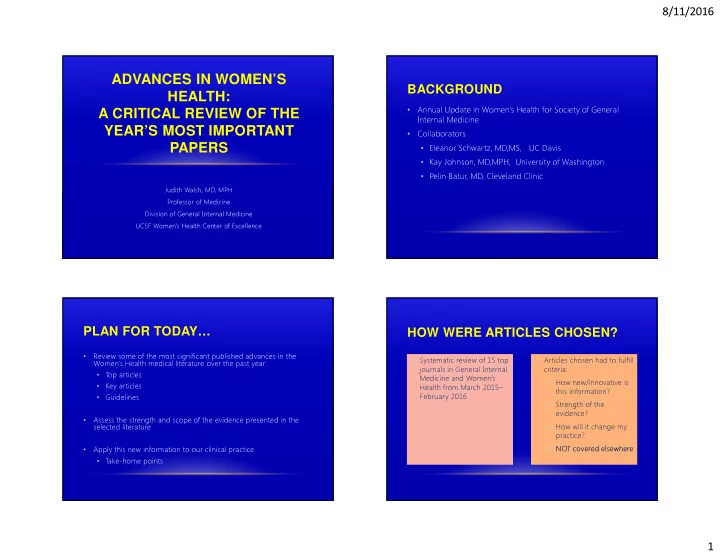
8/11/2016 ADVANCES IN WOMENS BACKGROUND HEALTH: A CRITICAL REVIEW OF THE Annual Update in Womens Health for Society of General Internal Medicine YEARS MOST IMPORTANT Collaborators PAPERS Eleanor Schwartz, MD,MS, UC


slide-1
SLIDE 1

8/11/2016 1

Judith Walsh, MD, MPH Professor of Medicine Division of General Internal Medicine UCSF Women’s Health Center of Excellence

ADVANCES IN WOMEN’S HEALTH: A CRITICAL REVIEW OF THE YEAR’S MOST IMPORTANT PAPERS

BACKGROUND

  • Annual Update in Women’s Health for Society of General

Internal Medicine

  • Collaborators
  • Eleanor Schwartz, MD,MS, UC Davis
  • Kay Johnson, MD,MPH, University of Washington
  • Pelin Batur, MD, Cleveland Clinic

PLAN FOR TODAY…

  • Review some of the most significant published advances in the

Women’s Health medical literature over the past year

  • Top articles
  • Key articles
  • Guidelines
  • Assess the strength and scope of the evidence presented in the

selected literature

  • Apply this new information to our clinical practice
  • Take-home points
  • Systematic review of 15 top

journals in General Internal Medicine and Women’s Health from March 2015– February 2016

  • Articles chosen had to fulfill

criteria:

  • How new/innovative is

this information?

  • Strength of the

evidence?

  • How will it change my

practice?

  • NOT covered elsewhere

HOW WERE ARTICLES CHOSEN?

slide-2
SLIDE 2

8/11/2016 2 TOPICS FOR TODAY

  • Breast Cancer Prevention
  • UTIs
  • Vitamin D and Bone Health
  • Cervical Cancer Screening
  • Ovarian Cancer Screening and Prevention

BREAST CANCER PREVENTION

CASE

A 39 year old woman is very worried about her risk of breast

  • cancer. Her mother and sister both had breast cancer; her sister

tested negative for a known gene mutation. Using an online breast cancer risk calculator, you estimate her 5 year risk of breast cancer to be 3%. Is she a candidate for chemoprophylaxis to decrease her breast cancer risk? A. Yes B. No C. Maybe

Y e s N

  • M

a y b e

7% 48% 46%

BACKGROUND

  • Four RCTs have shown that tamoxifen can reduce the risk of

breast cancer in women at increased risk in the first 10 years

  • f follow up
  • Infrequently prescribed
  • Limitations and surprising results of the first International

Breast Cancer Intervention Study (IBIS) report

  • Increased deaths, though not statistically significant
slide-3
SLIDE 3

8/11/2016 3 THE NEWS

  • Tamoxifen for prevention of breast cancer: extended long-

term follow-up of the IBIS-I breast cancer prevention trial

  • Cuzick et al. Lancet Oncol 2015;16:67-75
  • Objectives
  • Long-term follow-up after tamoxifen treatment to

determine impact on occurrence and mortality of invasive breast cancer and DCIS

METHODS

  • N=7154 women aged 35-70
  • Blindly randomized to oral tamoxifen 20 mg daily vs placebo

for 5 years

  • Inclusion criteria
  • Aged 45-70: ≥2x risk
  • Aged 35-44: >2x risk
  • Exclusions: h/o DVT, PE, desired pregnancy, h/o cancer

RESULTS

  • Median follow up 16 years. 74% still masked to assignment
  • Placebo group: 9.8% of women developed breast cancer
  • Tamoxifen group: 7% of women
  • Hazard ratio 0.71 (p<0.0001)
  • HR is the same for the first ten years and 10+ years
  • Women receiving HT had less benefit
  • Hot flashes during active treatment
  • DVTs OR 1.73 (increased during first 10 years only)
  • Endometrial cancer during active treatment only (2.5 excess cases per

thousand women)

CONCLUSIONS

  • Tamoxifen x 5 years offers a very long period of protection,

substantially improving the benefit-to-harm ratio

  • NNT 22 to prevent one case of breast cancer in 20 years
  • NNT 29 to prevent one case of estrogen receptor positive invasive

breast cancer in 20 years

  • No difference in breast cancer mortality (underpowered)
slide-4
SLIDE 4

8/11/2016 4 TAKE-HOME

  • Women with extremely high risk (BRCA1 or BRCA2 gene mutations
  • r other familial syndrome) should be counseled on prophylactic

mastectomy

  • Consider tamoxifen for women at otherwise increased risk (using

BCSC tool, or http://www.cancer.gov/bcrisktool/Default.aspx)

  • USPSTF 2013 (B recommendation): For women at increased risk of

breast cancer and low risk for adverse medication effects, clinicians should offer tamoxifen or raloxifene

CASE

A 39 year old woman is very worried about her risk of breast

  • cancer. Her mother and sister both had breast cancer; her sister

tested negative for a known gene mutation. Using an online breast cancer risk calculator, you estimate her 5 year risk of breast cancer to be 3%. Is she a candidate for chemoprophylaxis to decrease her breast cancer risk? A. Yes B. No C. Maybe – refer to genetic counselor/high risk breast clinic

Y e s N

  • e

– r e f e r t

  • g

e n e t i c . . .

0% 0% 0%

UTIS

CASE

Nellie natural is here for her annual visit. She mentions mild UTI symptoms for 4 days. UA is + for LE and nitrites. She's not a fan

  • f medications, tends to prefer “natural supplements”, and asks

you if antibiotics are truly necessary. You tell her: A. Antibiotics may lower her risk of pyelonephritis B. She can try ibuprofen 400 tid instead of an antibiotic C. More than 2/3 of typical UTIs resolve on their own D. All of the above

A n t i b i

  • t

i c s m a y l

  • w

e r h e r . . . S h e c a n t r y i b u p r

  • f

e n 4 . . . M

  • r

e t h a n 2 / 3

  • f

t y p i c a l . . . A l l

  • f

t h e a b

  • v

e

31% 67% 2% 0%

slide-5
SLIDE 5

8/11/2016 5 THE NEWS

  • Ibuprofen versus fosfomycin for uncomplicated urinary tract

infection in women: randomised controlled trial.

  • Gagyor et al. BMJ 2015;351:h6544.
  • Objective:

Can uncomplicated UTI be treated with ibuprofen to reduce antibiotic prescriptions without a significant increase in symptoms, recurrences, or complications?

METHODS

  • Study Design:
  • Double blind randomized multicenter trial of 42 GPs in Germany
  • Intervention:
  • 779 women, up to age 65, with suspected UTI randomized
  • Fosfomycin 3 g sachet x 1 day or
  • Ibuprofen 400 tid x 3 days
  • Women scored their daily symptoms and activity impairment
  • Safety data collected q 6mo, between 2012-2014
  • Inclusion criteria:
  • Dysuria, frequency, urgency, +/- lower abdominal pain
  • Exclusion criteria:
  • Fever, “loin” tenderness
  • pregnancy, renal disease
  • UTI within 2 wks
  • Urinary catheterization
  • Contraindication to NSAIDs

RESULTS:

Selected outcome Ibuprofen n=241 Fosfomycin n=243 Courses of antibiotic within 28d 81 277 RR 66.5% (58.8-74.4) Mean duration of symptoms 5.6 days 4.6 days P<0.001 % Patients symptoms–free at day 7 70% 82% P=0.004 % Patients with recurrence of UTI (d 15-28) 6% 11% P=0.049 Number of patients with pyelonephritis 5 1 P=0.12 Number of patients with GI symptoms 6 15 NS

CONCLUSIONS

  • Women with mild to moderate symptoms may benefit
  • Nonparticipants had higher symptom scores

Reminder: Treatment of asymptomatic bacteruria not

  • recommended. 2015 Cochrane review

showed no benefit of antibiotics to prevent:

  • symptomatic UTI
  • complications
  • death

Cochrane Kidney and Transplant Group. Antibiotics for asymptomatic bacteriuria; 8 APR 2015.

slide-6
SLIDE 6

8/11/2016 6 TAKE-HOME

  • Nellie can try ibuprofen for her UTI. She should be counseled to

call if her symptoms persist, and to watch for possible pyelonephritis.

  • Two-thirds of UTIS resolved on their own
  • Women who take ibuprofen are more likely to need additional

antibiotic therapy, but still less likely to receive antibiotics overall.

VITAMIN D AND BONE HEALTH

CASE

Frances fragile is a 67 year old woman who has just come in to establish care with you. She has never had a DXA scan and you

  • rder one. You are on your way out the door when she asks whether
  • r not you are going to check her vitamin D level. Her sister told

her that she is supposed to have a level of 30 ng/ml. What do you say? A. Of course. We should check Vitamin D levels in everyone B.

  • No. Just be sure you are taking a Vitamin D

supplement of 800 IU a day. C. We will check your Vitamin D level if your DXA scan shows osteoporosis. D. I don’t know. What do you want to do?

Of course. We should ch...

  • No. Just be sure you are ...

We will check your Vitam.. I don’t know. What do ...

6% 20% 46% 28%

BACKGROUND

  • Low Vitamin D levels contribute to osteoporosis
  • The optimal Vitamin D level for skeletal health is debated
  • >30 ng/ml recommended by some
  • >20 ng/ml recommended by IOM
  • Using a definition of Vitamin D deficiency of <30ng/ml, 75% of

postmenopausal women would be deficient

  • Determining the optimal level of 25 (OH) D for bone health and
  • ptimal calcium homeostasis is important
slide-7
SLIDE 7

8/11/2016 7 THE NEWS

  • “Treatment of Vitamin D Insufficiency in Postmenopausal Women: A

Randomized Controlled Trial”

  • Hansen et al. JAMA Intern Med. 2015
  • Objectives
  • To evaluate the impact of low dose and high dose cholecalciferol

compared with placebo in postmenopausal women with Vitamin D deficiency on the following outcomes:

  • changes in fractional calcium absorption,
  • Bone mineral density and muscle mass
  • Timed Up and Go tests and five sit to stand tests
  • Functional status and physical activity

METHODS

  • Single center randomized double blind controlled trial
  • Participants:
  • 230 postmenopausal women without osteoporosis
  • 75 years or younger
  • Baseline Vitamin D levels 14-27 ng/dl
  • Intervention
  • 800 IU Vitamin D3 daily
  • 50,000 IU Vitamin D3 twice a month
  • Achieved and maintained Vitamin D levels ≥30 ng/dl
  • Placebo
  • Outcomes measured at 1 year

RESULTS

  • Calcium absorption (change from baseline):
  • Increased by 1% in the high dose arm (10 mg/day)
  • Decreased by 2% in low dose arm (P=0.005 low vs high dose)
  • Decreased by 1.3% in placebo arm (P=0.03 placebo vs high dose)
  • BMD or muscle mass scores:
  • No between arm differences in any comparisons
  • Timed Up and Go or five sit to stand tests
  • No between arm differences in any comparisons
  • ALSO NO differences in:
  • number of falls
  • number of people who fell
  • functional status
  • physical activity

CONCLUSIONS

  • Although high dose cholecalciferol therapy increased calcium

absorption, there was no impact on bone density or other clinically important outcomes.

  • Low and high dose cholecalciferol were equivalent to

placebo with respect to effects on bone and muscle

  • utcomes.
slide-8
SLIDE 8

8/11/2016 8 TAKE-HOME

  • No evidence supports recommendations for maintaining serum 25

(OH) levels >30 ng/ml

  • Back to Frances

A. Of course. We should check Vitamin D levels in everyone B.

  • No. Just be sure you are taking a Vitamin D supplement of

800 IU a day. C. We will check your Vitamin D level if your DXA scan shows

  • steoporosis.

D. I don’t know. What do you want to do?

BACK TO FRANCES

  • You tell Frances that there is no evidence that a Vitamin D

level of >30 ng/ml is necessary for bone health, but she wants to know if there any other benefits to Vitamin D supplementation that she should know about.

VITAMIN D AND FUNCTIONAL DECLINE?

  • RCT conducted in Switzerland
  • 200 men and women ≥70 with prior fall
  • Three groups received monthly treatment
  • 24,000 IU Vit D3
  • 60,000 IU Vit D3
  • 24,000 Vit D3 plus 300µcg calcifediol
  • Outcomes
  • Higher doses were more likely to result in 25-OH D ≥30 ng/ml
  • No impact on lower extremity function
  • More falls in the higher dose groups.
  • Bischoff-Ferrari et al JAMA Int Med 2016

EXERCISE, VITAMIN D AND FALL PREVENTION

  • Two year RCT of exercise and Vitamin D supplementation in Finland
  • Four groups:
  • Vitamin D 800 IU without exercise
  • Vitamin D 800 IU with exercise
  • Placebo and exercise
  • Placebo and no exercise
  • Outcomes: monthly reported falls, injurious falls, number of fallers and injured

fallers

  • Neither Vitamin D nor exercise reduced rate of falls
  • Rate of injurious falls significantly decreased with strength/balance/exercise

training

  • Uusi-Rasi K et al JAMA Int Med 2015
slide-9
SLIDE 9

8/11/2016 9 CASE: MS. FRAGILE, CONTINUED

  • On further questioning, Ms. Fragile tells you that she has

been taking calcium supplements for years because she is very concerned about osteoporosis. Recently, she has heard that calcium supplements might actually be bad for her and that she might be better off getting all her calcium from her diet.

  • She wants to know what you recommend.

BACKGROUND

  • Calcium supplementation has been widely recommended for bone

health

  • Clinical trials of calcium supplementation of 1000 mg/day have

suggested an increase in cardiovascular events, kidney stones and GI symptoms

  • Current recommendations often focus on telling patients to

increase calcium intake through diet rather than supplements

  • Assumption that this increases calcium intake to recommended

goals without the adverse effects of supplements

THE NEWS

  • “Calcium intake and risk of fracture: systematic review”
  • Boland et al. BMJ, 2015
  • Objectives:
  • To evaluate the evidence underlying recommendations to

increase calcium intake through diet or calcium supplements in order to prevent fracture

METHODS

  • Systematic review
  • RCTs in adults >50 at baseline with endpoint of fracture
  • Cohort studies where most follow-up occurred in participants >50

years

  • Studies where calcium was given with another treatment assuming

treatment was given in both arms

  • Included studies with calcium and Vitamin D co-administered
  • Dietary calcium included milk, dairy, dietary intake from food and

hydroxyapatite

  • Meta-analyses with random effects and assessed for heterogeneity
slide-10
SLIDE 10

8/11/2016 10 RESULTS: DIETARY CALCIUM

  • Two RCTS and 44 cohort studies assessed relationship between dietary

calcium (n=37), milk (n=14), or dairy intake (n=8) and fracture

  • utcomes
  • Dietary calcium: most studies showed no association with fracture
  • 14/22 for total
  • 17/21 for hip
  • 7/8 for vertebral
  • 5/7 for forearm
  • Milk and dairy intake: most studies showed no association with

fracture

  • 25/28 milk
  • 11/13 dairy
  • Too few trials to calculate summary estimate

RESULTS: CALCIUM SUPPLEMENTS

  • 26 RCTS reported fracture outcomes
  • 14 calcium only
  • 8 Ca/D
  • 4 were multi-arm or factorial of both
  • 20 trials used a dose of ≥1,000 mg of calcium
  • Fracture reduction
  • Reduced risk of total fracture (RR 0.89: 95% C.I. 0.81-0.96)
  • Reduced risk of vertebral fracture (0.87: 95% C.I. 0.74-1.00)
  • No reduction in hip or forearm fracture
  • Funnel plot inspection suggested bias toward calcium supplements
  • Studies with lowest risk of bias showed no effect on fracture

CONCLUSION

  • Dietary calcium is not associated with fracture risk
  • There is no clinical trial evidence that dietary calcium reduces

fracture risk

  • Some evidence that calcium supplementation reduces

fracture risk but evidence is inconsistent

CALCIUM INTAKE AND BONE MINERAL DENSITY

  • Meta-analysis of the impact of dietary or supplemental calcium on BMD
  • Tai et al BMJ 2015
  • 59 eligible RCTs
  • 15 dietary calcium
  • 51 supplemental calcium
  • Increasing calcium intake from dietary sources increased BMD
  • 0.6-1.0% at total hip and total body at one year
  • 0.7-1.8% at these sites at two years
  • Calcium supplements increased BMD similarly
  • BMD increases similar for dietary and supplemental calcium and for Ca/D
  • Dietary and supplemental calcium lead to small nonprogressive increases in BMD-

clinical significance is unclear

slide-11
SLIDE 11

8/11/2016 11 IMPACT FOR PRACTICE

  • Dietary and supplemental calcium lead to small increases in BMD
  • There is no clinical trial evidence that dietary calcium reduces

fracture risk

  • Dietary studies have challenges
  • The evidence for calcium supplements and fracture reduction is

mixed

  • There is no evidence that dietary calcium is more effective than

supplemental calcium

CERVICAL CANCER SCREENING

QUESTION

Henrietta Peevey is a 35 year old woman who has always had normal pap smears. She has recently read about a “new and improved test” for cervical cancer which involves HPV instead of a conventional pap smear and she wants to know whether or not she should have

  • it. What do you recommend?

A. Conventional cytology B. HPV testing C. Conventional cytology and HPV testing D. Any of these are recommended options

C

  • n

v e n t i

  • n

a l c y t

  • l
  • g

y H P V t e s t i n g C

  • n

v e n t i

  • n

a l c y t

  • l
  • g

y . . . A n y

  • f

t h e s e a r e r e c

  • .

. .

13% 30% 50% 7%

CERVICAL CANCER SCREENING

  • Dramatic reduction in mortality with routine cervical cancer

screening

  • HPV is the causative agent in the majority of cases of cervical

cancer

  • Long latency period for development of cervical cancer
  • Many lesions will regress on their own
slide-12
SLIDE 12

8/11/2016 12 “IN THE OLD DAYS”

  • Annual Pap smear from now until forever
  • Guidelines for screening less frequently have been in place

for over 20 years

“IMPROVEMENTS” ON PAP TESTING

  • Liquid Based Cytology
  • Initially touted as “better” than Pap tests
  • Similar test characteristics but allows for reflex HPV testing
  • HPV testing
  • HPV types 16 and 18 major causative agents

CERVICAL CANCER SCREENING GUIDELINES

USPSTF 2012 ACS/American Society for Colposcopy and Cervical Pathology, and American Society for Clinical Pathology Joint Guidelines 2012

Pap smear every 3 years in women aged 21- 65 Pap every 3 years in women aged 21-29 For women aged 30-65 who want to lengthen the screening interval, screen with a combination of cervical cytology and HPV testing every 5 years For women aged 30-65 Pap plus HPV testing is the preferred method Pap every 3 years is acceptable Discontinue in women over the age of 65 in whom smears have been consistently normal Discontinue in women over the age of 65 in whom smears have been consistently normal Continue to screen women diagnosed with cervical pre- cancer No HPV screening in women younger than 30 No HPV testing in women less than age 30 unless needed after an abnormal test result No screening in women who have had a hysterectomy No screening in women who have had a hysterectomy and have no history of cervical cancer or pre-cancer

HPV PRIMARY SCREENING?

  • ATHENA trial evaluated HPV test as primary screen for

cervical cancer in women ≥25 years old

  • HPV alone detected more cases of CIN3+ but required more

colposcopies

  • Promising but not currently recommended as a primary

screening test

  • ATHENA, 2015
slide-13
SLIDE 13

8/11/2016 13 THE NEWS

Use of Primary High-Risk Human Papillomavirus Testing for Cervical Cancer Screening: Interim Clinical Guidelines

  • Huh WK et al. Obstet Gynecol Feb 2015
  • Sponsored by the Society of Gynecologic Oncology and

ASCCP

  • Representatives also from ACOG, ACS, ASC, CAP

, ASCP

INTERIM GUIDELINES

  • Primary hrHPV screening
  • Can be considered as an alternative to current U.S. cytology-

based cervical cancer screening methods

  • Should occur no sooner than every 3 years
  • Should not be initiated before 25 years of age
  • Panel had concerns about harms

“Progression to cancer is uncommon, and detection of most of the disease found in the 25-29 year age group can be safely deferred until age 30 and older.”

  • Based on limited evidence, this triage approach appears

reasonable:

2

(NILM= negative for intraepithelial lesion or malignancy) *If ≥ ASC-US or persistent hrHPV colpo

Recommended primary HPV screening algorithm

Primary hrHPV Screening Interim Guidance. Obstet Gynecol 2015

*

SCREENING GUIDELINES

  • These interim guidelines have not been broadly adopted
  • USPSTF, ACS guidelines remain unchanged
  • ACOG 2016
  • For women aged 30 and over, co-testing is the preferred

screening strategy

  • Primary cytology is an option
  • Primary HPV testing can be considered for women ≥25 while

acknowledging that cytology alone or co-testing “remain the

  • ptions specifically recommended in most major society

guidelines”

  • ACOG Practice Bulletin 157: 2016
slide-14
SLIDE 14

8/11/2016 14 BACK TO HENRIETTA

Henrietta peevey is a 35 year old woman who has always had normal pap smears. She has recently read about a “new and improved test” for cervical cancer which involves HPV instead of a conventional pap smear and she wants to know whether or not she should have it. What do you recommend? A. Conventional cytology B. HPV testing C. Conventional cytology and HPV testing D. Any of these are recommended options

  • However HPV alone is not broadly endorsed

HENRIETTA

  • You perform Henrietta’s Pap with HPV co-testing. She recalls

that in the past you have done a bimanual examination in

  • rder to “check her ovaries.” She wants to know why you did

not do that today.

SCREENING PELVIC EXAMINATION?

  • A part of preventive health care for women for many years
  • Not needed for contraception or STD screening
  • What is the goal of a screening pelvic examination?

PELVIC EXAM AT THE WELL-WOMAN VISIT ACOG COMMITTEE OPINION 534; AUGUST 2012

  • Women younger than 21 years
  • Pelvic exam only when indicated by medical history
  • Screen for GC, chlamydia with vaginal swab or urine
  • Women aged 21 years or older
  • “ACOG recommends an annual pelvic examination”
  • No evidence supports or refutes routine exam if low risk
  • If asymptomatic, pelvic exam should be a “shared decision”
  • Individual risk factors, patient expectations, and medico-legal concerns

may influence these decisions

  • If TAH-BSO, decision “left to the patient” if asymptomatic
slide-15
SLIDE 15

8/11/2016 15 SCREENING PELVIC EXAMINATION: ACP EVIDENCE REPORT

  • Review of 52 studies
  • No evidence supporting the use of pelvic examination in

asymptomatic average risk women

  • May cause pain, discomfort, fear, anxiety and

embarrassment in about 30% of young women

ROUTINE PELVIC EXAMINATION?

  • Diagnostic accuracy for detecting ovarian cancer or BV is low
  • Rarely detects non-cervical cancer or other treatable

conditions

  • ACP recommends against performing screening pelvic

examination in asymptomatic, non-pregnant adult women

  • Ann Intern Med. 2014;161:67-72

USPSTF DRAFT RECOMMENDATIONS

  • Draft evidence review for screening for gynecological conditions

with the pelvic examination

  • No studies assessing effectiveness of pelvic examination in

reducing all cause mortality, cancer and disease specific morbidity and mortality or improving QOL

  • Evaluated diagnostic accuracy and potential harms for ovarian

cancer, bacterial vaginosis, trichomoniasis and genital herpes

  • Limited evidence to guide practice in asymptomatic primary

care populations

  • USPSTF Draft Recommendations, 2016

DOES HENRIETTA NEED A PELVIC EXAM?

  • Clinicians who choose to perform pelvic examinations in

asymptomatic women should be aware that there is uncertain benefit and there is the potential to cause harm through a positive test result and subsequent testing

slide-16
SLIDE 16

8/11/2016 16

OVARIAN CANCER SCREENING & PREVENTION

CASE

Ana Lee comes to clinic requesting screening for ovarian cancer. A friend recently forwarded her an email which reads: "Please tell all your female friends and relatives to insist on a CA-125 blood test every year as part of their annual exam. This is an inexpensive and simple blood test. Don't take 'No' for an answer. If I had known then what I know now, we would have caught my cancer much earlier before it was Stage 3!"

CLINICAL QUESTION

Do you order:

  • A. A serum CA-125

B. A transvaginal ultrasound

  • C. Testing for BrCA1
  • D. More teal ribbons

E. None of the above

A s e r u m C A

  • 1

2 5 A t r a n s v a g i n a l u l t r a s

  • u

n d T e s t i n g f

  • r

B r C A 1 M

  • r

e t e a l r i b b

  • n

s N

  • n

e

  • f

t h e a b

  • v

e

9% 4% 77% 9% 2%

BACKGROUND

  • Ovarian cancer is most deadly of female reproductive cancers
  • Each year, 22,000 US women diagnosed with ovarian cancer
  • In 2011, the Prostate Lung Colorectal Ovarian (PLCO) Cancer

Screening trial, reported no benefit of screening over 78,000 women followed for over a decade…

  • Was the study underpowered?
  • Would a “risk of ovarian cancer algorithm” that considered

longitudinal changes in CA-125 be more useful??

slide-17
SLIDE 17

8/11/2016 17 THE NEWS

  • “Ovarian cancer screening and mortality in the UK Collaborative Trial
  • f Ovarian Cancer Screening (UKTOCS): a randomized controlled trial”
  • Jacobs et al. Lancet. 2016
  • Objectives
  • To assess the impact of annual screening for ovarian cancer using

transvaginal ultrasound with and without serum Ca-125 levels interpreted using a “risk of ovarian cancer algorithm” on:

  • Ovarian cancer mortality
  • Death due to ovarian or primary peritoneal cancer
  • Complications due to screening and false positives

METHODS

  • 202,638 postmenopausal women aged 50-74
  • 27 primary care trusts in England, Wales, Ireland
  • No history of oophorectomy, ovarian cancer or other active cancer
  • Randomized trial
  • 50% no screening
  • 25% annual transvaginal ultrasound
  • 25% annual transvaginal ultrasound + CA-125
  • Interpreted using the patented “Risk of Ovarian Cancer Algorithm”
  • Outcomes committee was masked,
  • Participants and their clinicians were not blinded
  • Followed for 10-12 years (median 11.1 years)

RESULTS

  • Ovarian cancer mortality ? No difference
  • Ovarian or primary peritoneal cancer mortality ? No

Per 100,000 woman years Ovarian CA Incidence False positive surgeries No Screening 57 Annual US 57 500 Annual US +CA-125 62 140 IF excluded prevalent cases AND deaths in first 7 years… Maybe??? But NNT>2000 for 10 years

slide-18
SLIDE 18

8/11/2016 18 BACK TO ANA LE

Do you order: (a) A serum CA-125 (b) A transvaginal ultrasound (c) Testing for BrCA1 (d) More teal ribbons (e) None of the above

CONCLUSIONS

  • Still no good way to screen for ovarian cancer
  • Focus on Prevention
  • Anything that suppresses ovulation
  • Hormonal contraception
  • Pregnancy & Lactation

TAKE-HOME

  • Consider tamoxifen or raloxifene in high risk women
  • Two thirds of UTIS will resolve without treatment
  • No evidence to support maintaining a Vitamin D level ≥ 30 mcg/dl
  • No clear evidence that dietary calcium is “better than”

supplemental calcium

  • The primary recommended cervical cancer screening strategies are

cytology alone or co-testing

  • Clinicians who perform routine pelvic examination should be aware
  • f the current evidence
  • No evidence for using transvaginal US or CA-125 to screen for
  • varian cancer

QUESTIONS?