Alaska Fiscal Facts: An Overview of State Savings, Revenues and - - PowerPoint PPT Presentation

alaska fiscal facts an overview of state savings revenues
SMART_READER_LITE
LIVE PREVIEW

Alaska Fiscal Facts: An Overview of State Savings, Revenues and - - PowerPoint PPT Presentation

Alaska Fiscal Facts: An Overview of State Savings, Revenues and Spending Gunnar Knapp Director and Professor of Economics Institute of Social and Economic Research University of Alaska Anchorage Presented at Institute of Social and Economic


slide-1
SLIDE 1

Alaska Fiscal Facts: An Overview of State Savings, Revenues and Spending

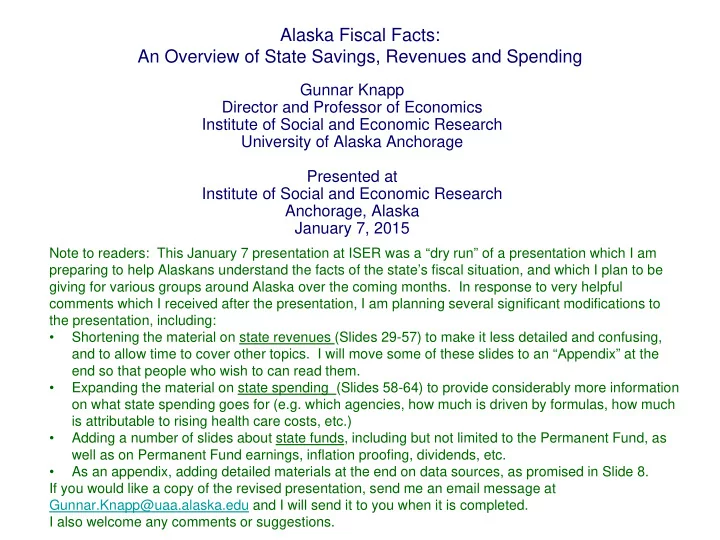
Gunnar Knapp Director and Professor of Economics Institute of Social and Economic Research University of Alaska Anchorage Presented at Institute of Social and Economic Research Anchorage, Alaska January 7, 2015

Note to readers: This January 7 presentation at ISER was a “dry run” of a presentation which I am preparing to help Alaskans understand the facts of the state’s fiscal situation, and which I plan to be giving for various groups around Alaska over the coming months. In response to very helpful comments which I received after the presentation, I am planning several significant modifications to the presentation, including:

  • Shortening the material on state revenues (Slides 29-57) to make it less detailed and confusing,

and to allow time to cover other topics. I will move some of these slides to an “Appendix” at the end so that people who wish to can read them.

  • Expanding the material on state spending (Slides 58-64) to provide considerably more information
  • n what state spending goes for (e.g. which agencies, how much is driven by formulas, how much

is attributable to rising health care costs, etc.)

  • Adding a number of slides about state funds, including but not limited to the Permanent Fund, as

well as on Permanent Fund earnings, inflation proofing, dividends, etc.

  • As an appendix, adding detailed materials at the end on data sources, as promised in Slide 8.

If you would like a copy of the revised presentation, send me an email message at Gunnar.Knapp@uaa.alaska.edu and I will send it to you when it is completed. I also welcome any comments or suggestions.

slide-2
SLIDE 2

Introduction

slide-3
SLIDE 3

My goal in this presentation The recent dramatic fall in oil prices has led to growing concern and discussion among Alaskans about the state’s fiscal situation My goal is to help Alaskans understand the facts of the state’s fiscal situation, to facilitate informed discussion of the challenges we face and how to address them. I am not advocating for or against any specific choices or policies. 3

slide-4
SLIDE 4

Briefly about myself . . .

  • I’ve been an economics professor at the UAA Institute of Social and

Economic Research (ISER) since 1981

  • I became Director of ISER two years ago
  • I’ve been studying Alaska’s economy for 33 years
  • I teach a UAA course on the Economy of Alaska

– One of the topics I teach about is the state’s finances – This presentation is part of what I teach for my course 4

slide-5
SLIDE 5

This is a complicated topic.

  • Alaska has many different kinds of savings, revenues and

expenditures

  • Understanding Alaska’s fiscal situation isn’t easy.
  • I’ve tried to keep this presentation as simple as possible

– But it’s still a complex topic

  • There are many other details that I won’t have time to talk about

5

slide-6
SLIDE 6

I’d like to improve on this presentation. I welcome your feedback.

  • Parts you found helpful
  • Parts you found confusing
  • Suggestions for how to improve it
  • Anything you thought was “biased”
  • Corrections to anything you think is wrong

6

slide-7
SLIDE 7

Data sources

slide-8
SLIDE 8

You don’t have to rely on “experts” to learn about Alaska’s finances.

  • All of the data in this presentation are posted on state websites.
  • At the end of this presentation I have listed websites where you can

find: – the data in this presentation – a lot of other, more detailed data – information about how the data are defined and collected

  • Two particularly useful sources of information are:

– Alaska Department of Revenue’s Revenue Sources Books – Legislative Finance Division’s Fiscal Summaries 8

slide-9
SLIDE 9

The Department of Revenue puts out Revenue Sources Books each fall and spring. These provide detailed data on state revenues, and also include the official state revenue projections that budgets are based on.

http://www.tax.alaska.gov/programs/sourcebook/index.aspx

slide-10
SLIDE 10

The Legislative Finance Division puts out two-page Fiscal Summaries which summarize major items in the state’s budget and how they are funded.

Source: http://www.legfin.akleg.gov/FisSum/DisplayReports.php

slide-11
SLIDE 11

Legislative Finance Division Fiscal Summary (page 2)

slide-12
SLIDE 12

Basic fiscal terminology

slide-13
SLIDE 13

State revenues and spending are reported by fiscal year. We are in fiscal year (FY) 2015.

Last fiscal year This fiscal year Next fiscal year Fiscal year FY 2014 FY 2015 FY 2016 Start date July 1, 2013 July 1, 2014 July 1, 2015 End date June 30, 2014 June 30, 2015 June 30, 2016 Legislative session which prepares the budget 2013 2014 2015 Are actual revenues and spending known yet? Yes No No Could revenues or spending change still? No Yes Yes

13

slide-14
SLIDE 14

The state has many different funds. Funds are different accounts of money or other financial assets that the state gets in different ways and are used for different purposes.

  • General Fund

– Pays for most of state government – Sort of like the checking account you use to pay for your regular household bills

  • Other funds

– Constitutional Budget Reserve Fund – Statutory Budget Reserve Fund – Permanent Fund – Sort of like other accounts you have to save for retirement, college, etc. 14

slide-15
SLIDE 15

State funds and revenues are either unrestricted or restricted. We can use unrestricted funds/revenues any way we want to. We can only use restricted funds/revenues in specified ways. The degree of restriction varies.

Type of funds or revenue How we can use them Analogies in your personal finances Examples of state revenues and funds Unrestricted Any way we want to Your wages Your lottery winnings Oil tax revenues Restricted Only in specified ways Relatively less restricted (restricted by custom) The money you’re saving for your kids to go to college Money your dad gave you “to buy a car” University tuition revenues Permanent Fund earnings Relatively more restricted (restricted by law) Your college scholarship Oil royalties Permanent Fund principal Federal highway grants

slide-16
SLIDE 16

Most of the discussion and debate about the state’s finances is about Unrestricted General Fund (UGF) revenues and spending.

Definition of Unrestricted General Fund Revenue (from the glossary of the Fall 2014 Revenue Sources Handbook) “Revenue not restricted by the constitution, state or federal law, trust or debt restrictions, or customary practice. This revenue is deposited into the State’s unrestricted general fund and most legislative and public debate over the budget each year centers on this category of revenue.”

slide-17
SLIDE 17

Most of this presentation is about the state’s Unrestricted General Fund revenues and spending. But the last part of the presentation is about

  • ther funds and other spending.

Other funds and other spending are very important to understanding the full picture of the state’s finances and our future options! But it’s easiest to start by focusing on Unrestricted General Fund revenues and spending.

slide-18
SLIDE 18

Overview of Alaska’s fiscal situation

slide-19
SLIDE 19

$ billions $ per Alaskan State spending (budgeted level) 5.9 8,022 Projected revenues (Fall 2014 projections) 2.6 3,465 Projected deficit

  • 3.4
  • 4,557

Cash savings at the start of the year 12.2 16,616 Years it would take to deplete savings at this year's spending levels (assuming Fall 2014 revenue projections) Projected deficit as share of spending

  • 57%

Overview of Alaska's Fiscal Situation, Fiscal Year 2015 (unrestricted general funds) Measured in: 7

slide-20
SLIDE 20

Trends in Alaska’s fiscal situation: past and projected

slide-21
SLIDE 21

From 2005 to 2012 revenues were high and trending up. Even though spending was growing rapidly, the state ran surpluses. Beginning in FY13, revenues fell and the state began to run deficits.

FY12 surplus was $2.2 billion FY14 deficit was $1.9 billion

slide-22
SLIDE 22

Since the start of this fiscal year,

  • il prices have fallen unexpectedly and dramatically.
slide-23
SLIDE 23

Because of the fall in oil prices, FY15 state revenues are projected to fall to less than half of FY14 revenues. The projected FY15 deficit is $3.3 billion.

slide-24
SLIDE 24

If we continued to spend at this year’s (FY 15) level, and if the most recent revenue projections are accurate, we would continue to run big deficits for many years.

Future deficits

slide-25
SLIDE 25

We saved the money from past surpluses in many different funds We have been paying for deficits by taking money out of the two “cash savings” funds that are the most accessible: The Constitutional Budget Reserve Fund (CBRF) The Statutory Reserve Fund (SRF) 25

slide-26
SLIDE 26

When we were running surpluses, we built up the value of the CBRF and the SRF. Now we are using those funds to pay for deficits. At the start of FY15, we had about $12 billion in cash savings in these funds.

FY15 $3 billion special contribution towards retirement

  • bligations

Available to pay for deficits

slide-27
SLIDE 27

If we continued to spend at this year’s (FY 15) level, then if future revenues equal the projections, we would deplete our cash savings funds in about seven years. If future revenues are less than projected, our future deficits would be bigger and we would deplete our savings sooner.

slide-28
SLIDE 28

That’s the quick overview of state finances. In the rest of this presentation I’ll talk about more details . . .

  • STATE REVENUES

– Where do our revenues come from? – Why did revenues grow so much from 2005 to 2012? – What caused projected revenues to fall so sharply this year? – What are the future revenue projections based on? – How reliable are they?

  • STATE SPENDING

– Where does the money go? – Why did spending grow since 2005?

  • OTHER FUNDS AND RESTICTED REVENUES

– How much do we have in other funds? – What are our restricted revenues?

slide-29
SLIDE 29

State Revenues

slide-30
SLIDE 30

Since North Slope oil production began, oil revenues have accounted for most of Alaska’s unrestricted general fund (UGF) revenues. In recent years oil revenues have provided about 90% of UGF revenues.

Revenues for FY15 and FY16 are Department

  • f Revenue

Fall 2014 projections

slide-31
SLIDE 31

But our oil revenues have fluctuated widely over time! Why????

Revenues for FY15 and FY16 are Department

  • f Revenue

Fall 2014 projections

slide-32
SLIDE 32

Oil prices have been the most important factor in the ups and downs

  • f our oil revenues. Oil prices have fluctuated widely over time.

They rose dramatically after 2002—and have fallen dramatically this year. Prices for FY15 and FY16 are Department

  • f Revenue

Fall 2014 projections

slide-33
SLIDE 33

You can see a clear historical relationship between oil prices and oil

  • revenues. But it’s not an exact relationship! Other factors have also been

affecting Alaska’s oil revenues.

Prices and revenues for FY15 and FY16 are Department

  • f Revenue

Fall 2014 projections

slide-34
SLIDE 34

Another critical factor affecting oil revenues has been oil production (which is now almost entirely North Slope oil production). North Slope production has been declining for many years—from a peak of 2 million barrels/day in 1988 to just over 500,000 barrels/day last year. We have a lot less oil to tax than we used to!

34

Production volumes for FY15 and FY16 are Department

  • f Revenue

Fall 2014 projections

slide-35
SLIDE 35

To really understand what has caused the changes over time in our oil revenues, and in particular why our revenues are down so much in FY15, you need to look at the details of our different kinds of oil revenues, and what they are based on. In particular, you need to look at: Oil royalties Oil production taxes

slide-36
SLIDE 36

Alaska collects several different kinds of oil revenues. The most important are royalties and production taxes. Other oil revenues include oil property taxes and corporate income

  • taxes. They represent an important but smaller source of income.

Revenues for FY15 and FY16 are Department

  • f Revenue

Fall 2014 projections

slide-37
SLIDE 37

Oil royalties . . .

  • Oil royalties are not taxes.
  • They are payments oil companies make to the state for oil leases.
  • We can’t change how oil royalties are calculated.

– They were set by the lease contracts we made with the oil companies.

  • For most oil leases royalties are calculated as:

12.5% of the “wellhead value” of the oil production from the lease. 37

slide-38
SLIDE 38

The “wellhead value” used to calculate royalties is the estimated value

  • f the oil at the “wellhead” (on the North Slope).

38 Estimated wellhead value = Market value of the oil on the west coast (where most of it is sold) minus Cost of transporting the oil from the North Slope to the west coast by pipeline and tankers

slide-39
SLIDE 39

Oil royalties . . .

  • Because transportation costs affect the wellhead value and oil

royalties there has been a lot of debate and legal cases about how transportation costs are estimated.

  • Under the constitution, 25% of oil royalties must be deposited into

the Permanent Fund. – So only 75% of oil royalties are unrestricted general fund revenues 39

slide-40
SLIDE 40

Actual and Projected Wellhead Prices, FY11-FY16

slide-41
SLIDE 41

Actual and Projected Wellhead Value, FY11-FY16

slide-42
SLIDE 42

As oil prices have fallen, royalties have declined proportionally to wellhead value

slide-43
SLIDE 43

Production taxes are taxes the state collects from oil companies,

  • ver and above royalty payments.

Unlike royalties, production taxes can be changed. 43

slide-44
SLIDE 44

Alaska has made several significant changes to oil production taxes since North Slope oil production began.

Alaska Petroleum Tax Regimes Since 1977 Acronym Name Years in effect ELF Economic Limit Factor (several different versions; was changed several times) 1977-2006 PPT Petroleum Profits Tax 2006-2007 ACES “Alaska’s Clear and Equitable Share” 2007-2013 MAPA “More Alaska Production Act” (SB21) 2014

Last year we had a major debate about whether to keep SB21 or to go back to the earlier ACES tax. We ended up voting to keep SB21.

slide-45
SLIDE 45

SB21—like the earlier ACES and PPT laws—taxes

  • il production based on companies net profits.

This is an important difference between royalties and production taxes! – Royalties are calculated based on the wellhead value – Production taxes are calculated based on companies’ net profits,

  • r production tax value (PTV) after subtracting deductible costs

from wellhead value, including:

  • Capital costs of oil production (CAPEX)
  • Operating costs of production (OPEX)

45

slide-46
SLIDE 46

ACES had a progressive tax rate which increased as profits increased SB 21 has a flat tax rate of 35% of production tax value

Source for graph: Gunnar Knapp calculations based on the tax formulas.

slide-47
SLIDE 47

The SB21 and ACES laws also differed in other important ways

  • Credits producers could receive as incentives for new investments
  • r production
  • Special treatment for production from some fields
  • Minimum tax provisions if oil prices were low

47

slide-48
SLIDE 48

Since 2012, operating and capital costs (as reported to DOR by producers) have risen significantly—while the wellhead value has fallen. This has led to a drastic decline in production tax value!

slide-49
SLIDE 49

The drastic decline in production tax value was the main factor contributing to a drastic decline in production taxes.

slide-50
SLIDE 50

Other factors also played a role in the decline in production taxes

  • A lower tax rate
  • Increased tax credits
  • But the change from ACES to SB21 is not the main reason our

projected oil revenues have fallen so dramatically. – The main reason was the fall in production tax value – At the current very low oil prices, SB21 was not a “tax cut.”

  • Regardless of whether you love or hate SB21, it is our current oil tax

law and what drives what our current oil production tax revenues 50

slide-51
SLIDE 51

The Department of Revenue projects that oil revenues and unrestricted general fund revenues will rebound significantly beginning in FY17. What are these projections based on? How reliable are they? 51

slide-52
SLIDE 52

The most important factor in the Department of Revenue’s projections for future oil revenues are their assumptions for future oil prices 52

slide-53
SLIDE 53

But predicting future oil prices is extremely difficult!

  • Most “experts” think that:

– Oil prices fell because world oil production has grown so rapidly that supply now exceeds demand – Unlike in the past, Saudi Arabia is no longer willing to reduce its production to keep oil prices high – Slowing world economic growth could make things worse by reducing demand – Oil prices won’t rebound until higher-cost producers reduce production because it isn’t profitable enough to reduce the excess supply that has dragged prices down

  • But none of these “experts” predicted that oil prices would fall so

dramatically this year!

  • No one knows for sure what will happen with oil prices in the future!
  • The Department of Revenue doesn’t know either

– Their price assumptions might be right—or they might be wrong 53

slide-54
SLIDE 54

The Department of Revenue has never been able to accurately predict future oil revenues. This is not intended as a criticism! The reality is that it is impossible to accurately predict future oil revenues.

slide-55
SLIDE 55

Mostly because they have not been able to accurately predict future prices, the Department of Revenue has also not been able to accurately predict future revenues 55

slide-56
SLIDE 56

We cannot assume that the Department of Revenue’s projections of future revenues will be correct! History suggests they almost certainly will not be correct. Future revenues could be significantly higher—or lower!— than these projections. 56

slide-57
SLIDE 57

We cannot assume that projections of when we might deplete our cash savings—based on projections of future oil revenues—will be correct. If we continued this year’s spending levels, we might deplete our savings much later—or sooner!—than 2023.

slide-58
SLIDE 58

State spending

slide-59
SLIDE 59

State unrestricted general fund spending includes

  • perating spending and capital spending.

Operating spending includes agency operations and statewide operations. Budget category FY 2015 budget Pays for OPERATING $5,244.5 million Agency operations $4,512.9 million Budgets of state government

departments (Education, Fish & Game, etc.)

Statewide operations $731.6 million Payments not attributable to

specific departments (debt service, retirement fund payments, etc.)

CAPITAL $594.9 million Capital projects

(buildings, roads, etc.)

TOTAL $5,839.4 million

slide-60
SLIDE 60
slide-61
SLIDE 61

61

slide-62
SLIDE 62

62

slide-63
SLIDE 63

63

slide-64
SLIDE 64

64

slide-65
SLIDE 65

Alaska’s fiscal challenge

slide-66
SLIDE 66

Alaska’s fiscal challenge Unless we are very lucky and

  • il prices rise dramatically and unexpectedly . . .
  • We will not be able to continue for more than a few more years with

“business as usual” revenues and spending” – Depending on the same sources of revenues – Spending money in the same ways

  • With “business as usual” revenues and spending we would

– Deplete our savings within a few years – Be forced (by lack of money) to either:

  • Cut spending
  • Raise new revenues
  • Use other funds

– This could happen by when today’s first-graders are eighth- graders—or possibly much sooner 66

slide-67
SLIDE 67

We could continue with “business as usual” for a few more years. But there are arguments for acting immediately to address our fiscal challenge.

  • If we spend our savings now we (and our children) may wish that we

hadn’t when we need them even more in the future

  • Our cash savings earn interest (more than $1 billion in FY14). The

more we draw down our savings, the less interest we will earn in the future.

  • Our credit rating and costs of borrowing are affected by whether

rating agencies think we have our finances under control.

  • Business confidence and willingness to invest is affected by whether

businesses think we have our finances under control 67

slide-68
SLIDE 68

We are now beginning a major and critical debate about how— and how quickly—we should address our fiscal challenge

  • Our options include:

– Cut spending – Raise new revenues – Use other funds

  • None of these options are popular
  • It would be very difficult to fully address the challenge through any
  • ne option

– Our FY15 deficit is $4500 per Alaskan 68

slide-69
SLIDE 69

In addition to our fiscal challenge, we also face other challenges

  • Economic challenge: How to develop the economy and create jobs

and income for Alaskans

  • Social challenge: How to improve the lives of Alaskans

69

slide-70
SLIDE 70

The fiscal, economic and social challenges are inter-related

  • If we cut spending too much or raises taxes too much it could

– Harm our economy – Harm services which matter to Alaskans

  • Education, public safety, etc.
  • Solutions to our economic and social challenges are not necessarily

solutions to our fiscal challenges – They are only solutions if they add to state revenues or reduce state costs – Growing our economy and population could increase state revenues – It could also increase state government costs 70