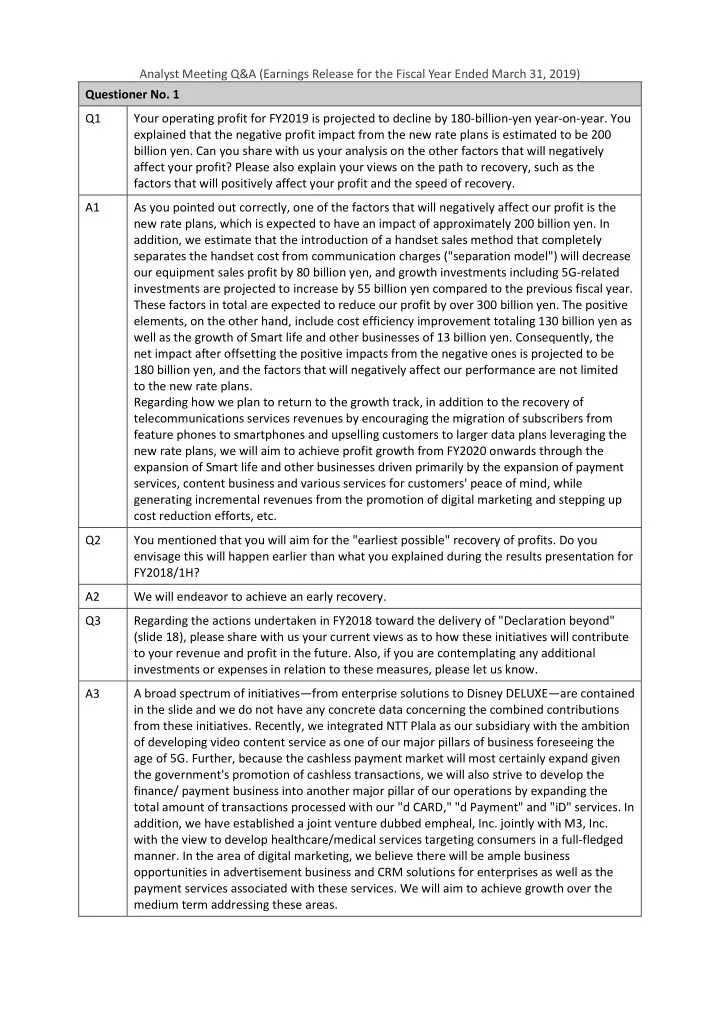
Analyst Meeting Q&A (Earnings Release for the Fiscal Year Ended - - PDF document

analyst meeting q a earnings release for the fiscal year
SMART_READER_LITE
LIVE PREVIEW

Analyst Meeting Q&A (Earnings Release for the Fiscal Year Ended - - PDF document

Analyst Meeting Q&A (Earnings Release for the Fiscal Year Ended March 31, 2019) Questioner No. 1 Q1 Your operating profit for FY2019 is projected to decline by 180-billion-yen year-on-year. You explained that the negative profit impact from


slide-1
SLIDE 1

Analyst Meeting Q&A (Earnings Release for the Fiscal Year Ended March 31, 2019) Questioner No. 1 Q1 Your operating profit for FY2019 is projected to decline by 180-billion-yen year-on-year. You explained that the negative profit impact from the new rate plans is estimated to be 200 billion yen. Can you share with us your analysis on the other factors that will negatively affect your profit? Please also explain your views on the path to recovery, such as the factors that will positively affect your profit and the speed of recovery. A1 As you pointed out correctly, one of the factors that will negatively affect our profit is the new rate plans, which is expected to have an impact of approximately 200 billion yen. In addition, we estimate that the introduction of a handset sales method that completely separates the handset cost from communication charges ("separation model") will decrease

  • ur equipment sales profit by 80 billion yen, and growth investments including 5G-related

investments are projected to increase by 55 billion yen compared to the previous fiscal year. These factors in total are expected to reduce our profit by over 300 billion yen. The positive elements, on the other hand, include cost efficiency improvement totaling 130 billion yen as well as the growth of Smart life and other businesses of 13 billion yen. Consequently, the net impact after offsetting the positive impacts from the negative ones is projected to be 180 billion yen, and the factors that will negatively affect our performance are not limited to the new rate plans. Regarding how we plan to return to the growth track, in addition to the recovery of telecommunications services revenues by encouraging the migration of subscribers from feature phones to smartphones and upselling customers to larger data plans leveraging the new rate plans, we will aim to achieve profit growth from FY2020 onwards through the expansion of Smart life and other businesses driven primarily by the expansion of payment services, content business and various services for customers' peace of mind, while generating incremental revenues from the promotion of digital marketing and stepping up cost reduction efforts, etc. Q2 You mentioned that you will aim for the "earliest possible" recovery of profits. Do you envisage this will happen earlier than what you explained during the results presentation for FY2018/1H? A2 We will endeavor to achieve an early recovery. Q3 Regarding the actions undertaken in FY2018 toward the delivery of "Declaration beyond" (slide 18), please share with us your current views as to how these initiatives will contribute to your revenue and profit in the future. Also, if you are contemplating any additional investments or expenses in relation to these measures, please let us know. A3 A broad spectrum of initiatives—from enterprise solutions to Disney DELUXE—are contained in the slide and we do not have any concrete data concerning the combined contributions from these initiatives. Recently, we integrated NTT Plala as our subsidiary with the ambition

  • f developing video content service as one of our major pillars of business foreseeing the

age of 5G. Further, because the cashless payment market will most certainly expand given the government's promotion of cashless transactions, we will also strive to develop the finance/ payment business into another major pillar of our operations by expanding the total amount of transactions processed with our "d CARD," "d Payment" and "iD" services. In addition, we have established a joint venture dubbed empheal, Inc. jointly with M3, Inc. with the view to develop healthcare/medical services targeting consumers in a full-fledged

  • manner. In the area of digital marketing, we believe there will be ample business
  • pportunities in advertisement business and CRM solutions for enterprises as well as the

payment services associated with these services. We will aim to achieve growth over the medium term addressing these areas.

slide-2
SLIDE 2

Q4 The projected growth of operating profit from Smart life and other businesses is limited to a mere 12.7 billion yen in FY2019. What are the reasons behind this slow growth? Is it because you need to make upfront investments to deliver your Medium-Term Strategy 2020 "Declaration beyond?" A4 As you pointed out, the year-on-year growth of operating profit from Smart life and other businesses in FY2019 is expected to be modest. In addition to the need to make advance investments for future business expansion, there is a technical factor, i.e., increased expense allocation to the Smart life business segment relative to the Telecommunications segment in FY 2019 resulting from the projected drop in telecommunications services revenues. Questioner No. 2 Q1 You spent a considerable amount for growth investments in FY2018. If you increase the amount of investments by 50 billion yen in FY2019, that would imply the total amount of growth investments will reach over 100 billion yen. The cumulative amount of growth investments planned for FY2018 and 2019 appears to be quite sizable, but how do you plan to generate returns from these investments going forward? You also mentioned that the impact from the change of handset sales method on your equipment sales profit is estimated to be 80 billion yen in FY2019. However, this will not have a full-year impact in FY2019, thus the size of impact will become much more significant in the next fiscal year. You mentioned earlier that you expect to see profit recovery from

  • FY2020. I believe you will try to achieve that by offsetting the negative impact from the rate

revision and decrease of equipment sales profit—which are both expected to become larger next fiscal year—through cost reduction. Please give us a concrete indication as to how much you plan to earmark for growth investments and how you plan to recoup these investments? A1 We plan to increase the amount of growth investments by 55 billion yen in FY2019. Given that we spent 15 billion yen during FY2018, the cumulative amount of growth investments for the two years is expected to be approximately 70 billion yen. These growth investments, which include the outlays required for the launch of 5G pre-commercial service, are not likely to produce returns immediately. We also plan to further accelerate our investments in the area of FinTech this year. As manifested by our alliance with Magic Leap, Inc., we also plan to pour resources into video services so it can help drive our next stage of growth. During our last results presentation, we explained that the growth investments for FY2018 would be 80 billion yen. Out of that amount, 60 billion yen were appropriated for growth investments in the narrow sense, i.e., outlays relating to 5G, membership expansion, Smart life business and disaster countermeasures, and the remaining 20 billion yen were the genuine investments for growth—the seeds of innovation to develop new businesses. We will increase the allocation for the former category by 50 billion yen in FY2019, so the total budget for the two years will amount to 110 billion yen. As for the 20 billion-yen allocation for the latter category, we could not use up the entire budget and carried over 5 billion yen into FY2019. On top of this, we will earmark the same amount of 20 billion yen in FY2019, so there will be an increase of 5 billion yen for this category. In this context, we explained that the amount of growth investments would increase by 55 billion yen in FY2019. These investments are expected to produce returns in the form of operating profit from Smart life and other businesses, which is estimated to reach 160 billion yen in FY2019. Our ambition is to further expand the profit to 200 or 300 billion yen further down the line. Regarding the equipment sales profit, there are two major reasons behind the projected deterioration: a decline in the number of handsets sold and reduced gross profit. The gross margin of high-end Android handsets has so far fared over 10,000 yen per unit, but we will not be able to set gross profit at such a high level in the future as we will no longer be allowed to offer handset subsidies in principle. Accordingly, the gross profit will be squeezed to less than 10,000 yen per unit for high-end and to below 5,000 yen for middle-end models. In addition, the sales volume of high-end models is expected to shrink and the proportion of

slide-3
SLIDE 3

models that carry a gross profit of less than 5,000 yen is likely to increase. However, we do not believe this trend will continue for a long period of time. Once the sales quantity starts to picks up, there is a good chance to see a turnaround in our handset sales profit. Q2 Although you are projecting a profit recovery next fiscal year, I would like you to present a guidance for the next two years because the decrease of profit for this fiscal year is so steep. The net impact of the new rate plan is estimated to be 160 billion yen (negative impact of 200 billion yen partly offset by the positive impact of 40 billion yen), which I believe is more

  • r less in line with the market forecast. In FY2020, despite the expansion of the negative

impact from the new rate plans, if you can also foresee additional positive impacts and

  • pportunity for cost reduction in the magnitude of 100 billion yen or so, the net impact of

the new rate plan could be suppressed to around 100 billion yen, which can be considered an absorbable level. I am aware of the difficulty of providing an accurate forecast but it will be helpful if you could clarify the elements that are expected to affect your results for the next fiscal year. A2 Although we mentioned that the positive impact from the termination of "Monthly Support" discounts is estimated to be 50 billion yen, the actual amount is approximately double that

  • level. Because the number of "docomo with" subscribers has been increasing, the benefits of

terminating "Monthly Support" will be cancelled out by the increase of "docomo with" subscriptions, and the net impact will be limited to approximately 50 billion yen. However, because we plan to stop accepting new applications for "docomo with" in May, the number

  • f "docomo with" subscriptions will no longer increase after FY2020, hence we will start to

see a more significant contribution from the termination of "Monthly Support" from FY2020

  • nwards. We also realized that our new rate plans have gained broader public recognition

than our earlier expectation, so we now estimate that the number of customers joining the new rate plans this year will be comparable to the number who switched to the new plan after the last rate revision in FY2014. If a large number of users migrates to the new rate plans during FY2019, the impact after FY2020 would be relatively smaller and we will need to anticipate an additional net negative impact (after offsetting the positive impact from the elimination of "Monthly Support" discounts) of only several tens of billions of yen compared to FY2019. We believe we will be able to sufficiently absorb the negative impact under that scenario, given that we have provided rate reductions every year through the roll out of "Basic Pack," "Simple Plan" and other packages, and also by promoting migration to smartphones and upsells leveraging the new rate plans while at the same time working on the expansion of Smart life business and cost reduction. Q3 If the net additional impact from the introduction of the new rate plan is limited to only several tens of billions of yen next year, do you think the positive impacts from subscriber migration, upsell, cost reduction and the positive outcome in Smart life business derived from the advance investments that you are accelerating this fiscal year will outweigh the negative impact from the introduction of the new rate plans? A3 We hope to halt the decline of profits in Telecommunications business by this fiscal year so that all the profit gains achieved in Smart life and other businesses will translate into increased operating profit as is. Questioner No. 3 Q1 Your competitors have not yet published their guidance, but the market expects that they will likely announce flat growth or profit gains for FY2019 even under the current market

  • circumstances. If that is the case, DOCOMO will become the only carrier that will suffer a

huge reduction in profit from the execution of a rate revision, which I believe is a sensitive issue that the management must take seriously. I believe the public perception of DOCOMO is that you have accumulated excessive amount of profits in the past, which will be stripped

  • ff in the course of the mobile industry's normalization process. How do you accept this

situation? A1 We have read the reports on the prospects of other carriers published by various analysts, but we do not agree with your view that DOCOMO is wrong because we do not necessarily

slide-4
SLIDE 4

follow the same trajectory as other companies. We made a decision to reinforce our competitiveness through the introduction of new rate plans. If other carriers believe that they can sufficiently compete against our new rates with their existing offers, there is a possibility that they may not to change their current rate structure at all but we rather anticipate that they will also take some actions. We made a resolve to strengthen our customer base and provide returns to our existing customers, and we are prepared to see a profit decline as a result of this decision. But it does not mean that we will stay with the losing profit without taking any measures. After reinforcing our customer base, we will strive to recover our performance capitalizing on the strengthened customer base. Q2 You have a customer base that is larger by tens of millions compared to your competitions'. In any infrastructure business, the carrier with a larger customer base generally can produce a larger amount of profits and yield a better profit margin due to the efficiency of network

  • utilization. Hypothetically, if we assume KDDI and Softbank will generate 1 trillion yen and

700 billion yen, respectively, in profit, DOCOMO's profit level would be inferior, or at best comparable to those carriers who have a customer base much smaller than yours. Don't you think DOCOMO should be able to achieve a higher profit level in light of the difference of the size of customer base? A2 Your comparison may be right if our business structure is completely identical to that of

  • ther carriers. While the three carriers you mentioned all operate mobile communications

service as their core business, we all have different structures with some players operating

  • ptical fiber and other fixed line services and others having larger contributions from
  • verseas businesses. It is difficult to make a simple comparison due to the difference of
  • structure. It might be possible to compare the carriers based on the mobile piece alone, but

if you look at the overall structure, we all have different business portfolios. Thus, we do not think we need to generate profits in the same way. Q3 Let me ask about shareholder returns. I believe you are planning on total shareholder returns worth approximately 700 billion yen for FY2019 against the projected net profit of less than 600 billion yen. I am sure you will be able to continue a comparable size of shareholder returns in the coming years given your strong balance sheet and the amount of disposable profit that can be used for dividends. Can we expect that you will continue to provide shareholders with returns exceeding your annual net income going forward? A3 This time around, we are planning to provide shareholders with returns exceeding the projected amount of net profit for this fiscal year. Our cash balance as of Mar. 31, 2019 was approximately 300 billion yen. We are well positioned to continue shareholder returns without the need of making additional borrowings, because even after conducting the planned shareholder returns, we estimate that we will still have approximately 140 billion yen of cash on hand as of Mar. 31, 2020. Further, our free cash flow is expected to gradually recover over time, and we are currently in the final phase of discussion with our audit firm concerning the accounting treatment of the planned securitization of installment/credit receivables that we explained to you on a separate occasion. Unlike other companies, we do not plan to split the securitized receivables between senior and subordinated portions, because it will allow us to transfer the receivables altogether to a third party and remove them from our balance sheet. The funds financed through this exercise can be counted as

  • perating cash flow, as opposed to cash flow from financing activities, enabling us to

increase the amount of our free cash flow. Therefore, both in substance and also in terms of free cash flow on our cash flow statement, we have no concerns for our near-term financing. Questioner No. 4 Q1 I understand Rakuten's entry in the mobile market was one of the reasons that led to the decision to lower your rates. In your projections for FY2019 on the number of subscribers and ARPU, etc., how did you foresee Rakuten's impact? A qualitative explanation will also work. A1 Let me first explain how we assumed the impact on our net additions and sales for FY2019. We did not think it was realistic to factor Rakuten's impact in our business plan as Rakuten

slide-5
SLIDE 5

has not yet unveiled their rate plans and campaign details, etc. Also, because we operate a "stock" business (as opposed to a "flow" business), the change of rate plans or sales method do not result in a dramatic change of performance overnight. Therefore, our FY2019 projections has been developed taking into consideration our recent track record. In FY2018, we acquired 2.08 million net additional subscriptions with communication modules accounting for half of the total. The attributes of the remaining half were quite different from the previous fiscal year, which makes us believe that our competitiveness in the handset market has improved significantly over the last fiscal year. This improvement was the result of our 1,980-yen tariff plan promotion, the promotion of our rate plan consultation fair, the promotional "d POINTs" that we offer to customers signing up for "docomo Hikari" optical fiber service and "d CARD,"—both of which have expanded their penetration over the last several years—and the development of new sales channels such as mass retailers and outbound tele-marketing, etc. As we believe this baseline trend will remain unchanged, we factored the improved momentum of our handset sales in our FY2019 plan. As we have explained to you earlier, one of the major changes anticipated for FY2019 is the implementation of the revised Telecommunications Business Act before the market entry by Rakuten. Under the revised law, we will be prohibited from offering handset subsidies tied with mobile subscriptions, and retention measures including two-year binding contracts will have to be adjusted, which will likely result in increased subscriber liquidity. We have unveiled our new rate plans ahead of the competition in anticipation of this new development, because we wanted to alter customers' general perception that our rates were relatively more expensive as this could potentially become a major setback when the new sales method is introduced. As we anticipate the new entrant will launch campaigns to some extent in an effort to acquire subscribers from October onward, we have factored a certain degree of subscriber outflows in our plans. On the other hand, as we revised our rates ahead

  • f the competition, we believe customers will have enough time to digest our offers, and

because we expanded the eligibility of our Family Discount program, we believe there is a good chance of acquiring subscriber inflows from incumbent mobile network operators. The churn prevention effect from the two-year binding contracts and other packages is expected to become weaker, but we intend to defend our customers with our preemptive rate reductions and various other means, maintaining the favorable momentum from the last fiscal year. Some of you may think that our FY2019 net additions projections are smaller than expected, but this is affected by reasons other than the competitive landscape, i.e., the slowdown of data plan net additions. Given that handset subsidies will be prohibited during this fiscal year; acquisition of new subscriptions will basically become more difficult in the

  • future. The change of handset sales method is expected to take a more significant toll on the

changes in subscriber count between FY2018 and FY2019 than the changes between FY2019 and FY2020. Unfortunately for FY2019, we expect a negative growth for data plan subscriptions, but other than that, we foresee that the general improvement trend in our

  • verall competitive position will continue.

Q2 Regarding your plan to promote digital marketing (Slide 26), I believe this refers to your marketing approach connecting your customer base with your partners. Previously these roles were fulfilled by the shops. When these roles are replaced by digital means, how powerful will they be as tools, how strongly can these tools appeal to customers, and how do you plan to capitalize on these tools? Please share with us your views. A2 We have so far operated our business through our docomo Shop network. However, these shops now face issues such as extended wait time and attendance time, and we need to resolve these issues first and foremost. On the other hand, the players that we will compete against in the future will be those that are active in the digital marketing field. Our customers visit the shops only once or twice a year, but those aggressive digital marketing players are able to contact customers more frequently through various touchpoints. We must also develop the capability to contact our customers through similar channels, although this is not for the purpose of reducing the number of our physical shops. To address this requirement, we have started working on value creation in order to establish a customer

slide-6
SLIDE 6

base pivoted on “d POINTs” from the autumn of 2015. The scale of our customer base expansion in the last three and half years is something that other players spent 10 years to

  • construct. We managed to achieve this in a very speedy fashion. Meanwhile, we have also

steadily increased the number of our partners over time. How we establish relations with customers leveraging our customer base and our partners' and DOCOMO's businesses will hold an important key for our future. We used the keyword "digital marketing" this time around because we aspire to become a player that operates not only through physical shops but also leveraging digital marketing. As for the content of digital marketing, as we explained during the presentation, we plan to engage in advertisement distribution, customer referral businesses, and through our

  • utdoor signage joint venture, we will also offer information through signages after

analyzing digital marketing data. We will seek commission revenues if our partners generate revenues leveraging our payment service, point program or agent functions, etc. We have also nearly completed the development of a mechanism that will allow us to generate revenues by employing digital marketing technologies in our own businesses ("d Market," "d CARD" and "d POINT.") A system that connects digital marketing, our partners and DOCOMO, and our customer base has started functioning and we plan to further reinforce this in the

  • future. We are currently strongly promoting this initiative, and we expect that the results of

these actions will become visible sometime around the latter half of FY2019 or FY2020. Questioner No. 5 Q1 The new rate plans are designed in a way that offers steeper discounts when two additional discount packages ("Minna DOCOMO Wari" and "Hikari Set Discount") are applied together. I believe users who subscribe to only one line and cannot be applied with these discounts account for approximately 15% of your total user base, or roughly several million. Do you plan to take any measures against those single-line users? A1 We do not plan to disadvantage the users who subscribe to only one line. These users can enjoy greater benefits by switching to the new plan, so we would like to properly communicate this message. It is also easy to form a group for Family Discount. Family members who live apart can also be included in the discount group so long as they are a subscriber of DOCOMO, allowing customers to receive discounts by coordinating with their family members. We plan to make proper announcements to ensure that those subscribers who have not yet applied for Family Discount will join the service together with their

  • families. We do not have any intention to offer a service particularly targeting single-line

subscribers at least for now. As there are many ways for single-line subscribers to formulate a group, we plan to properly communicate that point. Q2 I hear many voices that among the single-line subscribers, users of high-end models who are still receiving Monthly Support discounts will not be able to achieve any savings from the new rate plans. Don't you need to take any measures against this risk? In the assumptions that you used for developing your guidance, did you assume that those users who will be disadvantaged by switching to the new rate plans will stay on your network? Or did you factor a certain number of churns from this so-called "disadvantaged segment" in your plan? A2 We believe the "Minna DOCOMO Wari" discount program of the new rate plan is very

  • competitive. At our shop fronts and other occasions, we will encourage our staff to ask

single-line subscribers if there are any DOCOMO users in their family or relatives with whom they can form a family group. If you study our new rate plans carefully, you will find that we prepared various other beneficial offers besides "Minna DOCOMO Wari". For example, with the "Gigaho" plan, users will be able to access our network at a speed of 1Mbps even after reaching the upper limit of their monthly allowance, so we believe heavy data users, in particular, will be able to enjoy considerable savings. We also prepared a scheme that allows users who use a tablet as a second mobile device to share their monthly allowance between multiples devices at a reasonable rate. Because the point of relevance varies from customer to customer, we would like to make recommendations meticulously responding to the different needs of each customer through our shops or micromarketing activities. Customers who are still receiving Monthly Support discounts account for the largest portion of what

slide-7
SLIDE 7

you refer to the "disadvantaged segment" who may not immediately benefit from the new rate plans. Based on our past experience, we can predict that these customers will basically stay on their existing plans until the Monthly Support discount finishes, and we have applied this simulation in our business plan development. We think that the number of other customers who may be disadvantaged by switching to the new rate plan is insignificant. Q3 Regarding the assumptions that you used in developing your business plan, how many subscribers are expected to migrate to the new rate plans by the end of the current fiscal year? In particular, at which pace do you think the users who are no longer receiving Monthly Support will migrate to the new rate plans? I recall that when you introduced the "Kake-hodai" plan in FY2014, some 10 million users switched to the new plan in the first four

  • months. Are you expecting a similar pace or a faster migration this time around?

A3 When we introduced the "Kake-hodai & Pake-aeru" scheme in FY2014, we saw a migration

  • f some 17 million users by the end of the fiscal year (Mar. 31, 2015). This time, we are

expecting to complete the migration of a comparable number of users by the end of the fiscal year in March 2020. Last time, however, there was a concentration of 5 million users in the first month, but we do not foresee that to happen this time around. The pace of migration in the initial phase is expected to be slightly slower, but we will have migrated almost the same number of users by the end of the fiscal year. Questioner No. 6 Q1 Regarding "d POINT," how sizable will its impact on your profit for FY2019 be? How is this factored in your guidance which is predicting a negative profit growth? A1 In FY2018, "d POINT" program had an impact of approximately 130 billion yen in terms of reduction in revenues and increased expenditures. The impact is projected to expand by some 20 billion yen in FY2019. Q2 A question on your cash flow. Your free cash flow guidance seems to be conservative. Is the proceeds from the sale of your stake in Sumitomo Mitsui Card Co., Ltd. included in your projections? A2 The sale of Sumitomo Mitsui Card shares is included in our free cash flow forecast. During the results presentation for FY2018/1H, we mentioned that we did not expect a decline in cash flow despite the projected decrease in profit. However, we lowered our current cash flow projection by approximately 200 billion yen compared to the number that we estimated back then. This is due to the new investment of total 80 billion yen (including the 30-billion- yen investment in Magic Leap, Inc. and M3, Inc., respectively). Another element is the increase in credit card receivables, which has fared some 100 billion yen higher than our initial projections due to the favorable expansion of our credit card business driven by the popularity of GOLD CARD which generally carries larger credit usage. But we are not concerned about the increase in credit card receivables as we can recover this through the securitization exercise that I explained earlier. Q3 Your working capital seems to have deteriorated in FY2018. Was this due to the increase of credit card receivables? What level of improvement of working capital can you expect from securitization? A3 The increase of handset installment receivables and credit card receivables were the main reasons behind the deterioration of free cash flow in FY2018. The balance of the handset installment receivables is forecast to shrink in FY2019 because we are expecting a decline in the number of handsets sold, but it will start to rise again in FY2020. We currently estimate that the total securitization for the two types of receivables will reach 1 trillion yen, and the amount will continue to increase in the future. We will carry out securitization in accordance with our financing needs. The funds financed from securitization will be used for growth investments or share buybacks, meaning that we are well positioned to provide shareholder returns in an amount larger than our annual free cash flow. Questioner No. 7 Q1 You mentioned that you will introduce a new handset sales method and provide discounts in

  • ne way or another. Your equipment sales profitability is expected to deteriorate by 80

billion yen in FY2019 compared to the previous fiscal year, but does this reflect the impact

slide-8
SLIDE 8

from the change of handset sales method? Also, will the impact from the new sales method be recorded in your P/L for FY2019? Or, will you record only expenses in FY2019 and record the revenues in FY2020? A1 The handset costs will be separated from the communication tariff. But it does not mean that we will completely eliminate all forms of handset discounts. We are studying ways to make it easier for customers to purchase a new handset. The impact of the change of handset sales method is already factored in our equipment sales profit projections. The impact will vary depending on the size of discounts we offer each year. Q2 Will you complete the accounting treatment within the same year as opposed to splitting the timing of recording expenses and installment revenues between the current and the next fiscal year? A2 We cannot disclose the details pertaining to the recording method at this juncture. We will provide you with an explanation on the occasion of the upcoming new product presentation. Q3 I believe the increase in depreciation is caused by the switch to IFRS. Are there any other irregular factors that will affect the FY2019 depreciation amount? A3 We carried out a write-off of residual value of some assets in FY2017 but not in FY2018, which resulted in a decrease of depreciation for FY2018. If we set aside the impact from the change of accounting standard to IFRS, our depreciation amount will increase in FY2019 due to the impact from the change to straight-line depreciation from previously diminishing- balance method. There are no other irregular factors.