SLIDE 1
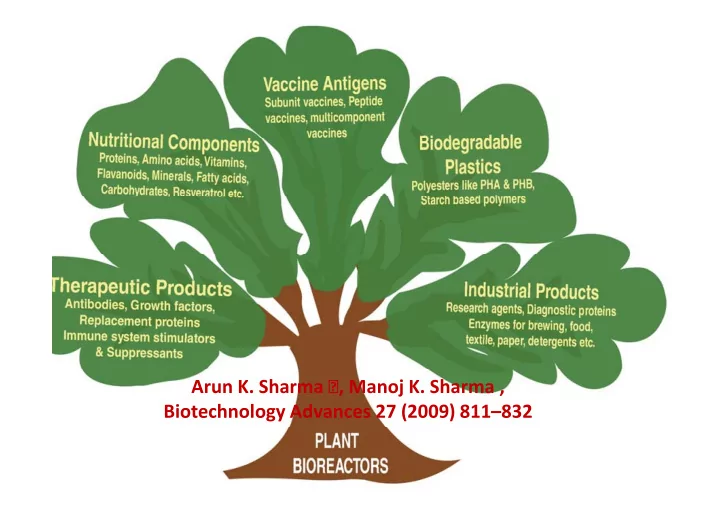
Arun K. Sharma , Manoj K. Sharma , Biotechnology Advances 27 (2009) 811–832
SLIDE 2 3rd International Workshop 3rd International Workshop Advances in Cleaner Production
PRELIMINARY STUDIES ON THE PRODUCTION OF NANOFIBRILS OF CELLULOSE FROM NEVER DRIED COTTON,USING ECO-FRIENDLY ENZYMATIC HYDROLISIS AND HIGH ENERGY SONICATION HYDROLISIS AND HIGH ENERGY SONICATION PATENTE DEPOSITADA
Edison Bittencourt bitt t@ l m b e_bittencourt@uol.com.br
FACULDADE DE ENGENHARIA QUÍMICA UNIVERSIDADE FACULDADE DE ENGENHARIA QUÍMICA, UNIVERSIDADE ESTADUAL DE CAMPINAS
Those who are inspired by a model other than Nature, a mistress above all masters are laboring in vain mistress above all masters, are laboring in vain. - Leonardo Da Vinci
SLIDE 3 An ecologically friendly method, to obtain cellulose nanofibrils, starting from Never Dried Cotton (NDC) is described, where cotton bowls are
and maintained in water. NDC cotton exhibits a highly accessible structure and porosity, thus allowing a more efficient enzyme action and chemical treatments and
- derivatization. In this work, the conditions utilized to
synthesize nano‐fibrils from NDC were also tested on
dried cotton; the latter failed to produce nano‐ fibrils when submitted to the experimental conditions applied
SLIDE 4
WHY NEVER DRIED? WHY NEVER-DRIED?
SLIDE 5 A first‐drying
- f cotton fibers results in a
structure h t i d b ll f th t b lik NDC fib characterized by a collapse of the tube‐like NDC fiber structure , which change from a circular cross section to its t pical “bean like” cross section ith red ced to its typical “bean‐ like” cross section, with reduced accessibility and porosity, and lower water sorption capacity Those changes are of the same nature as the
- capacity. Those changes are of the same nature as the
well known hornification described in pulp and paper science studies associated with irreversible reduced science studies, associated with irreversible reduced accessibility, which affects paper properties, and in general the utilization of cellulose for utilization as general, the utilization of cellulose for utilization as materials or fuel (i.e. alcohol)
SLIDE 6 K i ll l t i l i th d i d t t h
‐‐Keeping cellulose materials in the never‐dried state has
important advantages: vapor saturated wood chips, for instance, require half the time of impregnation with sodium hydroxide require half the time of impregnation with sodium hydroxide solution compared to the once dried material ‐‐Energy is required to dry pulps, but the drying process stiffens fibers, in a way that refining restores only a portion of the fiber i i l f bilit
‐‐Pulps should only be dried if storage, transport, or use of wet Pulps should only be dried if storage, transport, or use of wet pulps is uneconomical or impractical. Drying is a critical process affecting the properties of cellulosic materials, and consequently affects negatively the efficiency of processes intended to modify and utilize lignocellulosic yield of biomass products, due to the red ced accessibilit reduced accessibility
SLIDE 7
ESTRUTURA DA FIBRA DE ALGODÃO –ANTES DE UMA PRIMEIRA SECAGEM
SLIDE 8 ONCE DRIED CROSS ONCE DRIED CROSS- SECTION 70% CRYSTALINITY
SLIDE 9
SLIDE 10
BIOFUELS AND MICROFIBRILS ACESSIBILITY ACESSIBILITY
SLIDE 11 The root causes of biomass recalcitrance to he root causes of b omass recalc trance to hydrolysis have been attributed to several factors: low substrate accessibility to enzymes, factors
acc ss ty to nzym s, high crystallinity of cellulose, presence of hemicellulose, lignin, and other components, and m u , gn n, n mp n n , n high degree polymerization of cellulose chains. Highly ordered hydrogen bonds and van der Waals forces among sugar chains in crystalline f m g g y fibers result in high crystallinity index
Cellulose Solvent-Based Biomass Pretreatment Breaks Highly Ordered Hydrogen Bonds in Cellulose Fibers of Switchgrass Noppadon et al Biotechnology and Cellulose Fibers of Switchgrass, Noppadon et al., Biotechnology and Bioengineering, Vol. 108, No. 3, March, 2011
SLIDE 12 Biofuels; biomass pretreatment; cellulose solvent‐ and organic solvent‐based lignocellulose g g fractionation (COSLIF) ( )
“While many pretreatments attempt to While many pretreatments attempt to improve the enzymatic digestibility of biomass by removing lignin, this study b o ass by e
, t s study shows that improving the surface area accessible to cellulase is a more important f f hi i hi h i ld “ factor for achieving a high sugar yield. “
Rollin J A et al ( 2011 ) Increasing Cellulose Rollin, J. A. et al., ( 2011 ), Increasing Cellulose Accessibility Is More Important Than Removing Lignin.. Biotechnology and Bioengineering, Vol. 108,
- No. 1, January 1, pp. 22-30
, y , pp
SLIDE 13
The largest obstacle to economical The largest obstacle to economical production of cellulosic biofuels ( and f l ) ff l microfibrils ) is cost-effectively releasing sugars from recalcitrant g g lignocellulose.
SLIDE 14 CELLULOSE SOLVENT‐ AND ORGANIC SOLVENT‐ CELLULOSE SOLVENT‐ AND ORGANIC SOLVENT‐ BASED LIGNOCELLULOSE FRACTIONATION (COSLIF)
SLIDE 15 DECREASING PROCESSING COSTS CAN BE ACCOMPLISHED BY ACCOMPLISHED BY
(1) IMPROVING PRETREATMENT (2) ENHANCING CELLULASE PERFORMANCE (3) RECYCLING CELLULASE (3) RECYCLING CELLULASE (4) DECREASING ENZYME PRODUCTION COSTS (5) PRODUCING LESS RECALCITRANT BIOENERGY PLANTS ( SOME TRANSGENICS YIELD NEARLY TWICE AS MUCH SUGAR ( FROM CELL WALLS AS WILD-TYPE PLANTS ) IN-DEPTH UNDERSTANDING OF SUBSTRATE IN DEPTH UNDERSTANDING OF SUBSTRATE CHARACTERISTICS AFTER BIOMASS PRETREATMENT AND THEIR RELATIONSHIP WITH ENZYMATIC CELLULOSE HYDROLYSIS IS VITAL FOR DECREASING COSTS HYDROLYSIS IS VITAL FOR DECREASING COSTS ASSOCIATED WITH BIOMASS SACCHARIFICATION
SLIDE 16
NON WOOD LIGNO CELLULOSIC NON-WOOD LIGNO-CELLULOSIC FIBERS
SLIDE 17 Paako et al, Enzymatic Hydrolysis Combined with Mechanical Shearing Biomacromolecules 2007, 8, 1934‐1941
SLIDE 18 ENGENHARIA GENÉTICA PROCURA AUMENTAR % CELULOSE CELULOSE
SLIDE 19
Arun K. Sharma , Manoj K. Sharma , Biotechnology Advances 27 (2009) 811–832
SLIDE 20 NANOCELLULOSE DIMENSIONS (SAMIR ET AL. 2005; TANEM ET AL. 2006; HUBBE ET AL. 2008)
Cellulose structure diameter Length (nm) Aspect ratio L/D Cellulose structure diameter Length (nm) Aspect ratio L/D Microfibril 2 10 10 000 1 000 Microfibril 2–10 10,000 1,000 Microfibrillated cellulose (MFC) 0–40 1,000 100–150 Cellulose whisker 2–20 100–600 10–100 Mi lli ll l (MCC) 1 000 000 1 Microcrystalline cellulose (MCC) 1,000 ,000 1
SLIDE 21 CELLULOSE
- makes up 50% of the plant cell wall
- each molecule is a chain of approximately 10 000
beta-glucose unbranched beta glucose, unbranched
- OH-groups form H-bonds with neighbouring chains to
create a lattice about 2000 chains mass together to form microfibrils
- about 2000 chains mass together to form microfibrils,
which are visible under an electron microscope
SLIDE 22 Cellulosic nanofibers Image has dimensions of 1 μm on each has dimensions of 1 μm on each side (photo courtesy of M. Österberg, Helsinki University g, y
- f Technology) -Hubbe et al
SLIDE 23
WHISKERS WHISKERS
SLIDE 24
- -The cotton bowls were collected approximately a
week before expected opening, and the fibers were manually removed from seeds inside water A lk li d bl hi st s li d t th
- -An alkaline and bleaching step was applied to the
fibers to remove hemicelluloses, pectin, and wax After washing to pH 7 fibers were submitted to After washing to pH 7 fibers were submitted to enzymatic hydrolysis
- -Once-dried cotton and viscose fibers were
f submitted to the same treatments as NDC for comparison
- -After the enzymatic treatment, the fibers were
taken to the sonication procedure. TEM ( D J P Hi st s C ll U i sit )
- -TEM ( Dr Juan P Hinestrosa , Cornell University )
was used to verify the nature of the disaggregation
SLIDE 25
RESULTS RESULTS
SLIDE 26
Figure1 – Transmission electron mycroscopy view of NDC submitted to enzymatic hydrolysis sonicated for 20 submitted to enzymatic hydrolysis , sonicated for 20 minutes, potency 400 W
SLIDE 27
Figure 2 – Transmission electron mycroscopy view of NDC submitted to enzymatic hydrolysis sonicated for NDC submitted to enzymatic hydrolysis ,sonicated for 50 minutes, potencv 400W
SLIDE 28
Figure 3. Scanning electron mycroscopy of viscose films after enzymatic hydrolysis sonicated for 20 minutes, potency 400W
SLIDE 29
CONCLUSION CONCLUSION
SLIDE 30 NDC has been studied since the early 70’s In NDC has been studied since the early 70 s. In this work we have synthesized nanofibril structures starting with NDC under conditions structures starting with NDC, under conditions which do not produce the nanofibrils if applied to once dried cotton. Although much work to once dried cotton. Although much work remains to be done, to the best of our knowledge, this is the first time NDC has been knowledge, this is the first time NDC has been studied with respect to the synthesis of
- nanofibrils. Furthermore, the combination of
- nanofibrils. Furthermore, the combination of
enzymatic hydrolysis and high-energy sonication, consist of two eco-friendly sonication, consist of two eco friendly processes that have gained increasing studies and utilization, including in the more efficient, and utilization, including in the more efficient, and cleaner utilization of the biomass
SLIDE 31
THIS WORK IS INTENDED TO ADD KNOWLEDGE TO THE IRREVERSIBLE KNOWLEDGE TO THE IRREVERSIBLE MODIFICATIONS THAT OCCUR IN WOOD AND NO WOOD WOOD AND NO-WOOD LIGNOCELLLULOSIC MATERIALS – WHICH MAKES MORE DIFFICULT TO USE THE BIOMASS TO PRODUCE FUEL USE THE BIOMASS TO PRODUCE FUEL AND MATERIALS COTTON CAN BE CONSIDERED LIGNIN COTTON CAN BE CONSIDERED LIGNIN FREE