Assessment and reporting within an A-E framework Go to - - PowerPoint PPT Presentation

assessment and reporting within an a e framework
SMART_READER_LITE
LIVE PREVIEW

Assessment and reporting within an A-E framework Go to - - PowerPoint PPT Presentation

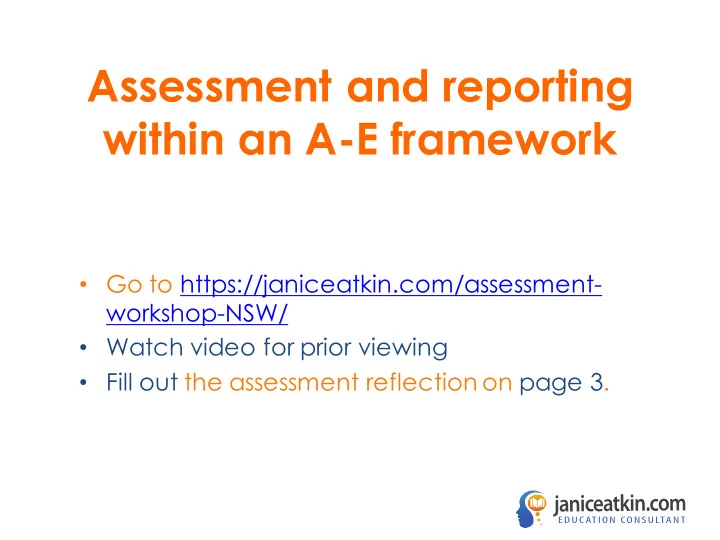
Assessment and reporting within an A-E framework Go to https://janiceatkin.com/assessment- workshop-NSW/ Watch video for prior viewing Fill out the assessment reflection on page 3. i n . c o m j a n i c e a t k


slide-1
SLIDE 1

j a n i c e a t k i n . c

  • m

EDUCATION CONSULTANT

Assessment and reporting within an A-E framework

  • Go to https://janiceatkin.com/assessment-

workshop-NSW/

  • Watch video for prior viewing
  • Fill out the assessment reflection on page 3.
slide-2
SLIDE 2

j a n i c e a t k i n . c

  • m

EDUCATION CONSULTANT

What is my why?

https://trustworks.files.wordpress.com/2013/08/complicated.jpg

slide-3
SLIDE 3

j a n i c e a t k i n . c

  • m

EDUCATION CONSULTANT

What is your why?

slide-4
SLIDE 4

j a n i c e a t k i n . c

  • m

EDUCATION CONSULTANT

Recording your thoughts

Add challenges, thoughts, insights and questions to either of the following:

  • Padlet
  • Workbook
slide-5
SLIDE 5

j a n i c e a t k i n . c

  • m

EDUCATION CONSULTANT

What I want you to walk away with

  • Solutions to challenges currently being

experienced

  • Picture of what achievement looks like

in the “new” PDHPE

  • Practical processes for planning

teaching, assessment and reporting.

slide-6
SLIDE 6

j a n i c e a t k i n . c

  • m

EDUCATION CONSULTANT

Workshop activity

Challenges you are experiencing with assessing PDHPE

slide-7
SLIDE 7

j a n i c e a t k i n . c

  • m

EDUCATION CONSULTANT

Setting the scene

Why do we assess and why A-E?

slide-8
SLIDE 8

j a n i c e a t k i n . c

  • m

EDUCATION CONSULTANT

Assessment is about helping students to learn better .... .... rather than just get a better grade.

slide-9
SLIDE 9

j a n i c e a t k i n . c

  • m

EDUCATION CONSULTANT

Assessment should ...

  • inform teaching and learning
  • provide quality feedback to students
  • provide a basis for reporting to

parents.

slide-10
SLIDE 10

j a n i c e a t k i n . c

  • m

EDUCATION CONSULTANT

Assessment should ....

Elicit a range of performance Provide multiple ways and opportunities to demonstrate understanding and skills Provide timely, quality feedback.

slide-11
SLIDE 11

j a n i c e a t k i n . c

  • m

EDUCATION CONSULTANT

Assessment ≠ Reporting

Assessment ≠ A-E grades* Reporting = A-E grades* A-E grades* given at two points in a year

* Or equivalent 5 point scale

slide-12
SLIDE 12

j a n i c e a t k i n . c

  • m

EDUCATION CONSULTANT

Planning process for teaching, assessing and reporting of the ”new” PDHPE

slide-13
SLIDE 13

j a n i c e a t k i n . c

  • m

EDUCATION CONSULTANT

Making the links

What do we report? What do we record? What do we assess? What do we want students to learn?

slide-14
SLIDE 14

j a n i c e a t k i n . c

  • m

EDUCATION CONSULTANT

Shifting the focus of our programs

slide-15
SLIDE 15

j a n i c e a t k i n . c

  • m

EDUCATION CONSULTANT

Traditional HPE programs

  • unintentionally label students
  • focus on individual responsibility
  • provide a one-size-fits-all

approach

  • focus on what not to do
  • provide information hoping to

influence attitudes and behaviours

slide-16
SLIDE 16

j a n i c e a t k i n . c

  • m

EDUCATION CONSULTANT

Shifting the focus to …

  • explore how they make sense of

themselves in local and global context

  • focus on how young people DO health

and physical activity

  • see health and physical activity as

practices NOT outcomes

  • recognise the varied influences on

how they behave and the choices they make

slide-17
SLIDE 17

j a n i c e a t k i n . c

  • m

EDUCATION CONSULTANT

understanding our students helps us identify the most valuable learning experiences

slide-18
SLIDE 18

j a n i c e a t k i n . c

  • m

EDUCATION CONSULTANT

understanding our students helps us prioritise what we teach

slide-19
SLIDE 19

j a n i c e a t k i n . c

  • m

EDUCATION CONSULTANT

understanding our students helps us make programming decisions

slide-20
SLIDE 20

j a n i c e a t k i n . c

  • m

EDUCATION CONSULTANT

understanding our students helps us plan for student engagement

slide-21
SLIDE 21

j a n i c e a t k i n . c

  • m

EDUCATION CONSULTANT

understanding our students helps us say no!

slide-22
SLIDE 22

j a n i c e a t k i n . c

  • m

EDUCATION CONSULTANT

They want to

do something

that

makes a difference now

What students told us ...

slide-23
SLIDE 23

j a n i c e a t k i n . c

  • m

EDUCATION CONSULTANT

What does that mean for you?

Give them real world problems to solve and an audience to hear their solutions ... make the learning feel essential!

slide-24
SLIDE 24

j a n i c e a t k i n . c

  • m

EDUCATION CONSULTANT

help students think more critically about what it takes to create real change... ...for themselves ... for others ... and for their communities.

slide-25
SLIDE 25

j a n i c e a t k i n . c

  • m

EDUCATION CONSULTANT

Reflecting on the “real world” of your students

  • What challenges do they

face?

  • What do they value?
  • What are they concerned

about?

  • What do they want to

change?

slide-26
SLIDE 26

j a n i c e a t k i n . c

  • m

EDUCATION CONSULTANT

slide-27
SLIDE 27

j a n i c e a t k i n . c

  • m

EDUCATION CONSULTANT

slide-28
SLIDE 28

j a n i c e a t k i n . c

  • m

EDUCATION CONSULTANT

What are the behaviours, decisions and actions that children and young people engage in that you are trying to influence through teaching HPE?

slide-29
SLIDE 29

j a n i c e a t k i n . c

  • m

EDUCATION CONSULTANT

  • What are the other contextual

influences on these behaviours, actions and decisions?

  • What skills and understandings can

help a young person to deal with these influences?

slide-30
SLIDE 30

j a n i c e a t k i n . c

  • m

EDUCATION CONSULTANT

Step 1: What do we want students to learn?

  • Identify key skills
  • Identify key understandings
  • Identify contexts for learning these

understanding and skills

Build a picture of why that learning matters

slide-31
SLIDE 31

j a n i c e a t k i n . c

  • m

EDUCATION CONSULTANT

Identifying key learnings

Understanding / Skills Outcomes Content Learning expectation

perform specialised movement skills by combining movement concepts. Apply, adapt and vary movement skills with increased confidence and precision (Movement skills – fundamental movement) Apply movement concepts and select tactics to create, perform and solve movement challenges (Movement skills – tactical movement)

slide-32
SLIDE 32

j a n i c e a t k i n . c

  • m

EDUCATION CONSULTANT

Recording your thoughts

Add thoughts, insights and questions from session 2 to either of the following:

  • Padlet
  • Workbook
slide-33
SLIDE 33

j a n i c e a t k i n . c

  • m

EDUCATION CONSULTANT

slide-34
SLIDE 34

j a n i c e a t k i n . c

  • m

EDUCATION CONSULTANT

Unpacking learning expectations

  • For each of the understandings and

skills, identify the learning expectations described within the DRAFT:

– Outcomes – Content

Build a picture of how well students need to learn

slide-35
SLIDE 35

j a n i c e a t k i n . c

  • m

EDUCATION CONSULTANT

The “new” PDHPE

slide-36
SLIDE 36

j a n i c e a t k i n . c

  • m

EDUCATION CONSULTANT

Unpacking learning expectations

Understanding / Skills Outcomes Content Learning expectation

perform specialised movement skills by combining movement concepts. Refines, applies and transfers movement skills in a variety of dynamic PA contexts (PD 4-4) ACPMP080 ACPMP082 Apply, adapt and vary movement skills with increased confidence and precision (Movement skills – fundamental movement) Transfers and adapts solutions to complex movement challenges (PD 4-5) 1st dot point ACPMP080 Apply movement concepts and select tactics to create, perform and solve movement challenges (Movement skills – tactical movement) Demonstrates how movement skills and elements of movement can be adapted and transferred to enhance and solve movement challenges (PD 4-11) ACPMP082 ACPMP087

slide-37
SLIDE 37

j a n i c e a t k i n . c

  • m

EDUCATION CONSULTANT

Identifying learning expectations

Understanding / Skills Outcomes Content Learning expectation

perform specialised movement skills by combining movement concepts. Refines, applies and transfers movement skills in a variety of dynamic PA contexts (PD 4-4) ACPMP080 ACPMP082

analyse their own performance and use feedback to refine their movement skills

Apply, adapt and vary movement skills with increased confidence and precision (Movement skills – fundamental movement) Transfers and adapts solutions to complex movement challenges (PD 4-5) 1st dot point ACPMP080

explain and justify the movement concepts and strategies selected in different game situations

Apply movement concepts and select tactics to create, perform and solve movement challenges (Movement skills – tactical movement) Demonstrates how movement skills and elements of movement can be adapted and transferred to enhance and solve movement challenges (PD 4-11) ACPMP082 ACPMP087

select strategies that have been successful before and implement them in different game situations
slide-38
SLIDE 38

j a n i c e a t k i n . c

  • m

EDUCATION CONSULTANT

Questions?

slide-39
SLIDE 39

j a n i c e a t k i n . c

  • m

EDUCATION CONSULTANT

Take 5

  • 5 squats
  • 5 jumping jacks
  • 5 arm circles
  • 5 “looking for the chicken”
slide-40
SLIDE 40

j a n i c e a t k i n . c

  • m

EDUCATION CONSULTANT

Making the links

What do we report? What do we record? What and how do we assess? What do we want students to learn?

slide-41
SLIDE 41

j a n i c e a t k i n . c

  • m

EDUCATION CONSULTANT

slide-42
SLIDE 42

j a n i c e a t k i n . c

  • m

EDUCATION CONSULTANT

Make a judgement about student achievement

Aqua 8

Task 1 Task 2 Essay Book Test Group task Report grade

Jemima Puddleduck

74% C 12 ✔ 21.5 C

Thomas Engine

89% A 9 ✔ 25 A

Bob Workman

61% B 15

Poor/ needs attention

20 A

slide-43
SLIDE 43

j a n i c e a t k i n . c

  • m

EDUCATION CONSULTANT

slide-44
SLIDE 44

j a n i c e a t k i n . c

  • m

EDUCATION CONSULTANT

Our tools of the trade

slide-45
SLIDE 45

j a n i c e a t k i n . c

  • m

EDUCATION CONSULTANT

What sorts of assessment tools and evidence do you currently use to make judgements about student achievement?

Group relay challenge

slide-46
SLIDE 46

j a n i c e a t k i n . c

  • m

EDUCATION CONSULTANT

What constitutes evidence?

  • work samples / work books
  • practical performances
  • peer coaching opportunities
  • group presentations
  • group and class discussions
  • responses to questions
  • observations of students working
  • in-class tasks
  • tests
  • take home assignments
slide-47
SLIDE 47

j a n i c e a t k i n . c

  • m

EDUCATION CONSULTANT

Considerations when selecting assessment tools

  • time efficiency (both the students’ time

and yours)

  • reliability within a class
  • consistency of judgement across

classes

slide-48
SLIDE 48

j a n i c e a t k i n . c

  • m

EDUCATION CONSULTANT

Step 2: What do we assess?

Map how understandings and skills could be taught and assessed

  • Are there opportunities to teach/assess multiple

understandings or skills simultaneously?

  • Would you prioritise some understandings and skills
  • ver others?

Build a picture of what learning is valued

slide-49
SLIDE 49

j a n i c e a t k i n . c

  • m

EDUCATION CONSULTANT

Identifying learning expectations

Understanding / Skills Outcomes Content

Learning expectation

perform specialised movement skills by combining movement concepts. Refines, applies and transfers movement skills in a variety

  • f dynamic PA contexts (PD

4-4) ACPMP080 ACPMP082

analyse their own performance and use feedback to refine their movement skills

Apply, adapt and vary movement skills with increased confidence and precision (Movement skills – fundamental movement) Transfers and adapts solutions to complex movement challenges (PD 4- 5) 1st dot point ACPMP080

explain and justify the movement concepts and strategies selected in different game situations

Apply movement concepts and select tactics to create, perform and solve movement challenges (Movement skills – tactical movement) Demonstrates how movement skills and elements of movement can be adapted and transferred to enhance and solve movement challenges (PD 4- 11) ACPMP082 ACPMP087

select strategies that have been successful before and implement them in different game situations

slide-50
SLIDE 50

j a n i c e a t k i n . c

  • m

EDUCATION CONSULTANT

What learning activities, tasks or performances ..... will provide students with an

  • pportunity to demonstrate

evidence of their learning?

Planning your assessment

slide-51
SLIDE 51

j a n i c e a t k i n . c

  • m

EDUCATION CONSULTANT

What might you observe students doing, saying or producing that shows they have learnt what you intended?

Planning your assessment

slide-52
SLIDE 52

j a n i c e a t k i n . c

  • m

EDUCATION CONSULTANT

Planning assessment

  • pportunities

Learning expectation

Assessment opportunities analyse their own performance and use feedback to refine their movement skills Video analysis Peer assessment and feedback Comparison of own technique to elite athlete explain and justify the movement concepts and strategies selected in different game situations Handout Journal reflection Small group discussion Response to questioning select strategies that have been successful before and implement them in different game situations Game play observation Peer coaching activity Questioning of spectators or small groups -what would you do

differently?

slide-53
SLIDE 53

j a n i c e a t k i n . c

  • m

EDUCATION CONSULTANT

Questions?

slide-54
SLIDE 54

j a n i c e a t k i n . c

  • m

EDUCATION CONSULTANT

Bringing it all together

What do we report? What do we record? What do we assess? What do we want students to learn?

slide-55
SLIDE 55

j a n i c e a t k i n . c

  • m

EDUCATION CONSULTANT

Collecting evidence of learning

slide-56
SLIDE 56

j a n i c e a t k i n . c

  • m

EDUCATION CONSULTANT

Step 3: Collecting and recording evidence of achievement

How can you collect and record evidence of student learning .... .... in an efficient and valid way?

slide-57
SLIDE 57

j a n i c e a t k i n . c

  • m

EDUCATION CONSULTANT

Recording evidence

slide-58
SLIDE 58

j a n i c e a t k i n . c

  • m

EDUCATION CONSULTANT

Observation records

Develop a recording template for your selected unit of work

slide-59
SLIDE 59

j a n i c e a t k i n . c

  • m

EDUCATION CONSULTANT

Questions?

slide-60
SLIDE 60

j a n i c e a t k i n . c

  • m

EDUCATION CONSULTANT

Recording your thoughts

Add thoughts, insights and questions from session 3 to either of the following:

  • Padlet
  • Workbook
slide-61
SLIDE 61

j a n i c e a t k i n . c

  • m

EDUCATION CONSULTANT

slide-62
SLIDE 62

j a n i c e a t k i n . c

  • m

EDUCATION CONSULTANT

Take 5

  • 5 shoulder shrugs
  • 5 high knee runs
  • 5 elephant swings
  • 5 neck stretches
slide-63
SLIDE 63

j a n i c e a t k i n . c

  • m

EDUCATION CONSULTANT

Bringing it all together

What do we report? What do we record? What do we assess? What do we want students to learn?

slide-64
SLIDE 64

j a n i c e a t k i n . c

  • m

EDUCATION CONSULTANT

What do you currently report?

Source: https://leachlegacy.ece.gatech.edu/abbeville/misc/ReportCard.jpg

slide-65
SLIDE 65

j a n i c e a t k i n . c

  • m

EDUCATION CONSULTANT

NSW A-E descriptors

A – Outstanding Achievement: The student has an extensive knowledge and understanding of the content and can readily apply this knowledge. In addition, the student has achieved a very high level of competence in the processes and skills and can apply these skills to new situations. B – High Achievement: The student has a thorough knowledge and understanding of the content and a high level of competence in the processes and skills. In addition, the student is able to apply this knowledge and these skills to most situations. C – Sound Achievement: The student has a sound knowledge and understanding of the main areas of content and has achieved an adequate level of competence in the processes and skills. D – Basic Achievement: The student has a basic knowledge and understanding

  • f the content and has achieved a limited level of competence in the processes

and skills E – Limited Achievement: The student has an elementary knowledge and understanding in few areas of the content and has achieved very limited competence in some of the processes and skills

slide-66
SLIDE 66

j a n i c e a t k i n . c

  • m

EDUCATION CONSULTANT

Unpacking achievement in HPE

Approaching the standard (D) At standard (C) Above the standard (B) interpret basic feedback and use it to refine their kicking and passing skills analyse their own performance and use feedback to refine their football skills analyse their own and others’ performances and can provide constructive feedback to enhance performance provides simple arguments to justify the choice of strategies selected in a narrow range of game situations explaining and justifying the movement concepts and strategies selected in different game situations Provides clear explanations and justifies decisions made in a range

  • f different games about the

strategies selected Transfers some basic strategies to games in similar categories selecting strategies that have been successful before and implementing them in different game situations evaluates the success of selected strategies and proposes alternative strategies for greater success

slide-67
SLIDE 67

j a n i c e a t k i n . c

  • m

EDUCATION CONSULTANT

Exploring levels of achievement

  • ACARA work samples

http://www.australiancurriculum.edu.au/health-and-physical- education/curriculum/f-10?layout=1

  • Queensland standard elaborations

https://www.qcaa.qld.edu.au/p-10/aciq/standards- elaborations/p-10-hpe

slide-68
SLIDE 68

j a n i c e a t k i n . c

  • m

EDUCATION CONSULTANT

What levels of achievement would you expect of students?

  • Record what sound achievement (C)

looks like for your unit of work

  • Record what limited (D) and high (B)

level achievement looks like.

slide-69
SLIDE 69

j a n i c e a t k i n . c

  • m

EDUCATION CONSULTANT

Questions?

slide-70
SLIDE 70

j a n i c e a t k i n . c

  • m

EDUCATION CONSULTANT

Recording your thoughts

Add thoughts, insights and questions from session 4 to either of the following:

  • Padlet
  • Workbook
slide-71
SLIDE 71

j a n i c e a t k i n . c

  • m

EDUCATION CONSULTANT

Planning future directions

What are your next steps?

– teaching and learning – assessment processes – professional development – reporting processes

slide-72
SLIDE 72

j a n i c e a t k i n . c

  • m

EDUCATION CONSULTANT

3-2-1 reflector

  • 3 people you will have a conversation

with when you get back to school

  • 2 insights you will share with each of

these people

  • 1 question that you still have and need

to investigate further

slide-73
SLIDE 73

j a n i c e a t k i n . c

  • m

EDUCATION CONSULTANT

Workshop evaluation

https://ja53.typeform.com/to/ITpWOW

slide-74
SLIDE 74

j a n i c e a t k i n . c

  • m

EDUCATION CONSULTANT

Want resources or training?

Email: janice@janiceatkin.com