
SLIDE 1
Bucket-Sort and Radix-Sort 1
Bucket-Sort and Radix-Sort
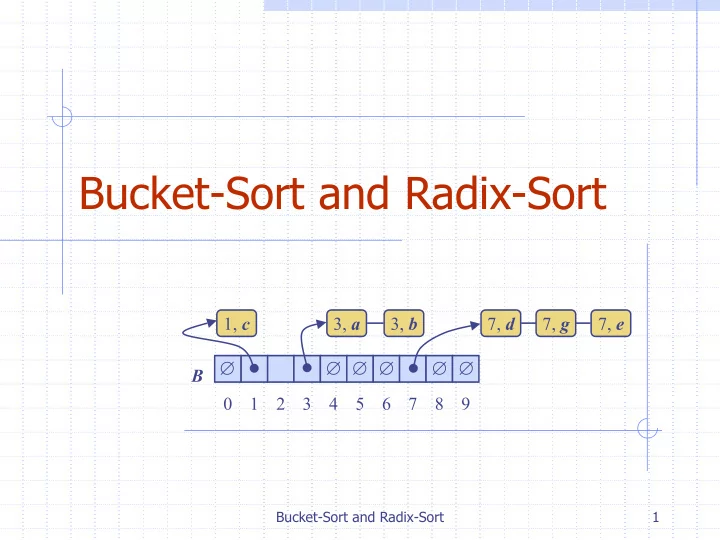
B 1, c ∅ ∅ 1 2 ∅ 3 4 5 3, b ∅ ∅ ∅ 3, a 7, d 7, g 7, e ∅ 6 7 8 9
Bucket-Sort and Radix-Sort 1, c 3, a 3, b 7, d 7, g 7, e - - PowerPoint PPT Presentation
Bucket-Sort and Radix-Sort 1, c 3, a 3, b 7, d 7, g 7, e B 0 1 2 3 4 5 6 7 8 9 Bucket-Sort and Radix-Sort 1 Bucket-Sort (10.5.1) Let be S be a sequence of n Algorithm bucketSort ( S, N ) (key,
Bucket-Sort and Radix-Sort 1
B 1, c ∅ ∅ 1 2 ∅ 3 4 5 3, b ∅ ∅ ∅ 3, a 7, d 7, g 7, e ∅ 6 7 8 9
Bucket-Sort and Radix-Sort 2
Let be S be a sequence of n (key, element) items with keys in the range [0, N − 1] Bucket-sort uses the keys as indices into an auxiliary array B
Phase 1: Empty sequence S by moving each item (k, o) into its bucket B[k] Phase 2: For i = 0, …, N − 1, move the items of bucket B[i] to the end of sequence S
Analysis:
Phase 1 takes O(n) time Phase 2 takes O(n + N) time
Bucket-sort takes O(n + N) time
Algorithm bucketSort(S, N) Input sequence S of (key, element) items with keys in the range [0, N − 1] Output sequence S sorted by increasing keys B ← array of N empty sequences while ¬S.isEmpty() f ← S.first() (k, o) ← S.remove(f) B[k].insertLast((k, o)) for i ← 0 to N − 1 while ¬B[i].isEmpty() f ← B[i].first() (k, o) ← B[i].remove(f) S.insertLast((k, o))
Bucket-Sort and Radix-Sort 3
∅ ∅ ∅ ∅ ∅ ∅ ∅ 1 2 3 4 5
6 7 8 9
Bucket-Sort and Radix-Sort 4
Integer keys in the range [a, b]
Put item (k, o) into bucket
B[k − a]
String keys from a set D of
possible strings, where D has constant size (e.g., names of the 50 U.S. states)
Sort D and compute the rank
r(k) of each string k of D in the sorted sequence
Put item (k, o) into bucket
B[r(k)]
The keys are used as
indices into an array and cannot be arbitrary
No external comparator
The relative order of
any two items with the same key is preserved after the execution of the algorithm
Bucket-Sort and Radix-Sort 5
The Cartesian coordinates of a point in space are a 3-tuple
(x1, x2, …, xd) < (y1, y2, …, yd)
x1 < y1 ∨ x1 = y1 ∧ (x2, …, xd) < (y2, …, yd)
Bucket-Sort and Radix-Sort 6
Algorithm lexicographicSort(S) Input sequence S of d-tuples Output sequence S sorted in lexicographic order for i ← d downto 1 stableSort(S, Ci) Let Ci be the comparator that compares two tuples by their i-th dimension Let stableSort(S, C) be a stable sorting algorithm that uses comparator C Lexicographic-sort sorts a sequence of d-tuples in lexicographic order by executing d times algorithm stableSort, one per dimension Lexicographic-sort runs in O(dT(n)) time, where T(n) is the running time of stableSort
(7,4,6) (5,1,5) (2,4,6) (2, 1, 4) (3, 2, 4) (2, 1, 4) (3, 2, 4) (5,1,5) (7,4,6) (2,4,6) (2, 1, 4) (5,1,5) (3, 2, 4) (7,4,6) (2,4,6) (2, 1, 4) (2,4,6) (3, 2, 4) (5,1,5) (7,4,6)
Bucket-Sort and Radix-Sort 7
Radix-sort is a specialization of lexicographic-sort that uses bucket-sort as the stable sorting algorithm in each dimension Radix-sort is applicable to tuples where the keys in each dimension i are integers in the range [0, N − 1] Radix-sort runs in time O(d( n + N)) Algorithm radixSort(S, N) Input sequence S of d-tuples such that (0, …, 0) ≤ (x1, …, xd) and (x1, …, xd) ≤ (N − 1, …, N − 1) for each tuple (x1, …, xd) in S Output sequence S sorted in lexicographic order for i ← d downto 1 bucketSort(S, N)
Bucket-Sort and Radix-Sort 8
Algorithm binaryRadixSort(S) Input sequence S of b-bit integers Output sequence S sorted replace each element x
for i ← 0 to b − 1 replace the key k of each item (k, x) of S with bit xi of x bucketSort(S, 2)
Bucket-Sort and Radix-Sort 9