Canadian Rail Traffic Control Fundamentals Sean Robitaille - - PowerPoint PPT Presentation

canadian rail traffic control fundamentals
SMART_READER_LITE
LIVE PREVIEW

Canadian Rail Traffic Control Fundamentals Sean Robitaille - - PowerPoint PPT Presentation

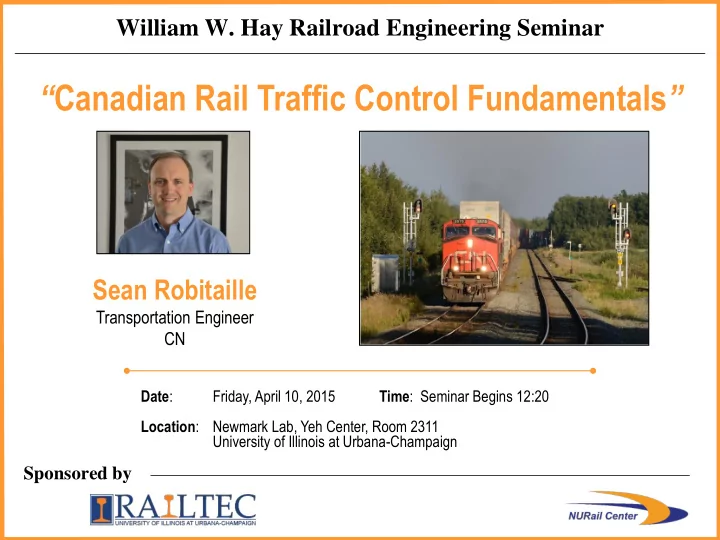
William W. Hay Railroad Engineering Seminar Canadian Rail Traffic Control Fundamentals Sean Robitaille Transportation Engineer CN Date : Friday, April 10, 2015 Time : Seminar Begins 12:20 Location : Newmark Lab, Yeh Center, Room 2311


slide-1
SLIDE 1

Sponsored by

William W. Hay Railroad Engineering Seminar

“Canadian Rail Traffic Control Fundamentals”

Sean Robitaille

Transportation Engineer CN

Date: Friday, April 10, 2015 Time: Seminar Begins 12:20 Location: Newmark Lab, Yeh Center, Room 2311 University of Illinois at Urbana-Champaign

slide-2
SLIDE 2

Canadian Rail Traffic Control Fundamentals

Sean Robitaille CN Transportation Engineer University of Illinois William W. Hay Railroad Engineering Seminar April 10, 2015

slide-3
SLIDE 3

3

Presentation Overview

  • The framework for Canadian control

systems

  • Control without signals
  • Automatic Block Signals
  • Centralized Traffic Control
  • Interlocking
  • Questions
slide-4
SLIDE 4

4

Rail Traffic Control Framework

  • Canada: Canadian Rail Operating Rules, as
  • verseen by Transport Canada
  • Complete document available on web

http://www.railcan.ca/assets/images/regulations/rules/CANADIAN_RAIL_OPERATING_RULES__ENGLISH__TC_O_0-167.pdf

  • Provides the parameters

by which to operate all railways in Canada

slide-5
SLIDE 5

5

Rail Traffic Control Framework

  • How did a single rule book evolve for an

entire country?

– Early amalgamation into two transcon networks – CP network effectively complete by 1915 – CN created from bankrupt roads by 1924 – Individual railroad rulebooks approved by Canadian Board of Transport Commisioners until... – Uniform Code of Operating Rules 1962

slide-6
SLIDE 6

6

Rail Traffic Control Framework

  • Railway Specific Instructions

– Company-tailored rulebook – Employee Time Table

  • Provides specific instruction for
  • peration on a rail company’s

individual lines of track

– “Subdivisions” – Yards/Terminals

  • Identifies method of control

and who oversees the application of rules

slide-7
SLIDE 7

7

Rail Traffic Control Framework

  • Sample Subdivision page from time table

Traffic Control Method Number of Main Tracks Station Names Siding Location and Length Direction

slide-8
SLIDE 8

8

Basic Control – Non Main Track

  • Movement governed by CROR 105
  • Trains operate at ‘reduced’ speed, being

able to stop in half the range of vision of equipment, red flag or end-of-track

  • A ‘main track’ can be designated as

Cautionary Limits (CROR 94) and be

  • perated as yard track
  • Typical application:

– Yards – Spur tracks – Customer sidings

slide-9
SLIDE 9

9

Basic Control – Non Main Track

  • Non main track switches identified by

yellow targets

  • ‘Subdivision Track’ used to denote ‘through

track’ at a location instead of yard limits

Yellow target indicates switch is lined for diverging route

slide-10
SLIDE 10

10

Basic Control – Main Track

  • Rail Traffic Controller (RTC) supervises and

directs traffic on specified territory

  • Most basic CROR system for main track

authority is called “Occupancy Control System” (OCS)

  • Similar to ‘Track Authority’

method of operation on CN in US, or TWC territory elsewhere

slide-11
SLIDE 11

11

Main Track – Occupancy Control System

  • Provision to operate OCS

using CROR 301 – 315

  • Authority to use main

track in effect until clearance:

– Fulfilled – Cancelled – Superseded

slide-12
SLIDE 12

12

Main Track – Occupancy Control System

  • Procedure to operate trains at main track

speeds without any signal protection

  • Each train movement and trackwork

personnel must have authority to occupy the main track

  • Rail Traffic Controller (RTC) oversees the
  • peration and issues authority to use main

track

OCS Control Screen

slide-13
SLIDE 13

13

Main Track – Occupancy Control System

  • Main track authority limits defined by

identifiable railway features:

– Milepost – Station Sign – Marked turnouts (ends of sidings, junctions)

Milepost Station Sign

slide-14
SLIDE 14

14

Main Track – Occupancy Control System

Addressed to Wait instruction Direction to operate Bidirectional authority Instruction regarding

  • ther authorities

Turnout Status Turnout Permissions Authority Completed Authority Cancelled

slide-15
SLIDE 15

15

Main Track – Occupancy Control System

  • Turnouts generally

manually operated – some may have push button

  • r radio controls
  • Efficiency of system dependent on:

– Forward thinking by train crew – Workload/responsiveness of Rail Traffic Controller – Effectiveness of radio tower communication system

slide-16
SLIDE 16

16

Main Track – Occupancy Control System

  • Example of OCS operation – time table

station table

slide-17
SLIDE 17

17

Main Track – Occupancy Control System

  • Example of OCS operation – track diagram

Station Sign ‘other track’ Train (authorized to ‘Work’) Siding East Switch Kitchener Siding 13,550’ Switch Station Sign Switch Main Track Siding West Switch Kitchener

slide-18
SLIDE 18

18

Signal Overlay for Main Track

  • CROR provides for three methods of

movement utilizing signals:

– ABS (CROR 505-515) – CTC (CROR 560-578) – Interlocking (CROR 601-620)

  • ABS and interlocking common

since WWI

  • CTC first installed in early 1920s in USA

with first significant installations implemented during WWII

slide-19
SLIDE 19

19

Signal Overlay for Main Track

  • Signal Aspects & Indications provided by

CROR 405-440 – speed signal system

Letter Markers (“L”, “DV”, “R”) used to upgrade certain indications

slide-20
SLIDE 20

20

Automatic Block Signals

  • ABS currently only utilized by CP

– Single track in Ontario and Alberta – Double track in Ontario and Quebec

  • Application essentially identical to US
slide-21
SLIDE 21

21

Automatic Block Signals

  • ABS usage covered by CROR 505-515
  • Used in conjunction with OCS Rules

– ABS provides the broken rail and following/head

  • n train protection

– OCS provides the authority for movement/occupancy

  • All signals identified with

number plates for identification

slide-22
SLIDE 22

22

Centralized Traffic Control

  • Canadian implementation of CTC followed

the experiences of the US roads from 1920- 1940

  • First installation on CP Medicine Hat –

Dunmore (Alberta) 6-mile hill in 1928

  • CN commissioned first

long distance (185 miles) single track CTC Moncton- Halifax during WWII to help with war effort

slide-23
SLIDE 23

23

Centralized Traffic Control

  • CTC installed on the core main lines and by

the two heavy haul iron ore railroads in Quebec / Labrador

Western Canada (CTC highlighted) Eastern Canada

slide-24
SLIDE 24

24

Centralized Traffic Control

  • Example of CN RTC-II panel track layout

Main Track Station Name Controlled Signals Power Switches Trains

slide-25
SLIDE 25

25

Centralized Traffic Control

  • Typical plan view of a single track CTC

arrangement – basically identical to US installations

Controlled Locations Intermediate Signals Station Name (identifier only) Industry track Manual Entry/Exit

slide-26
SLIDE 26

26

Centralized Traffic Control

  • Canadian railroads have physically

identified all signals with number plates to facilitate written authority procedures

Provides unique and efficient method to identify signals Controlled Signals Signal Number plate

slide-27
SLIDE 27

27

Centralized Traffic Control

  • Written authority required:

– To pass a controlled signal at stop (CROR 564) – To work between defined signals – To enter main track at hand-operated switch

CN CTC Authority document

slide-28
SLIDE 28

28

Interlocking Control

  • CROR 601-620 govern interlocking
  • peration
  • Four main types of interlockings in CROR:

– Manual – by special instruction only – Locally controlled – local tower operation – Remotely controlled – by RTC at control center – Automatic – simple diamonds

  • CROR 620 provides for non-interlocked

crossings or movable bridges

slide-29
SLIDE 29

29

Interlocking Control-Evolution

  • West Toronto interlocking

circa 1923 – locally controlled CN/CP crossing

  • West Toronto circa 2012

remotely controlled interlocking (CP RTC)

slide-30
SLIDE 30

30

Interlocking Control

  • Locally controlled interlocking

– Toronto – Scott Street Tower

Opened June 1931 78 signal levers 84 switch levers 192 levers total

slide-31
SLIDE 31

31

Future Control Systems

  • CROR provides for “Special Control System”

(SCS)

– Basic framework provided by CROR 351-353 – Will be used to implement new methods of control as they are developed – OCS was originally implemented through this method

  • Currently no mandate or requirement to

implement PTC in Canada

slide-32
SLIDE 32

32

Conclusion

  • Canadian railroads continue to make a

single-rulebook methodology work

  • Hardware effectively identical to US
  • Canada-US procedural differences for
  • perating authorities will likely remain in

force

slide-33
SLIDE 33