Chapter 4 State Feedback LQR Motivation Quadratic minimization : - - PDF document

chapter 4 state feedback lqr motivation quadratic
SMART_READER_LITE
LIVE PREVIEW

Chapter 4 State Feedback LQR Motivation Quadratic minimization : - - PDF document

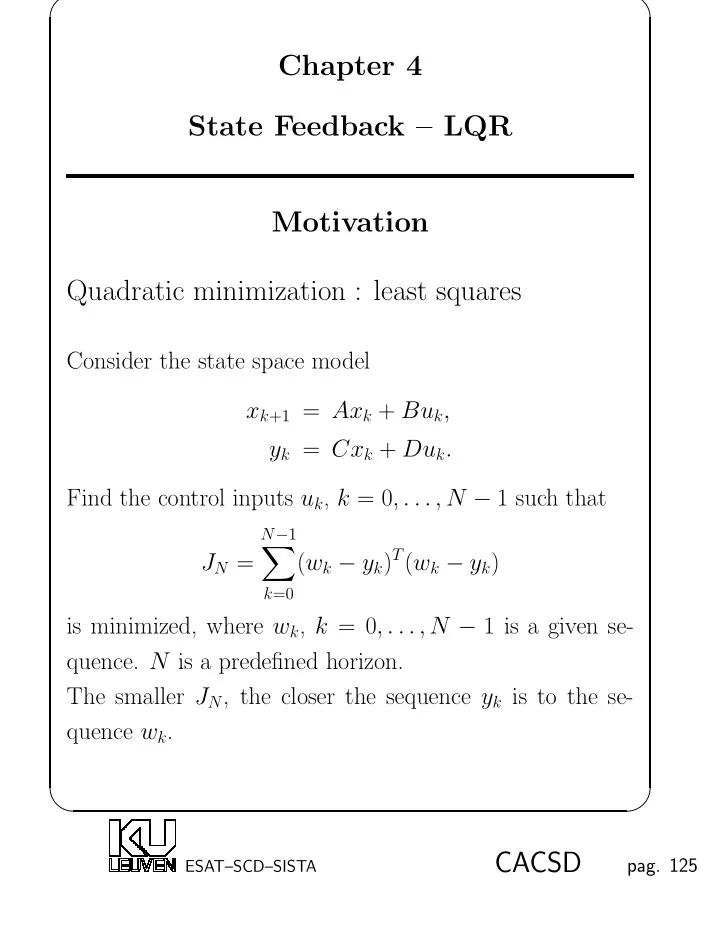
Chapter 4 State Feedback LQR Motivation Quadratic minimization : least squares Consider the state space model x k +1 = Ax k + Bu k , y k = Cx k + Du k . Find the control inputs u k , k = 0 , . . . , N 1 such that N 1 (


slide-1
SLIDE 1

✬ ✫ ✩ ✪

Chapter 4 State Feedback – LQR Motivation Quadratic minimization : least squares

Consider the state space model xk+1 = Axk + Buk, yk = Cxk + Duk. Find the control inputs uk, k = 0, . . . , N − 1 such that JN =

N−1

  • k=0

(wk − yk)T(wk − yk) is minimized, where wk, k = 0, . . . , N − 1 is a given se-

  • quence. N is a predefined horizon.

The smaller JN, the closer the sequence yk is to the se- quence wk.

ESAT–SCD–SISTA

CACSD

  • pag. 125
slide-2
SLIDE 2

✬ ✫ ✩ ✪

The solution can be derived in terms of the following input-output equations :

      y0 y1 . . . yN−1      

  • y

=

      C CA . . . CAN−1      

  • ON

x0+

         H0 · · · · · · H1 H0 · · · · · · H2 H1 H0 · · · · · · · · · · · · · · · · · · HN−1 HN−2 · · · · · · H0         

  • HN

      u0 u1 . . . uN−1      

  • u

where Hk are called the Markov parameters (impulse re- sponse matrices) defined as : H0 = D, Hk = CAk−1B, k = 1, 2, · · · , N − 1. Let vector w be defined in a similar way as y, then JN = wTw + xT

0 OT NONx0 + uTHT NHNu

−2wTONx0 − 2wTHNu + 2xT

0 OT NHNu

is the quadratic criterion to be minimized. Now find the optimal u as the solution to minu JN. In order to do so we set the derivatives of JN with respect to the vector u to zero, resulting in : HT

NHNu = HT Nw − HT NONx0. ESAT–SCD–SISTA

CACSD

  • pag. 126
slide-3
SLIDE 3

✬ ✫ ✩ ✪

When HT

NHN is invertible, then

uopt = (HT

NHN)−1HT N(w − ONx0),

which can be written as     

u0 u1 . . . uN−1

     =     

F0 F1 . . . FN−1

     x0+     

G11 G12 · · · G1N G21 G22 · · · G2N · · · · · · · · · · · · GN1 GN2 · · · GNN

         

w0 w1 . . . wN−1

     .

Constrained minimization : basics of MPC

The least squares solution can be complemented with lin- ear constraints, for instance on the magnitude of the in- put sequence or on its derivative. This then leads to a quadratic programming problem (see Matlab quadprog.m). One could require for instance that all components of the input u are smaller in absolute value than a certain pre- specified threshold or that they have to be nonnegative (to avoid that too large or too small inputs are applied to the actuators), that the first derivative of the input u stays within certain bounds (to avoid abrupt changes in the in- put), etc ... .

ESAT–SCD–SISTA

CACSD

  • pag. 127
slide-4
SLIDE 4

✬ ✫ ✩ ✪

Example : Consider the following SISO system xk+1 =    0.7 0.5 −0.5 0.7 0.9    xk +    1 1 1    uk, x0 =    0.1 0.2 0.3    yk =

  • 0 −1 1
  • xk + 0.5uk.

We want the output to be as close as possible to a prede- fined w by minimizing (w −y)T(w −y), where w looks like (N=20) :

2 4 6 8 10 12 14 16 18 20 −1 −0.8 −0.6 −0.4 −0.2 0.2 0.4 0.6 0.8 1 discrete time amplitude desired output w

Construct HN and ON. Now compute u as the least squares solution to minu(w − y)T(w − y) (formula on top

  • f page 127).

ESAT–SCD–SISTA

CACSD

  • pag. 128
slide-5
SLIDE 5

✬ ✫ ✩ ✪

The input u is shown in the figure below.

2 4 6 8 10 12 14 16 18 20 −2500 −2000 −1500 −1000 −500 500 1000 discrete time amplitude least squares input u

It appears that if this input is applied to the system the

  • utput is exactly the desired block wave we wanted.

The input however may be too large. Now let’s assume that for safety reasons the input should stay between -100 and 100. Then we have to solve a constrained optimization problem minimizing (w − y)T(w − y) with respect to u and subject to −100 ≤ uk ≤ 100. This comes down to a quadratic programming problem which basically solves min

u

1 2uTHu + fTu subject to Au ≤ b. Matlab program quadprog.m can be used to solve this equation.

ESAT–SCD–SISTA

CACSD

  • pag. 129
slide-6
SLIDE 6

✬ ✫ ✩ ✪

H and f follow from the expression for JN on page 126 and A and b depend on the constraints which are being applied. The input is shown in the next figure

2 4 6 8 10 12 14 16 18 20 −100 −80 −60 −40 −20 20 40 60 80 100 discrete time amplitude constrained input u

and clearly remains between the predefined bounds. The

  • utput follows the block wave quite well :

2 4 6 8 10 12 14 16 18 20 −1 −0.8 −0.6 −0.4 −0.2 0.2 0.4 0.6 0.8 1 discrete time amplitude

  • utput y and desired output w

ESAT–SCD–SISTA

CACSD

  • pag. 130
slide-7
SLIDE 7

✬ ✫ ✩ ✪

A more general quadratic criterion is one in which the in- puts and the outputs are weighted with two weighting ma- trices R ∈ RmN×mN and Q ∈ RpN×pN such that JN = uTRu + (y − w)TQ(y − w). In this way the controller can be better adjusted to the de- signer’s wishes. Furthermore, it appears that this approach is numerically more robust. Try to express JN as a function of w, u, x0, ... as on page

  • 126. The optimal solution is now given by

uopt = min

u JN = (R+HT NQHN)−1(HT NQw−HT NQONx0).

Also in this case the minimization criterion can be comple- mented with linear constraints. The problem with the controller so far is that the input sequences are not really generated by state feedback. If the system model differs from the real system due to inaccurate modeling or nonlinearities, the previous method might fail. In practice therefore feedback is inserted. Further, only the first element of vector uopt is applied to the system and uopt is recomputed each sample instance. This basically leads to the so–called Model–based Predictive Controller (MPC).

ESAT–SCD–SISTA

CACSD

  • pag. 131
slide-8
SLIDE 8

✬ ✫ ✩ ✪

Linear Quadratic Regulator (LQR)

Solving a quadratic programming problem is a computa- tionally intensive operation. For this purpose we propose to use a simpler quadratic cost function of the form

N

  • k=0

(xT

k Qxk + uT k Ruk)

where both Q and R are nonnegative definite. We also constrain the optimization problem in this case, but now requiring that uk = −Kxk. By introducing state feedback the regulator is armed against model uncertainties, plant changes, ... . Remark that using this simpler approach we cannot force the input to stay within predefined bounds, as with the MPC. The central question is whether we can find a stabilizing feedback matrix K in an easy way without having to solve a complex optimization problem. In this chapter it will become clear how to choose a feedback matrix K that is

  • ptimal w.r.t. a quadratic criterion such as the one defined
  • n the previous page. This will lead to the Linear Quadratic

Regulator (LQR). Afterwards we’ll show how to design a state estimator.

ESAT–SCD–SISTA

CACSD

  • pag. 132
slide-9
SLIDE 9

✬ ✫ ✩ ✪

This overcomes that all state variables need to be mea-

  • sured. Measuring all state variables is too expensive or can

be even practically impossible. The chapter on reference introduction and integral design shows how to extend the feedback equation to uk = −Kxk + f(ref) such that track- ing of an external signal is feasible. First example of LQR : Consider the system xk+1 = xk + uk and apply static feedback uk = −κxk. Suppose that the cost function is given by

  • k=0

(x2

k + ρu2 k).

If ρ is small, we don’t care about the magnitude of the control inputs (cheap control) and we are mainly interested in a fast response, requiring that the terms x2

k are small.

If on the other hand ρ is large, we weigh the control input heavily in the quadratic cost function (high cost). We find easily that xk = (1 − κ)kx0

ESAT–SCD–SISTA

CACSD

  • pag. 133
slide-10
SLIDE 10

✬ ✫ ✩ ✪

Now,

  • k=0

(x2

k + ρu2 k) = x2

(1 + ρκ2) 1 − (1 − κ)2 if 0 < κ < 2 = ∞ if κ ≤ 0 or κ > 2 Observe that the cost is quadratic in x0. In case that 0 < κ < 2 we find the optimal value of κ by setting the derivative with respect to κ equal to 0. κopt = √1 + 4ρ − 1 2ρ For this choice of κ, the optimal cost is 2ρx2 √1 + 4ρ − 1 = x2 κopt For low cost, cheap control, we have : lim

ρ→0 κopt = 1

The corresponding cost is x2

0(1 + ρ). For high cost control,

we find that κopt ≈

1 √ρ if ρ is large. κopt is small. It barely

stabilizes the system (closed-loop eigenvalue is 1 − 1

√ρ) but

the plant input is small.

ESAT–SCD–SISTA

CACSD

  • pag. 134
slide-11
SLIDE 11

✬ ✫ ✩ ✪

LQR Quadratic minimization : state feedback

Given the linear time invariant discrete time system xk+1 = Axk + Buk, x0 is known. Find a control sequence uk, k = 0, . . . , N − 1 such that JN = 1 2

N−1

  • k=0

[xT

k Qxk + uT k Ruk] + 1

2xT

NQNxN

is minimized. R, Q and QN are nonnegative definite weighting matrices.

ESAT–SCD–SISTA

CACSD

  • pag. 135
slide-12
SLIDE 12

✬ ✫ ✩ ✪

Lagrange multipliers method : Take the state equations for k = 0, . . . , N − 1 as N con-

  • straints. There will be one Lagrange multiplier vector, lk+1,

for each value of k. Write the Lagrangean JN as

N−1

  • k=0

1 2xT

k Qxk + 1

2uT

k Ruk + lT k+1(−xk+1 + Axk + Buk)

  • + 1

2xT

NQNxN.

Setting the derivatives with respect to uk, lk+1 and the xk to zero results in a set of control equations : uT

k R + lT k+1B = 0,

state equations : −xk+1 + Axk + Buk = 0, adjoint equations : xT

k Q − lT k + lT k+1A = 0,

final state equations : QNxN − lN = 0. ⇒ Two-point boundary value problem. The adjoint equations may also be written as lk = ATlk+1 + Qxk This equation runs backwards in time. In order to solve this set of coupled difference equations we need to know the initial condition on xk and the final condition on lk. x0 is assumed to be given.

ESAT–SCD–SISTA

CACSD

  • pag. 136
slide-13
SLIDE 13

✬ ✫ ✩ ✪

Sweep method to solve the two-point boundary value problem

Assume lk = Skxk, for a certain matrix Sk. The control equations become : Ruk = −BTSk+1(Axk + Buk) Solving for uk, we obtain uk = −P −1

k+1BTSk+1Axk, with Pk+1 = R + BTSk+1B.

From the adjoint equations and the state equations : Skxk = ATSk+1(Axk + Buk) + Qxk. Combine these two equations :

  • Sk − AT

Sk+1 − Sk+1BP −1

k+1BTSk+1

  • A − Q
  • xk

∀k

= 0 ⇒ Riccati difference equation : Sk = AT Sk+1 − Sk+1BP −1

k+1BTSk+1

  • A + Q.

ESAT–SCD–SISTA

CACSD

  • pag. 137
slide-14
SLIDE 14

✬ ✫ ✩ ✪

This equation runs backwards in time. The boundary con- dition on the recursion is obtained from the final state equa- tions : lN = QNxN = SNxN → SN = QN. The final solution for finite horizon can be found by solving for uk : uk = −Kkxk, where Kk = (R + BTSk+1B)−1BTSk+1A. This matrix Kk is the desired optimal time-varying feed- back matrix. Note that the optimal gain sequence is in- dependent of x0. It can be pre-computed if the system matrices A and B are known and R, Q, QN and N are specified. The optimal cost is Jmin

N

= 1 2xT

0 S0x0. ESAT–SCD–SISTA

CACSD

  • pag. 138
slide-15
SLIDE 15

✬ ✫ ✩ ✪

Example : Consider the following discrete-time system xk+1 = 0.3679xk + 0.6321uk, x0 = 1 Determine the control sequence that minimizes the follow- ing cost function : J = 1 2

9

  • k=0

[x2

k + u2 k] + 1

2x2

10

Note that in this example Q = 1, R = 1 and QN = 1. The Riccati difference equation we have to solve is

Sk = 0.3679[Sk+1 − Sk+10.6321(1 + 0.6321Sk+10.6321)−10.6321Sk+1]0.3679 + 1

which can be simplified to Sk = 1 + 0.1354Sk+1[1 + 0.3996Sk+1]−1 The boundary condition is SN = S10 = QN = 1.

ESAT–SCD–SISTA

CACSD

  • pag. 139
slide-16
SLIDE 16

✬ ✫ ✩ ✪

Sk can be computed backwards from k = 9 to k = 0. Notice that the values of Sk rapidly approach a steady- state value Sss. The feedback gain can be computed from Kk = [1 + 0.6321Sk+10.6321]−10.6321Sk+10.3679

1 2 3 4 5 6 7 8 9 10 0.2 0.4 0.6 0.8 1 k Sk 1 2 3 4 5 6 7 8 9 10 0.02 0.04 0.06 0.08 0.1 0.12 0.14 0.16 0.18 0.2 Kk k

The important conclusion from this example is that the control gains Kk keep their constant value until at the very end of the time horizon. This suggests that, when the horizon N is large, a ‘steady-state’ controller with its gain matrix fixed and equal to the initial gain will not differ much from the optimal one.

ESAT–SCD–SISTA

CACSD

  • pag. 140
slide-17
SLIDE 17

✬ ✫ ✩ ✪

One can show that the set Sk converges to a steady-state value S. S can be found from the so-called discrete alge- braic Riccati equation : S = AT S − SB(R + BTSB)−1BTS

  • A + Q.

The steady-state optimal control law is then time-invariant: K = (R + BTSB)−1BTSA, The feedback solution for infinite horizon is uk = −Kxk. The closed-loop system matrix A − BK is stable if the system (A, B) is controllable and (A, R1/2) is observable. The optimal cost is : Jmin

N

= 1 2xT

0 Sx0. ESAT–SCD–SISTA

CACSD

  • pag. 141
slide-18
SLIDE 18

✬ ✫ ✩ ✪

Solving the algebraic Riccati equation

Combine the state equations and the control equations : Axk = xk+1 + BR−1BTlk+1 From the adjoint equations we have : ATlk+1 = lk − Qxk We can combine these equations as

  • A

−Q I xk lk

  • =
  • I BR−1BT

AT xk+1 lk+1

  • .

If we take the z-transform

  • A

−Q I X(z) L(z)

  • =
  • I BR−1BT

AT X(z) L(z)

  • z,

and call y =

  • X(z)

L(z)

  • =
  • v

w

  • and z = λ

ESAT–SCD–SISTA

CACSD

  • pag. 142
slide-19
SLIDE 19

✬ ✫ ✩ ✪

we get

  • A

−Q I

  • y =
  • I BR−1BT

AT

  • yλ,

which is a generalized eigenvalue problem. If λ is an eigenvalue, the also 1/λ will be one. So, the eigenvalue spectrum is symmetric with respect to the unit circle. We assume that the eigenvalues are distinct and |λi| < 1. Then 1/λi are all lying outside the unit circle. Also assume that the vectors vi are linearly independent. Now suppose wi can be written as Svi :

  • A

−Q I vi Svi

  • =
  • I BR−1BT

AT vi Svi

  • λi.

This can be rewritten as Avi = λi(I + BR−1BTS)vi λiATSvi = −Qvi + Svi. If we pre-multiply the first equation with ATS, we find λiATSvi = ATS(I + BR−1BTS)−1Avi.

ESAT–SCD–SISTA

CACSD

  • pag. 143
slide-20
SLIDE 20

✬ ✫ ✩ ✪

Now we can eliminate λi to find (S − Q − ATS(I + BR−1BTS)−1A)vi = 0. Since the vi are independent, we have S − Q − ATS(I + BR−1BTS)−1A = 0 and it can be proven, using the matrix inversion lemma1, that this is the algebraic Riccati equation. Hence we have found an algorithm to solve the algebraic Riccati equation :

  • 1. solve the generalized eigenvalue problem
  • A

−Q I vi wi

  • =
  • I BR−1BT

AT vi wi

  • λi,
  • 2. let vi and wi correspond to the eigenvalues within the

unit circle,

  • 3. define V = [v1...vN] and W = [w1...wN],
  • 4. then

S = WV −1.

1(A + BCD)−1 = A−1 − A−1B(C−1 + DA−1B)−1DA−1

ESAT–SCD–SISTA

CACSD

  • pag. 144
slide-21
SLIDE 21

✬ ✫ ✩ ✪

LQR for continuous-time systems

Up till now we restricted ourselves to LQR design for discrete-time system. A similar procedure exists in con- tinuous time. We will discuss the results briefly.

The finite-horizon problem

Be given a continuous-time system : ˙ x = Ax + Bu, u = −K(t)x Consider the problem of minimizing the cost function J = T

t

(xTQx + uTRu)dτ + xT(T)QTx(T) with Q, QT and R nonnegative definite weighting matrices and K(t) the linear system over which the cost function is going to be minimized.

ESAT–SCD–SISTA

CACSD

  • pag. 145
slide-22
SLIDE 22

✬ ✫ ✩ ✪

One can prove that the optimal K(t) = R−1BTP(t). P(t) is the solution to the following Riccati differential equation: − ˙ P = PA + ATP − PBR−1BTP + Q, P(T) = QT

The infinite-horizon problem

Now let t = 0 and T → ∞. The optimal controller is K = R−1BTP where P is the solution to the continuous algebraic Riccati equation : PA + ATP − PBR−1BTP + Q = 0. Note that P and K are constant matrices now.

ESAT–SCD–SISTA

CACSD

  • pag. 146
slide-23
SLIDE 23

✬ ✫ ✩ ✪

Algebraic Riccati Equations

Consider the following Riccati equation: ATX + XA − XBBTX + CTC = 0

Existence, Uniqueness and Stabilizability

Suppose that (A, B) is stabilizable and (A, C) is de-

  • tectable. Then the Riccati equation has a unique positive

semidefinite solution. Moreover, this solution is stabilizing, that is, A − BBTX has all its eigenvalues in the left half-plane. Recall that BTX is the state feedback gain K for LQR, thus the closed loop system with LQR is stable.

ESAT–SCD–SISTA

CACSD

  • pag. 147
slide-24
SLIDE 24

✬ ✫ ✩ ✪

Elimination of cross terms

So far we used LQR cost functions that made a trade-off between weighted states x and weighted inputs u. Quite

  • ften however, a trade-off between inputs u and outputs y

is more appropriate. For continuous-time systems the direct transmission matrix D is equal to 0 in practice, so y = Cx. A cost function, making a trade-off between inputs and outputs, can be de- fined J = ∞ (yTQy+uTRu)dτ = ∞ (xTCTQCx+uTRu)dτ, and apparently falls down to equations we already dis-

  • cussed. Here, Q and R are typically chosen to be diagonal

matrices. However, in discrete-time the direct transmission matrix D typically does exist : yk = Cxk + Duk. So yT

k Qyk = xT k CTQCxk + uT k DTQDuk + 2xT k CTQDuk, ESAT–SCD–SISTA

CACSD

  • pag. 148
slide-25
SLIDE 25

✬ ✫ ✩ ✪

such that J = yT

k Qyk + uT k Ruk equals ∞

  • k=0

xT

k CTQCxk + uT k (DTQD + R)uk + 2xT k CTQDuk.

Hence, we have to solve the quadratic function J =

  • k=0

xT

k Pxxxk + uT k Puuuk + 2xT k Pxuuk.

in which some cross terms do appear. They need to be eliminated in order to obtain a Riccati equation. Now de- fine a new input vector vk as (assuming Puu is symmetric and invertible) vk = uk + P −1

uu P T xuxk.

Then we find for the state space equations : xk+1 = (A − BP −1

uu P T xu)xk + Bvk

yk = (C − DP −1

uu P T xu)xk + Dvk

and the cost function is transformed into J =

  • k=0

xT

k (Pxx − PxuP −1 uu P T xu)xk + vT k Puuvk

without cross terms. Previously discussed techniques can now be applied.

ESAT–SCD–SISTA

CACSD

  • pag. 149
slide-26
SLIDE 26

✬ ✫ ✩ ✪

Examples of LQR design

Example Boeing 747 aircraft control - LQR design Minimize the sum of the energy of the output y and the energy of the control u. The main effort is to minimize the energy of y which is supposed to be zero in a steady state condition. So we put a weight q = 9.527 > 1 on the energy of y. The problem now is as follows. Solve the optimization problem: min

K

∞ (qyTy + uTu)dt

  • , u = −Kx, x(0) = x0

where y and u satisfy the lateral model of a Boeing 747. This corresponds to min

K

∞ (xTCTQCx + uTRu)dt, u = −R−1BTPx if the weighting matrix for the states is Q = q. The weight for the control input u is unity, so R = 1.

ESAT–SCD–SISTA

CACSD

  • pag. 150
slide-27
SLIDE 27

✬ ✫ ✩ ✪

The Riccati equation ATP + PA − PBR−1BTP + CTQC = 0 has a solution : P =            1.06 −0.19 −2.32 0.10 0.04 0.49 −0.19 3.12 0.13 −0.04 0.02 −0.34 −2.32 0.13 5.55 −0.20 −0.08 −1.22 0.10 −0.04 −0.20 0.06 0.03 −0.17 0.04 0.02 −0.08 0.03 0.02 −0.10 0.49 −0.34 −1.22 −0.17 −0.10 1.23            and the feedback control gain K = R−1BTP =

  • 1.06 −0.19 −2.32 0.10 0.04 0.49
  • .

ESAT–SCD–SISTA

CACSD

  • pag. 151
slide-28
SLIDE 28

✬ ✫ ✩ ✪

Example Tape drive control - LQR design The control specification is : minimize the energy of the output (the position of the read/write head and the tension at that position) and the control output. The main purpose is mainly to minimize the energy of the output which is required to be zero. How- ever, the control output must not be too large because of the saturation of the actuator (the drive motor here). Thus a certain amount of trial and error is usually required to choose the weighting matrix R and Q. Let Q = 2I and R = I and solve the Riccati equation ATP + PA − PBR−1BTP + CTQC = 0.

ESAT–SCD–SISTA

CACSD

  • pag. 152
slide-29
SLIDE 29

✬ ✫ ✩ ✪

The solution for the Riccati equation is P =            1.02 1.73 0.84 1.36 0.55 0.45 1.73 4.35 1.36 3.02 1.78 1.14 0.84 1.36 1.02 1.73 0.45 0.55 1.36 3.02 1.73 4.35 1.14 1.78 0.55 1.78 0.45 1.14 0.86 0.46 0.45 1.14 0.55 1.79 0.46 0.86            and thus K = R−1BTP =

  • 0.55 1.78 0.45 1.14 0.86 0.46

0.45 1.14 0.55 1.78 0.46 0.86

  • .

The closed loop poles are at −0.627 ± 0.865, −0.406 ± 0.727i, −1.315, −1.041.

ESAT–SCD–SISTA

CACSD

  • pag. 153
slide-30
SLIDE 30

✬ ✫ ✩ ✪

Now let Q = 9I and R = I, then the Riccati equation ATP + PA − PBR−1BTP + CTQC = 0 has a solution: P =            3.52 4.83 2.84 3.41 1.26 0.86 4.83 9.74 3.41 5.74 3.31 1.68 2.84 3.41 3.52 4.83 0.86 1.26 3.41 5.74 4.83 9.74 1.68 3.31 1.26 3.31 0.86 1.68 1.39 0.53 0.86 1.68 1.26 3.31 0.53 1.39            so the state feedback gain: K = R−1BTP =

  • 1.26 3.31 0.86 1.68 1.39 0.53

0.86 1.68 1.26 3.31 0.53 1.39

  • .

The closed loop poles are: −0.784 ± 1.174, −0.574 ± 0.907, −1.596, −1.158.

ESAT–SCD–SISTA

CACSD

  • pag. 154
slide-31
SLIDE 31

✬ ✫ ✩ ✪

The output impulse responses:

5 10 15 20 0.1 0.2 Input1/Output1 5 10 15 20 −0.2 −0.15 −0.1 −0.05 0.05 Input1/Output2 5 10 15 20 0.1 0.2 Input2/Output1 5 10 15 20 −0.05 0.05 0.1 0.15 0.2 Input2/Output2

Dashed line: Q = 2I Solid line: Q = 9I The larger Q, the faster and smaller the transient. (What is the price for a larger Q?)

ESAT–SCD–SISTA

CACSD

  • pag. 155
slide-32
SLIDE 32

✬ ✫ ✩ ✪

The control output impulse responses:

5 10 15 20 −0.5 0.5 1 1.5 input1/control1 5 10 15 20 −0.2 0.2 0.4 0.6 Input1/control2 5 10 15 20 −0.2 0.2 0.4 0.6 Input2/control1 5 10 15 20 −0.5 0.5 1 1.5 Input2/control2

Dashed line: Q = 2I Solid line: Q = 9I The larger Q, the larger the control output u.

ESAT–SCD–SISTA

CACSD

  • pag. 156
slide-33
SLIDE 33

✬ ✫ ✩ ✪

Matlab Functions

are dare dlqr dlqry lqr lqry quadprog rlocus

ESAT–SCD–SISTA

CACSD

  • pag. 157