Management of Intestinal Malrotation in UCSF General Surgery - - PowerPoint PPT Presentation

management of intestinal malrotation in
SMART_READER_LITE
LIVE PREVIEW

Management of Intestinal Malrotation in UCSF General Surgery - - PowerPoint PPT Presentation

3/8/2014 Disclosures I have nothing to disclose. Management of Intestinal Malrotation in UCSF General Surgery Children vs. Adults Division of Pediatric Surgery Benjamin Padilla, MD Benjamin Padilla, MD Assistant Professor of


slide-1
SLIDE 1

3/8/2014 1

Management of Intestinal Malrotation in Children vs. Adults

Benjamin Padilla, MD Assistant Professor of Surgery March 2014 Benjamin Padilla, MD Assistant Professor of Surgery March 2014 UCSF General Surgery Division of Pediatric Surgery

Disclosures

2

“I have nothing to disclose.”

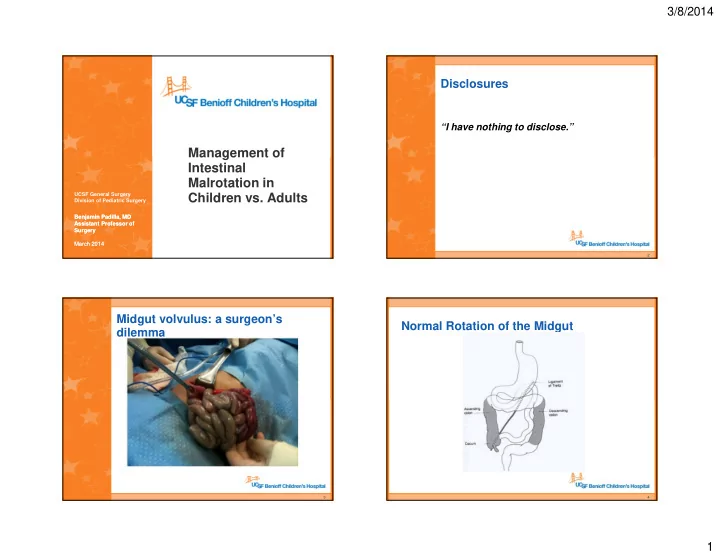
Midgut volvulus: a surgeon’s dilemma

3

Normal Rotation of the Midgut

4

slide-2
SLIDE 2

3/8/2014 2 Normal Rotation of the Midgut

5

“The midgut mesentery is a plane”

Normal Rotation of the Midgut

6

1. Duodenum rotates behind SMA Right colon rotates

  • ver the top of SMA

2.

Normal Rotation of the Midgut

7

Normal Rotation of the Midgut

8

AP Lateral

slide-3
SLIDE 3

3/8/2014 3 Malrotation of the Midgut

9

1. Duodenum fails to cross midline 2. Ladd’s bands form to RUQ

Malrotation of the Midgut

10

AP Lateral

Fulcrum for Midgut Volvulus

11

Fulcrum for Midgut Volvulus

12

Clockwise rotation

  • f the midgut
slide-4
SLIDE 4

3/8/2014 4 Midgut Volvulus

13

AP Lateral

Ladd’s Procedure

14

Ladd’s Procedure

1. Counterclockwise de-torsion of the midgut

– “turn back the hands of time”

2. Divide Ladd’s bands 3. Broaden the midgut mesentery 4. Appendectomy 5. Place the midgut in “non-rotated” configuration

– Small bowel >>> Right – Colon >>> Left – Cecum >>> Hypogastric midline

15

Ladd’s Procedure is Effective

  • 147 patients over 10-year period
  • 38 (26%) post-operative complications
  • 11 (7.5%) reoperation
  • 8 (5.4%) Adhesive SBO
  • 1 (0.7%) Volvulus
  • Laparoscopic vs Open
  • Similar complication rates

16

www.elsevier.com/locate/jpedsurg

Journa l of Pediatric Surgery (2011) 46, 1720–1725

Assessment of recurrent abdominal symptoms after Ladd procedure: clinical and radiographic correlation☆,☆

☆ David M. Biko a,b,⁎, S udha A. Anupindi a, S tephanie B. Hanhan a,c, T hane Blinman d, R ichard I. Markowitza

a

Department of Radiology, The Children's Hospital of Philadelphia, Phildelphia, PA 19104, US A

bDepartment of Radiology, National Naval Medical Center, Bethesda, MD 20889, US

A

cDepartment of Radiology, Jersey S

hore University Medical Center, Neptune NJ 07753, US A

dDepartment of General S

urgery, The Children's Hospital of Philadelphia, Phildelphia, PA 19104, US A
slide-5
SLIDE 5

3/8/2014 5 Age-related Presentation

17

Age at presentation

Nehra and Goldstein. Surgery. 2011 Mar;149(3):386-93.

Age-related Presentation

18

Duration of symptoms by age

Nehra and Goldstein. Surgery. 2011 Mar;149(3):386-93.

Age-related Presentation

19

Presenting symptoms by age

Nehra and Goldstein. Surgery. 2011 Mar;149(3):386-93.

Management of “Asymptomatic” Malrotation

  • Markov decision analysis

Parameters

  • Risk of observation: volvulus,

short gut, death

  • Risk of operation: death

Treatment recommendation

  • QALY gain by either operation
  • r observation

Children: Ladd’s procedure should be considered Adults: The risk of midgut volvulus does not justify prophylactic Ladd’s procedure

20

“ “ “ “QALY gained by elective Ladd’ ’ ’ ’s Procedure” ” ” ”

Malek and Burd. Am J Surg. 2006 Jan;191(1):45-51.

slide-6
SLIDE 6

3/8/2014 6 Summary

  • Intestinal malrotation is the primary risk factor for

midgut volvulus

  • Clinical presentation varies with age
  • Babies: bilious emesis
  • Adult: abdominal pain and obstructive symptoms
  • Ladd’s procedure effectively prevents midgut volvulus
  • All symptomatic patients should have a Ladd’s

procedure

  • “Asymptomatic” malrotation is less concerning with age

21 22

Opening February 1, 2014