
SLIDE 1
CSCE 478/878 Lecture 4: Artificial Neural Networks
Stephen D. Scott (Adapted from Tom Mitchell’s slides)
1
Outline
- Threshold units: Perceptron, Winnow
- Gradient descent/exponentiated gradient
- Multilayer networks
- Backpropagation
- Support Vector Machines
2
Connectionist Models Consider humans:
- Total number of neurons ≈ 1010
- Neuron switching time ≈ 10−3 second (vs. 10−10)
- Connections per neuron ≈ 104–105
- Scene recognition time ≈ 0.1 second
- 100 inference steps doesn’t seem like enough
⇒ much parallel computation Properties of artificial neural nets (ANNs):
- Many neuron-like threshold switching units
- Many weighted interconnections among units
- Highly parallel, distributed process
- Emphasis on tuning weights automatically
Strong differences between ANNs for ML and ANNs for biological modeling
3
When to Consider Neural Networks
- Input is high-dimensional discrete- or real-valued (e.g.
raw sensor input)
- Output is discrete- or real-valued
- Output is a vector of values
- Possibly noisy data
- Form of target function is unknown
- Human readability of result is unimportant
- Long training times acceptable
Examples:
- Speech phoneme recognition [Waibel]
- Image classification [Kanade, Baluja, Rowley]
- Financial prediction
4
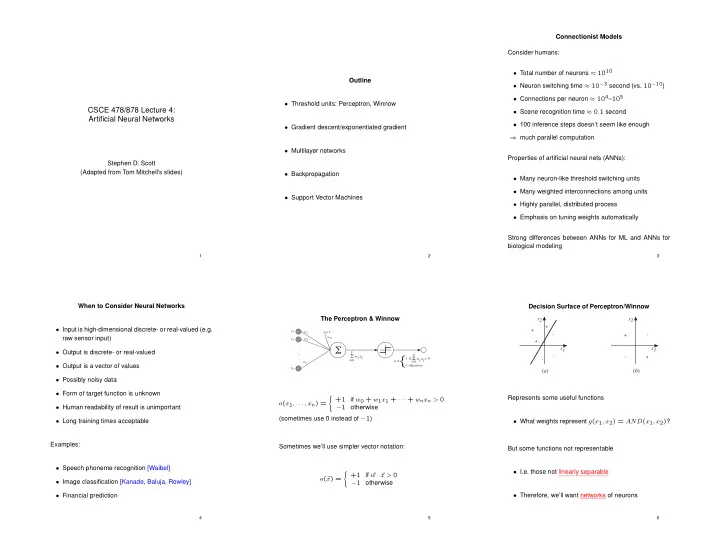
The Perceptron & Winnow
w1 w2 wn w0 x1 x2 xn x0=1. . .
!
! wi xi
n i=0 1 if > 0- 1 otherwise
{
- =
! wi xi
n i=0- (x1, . . . , xn) =
- +1
if w0 + w1x1 + · · · + wnxn > 0 −1
- therwise
(sometimes use 0 instead of −1) Sometimes we’ll use simpler vector notation:
- (
x) =
- +1
if w · x > 0 −1
- therwise
5
Decision Surface of Perceptron/Winnow
x1 x2 + +
- +
- x1
x2
(a) (b)
- +
- +
Represents some useful functions
- What weights represent g(x1, x2) = AND(x1, x2)?
But some functions not representable
- I.e. those not linearly separable
- Therefore, we’ll want networks of neurons
6