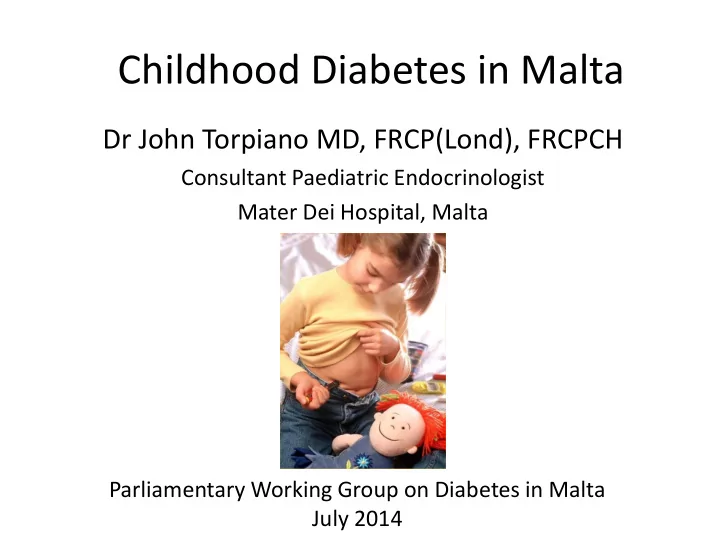
Childhood Diabetes in Malta Dr John Torpiano MD, FRCP(Lond), FRCPCH - - PowerPoint PPT Presentation
Childhood Diabetes in Malta Dr John Torpiano MD, FRCP(Lond), FRCPCH Consultant Paediatric Endocrinologist Mater Dei Hospital, Malta Parliamentary Working Group on Diabetes in Malta July 2014 Types of diabetes in children in Malta 1.7% 1.7%
Types of diabetes in children in Malta
T1DM patients incur higher mean treatment costs than T2DM patients1
1Garattini L 2004
95.5% 1.7% 1.7% 1.1%
T1DM T2DM Wolfram CFRD
Childhood type 1 diabetes
Bad News:
- Cannot be cured permanently
- Cannot be prevented
Good news:
- Improvement in health and quality of life can be achieved
....but we need help
Paediatric Diabetes Service: Mater Dei Hospital Children are NOT small adults
- Run by paediatric endocrinologist since 2006
- Annual case-load:
˗ 650 outpatient appointments (2 clinics per week) ˗ 250 day-case appointments ˗ 25 new patients (on average)
- Detailed education for each new patient (circa 20 hours over 1 week)
- Printed handouts for parents (Maltese & English)
- Point-of-care capillary blood HbA1c (every 2 – 3 months)
- Outreach clinic at Gozo General Hospital
Childhood diabetes statistics in Malta (2006 – 2010)
Age group (years) Mean incidence (per 100,000 per year) Annual increase in incidence 0 – 4 21.7 +39% per year (p = 0.04) 5 – 9 30.4 +31% per year (p = 0.026) 10 – 14 16.1
- 6.5% per year (p = 0.66)
Total (0 – 14) 21.86 21.8%
Circa 25 new patients (under 16 years) every year
Formosa N et al 2012
1 new young patient every 2 weeks
- n average
Childhood type 1 diabetes (0 – 14 years of age) incidence across EU member states (SWEET Project, 2009)
10 20 30 40 50
Finland Sweden United Kingdom Denmark Malta Netherlands Czech Republic Estonia Ireland Germany Luxembourg Belgium France Cyprus Slovakia Austria Portugal Poland Spain Italy Hungary Romania Slovenia Greece Lithuania Bulgaria Latvia
Diabetic children should receive multidisciplinary care
Health care professional Recommended staff level Current staff level Doctor 2 - 3 2 Clinical nurse specialist / educator 1 per 70 children (i.e. 3 for children only) 2 for all diabetics (circa 35,000) in Malta!! Dietician 1 Ad hoc only Psychologist 1 Ad hoc only Social worker Ad hoc Nil Exercise specialist Ad hoc Nil
Blood glucose checks (≥ 4/day) Insulin injections (4/day) Meal planning Physical exercise (45 mins daily)
Therapy of type 1 diabetes A daily juggling act
Long-term uncontrolled diabetes Eye damage (retinopathy) Loss of vision Kidney damage (nephropathy) Kidney failure Nerve damage (neuropathy) Loss of sensation Blood vessel damage Heart disease Stroke Poor circulation
Sequelae in Diabetic Children
- Over 50% develop complications 12 years after diagnosis1
- Life expectancy is reduced (but is improving with time)2
- Better glycaemic control = better quality of life3
1Danne T et al 2007 2Miller RG et al 2012 3Hoey H et al 2001
Modalities of insulin treatment in childhood type 1 diabetes
CONVENTIONAL THERAPY INTENSIVE THERAPY
Twice-daily insulin dosing Multiple doses of insulin (MDI) Continuous subcutaneous insulin infusion (CSII) Insulin injected at 2 times in the day. Insulin injected at 4 times in the day (basal-bolus regimen). Insulin pump. Uses “old-fashioned” isophane insulin. Only effectively possible with insulin glargine. Patient selection. MDT care is crucial. Technical backup is crucial. Least expensive. Slightly more expensive. Very expensive.
Comparison of intensive therapy & conventional therapy: much better results with intensive therapy
Complication Intensive therapy reduces risk by Intensive therapy slows progression by Eye disease 76% 54% Kidney disease 50% 50% Nerve disease 60%
- DCCT Research Group 1993
Measuring glycaemic control in diabetes
SMBG (≥ 4 times/day) HbA1c (every 2 - 3 months)
Higher HbA1c → Increased risk of future complications
Skyler JS 1996
More frequent SMBG, by itself, leads to significant improvement in HbA1c
Levine BS et al 2001 Ziegler R et al 2011
Blood sugar test-strips Free entitlement quota of test-strips Current Ideal (minimum) 50 every 4 weeks 112 every 4 weeks 1.7 per day 4 per day Increased expenditure = €350 per child per year
(1 dialysis patient = €42,000 per year)
Recommendations for improved care of diabetic children
- 1. Increased quota of free blood sugar test-strips (4 per day)
- 2. Reduce restriction on insulin analogues (esp. glargine)
- 3. Many more diabetes nurse specialists
- 4. Improved support for diabetic children at school
- 5. Regular reviews by dietician, psychologist & social worker
Diabetes care for children in Malta can be improved by relatively simple measures Please help us achieve it
References
- The effect of intensive treatment of diabetes on the development and progression of
long-term complications in insulin-dependent diabetes mellitus. The Diabetes Control and Complications Trial Research Group. N Engl J Med. 1993;329(14):977-86.
- Danne T, Kordonouri O. Current challenges in children with type 1 diabetes. Pediatr
- Diabetes. 2007;8 Suppl 6:3-5.
- Formosa N, Calleja N, Torpiano J. Incidence and modes of presentation of childhood
type 1 diabetes mellitus in Malta between 2006 and 2010. Pediatr Diabetes. 2012;13(6):484-8.
- Garattini L, Chiaffarino F, Cornago D, Coscelli C, Parazzini F, Diabete SGRREdCeRd.
Direct medical costs unequivocally related to diabetes in Italian specialized centers. Eur J Health Econ. 2004;5(1):15-21.
- Hoey H, Aanstoot HJ, Chiarelli F, Daneman D, Danne T, Dorchy H, et al. Good
metabolic control is associated with better quality of life in 2,101 adolescents with type 1 diabetes. Diabetes Care. 2001;24(11):1923-8.
- Levine BS, Anderson BJ, Butler DA, Antisdel JE, Brackett J, Laffel LM. Predictors of
glycemic control and short-term adverse outcomes in youth with type 1 diabetes. J
- Pediatr. 2001;139(2):197-203.
- Miller RG, Secrest AM, Sharma RK, Songer TJ, Orchard TJ. Improvements in the life
expectancy of type 1 diabetes: the Pittsburgh Epidemiology of Diabetes Complications study cohort. Diabetes. 2012;61(11):2987-92.
- Skyler JS. Diabetic complications. The importance of glucose control. Endocrinol Metab
Clin North Am. 1996;25(2):243-54.
- Ziegler R, Heidtmann B, Hilgard D, Hofer S, Rosenbauer J, Holl R, et al. Frequency of
SMBG correlates with HbA1c and acute complications in children and adolescents with type 1 diabetes. Pediatr Diabetes. 2011;12(1):11-7.