Classification Species of Organisms 13 billion known species of - PowerPoint PPT Presentation
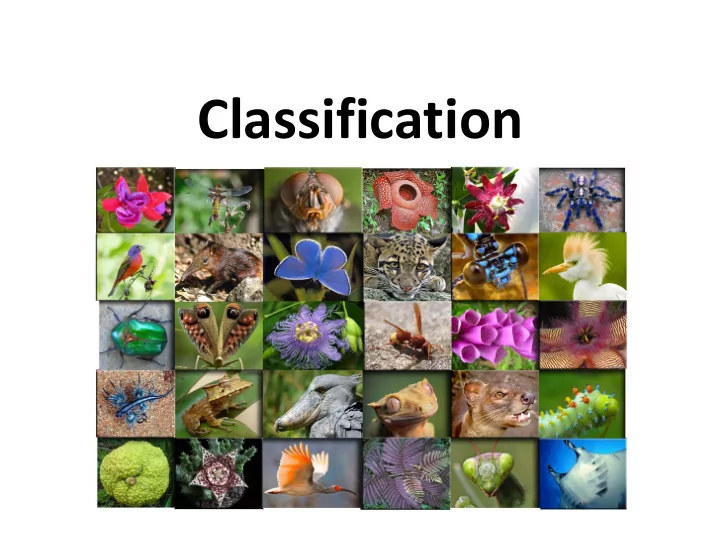
Classification Species of Organisms 13 billion known species of organisms This represents only 5% of all organisms that have ever lived on Earth New organisms are still being found and identified where? What is classification?
Classification
Species of Organisms • 13 billion known species of organisms • This represents only 5% of all organisms that have ever lived on Earth • New organisms are still being found and identified – where?
What is classification? • Classification is the arrangement of organisms into orderly groups based on their similarities • Also known as taxonomy • Taxonomists are scientists that identify and name organisms
Benefits of Classifying Organisms • Accurately and uniformly names organisms • Prevents misnomers Example: Starfish and jellyfish are NOT fish • Uses the same language (mostly Latin) for all names
Using Different Languages for Names
Latin Names Minimize Confusion
Early Taxonomists
Aristotle • The first taxonomist (2000 years ago) • Divided organisms into plants and animals • Further subdivided them by their habitat – land, sea or air dwellers
John Ray • John Ray (botanist) was the first to use Latin for naming organisms • Names consisted on very long descriptions telling many details about the plant
Carolus Linnaeus “Father of Taxonomy” • 18 th century taxonomist (1707-1778) • Classified organisms by their structure • Developed the modern system of naming organisms known as binomial nomenclature – Two word name consisting of the genus and species
Binomial Nomenclature • Genus species ( capitalize genus, but NOT species) • Species are identified by their common name and scientific name • International Code for Binomial Nomenclature – rules for naming Turdus American Robin migratorius
Binomial Nomenclature • Which two bears are most closely related?
Classification Groups • Taxon (taxa-plural) is a category into which related organisms are placed • Hierarchy of groups (taxa) from broadest to most specific
Red Fox
Mnemonic Device • D readful • K ing • P hilip • C ame • O ver • F or • G ood • S oup
Basis for Modern Taxonomy • Classification is based on evolutionary relationships • Homologous structures (same internal structure, different function), similar embryonic development, and molecular similarities in DNA, RNA, amino acid sequences or proteins
Homologous Structures
Cladogram
Rhesus Human Chimpanzee Monkey • Animalia • Animalia • Animalia • Chordata • Chordata • Chordata • Mammalia • Mammalia • Mammalia • Primates • Primates • Primates • Hominidae • Hominidae • Cercopithecidae • Homo • Pan • Macaca • H. sapien • P. troglodytes • M. mulatta
Dichotomous Keying • Used to identify organisms • Identifying characteristics are given in pairs • Read both characteristics and either go to another set of characteristics OR identify the organism Let’s Try It!
Recommend
More recommend
Explore More Topics
Stay informed with curated content and fresh updates.