
SLIDE 1
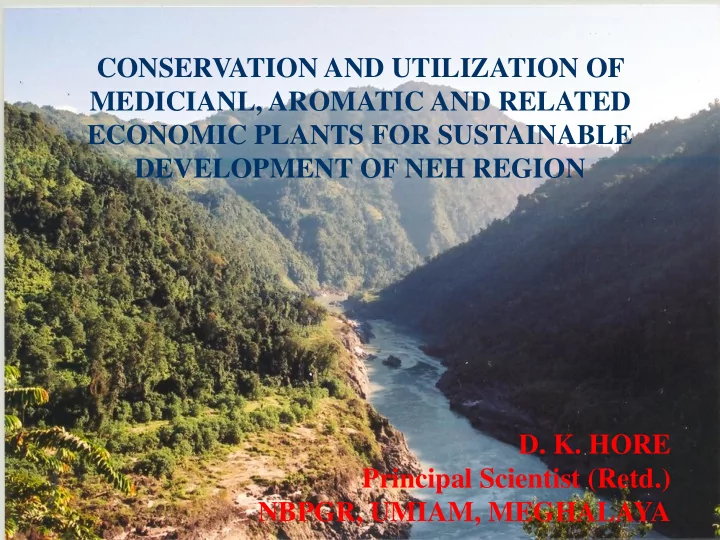
CONSERVATION AND UTILIZATION OF MEDICIANL, AROMATIC AND RELATED ECONOMIC PLANTS FOR SUSTAINABLE DEVELOPMENT OF NEH REGION
- D. K. HORE
Principal Scientist (Retd.) NBPGR, UMIAM, MEGHALAYA
CONSERVATION AND UTILIZATION OF MEDICIANL, AROMATIC AND RELATED - - PowerPoint PPT Presentation
CONSERVATION AND UTILIZATION OF MEDICIANL, AROMATIC AND RELATED ECONOMIC PLANTS FOR SUSTAINABLE DEVELOPMENT OF NEH REGION D. K. HORE Principal Scientist (Retd.) NBPGR, UMIAM, MEGHALAYA NORTH EAST INDIA STATES : 8 DISTRICTS : 72
CONSERVATION AND UTILIZATION OF MEDICIANL, AROMATIC AND RELATED ECONOMIC PLANTS FOR SUSTAINABLE DEVELOPMENT OF NEH REGION
Principal Scientist (Retd.) NBPGR, UMIAM, MEGHALAYA
NORTH EAST INDIA STATES : 8 DISTRICTS : 72 VILLAGES : 9945 FLORISTIC : 43% of Total PERCENTAGE Indian flora
PHYSIOGRAPHY ENVIRONMENT-BASED ON CLIMATE AND ALTITUDE
: (0 – 500m)
: (2000 – 3000m)
TREND IN TEMP. & RAINFALL
World Health Organization (WHO)
Medicinal Plant Species World :20,000 India :2,500 Documented :7,500 Frequently used in ISM & H :1,100 Commonly used in Ayurveda :500 No. of units engaged in manufacturing plant based drugs :700 (covering around 14,000 recipes)
BASIC FACTS ON MEDICINAL PLANTS IN NE REGION
i) Percentage of Indian flora in NE Region
: 43 %
ii) Medicinal plant species in forest areas
: 70 %
iii) Remaining in non-forest land
: 30 %
iv) Harvested for marketing
: 5 %
v) Threatened medicinal plant species
: 10 %
COMPONENT OF USEFUL MEDICINAL
AND AROMATIC PLANT AT DIFFERENT ENVIRONMENT Tropical : Adhatoda vesica; Andrographis paniculata; Aquillaria agallocha; Centella asiatica; Dioscorea alata; Ocimum basilicum; Plantago erosa; Withania somnifera; Vitex negundo; Paedaria foetida; Cryptolepis buchanani; Acorus calamus.
Subtropical : Artemisia maritime; Hydnocarpus kurzii; Lavendula vera; Litsea cubeba; Mucuna pruriens; Pogostemon calelin; Zanthoxylum armatum; Curcuma caesia; Leonotis nepetaefolia.
Plants of Leonotis nepaetifolia R. Br.
Clerodendron colebrookianum – A medicinal plant
Temperate : Coptis teeta; Geranium nepalensis; Panax pseudoginseng; Swertia chirata; Picrorrhiza kurooa; Satyrium nepalensis; Rubia cordifolia; Taxus baccata, Orchis latifolia.
Alpine : Aconitum ferox; A. heterophyllum; Illicium griffithii; Berberis spp.; Podophyllum hexandrum; Rheum emodi; Delphinium subulatum.
Rheum emodi – A high altitude medicinal plant
WHY CULTIVATE MEDICINAL PLANTS To ease pressure on natural resources To make available fresh, genuine and quality raw material for manufacturing of standardized and efficacious drugs To evolve better strains and high yielding crops of medicinal plants through improvement programmes and tissue culture techniques To check the use of spurious substitutes and adulterants which have resulted in the deterioration of the standard of drugs of ISM To standardize the collection, storage and post harvest technology for medicinal plants To provide regular and alternative source of income to the farmers for amelioration of their economic conditions For introduction and domestication of useful exotic drug plants to minimize import and maximize export To conserve the biological and genetic diversity in medicinal plants for the posterity.
ETHNIC KNOWLEDGE: DIVERSE USES IN HEALTH CARE Uses Number
Uses Number
Anti Fertility 18 Blood Cholesterol 16 Stress Control 17 Anti Bacterial 26 Cardio Vascular 17 Anti Viral 11 Hypertension 21 Anti Protozoal 13 Blood Sugar Control 25 Anti Fungal 9 Respiratory Diseases 33 Galactogogue 10 Liver Function 33 Anti Ageing 10 Gastro Intestinal Disorder 40 Analgesic 18 Urinogenital Disorder 26 Vitality Enhancer 30 Anti Cancer 21
PROPAGATION TECHNIQUES
parts (Roots, Cuttings, Sucker, Corm, Rhizome, Bulb).
tissue culture
EXAMPLES OF MEDICINAL PLANTS PROPAGATED THROUGH SEED
EXAMPLES OF MEDICINAL PLANTS PROPAGATED THROUGH CUTTINGS
§ Dichroa febrifuga Lour. § Artemisia maritime Linn. § Cryptolepis buchanani Roem. & Schult.
EXAMPLES OF MEDICINAL PLANTS PROPAGATED THROUGH SPECIALIZED STRUCTURES
§ Alisma aquatica Linn. (suckers) § Caladium bicolor Vent. (suckers) § Kyllingia nemoralis J.R. & G. Frost (suckers) § Potentilla sundaica (Bl.) O. Kuntz. (suckers) § Alpinia galanga (rhizome) § Coptis teeta Wall. (rhizome) § Dioscorea alata Linn.(tubers) § Campylandra aurantiaca Baker (bulb)
Plants of Curcuma caesia Rhizomes of Curcuma caesia
Kaempfaria galanga – an important medicinal plant
POTENTIAL SCOPE FOR CULTIVATION
80% people from developing countries depend
herbal medicine. 25% medicines are plant derived drugs (Fransworth & Soejarto, 1991)
_________________________________________________________________
World Trade : $ 70 billion (US) Growth rate : 7% per annum (Gera et al., 2003).
_________________________________________________________________
NE REGION 120 Species of Medicinal plant
COMMERCIAL IMPORTANCE
Pharmaceutical Industry 1) Rouvolfia serpentina 2) Dioscorea deltoidea 3) Curcuma spp. 4) Withania somnifera 5) Acorus calamus
ANTIFERTILITY DRUGS
1) Berberis aristata 2) Picrrorrhiza kurroa 3) Artemisia maritima 4) Aconitum ferox 5) Podophyllum hexandrum ANTIMALARIAL PROPERTY 1) Coptis teeta
AROMATIC PLANTS
Agar – Aquillaria agallocha Patchouli – Pogostemon patchouli Palmarosa – Cymbopogon martinii Mint – Mentha spp. Vetiver – Vetiveria zizanoides Geranium oil – Pelargonium graveolens (Rose scented) Tezpat – Cinnamomum tamala
STATUS OF CULTIVATION
Arunachal Pradesh : State Forest Department; CSIR stations; BSI field station; various NGO’s at Roing, Itanagar, Chowkham, Ziro, Dirang, Lohit (Bordumsa). Assam : Assam Valley Agotech Pvt. Ltd.; NEDFi at Khetri; RRC (Ayurveda); Gauhati University; various organisations at Golaghat, Dhemaji Districts.
Meghalaya : BSI, Shillong; NBPGR, Umiam; Biochemistry Deptt. (NEHU); Forest Deptt.; Herbalists at Smit, Nongstoin. Tripura : State Forest Department. Mizoram : State medicinal plants Board; Mizoram Univ. (School of Forestry).
‘Dikki-ka-thong’ (IC-204263) – rhizome used in lung & liver ailments
Nagaland : SASRD, Medziphema. Sikkim : BSI Circle; GBPHED; NGO at North Sikkim. Manipur : No specific information available.
ISSUES AND SUGGESTIONS
medicinal plants. It should be market driven demand.
endangered species.
Agrotechnique for wild medicinal plant species which are not known
insufficiently known.
production →Cooperative marketing →Industry linkages → viable system for steady supply and utilisation.
techniques for value added products.
technical knowledge) issues.
MARKETING BOTTLENECKS Lack of regulated market for raw materials Middleman and pharmatuetical industry keeps hold on the market price. Random extraction from the wild habitat, which declines the market price Buy back policy should be introduced at government level
CONSERVATION STRATEGIES
Field gene bank Seed gene bank In – vitro conservation Cryopreservation for recalcitrant seeds
GENE BANK SEED STORAGE
Sl. No. Type of Conservation Temperature (oC) Relative Humidity Longevity (years) 1. 2. 3. Short term Medium term Long term 18-19 7-8
50 40 37 3-5 25-40 50-100
ISSUES ON IPR AND GERMPLASM MANAGEMENT
matter of biopiracy.
about the IPR issues at grassroot level.
Biological diversity including genetic diversity shall be conserved, enhanced and sustainability used. Patents and other IPRs shall be supportive of and not run counter to this objective Access to genetic resources shall be subject to prior informed consent. Where granted, access shall be on mutually agreed terms Benefits arising from the commercial and other utilization of genetic resources shall be shared in a fair and equitable way upon mutually agreed terms, multilaterally or on a bilateral basis
OPTION AND ADOPTION OF SUI- GENERIS SYSTEM HELPS THE REGION Conservation of biodiversity Protection of traditional and indigenous knowledge Equitable system of benefit sharing, technology transfer and proper rewards