
SLIDE 1
Capacity-building workshop for Latin America and the Caribbean
- n achieving Aichi Biodiversity Targets 11 and 12
- Dr. Thora Amend
Curitiba, Oct.2015
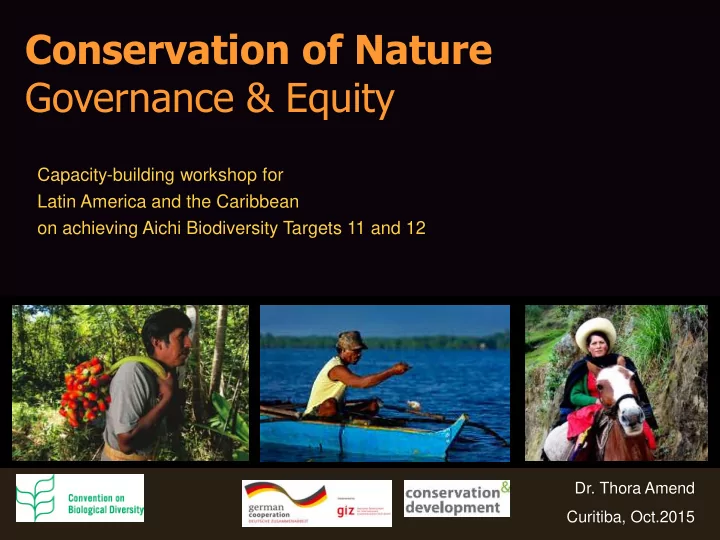
Conservation of Nature Governance & Equity Capacity-building - - PowerPoint PPT Presentation
Conservation of Nature Governance & Equity Capacity-building workshop for Latin America and the Caribbean on achieving Aichi Biodiversity Targets 11 and 12 Dr. Thora Amend Curitiba, Oct.2015 Why governance? organized by IUCN, once
Capacity-building workshop for Latin America and the Caribbean
Curitiba, Oct.2015
world's largest gathering of conservationists
more than 6,000 participants of 170 countries (park rangers, NGO workers, activists but also politicians and business representatives) discuss the future of the Earth's protected areas
Why governance? Why now?
Sydney, Nov.2014
8 streams Stream 6: Enhancing the Diversity & Quality of Governance 4 cross cutting themes: Capacity Development, Marine, World Heritage, New Social Compact
Why governance? Why now?
Sydney, Nov.2014
Why governance? Why now?
Two-thirds of the world's land occupied, used, or owned by indigenous communities and 80 percent of global biodiversity present in those lands
the conservation community needs to build partnerships with traditional communities to enhance and preserve natural areas.
In Durban, South Africa, at WPC 2003 Nelson Mandela, said:
"I see no future for parks unless they address the needs of communities as equal partners in their development.”
Mandela condemned unequal distribution of benefits and costs, and set
and local communities are respected and protected.
Sydney reasserted that message.
linear conections between protected areas = biological / ecological corridors PA’s embedded in landscape with different types and intensities of resource use
Isolated protected areas Conservation areas with buffer zones around them PA as a “blind spot” in regional context – no mandate / no perceived connection with development agenda PA as service provider (ecosystem services) PA expected to generate income via payment for ecosystem services (i.e. water, tourism, carbon storage)
$ $ $
PA’s “claimed” by local and regional stakeholders, as part
development rights
from PA islands to conservation landscapes development perspective: from segregation to integrated territorial perceptions
I plan, you plan, we all make plans…..
elaborate strategic plans for areas with conservation value, as part of regional development
Planning for one player who holds all the powers?
new roles and mandates for PA staff Why governance? Why now?
planned and managed against local people run by central government “set aside” from mainstream concerns developed individually managed as “islands” designed and managed as part of national & international systems designed & managed at landscape scale run with, for and - in some cases – by local people run by many partners identified as essential for sustainable ecosystem services.
As it was – protected areas have been: As it is becoming – protected areas:
Inspired by: A. Phillips 2002 + 2014
Why governance? Why now?
As it was – protected areas have been:
established for biodiversity conservation focus on preservation and protection managed reactively within short term frameworks financed by the state
As it is becoming – protected areas:
in line with principles of CBD „s most relevant tool: Ecosystem Approach
are in addition, linked with a range of development objectives focus also on rehabilitation and restoration are managed adaptively in a longer term perspective are financed from diverse sources
Inspired by: A. Phillips 2002 + 2014
Why governance? Why now?
http://www.marn.gob.sv/index.php?option=com_content&view=article&catid=162:especiales&id=699:areas-naturales-protegidas-con-un-nuevo-modelo-de-gestion-inclusiva
“Áreas Naturales Protegidas con un nuevo modelo de gestión inclusiva”
El Salvador. Ministerio de Medio Ambiente y Recursos Naturales (MARN).
Viernes, 17 de Diciembre de 2010 En este nuevo modelo se incluye una plena integración en la gestión del Parque, de las comunidades locales y de otros actores de la zona de influencia, en particular el gobierno local y los propietarios de terrenos privados colindantes. Los cambios sustanciales de este modelo de gestión fortalecerán la cultura ambiental de la población y su inclusión en el manejo y aprovechamiento de estas áreas, sin dejar de lado la preservación de los recursos naturales. Su implementación ha requerido la articulación de los derechos y deberes de cada actor bajo una visión compartida. Este esquema de gobernanza territorial busca obtener alternativas conjuntas que permiten lograr un balance adecuado entre la conservación y el uso sostenible de los ecosistemas. Ante este nuevo reto, la consolidación del Sistema Nacional de Áreas Protegidas viene a ser un elemento central del actual Plan Estratégico del Ministerio, al reconocer la importancia que juega este Sistema en la conservación y en la consecuente provisión de servicios ecosistémicos (agua, mitigación de los efectos del cambio climático, protección del suelo, ecoturismo, espacios para realizar investigaciones científicas y de estudio, entre otros).
Conservation needs to pay more attention to the crucial ties between biological and cultural diversity, and to the conditions that allow communities to be empowered for conservation
Conservation needs equity: a fair sharing of the costs and benefits of preserving biodiversity and managing natural resources in a sustainable way Conservation needs to respect human rights: “do no harm”…& have a positive impact
Why governance? Why now?
Why? Implementation of CBD Programme of Work on Protected Areas (PoWPA) is lagging behind in the area governance, participation, equity, and benefit sharing
„Governance of Protected Areas – From understanding to action“
IUCN Best Practice Guidelines No. 20
http://www.iucn.org/pa_governance
So, what is governance?
The interactions among structures, processes and traditions that determine how power and responsibilities are exercised, how decisions are taken, and how citizens or other stakeholders have their say.
(Graham et al., 2003)
Why governance? Why now?
consent (FPIC)
“Good Governance“
Why governance? Why now?
and how we do it…
management effectiveness
equity, accountability, ...
“good governance”
http://www.WWF.org
Governance – key terms
Governance – key terms
Rights-holders = actors socially endowed with legal or customary rights with respect to land, water and natural resources. Stakeholders = possess direct or indirect interests and concerns, but do not necessarily enjoy a legally or socially recognised entitlement.
http://press.anu.edu.au/wp-content/uploads/2015/02/CHAPTER7.pdf
Aspects to take into account: various types of powers that the key actors apply when they take and implement decisions (i.e. regulatory, financial, related to knowledge or related to coercion) scale of decision-making and operations (i.e. local, at ecosystem level, national, trans-boundary, international)
Governance – key terms
Governance – key terms
G
https://portals.iucn.org/library/sites/library/files/documents/2014-033.pdf
Governance is appropriate
specific context and effective in delivering lasting conservation results, livelihood benefits and the respect of rights. Diversity of governance
institution...
government
government structures at sub- national and municipal levels
private operators
Decision making authority, responsibility and accountability held and exercised by government (at various levels)
Diversity of governance
Decision making authority, responsibility and accountability shared between governmental agencies and other stakeholders (in particular the relevant landowners and the indigenous peoples and local communities - sedentary or mobile - who depend on the natural resources culturally and/or for their livelihoods)
plurality of actors
mutual recognition, collective interests
need for negotiation compromise/ consensus
reaching an agreement
and institutions Diversity of governance
https://portals.iucn.org/library/ efiles/documents/2006-010.pdf
Mechanisms and incentives:
voluntary protected area designations
management of an area for conservation
Corporations (companies, shareholders)
Non-governmental organisations (private or semi-private, religious, researching, teaching and training) Diversity of governance
livelihoods and conservation linked Diversity of governance
Three essential characteristics of ICCAs:
1.
an indigenous people or local community possesses a close and profound relation with a site
2.
the people or community is the major player in decision-making and has de facto and/or de jure capacity to develop and enforce regulations
3.
the people‟s or community‟s decisions and efforts lead to the conservation of biodiversity, ecological functions and associated cultural values
adapted from: Borrini-Feyerabend & Hill, in IUCN 2015 http://press.anu.edu.au/wp-content/uploads/2015/02/CHAPTER7.pdf
Governance Type
Government
Peoples & Community Governance
IUCN Category (management
Federal or national ministry or agency Sub- national ministry or agency in charge Governm delegated manage- ment (e.g. to an NGO) Trans- boundary gover-nance Collaborativ
e
manageme nt (various forms of pluralist influence) Joint manageme nt (pluralist governing body) Conserved area established and run by individual land-owner …by non- profit
tion (e.g. NGO, university etc.) …by for- profit
n (e.g. corporate land-
Indigenous peoples’ conserved areas & territories - established and run by indigenous peoples Community conserved areas and territories - established and run by local communities
I - Strict Nature Reserve/ Wilderness Area II -National Park (ecosystem protection & associated cultural values) III – Natural Monument IV – Habitat/ Species Management V – Protected Landscape/ Seascape VI – Managed Resource
Working with the PA governance matrix – Madagascar 2003 and 2013
Diversity of governance
Diversity of governance
http://www.iccaconsortium.org/
Legitimacy and voice
Direction
Performance
Accountability
Fairness and rights
Governance quality
please send to Sarat & Leah by 30th of October !
foster social and ecological resilience in times of multiple challenges
thora.amend@gmx.net