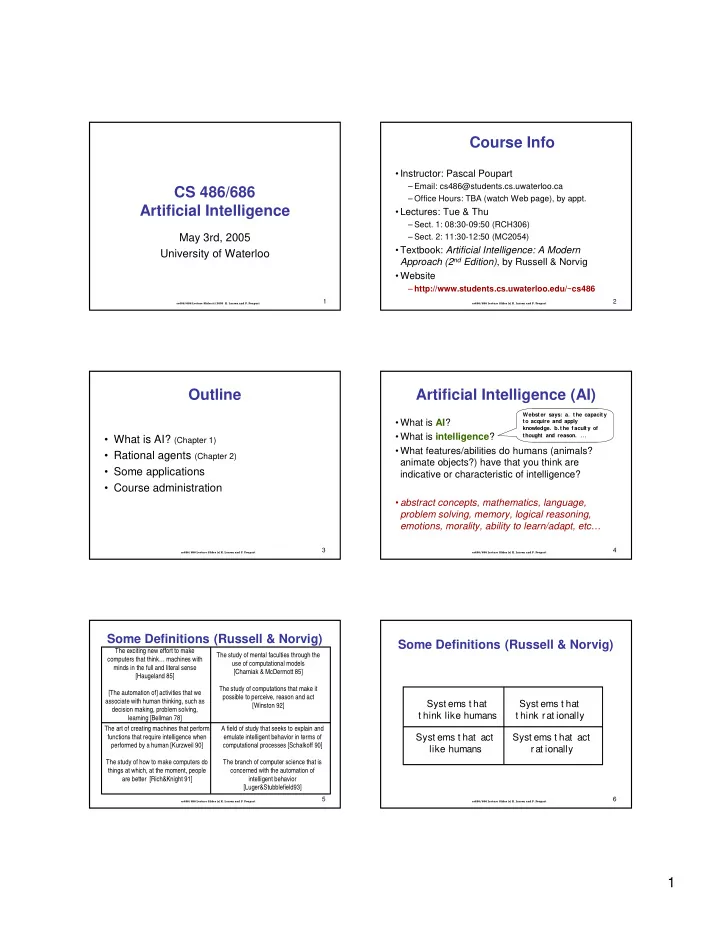
Course Info Instructor: Pascal Poupart Email: - - PDF document

course info
SMART_READER_LITE
LIVE PREVIEW

Course Info Instructor: Pascal Poupart Email: - - PDF document

Course Info Instructor: Pascal Poupart Email: cs486@students.cs.uwaterloo.ca CS 486/686 Office Hours: TBA (watch Web page), by appt. Artificial Intelligence Lectures: Tue & Thu Sect. 1: 08:30-09:50 (RCH306) May 3rd,


slide-1
SLIDE 1

1

cs486/686 Lecture Slides (c) 2005 K. Larson and P. Poupart

1

CS 486/686 Artificial Intelligence

May 3rd, 2005 University of Waterloo

cs486/686 Lecture Slides (c) K. Larson and P. Poupart

2

Course Info

  • Instructor: Pascal Poupart

– Email: cs486@students.cs.uwaterloo.ca – Office Hours: TBA (watch Web page), by appt.

  • Lectures: Tue & Thu

– Sect. 1: 08:30-09:50 (RCH306) – Sect. 2: 11:30-12:50 (MC2054)

  • Textbook: Artificial Intelligence: A Modern

Approach (2nd Edition), by Russell & Norvig

  • Website

– http://www.students.cs.uwaterloo.edu/~cs486

cs486/686 Lecture Slides (c) K. Larson and P. Poupart

3

Outline

  • What is AI? (Chapter 1)
  • Rational agents (Chapter 2)
  • Some applications
  • Course administration

cs486/686 Lecture Slides (c) K. Larson and P. Poupart

4

Artificial Intelligence (AI)

  • What is AI?
  • What is intelligence?
  • What features/abilities do humans (animals?

animate objects?) have that you think are indicative or characteristic of intelligence?

  • abstract concepts, mathematics, language,

problem solving, memory, logical reasoning, emotions, morality, ability to learn/adapt, etc…

Webst er says: a. t he capacit y t o acquire and apply

  • knowledge. b. t he f acult y of

t hought and reason. …

cs486/686 Lecture Slides (c) K. Larson and P. Poupart

5

Some Definitions (Russell & Norvig)

The exciting new effort to make computers that think… machines with minds in the full and literal sense [Haugeland 85] [The automation of] activities that we associate with human thinking, such as decision making, problem solving, learning [Bellman 78] The study of mental faculties through the use of computational models [Charniak & McDermott 85] The study of computations that make it possible to perceive, reason and act [Winston 92] The art of creating machines that perform functions that require intelligence when performed by a human [Kurzweil 90] The study of how to make computers do things at which, at the moment, people are better [Rich&Knight 91] A field of study that seeks to explain and emulate intelligent behavior in terms of computational processes [Schalkoff 90] The branch of computer science that is concerned with the automation of intelligent behavior [Luger&Stubblefield93]

cs486/686 Lecture Slides (c) K. Larson and P. Poupart

6

Some Definitions (Russell & Norvig)

Syst ems t hat t hink like humans Syst ems t hat t hink rat ionally Syst ems t hat act like humans Syst ems t hat act rat ionally

slide-2
SLIDE 2

2

cs486/686 Lecture Slides (c) K. Larson and P. Poupart

7

What is AI?

  • Systems that think like humans

– Cognitive science – Fascinating area, but we will not be covering it in this course

  • Systems that think rationally

– Aristotle: What are the correct thought processes – Systems that reason in a logical manner – Systems doing inference correctly

cs486/686 Lecture Slides (c) K. Larson and P. Poupart

8

What is AI?

  • Systems that behave like humans

– Turing (1950) “Computing machinery and intelligence” – Predicted that by 2000 a computer would have a 30% chance of fooling a lay person for 5 minutes – Anticipated all major arguments against AI in the following 50 years – Suggested major components of AI: knowledge, reasoning, language understanding, learning

cs486/686 Lecture Slides (c) K. Larson and P. Poupart

9

What is AI?

  • Systems that act rationally

– Rational behavior: “doing the right thing” – Rational agent approach

  • Agent: entity that perceives and acts
  • Rational agent: acts so to achieve best outcome

– This is the approach we will take in this course

  • General principles of rational agents
  • Components for constructing rational agents

cs486/686 Lecture Slides (c) K. Larson and P. Poupart

10

Intelligent Assistive Technology

  • Let’s facilitate aging in place
  • Intelligent assistive technology

– Non-obtrusive, yet pervasive – Adaptable

  • Benefits:

– Greater autonomy – Feeling of independence

cs486/686 Lecture Slides (c) K. Larson and P. Poupart

11

COACH project COACH project

  • Automated prompting system to help elderly persons

wash their hands

  • Collaborators: Szymon Wartak, Geoff Fernie, Alex

Mihailidis, Jennifer Boger, Jesse Hoey and Craig Boutilier

cs486/686 Lecture Slides (c) K. Larson and P. Poupart

12

System Overview

sensors hand washing verbal cues planning

slide-3
SLIDE 3

3

cs486/686 Lecture Slides (c) K. Larson and P. Poupart

13

Video Clip #1 Video Clip #1

cs486/686 Lecture Slides (c) K. Larson and P. Poupart

14

Video Clip #2 Video Clip #2

cs486/686 Lecture Slides (c) K. Larson and P. Poupart

15

Topics covered

  • Search

– Uninformed and heuristic search – CSP’s and optimization – Game playing

  • Reasoning under uncertainty

– Probability theory, utility theory and decision theory – Bayesian networks and decision networks – Multi-agent systems

  • Learning

– Decision trees, neural networks, ensemble learning, reinforcement learning

  • Specialized areas

– Natural language processing, computational vision and robotics

cs486/686 Lecture Slides (c) K. Larson and P. Poupart

16

A brief history of AI

  • 1943-1955: Initial work in AI

– McCulloch and Pitts produce boolean model of the brain – Turing’s “Computing machinery and intelligence”

  • Early 1950’s: Early AI programs

– Samuel’s checker program, Newell and Simon’s Logic Theorist, Gerlenter’s Geometry Engine

  • 1956: Happy birthday AI!

– Dartmouth workshop attended by McCarthy, Minsky, Shannon, Rochester, Samuel, Solomonoff, Selfridge, Simon and Newell

cs486/686 Lecture Slides (c) K. Larson and P. Poupart

17

A brief history of AI

  • 1950’s-1969: Enthusiasm and expectations

– Many successes (in a limited way) – LISP, time sharing, Resolution method, neural networks, vision, planning, learning theory, Shakey, machine translation,…

  • 1966-1973: Reality hits

– Early programs had little knowledge of their subject matter

  • Machine translation

– Computational complexity – Negative result about perceptrons - a simple form of neural network

cs486/686 Lecture Slides (c) K. Larson and P. Poupart

18

A brief history of AI

  • 1969-1979: Knowledge-based systems
  • 1980-1988: Expert system industry booms
  • 1988-1993: Expert system busts, AI Winter
  • 1986-present: The return of neural networks
  • 1988-present:

– Resurgence of probabilistic and decision-theoretic methods – Increase in technical depth of mainstream AI – Intelligent agents

slide-4
SLIDE 4

4

cs486/686 Lecture Slides (c) K. Larson and P. Poupart

19

Agents and Environments

environment percept s

act ions

? agent sensors

act uat ors Agent s include humans, robot s, sof t bot s, t hermost at s… The agent f unct ion maps percept s t o act ions f :P* A The agent program runs on t he physical archit ect ure t o produce f

cs486/686 Lecture Slides (c) K. Larson and P. Poupart

20

Rational Agents

  • Recall: A rational agent “does the right thing”
  • Performance measure – success criteria

– Evaluates a sequence of environment states

  • A rational agent chooses whichever action

maximizes the expected value of its performance measure given the percept sequence to date

– Need to know performance measure, environment, possible actions, percept sequence

  • Rationality ≠ Omniscience, Perfection, Success
  • Rationality exploration, learning, autonomy

cs486/686 Lecture Slides (c) K. Larson and P. Poupart

21

PEAS

  • Specify the task environment:

– Performance measure, Environment, Actuators, Sensors

Example: Aut onomous Taxi Perf M: Saf et y, dest inat ion, legalit y… Envir: St reet s, t raf f ic, pedest rians, weat her… Act u: St eering, brakes, accelarat or, horn… Sens: GP S, engine sensors, video… Example: COACH syst em Perf M: t ask complet ion, t ime t aken, amount of int ervent ion Envir: Bat hroom st at us, user st at us Act u: Verbal prompt s, CallCaregiver, DoNot hing Sens: Video cameras, microphones, t ap sensor

cs486/686 Lecture Slides (c) K. Larson and P. Poupart

22

Properties of task environments

  • Fully observable vs. partially observable
  • Deterministic vs. stochastic
  • Episodic vs. sequential
  • Static vs. dynamic
  • Discrete vs. continuous
  • Single agent vs. multiagent

Hardest case: Part ially observable, st ochast ic, sequent ial, dynamic, cont inuous and mult iagent . (Real world)

cs486/686 Lecture Slides (c) K. Larson and P. Poupart

23

Examples

Multiagent Multiagent Multiagent Single agent Continuous Discrete Discrete Discrete Dynamic Dynamic Static Static Episodic Sequential Sequential Sequential Stochastic Stochastic Stochastic Deterministic Partially Observable Partially Observable Fully Observable Fully Observable Taxi Internet Shopping Backgammon Solitaire

cs486/686 Lecture Slides (c) K. Larson and P. Poupart

24

Many Applications

  • credit card fraud detection
  • printer diagnostics, help in Windows, spam filters
  • medical diagnosis, teleoperated/micro surgery
  • information retrieval, Google
  • TAC (Trading Agent Competition)
  • scheduling, logistics, etc.
  • aircraft, pipeline inspection
  • speech understanding, generation, translation
  • Mars rovers
  • and, of course, cool robots
slide-5
SLIDE 5

5

cs486/686 Lecture Slides (c) K. Larson and P. Poupart

25

Mobile Robotics

cs486/686 Lecture Slides (c) K. Larson and P. Poupart

26

Next Class

  • Uninformed search
  • Chapter 3 (Russell & Norvig)