Covid-19 Litigation Outline Introduction Robert Sumner I. a. Butler - - PDF document

covid 19 litigation outline introduction robert sumner i
SMART_READER_LITE
LIVE PREVIEW

Covid-19 Litigation Outline Introduction Robert Sumner I. a. Butler - - PDF document

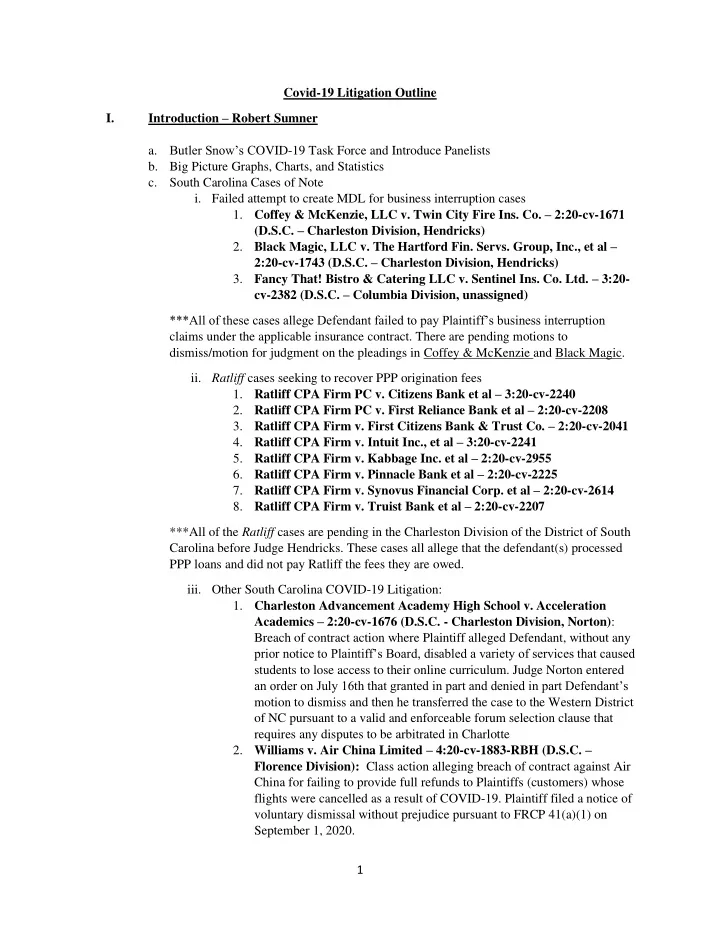
Covid-19 Litigation Outline Introduction Robert Sumner I. a. Butler Snows C OVID-19 Task Force and Introduce Panelists b. Big Picture Graphs, Charts, and Statistics c. South Carolina Cases of Note i. Failed attempt to create MDL for business


slide-1
SLIDE 1

1 Covid-19 Litigation Outline I. Introduction – Robert Sumner

  • a. Butler Snow’s COVID-19 Task Force and Introduce Panelists
  • b. Big Picture Graphs, Charts, and Statistics
  • c. South Carolina Cases of Note
  • i. Failed attempt to create MDL for business interruption cases
  • 1. Coffey & McKenzie, LLC v. Twin City Fire Ins. Co. – 2:20-cv-1671

(D.S.C. – Charleston Division, Hendricks)

  • 2. Black Magic, LLC v. The Hartford Fin. Servs. Group, Inc., et al –

2:20-cv-1743 (D.S.C. – Charleston Division, Hendricks)

  • 3. Fancy That! Bistro & Catering LLC v. Sentinel Ins. Co. Ltd. – 3:20-

cv-2382 (D.S.C. – Columbia Division, unassigned) ***All of these cases allege Defendant failed to pay Plaintiff’s business interruption claims under the applicable insurance contract. There are pending motions to dismiss/motion for judgment on the pleadings in Coffey & McKenzie and Black Magic.

  • ii. Ratliff cases seeking to recover PPP origination fees
  • 1. Ratliff CPA Firm PC v. Citizens Bank et al – 3:20-cv-2240
  • 2. Ratliff CPA Firm PC v. First Reliance Bank et al – 2:20-cv-2208
  • 3. Ratliff CPA Firm v. First Citizens Bank & Trust Co. – 2:20-cv-2041
  • 4. Ratliff CPA Firm v. Intuit Inc., et al – 3:20-cv-2241
  • 5. Ratliff CPA Firm v. Kabbage Inc. et al – 2:20-cv-2955
  • 6. Ratliff CPA Firm v. Pinnacle Bank et al – 2:20-cv-2225
  • 7. Ratliff CPA Firm v. Synovus Financial Corp. et al – 2:20-cv-2614
  • 8. Ratliff CPA Firm v. Truist Bank et al – 2:20-cv-2207

***All of the Ratliff cases are pending in the Charleston Division of the District of South Carolina before Judge Hendricks. These cases all allege that the defendant(s) processed PPP loans and did not pay Ratliff the fees they are owed.

  • iii. Other South Carolina COVID-19 Litigation:
  • 1. Charleston Advancement Academy High School v. Acceleration

Academics – 2:20-cv-1676 (D.S.C. - Charleston Division, Norton): Breach of contract action where Plaintiff alleged Defendant, without any prior notice to Plaintiff’s Board, disabled a variety of services that caused students to lose access to their online curriculum. Judge Norton entered an order on July 16th that granted in part and denied in part Defendant’s motion to dismiss and then he transferred the case to the Western District

  • f NC pursuant to a valid and enforceable forum selection clause that

requires any disputes to be arbitrated in Charlotte

  • 2. Williams v. Air China Limited – 4:20-cv-1883-RBH (D.S.C. –

Florence Division): Class action alleging breach of contract against Air China for failing to provide full refunds to Plaintiffs (customers) whose flights were cancelled as a result of COVID-19. Plaintiff filed a notice of voluntary dismissal without prejudice pursuant to FRCP 41(a)(1) on September 1, 2020.

slide-2
SLIDE 2

2

  • 3. Mackie v. Coconut Joe’s IOP LLC – 2:20-cv-02562 (D.S.C. –

Charleston Division, Norton): Class action where Plaintiff alleges he and others similarly situated were terminated in violation of the Families First Coronavirus Response Act (FFCRA). Plaintiff also alleged Defendant violated the minimum wage provisions of the FLSA. Essentially, according to Plaintiff, he alleged he had COVID-19 symptoms while at work, left to go get tested, and was terminated for leaving without permission. Answer has been filed, but no pending motions.

  • 4. Peay and Associates, LLC v. First Community Bank et al – 6:20-cv-

2651 (D.S.C. – Greenville Division, Cain): Class action alleging Defendants failed to pay mandated agent fees to Plaintiff, who were assisting clients with submitting applications to obtain PPP loans under the CARES Act. This case is before Judge Cain and there is a pending motion to remand that has not yet been ruled on.

  • 5. Hope Clinic LLC et al v. Heartwise Clinic LLC – 2:20-cv-2051

(D.S.C. – Charleston Division, Hendricks): Litigation arose out of dispute between a testing facility and a corporation that provided the testing materials and ran the back-end logistics for Plaintiff. Before Judge Hendricks could rule on the pending motion for a preliminary injunction, the case settled and Judge Hendricks entered an order dismissing the case.

  • 6. Taylor v. Charleston Southern University – 2:20-cv-2731 (D.S.C. –

Charleston Division, Hendricks): Class action alleging breach of contract, unjust enrichment, and conversion seeking reimbursement for tuition fees and other costs Plaintiffs paid for to attend Charleston Southern for the Spring 2020 academic semester. Case arose after Charleston Southern cancelled all in-person classes and closed its physical campus on March 18, 2020 following the spread of COVID-19. There is a pending motion to dismiss and a pending motion to remand; no substantive orders have been entered yet.

  • d. Potential Developments in South Carolina
  • i. Real Estate Litigation
  • 1. Commercial Landlord-Tenant Leasing Litigation
  • 2. Commercial Loan Foreclosure Litigation
  • 3. Commercial Mortgage Backed Security (CMBS) Litigation

II. Employment Considerations – Tim Lindsay

  • a. NLRA Issues
  • i. Concerted Activity
  • 1. Employees express safety concerns
  • ii. Bargaining Obligations
  • 1. Changes in workplace conditions
  • b. OSHA Issues
  • i. General Rule: providing safe work environment
  • ii. CDC Guidelines
  • iii. Preparing a COVID policy/rule
slide-3
SLIDE 3

3

  • iv. http://www.scosha.llronline.com/coronavirus.aspx
  • c. WARN Act
  • i. 60-day notice requirement
  • 1. Unforeseeable circumstances
  • ii. Business Closure or Layoffs vs. Furloughing Employees
  • d. Litigation Issues
  • i. FFCRA and FMLA
  • ii. DOL Final Rule - State of New York v. U.S. Dept. of Labor, Case No. 20-cv-

3029 (S.D.N.Y. August 3, 2020).

III. Legislation – Kat Carrington

  • a. Federal
  • i. HHS PREP Act Declaration
  • 1. “Recommended Activities”
  • 2. “Covered countermeasures”
  • 3. “Covered persons”
  • ii. Immunity afforded by the PREP Act
  • 1. Suit and liability under federal and state law
  • 2. All claims for “loss” concerning
  • 3. Administration to or use by an individual of a “Covered

Countermeasure”

  • a. Exception: Willful Misconduct
  • b. “Loss” = Death, Personal Injury (physical, mental, emotional),

fear of personal injury, property damage, business interruption loss

  • iii. Senate Bill 4317 – SAFE TO WORK Act (introduced 7/27/20)
  • 1. Purpose = “To lessen burdens on interstate commerce by discouraging

insubstantial lawsuits relating to COVID-19 while preserving the ability

  • f individuals and businesses that have suffered real injury to obtain

complete relief”

  • 2. Who is covered?
  • a. Businesses, services, activities, or accommodations touching on

interstate or foreign commerce, governmental entities, health care providers, and individuals related thereto (employees,

  • fficers, agents, etc.)
  • 3. Protection from what?
  • a. Claims of personal injury or risk of personal injury caused by

actual, alleged, feared, or potential exposure to coronavirus

  • i. Unless:
  • 1. Defendant made no reasonable efforts to comply

with government guidance;

  • 2. Gross negligence or willful misconduct caused

actual exposure; AND

  • 3. Actual exposure caused personal injury.
  • ii. Similar standard in the medical context
  • iii. Also- specific limitations in employment context
  • b. Preemption – unless state law has stricter limits on damages or

liabilities, or affords greater protection to defendants

slide-4
SLIDE 4

4

  • c. Statute of Limitations – 1 year
  • d. Jurisdiction – federal district courts (concurrent original)
  • i. Removal – any defendant can remove without the

consent of all defendants

  • e. Damages – limited to economic losses, unless:
  • i. Willful misconduct – permits noneconomic losses
  • ii. Punitive damages if injury caused by willful misconduct

(capped at compensatories)

  • iii. Also: Collateral Source Rule
  • b. State
  • i. Current state of state immunity legislation efforts
  • ii. South Caroline Senate Bill 1259 (introduced 9/2/20); House Bill 5527

(introduced 6/24/20)

  • 1. Who is protected?
  • a. Businesses (profit and non-profit), governmental entities, health

care facilities and providers, and any of their officers, agents, employees, etc.

  • i. Must reasonably adhere to “Public Health Guidance” for

protection

  • ii. BUT failure to adhere is not negligence per se
  • 2. Protection from what?
  • a. “Coronavirus claim” = any claim arising from COVID-19 from

premises, operations, products, services, acts or omissions of individuals, and efforts to prevent or delay spread of virus

  • i. Exceptions:
  • 1. Reckless, willful, intentional misconduct
  • 2. Failing to make any attempt to follow Public

Health Guidelines IV. Government Guidance – Mitch Morris and Kat Carrington

  • a. “The Government said I could” as a defense to liability
  • b. CDC
  • c. FDA

V. Common Law Topics of Interest – Mitch Morris

  • a. Duty
  • i. Test: Foreseeability vs. Policy Decision
  • 1. Authority for notion that a non-medical defendant owes a duty to protect

the public from an infections disease the outbreak of which its own negligence did not cause?

  • a. E. coli/listeria food cases, cruise ship norovirus cases, and

Legionnaires water pipe cases are all distinguishable

  • ii. Retroactivity/Fair Notice
  • iii. Duty may evolve over time
  • b. Breach
  • i. Standard of Care?
  • 1. CDC/State guidance
  • 2. Governmental reliance as a defense - The more specific the guidance, the

more novel the situation, the greater the reliance interest

slide-5
SLIDE 5

5

  • c. Proximate Causation
  • i. General
  • ii. Specific
  • 1. “[T]he District Judge…assumed that even if Safeway did create a

nuisance, there was no proof to establish that such condition caused the presence of the rats in the Ebhardt house, since there were so many other equally probable causes for the presence of the rats.” Ebhardt v. Safeway Stores, 227 F.2d 379, 380 (4th Cir. 1955).

  • d. Other Doctrines
  • i. “[U]nder the doctrine of ferae naturae, a property owner owes an invitee no duty
  • f care to protect him from wild animals indigenous to the area unless he reduces

the animals to his possession, attracts the animals to his property, or knows of an unreasonable risk and neither mitigates the risk nor warns the invitee.” Union

  • Pac. R.R. Co. v. Nami, 498 S.W.3d 890, 896 (Tex. 2016).
  • e. Non-Negligence Causes of Action
  • i. Public Nuisance: “an unreasonable interference with a right common to the

general public.” Restat. 2nd of Torts § 821B.

  • 1. McDonald’s employee suit
  • ii. Private Nuisance: “a nontrespassory invasion of another’s interest in the private

use and enjoyment of land.” Restat. 2nd of Torts § 821D.

  • iii. Consumer Protection laws/UDAP laws
  • 1. Signs advertising frequency/quality of cleaning, etc.
  • f. Removal

VI. Education Litigation – David Mayhan

  • a. Over 200 colleges and universities have been sued since March 2020 for refunds due to

campus closures caused by the COVID-19 pandemic

  • b. Common Themes:
  • i. Breach of Contract;
  • ii. Misrepresentation; and
  • iii. Unjust Enrichment
  • c. Many seek class action status, often separating the class into 2 groups:
  • i. Those seeking tuition refunds; and
  • ii. Those seeking refunds of various fees.
  • d. Effects beyond the college and university setting

VII. Recommendations for How to Prepare for COVID-19 Litigation – All Panelists

  • a. Advanced Planning
  • b. Communications with Employees and Business Partners
  • c. Retain Counsel – provide privileged advice