Creating culturally safe primary care for people who use substances - - PowerPoint PPT Presentation

creating culturally safe primary care for
SMART_READER_LITE
LIVE PREVIEW

Creating culturally safe primary care for people who use substances - - PowerPoint PPT Presentation

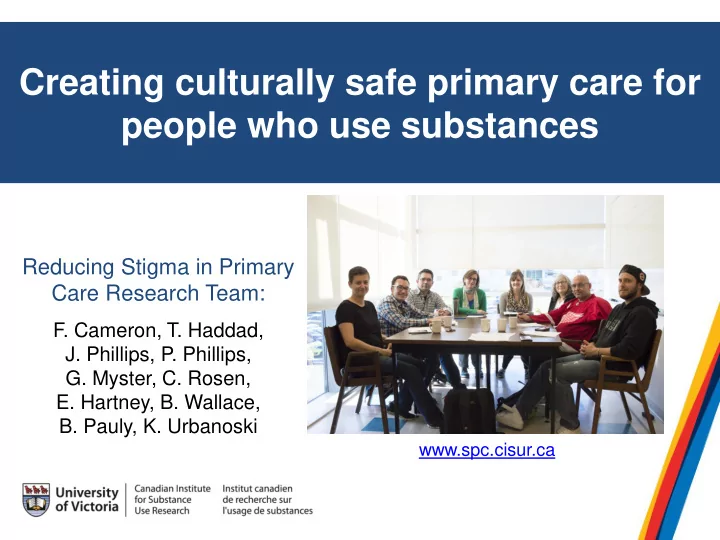
Creating culturally safe primary care for people who use substances Reducing Stigma in Primary Care Research Team: F. Cameron, T. Haddad, J. Phillips, P. Phillips, G. Myster, C. Rosen, E. Hartney, B. Wallace, B. Pauly, K. Urbanoski


slide-1
SLIDE 1

Creating culturally safe primary care for people who use substances

Reducing Stigma in Primary Care Research Team:

  • F. Cameron, T. Haddad,
  • J. Phillips, P. Phillips,
  • G. Myster, C. Rosen,
  • E. Hartney, B. Wallace,
  • B. Pauly, K. Urbanoski

www.spc.cisur.ca

slide-2
SLIDE 2

Acknowledgements

This work was funded by a Strategy for Patient-Oriented Research (SPOR) Collaboration Grant by CIHR, with contributions from the University of Victoria, Island Health, and the Victoria Division of Family Practice

slide-3
SLIDE 3

Patient-Oriented Research (POR)

slide-4
SLIDE 4

Shifting the Power

Shifting from researcher-driven to patient-driven research

slide-5
SLIDE 5

Peer research models in public health and community-based research

Peer Research Models

Employment Model Partner or Leader Model Advisory Model

Source: Roche, Guta & Flicker, 2013

slide-6
SLIDE 6

Our approach

CORE RESEARCH TEAM FULL PROJECT TEAM

slide-7
SLIDE 7

Cultural safety: origins in nursing

Cultural safety is a framework developed in New Zealand in response to the health needs

  • f the Maori people to address culturally

inappropriate and insensitivity in the health care system (Ramsden, 1996)

Wepa, 2015; Cambridge University Press

slide-8
SLIDE 8

Cultural safety in health care to reduce drug related stigma in hospitals

Peer advisory research team (2012-2014)

https://www.uvic.ca/research/centres/cisur/assets/ docs/bulletin11-creating-culturally-safe-care.pdf

slide-9
SLIDE 9

Creating culturally safe primary care for people who use substances: Objectives

  • Identify ways of creating safe spaces for service planning,

implementation, and research that are inclusive of members of the population who use substances

  • Investigate patient understandings of cultural safety in

primary care

  • Develop recommendations for implementing culturally

safe primary care services and research with people who use substances

slide-10
SLIDE 10

Our approach

CORE RESEARCH TEAM FULL PROJECT TEAM

slide-11
SLIDE 11

Project expectations (developed by the community researchers)

  • Increase awareness
  • Increase dignity
  • Contribute in a meaningful

way to the community

slide-12
SLIDE 12

Project expectations (developed by the community researchers)

Increase awareness:

  • We hope to increase physician awareness and compassion to reduce

stigma

  • We will be aware that stigma between people who use substances

and primary care providers can go both ways

  • We hope that one day substance use and mental health will be less

stigmatized and openly discussed and acknowledged

slide-13
SLIDE 13

Project expectations (developed by the community researchers)

Increase dignity:

  • In healthcare and other social settings – this in the form of more

humane treatment and safe respectful services

  • We expect to be treated with dignity while learning and sharing our

experiences with one another

  • We hope to build trusting relationships across the groups represented

in this project

slide-14
SLIDE 14

Project expectations (developed by the community researchers)

Contribute in a meaningful way to the community:

  • Given the current opioid epidemic, we expect our team to acknowledge

the value in both abstinence and harm reduction models and keep in mind the importance of saving lives.

  • We aim to be part of a forward thinking movement building on the work
  • f Insite [supervised injection site in Vancouver] and the overdose

response units here in Victoria.

  • We hope to impact physicians in positive ways so that primary care will

be improved for the whole community and prevent or lessen the impact

  • f harms which could ultimately result in savings to the economy.
slide-15
SLIDE 15

Source: Trochim, 2006 https://socialresearchmethods.net/kb/conmap.php

slide-16
SLIDE 16

FOCUS PROMPT: I would feel safe going to the doctor if…

Three rounds of focus groups: 1. Brainstorming statements 2. Sorting statements 3. Naming clusters and ranking statement importance

slide-17
SLIDE 17

ROUND 1: Within three weeks…..

  • 75 participants recruited in 12 focus groups
  • Groups led by community researchers, with

support from the academic researchers

  • Even numbers of males and females
  • 80% of participants returned for Rounds 2 & 3
slide-18
SLIDE 18

Pre-ROUND 2: a mind-melting experience

  • 700+ statements brainstormed in Round 1
  • Reduced to 73 statements for sorting in Round 2
  • Volume, time, pacing, and differences in

perspectives

slide-19
SLIDE 19

Culturally safe primary care means…..

slide-20
SLIDE 20

Definition Physician is 'drug wise' meaning they are knowledgeable about and recognize addiction as a health condition not as a criminal issue. They are up to date on treatment, management and resources. Don’t red flag me for my drug use and instead offer a range of treatment options including harm reduction.

slide-21
SLIDE 21

Definition The care I receive is characterized by respect, dignity, sensitivity, empathy and understanding. I am not fearful of being judged, labeled or stigmatized for drug use.

slide-22
SLIDE 22

Definition Don’t turn me away or refuse to provide care for me as a result of my drug use. Treat all patients with respect, compassion, dignity, and human decency.

slide-23
SLIDE 23

Definition The doctor has up to date knowledge of addiction and pain management for people who use drugs. My doctor collaborates and communicates with me to make informed decisions about my treatment, especially with regard to prescribing medications and pain management.

slide-24
SLIDE 24

Definition Feeling like the physician has time and isn't rushing. We have a relationship and rapport with consistency in care from one provider which allows for continuity and follow up. Our relationship is characterized by trust and rapport and the care provided is holistic.

slide-25
SLIDE 25

Definition The environment of the clinic itself is welcoming, comfortable, and non- institutional to reduce my feelings of vulnerability. The waiting room has adequate space. Office policies and protocol are designed to ensure patient information is kept private and confidential. There is no public sharing of information in the waiting room or between staff. I don't have to wait for an appointment and appointments and information are accessible.

slide-26
SLIDE 26

Definition An approach to care that recognizes the social determinants of health and makes the necessary arrangements to ensure care is not limited by my

  • circumstances. Patients should not suffer negative

repercussions and/or harms as result of their social and economic position in society.

slide-27
SLIDE 27

Definition Patients need supports to feel safe and secure to reduce anxiety they may have about seeking care. These supports extend beyond the competencies or characteristics of individual physicians or the clinic itself to include environmental supports such as an advocate, the environment outside the clinic and system supports such as adequate insurance coverage.

slide-28
SLIDE 28

Strategy for Knowledge Exchange

In community the results of our study, we want to: 1. Raise awareness of the issues related to stigma and barriers to primary care experienced by people who use/used substances, and share understandings of culturally safe primary care for this population 2. Support the ability of people who use/used substances to advocate for their

  • wn primary care

3. Secure the commitment of people who use/used substances, physicians, and health planners/government to collaborate on strategies to improve cultural safety in primary care 4. Encourage the participation of people who use/used substances, physicians, and health planners/government in developing and implementing policies and practices to improve cultural safety in primary care

slide-29
SLIDE 29
slide-30
SLIDE 30

Engagement with physicians to enhance cultural safety in primary care for people who use substances

Hartney E (PI), Harrison A, Urbanoski K, Pauly E. With SOLID Outreach and the Umbrella Society

slide-31
SLIDE 31

Definition of culturally safe research

Culturally safe research must be led by people with lived experience of substance use (either past or current). They determine what is safe within a collaborative and community engaged

  • framework. Lived experience is valued

and recognition of how stigma and power operate with equitable processes for doing research and action as an

  • utcome.

Developed by the Reducing Stigma in Primary Care Research Team

slide-32
SLIDE 32

Thank you!