EAT THIS NOT THAT! 1 9/26/2018 But first, we need to learn Why - - PDF document

eat this not that
SMART_READER_LITE
LIVE PREVIEW

EAT THIS NOT THAT! 1 9/26/2018 But first, we need to learn Why - - PDF document

9/26/2018 Top 10 legacy fundraising principles from scientific research: Theory, statistics, and results from the lab 1. If you want a larger 6. Use family words not audience, dont lead with formal words death 7. Dont count it and 2.


slide-1
SLIDE 1

9/26/2018 1

  • 1. If you want a larger

audience, don’t lead with death

  • 2. Emphasize lasting social

impact

  • 3. Present a social norm

default (people like me do things like this)

  • 4. Advance the donor life

story

  • 5. Encourage tribute gifts in

wills

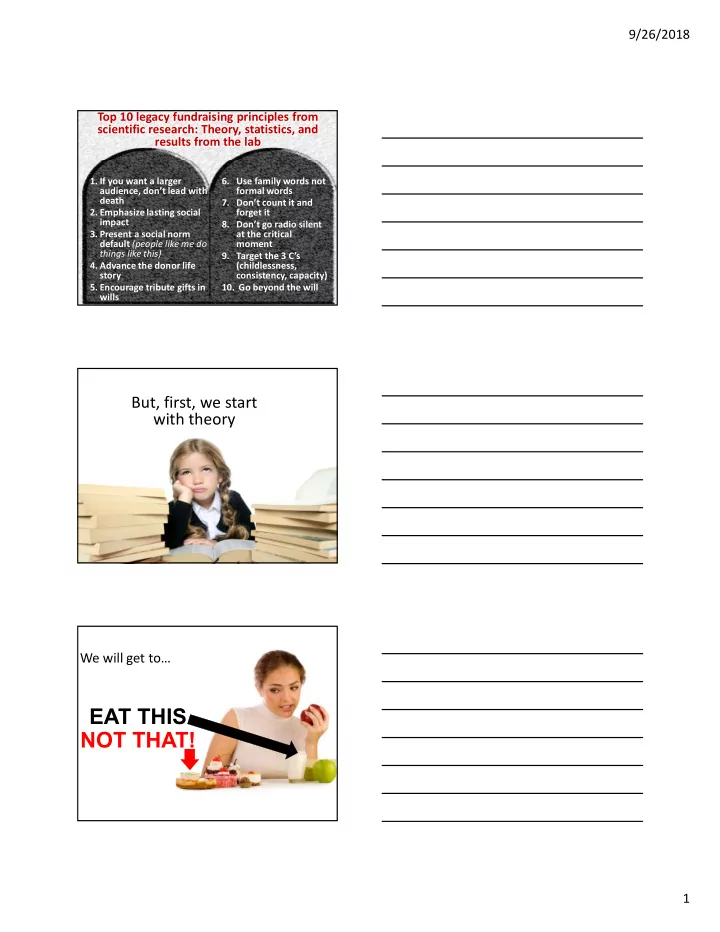
Top 10 legacy fundraising principles from scientific research: Theory, statistics, and results from the lab

  • 6. Use family words not

formal words

  • 7. Don’t count it and

forget it

  • 8. Don’t go radio silent

at the critical moment

  • 9. Target the 3 C’s

(childlessness, consistency, capacity)

  • 10. Go beyond the will

But, first, we start with theory

We will get to…

EAT THIS NOT THAT!

slide-2
SLIDE 2

9/26/2018 2 But first, we need to learn…

Why theory first?

  • New techniques can

emerge as circumstances change

  • Guides practice even

where (as in bequest and major giving) interim measurement is difficult

  • “Best practices” might just

be “practices”

  • Just because a technique

“works” for one

  • rganization …

Theory based strategies are more flexible than a list of techniques

slide-3
SLIDE 3

9/26/2018 3

Seminar Tonight: Estate Planning

What you see

Seminar Tonight: Your Upcoming Death

What the subconscious sees

  • Regardless of

terminology or packaging, estate planning is planning for one’s own death.

  • It is a strong

reminder of the reality of one’s

  • wn mortality.
  • Experimental

research has identified consistent reactions to mortality reminders.

1st Stage Defense

AVOIDANCE

Avoid death reminders, e.g., deny one’s vulnerability, distract oneself, avoiding self- reflective thoughts 2nd Stage Defense

SYMBOLIC IMMORTALITY

Some part of one’s self –

  • ne’s family, achievements,

community – will continue to exist after death (a form of autobiographical heroism)

Both economic and psychological approaches predict

slide-4
SLIDE 4

9/26/2018 4

Distract: I’m too busy to think about

that right now

Differentiate: It doesn’t apply to

me now because I (exercise, have good cholesterol, don’t smoke…)

Deny: These worries are overstated Delay: I definitely plan to

think about this… later

Depart: I am going to

stay away from that reminder

Examples of avoidance 2nd stage defense: Symbolic immortality

(a form of autobiographical heroism)

Some part of one’s self - one’s name, family, community, achievements, values, goals, etc.

  • will persist after death

As personal mortality awareness grows, the desire for investing in future social impact becomes relatively more attractive

H

Pursuit of symbolic immortality: something reflecting the person’s life story (community and values) will live beyond them

slide-5
SLIDE 5

9/26/2018 5

Death reminders increase support for one’s surviving community (“in-group”) and community values

  • 1. If you want a larger

audience, don’t lead with death

  • 2. Present a social norm

default (people like me do things like this)

  • 3. Emphasize lasting social

impact

  • 4. Advance the donor life

story

  • 5. Encourage tribute gifts in

wills

If you want a larger audience, don’t lead with death

  • 6. Use family words not

formal words

  • 7. Don’t count it and

forget it

  • 8. Don’t go radio silent

at the critical moment

  • 9. Target the 3 C’s

(childlessness, consistency, capacity)

  • 10. Go beyond the will

Communicating Obliquely

Personal mortality topics are subconsciously aversive to most people. Wrap them in other topics to sidestep the initial avoidance response.

A common theme in several successful approaches to introducing planned giving

slide-6
SLIDE 6

9/26/2018 6

Stories from the frontlines

  • Charity projects
  • Stories of

planned donors who fund it

Charitable Estate Planning

The Oblique Seminar

You “just happen” to communicate about planned giving in the context of something else

Christians and the Law

  • Religious liberties
  • Stewardship /

estate planning

Tax-smart giving

  • Current giving tips
  • Planned giving tips

“Since you’re thinking about ways to protect yourself and your identity, why not think about ways to protect your estate, as well?” We ended with an abbreviated seminar on how to be sure your estate is in order (with appropriate charitable bequests in place).”

  • Barbara Diehl, Journal of Gift Planning, 2006

Identity theft?

4 S

  • 1. Story
  • 2. Story
  • 3. Story
  • 4. Shut up

So, what’s new at Texas Tech? 1. … new coach … 2. … new building … 3. Oh, and Mary Smith did a neat thing. Did you know Mary? She graduated two years before you... No? Well, Mary signed a new will that one day will endow a permanent scholarship for financial planning students.

Concept from Jeff Comfort, Oregon State University

The Oblique Conversation The Oblique Survey

Many friends of [org] like to receive a tax deduction and make a gift that pays them income for life. Rate your level of interest in making this type of gift. □ Will never be interested □ Not today, but some day □ Somewhat interested □ Definitely interested In the middle of an 8-10 question survey of opinions about the organization… Many people like to leave a gift to [org] in their will to support a cause that has been important in their life. If you signed a will in the next three months, what is the likelihood that you might leave a gift to [org]? □ None □ Somewhat Unlikely □ Somewhat Likely □ Very Likely □ Definitely

  • r
slide-7
SLIDE 7

9/26/2018 7

The Oblique Focus Group

Bigelow & Kolmerten (Journal of Gift

Planning, 2008) set up a donor focus

group “about why no one seems willing to learn about planned giving by attending workshops …The participants, in order to give advice about workshops on planned giving, had to ask questions about CRTs and CGAs…Thus, like scientists who discover a cure unexpectedly, we had inadvertently found our answer where we least expected it: the best venue to teach people about planned giving was not a workshop

  • r a seminar but a focus group.”

The Oblique Investment How is Death Insurance Sold?

Annuity strategies: If you want a larger audience, don’t lead with death

Changing annuity description from “each year you live” to “each year you live until you die”, and “if the annuity holder lives up to different ages” with “depending on the age when the annuity holder dies” increased death-related thoughts and consequently lowered interest in purchasing annuities. The reduction in interest was fully mediated by the change in death-related thoughts.

Salisbury, L. C., & Nenkov, G. Y. (2016). Solving the annuity puzzle: The role of mortality salience in retirement savings decumulation decisions. Journal of Consumer Psychology, 26(3), 417-425.
slide-8
SLIDE 8

9/26/2018 8 Avoidance suggests that we don’t want to admit the likelihood of impending death as a reason to act

Now Yes

I don’t want to think about it

Now Yes

I don’t want to think about it If I am not going to die tomorrow, why not deal with this later?

So create another reason…

Now Yes

I don’t want to think about it

Later

slide-9
SLIDE 9

9/26/2018 9

Now Yes

I don’t want to think about it

Later

Our campaign to reach 100 planned gifts in wills or trusts ends in 3 months, won’t you consider joining these

  • thers?

Left Out

  • f Group

Now Yes

I don’t want to think about it

Later

We are offering a ______ for anyone who signs up for an appointment tonight only No ____

Now Yes

I don’t want to think about it

Later

People really take their cue from leaders like you. Your action would motivate many of them to act. Bad Example

slide-10
SLIDE 10

9/26/2018 10

I commit to complete an estate plan with a gift to (organization) within 6 months □ Yes □ No □ Already Completed

Pledge and follow-up

“To show a strong leadership commitment in this planned giving push, we want to announce board participation levels at the fall

  • banquet. Can we

count you in?”

Now Yes

I don’t want to think about it

Later

We really appreciate your commitment to make this bequest

  • gift. Can I check back

in a month to see how the planning process is going? Violating “Pledge”

  • 1. If you want a larger

audience, don’t lead with death

  • 2. Emphasize lasting social

impact

  • 3. Present a social norm

default (people like me do things like this)

  • 4. Advance the donor life

story

  • 5. Encourage tribute gifts in

wills

Emphasize lasting social impact

  • 6. Use family words not

formal words

  • 7. Don’t count it and

forget it

  • 8. Don’t go radio silent

at the critical moment

  • 9. Target the 3 C’s

(childlessness, consistency, capacity)

  • 10. Go beyond the will
slide-11
SLIDE 11

9/26/2018 11 Strategies: When to lead with death

1.Captive audience

Increase mortality salience to heighten interest in lasting social impact through bequest

2.Low-hanging fruit

Intentionally limiting audience only to those ready for death planning (often related to some

  • ther external shock

such as death of a loved

  • ne, negative diagnosis,

estate planning)

Annuity strategy: Pursuit of lasting social impact

suggests that once mortality salience is induced, a bequest benefit will become more attractive

Both increasing death wording and writing a death essay increased preference for an annuity with a bequest benefit instead of a standard annuities

(Williams & James, 2017)

Increasing bequest motivation will decrease interest in standard annuities (Friedman & Warshawsky, 1990; Lockwood,

2012).

Three-fourths of all annuities

  • wned by recent retirees actually

contain survivor benefits (Lockwood,

2012).

Estate planning strategies: Emphasize lasting social impact

H

Something reflecting the person’s life story (community and values) will live beyond them

  • Dynasty trusts, private

foundations, and other long term plans become attractive

  • Without planning: Big

pile of money for heirs to quickly blow, violating client values.

  • With planning: Lasting

impact expressing client values, e.g., education for

  • ffspring, retirement

for spouse, wage matching trust payments.

slide-12
SLIDE 12

9/26/2018 12

Permanent Gifts

Symbolic immortality in practice

A poverty relief charity was described as an

  • rganization

that focused on either …

Normal Average Gift Death Reminded Average Gift

“meeting the immediate needs of people” or

R1

$257.77 $80.97

“creating lasting improvements that would benefit people in the future”

R2

$100.00 $235.71

*participants giving share of potential $1,000 award
  • K. A., Tost, L. P., Hernandez, M., & Larrick, R. P. (2012). It’s Only a Matter of Time Death,
Legacies, and Intergenerational Decisions. Psychological Science, 23(7), 704-709.)

↓ d ↔ d

Pursuit of lasting social impact

Lasting gifts (endowments, named buildings, scholarship funds, etc.) to stable organizations may be particularly compelling

slide-13
SLIDE 13

9/26/2018 13 Consider developing permanent giving

  • pportunities for

mid-level bequest donors

  • Scholarships, lectureships,

annual performances, perpetual child sponsorship, perpetual rescued pet sponsorship, etc.

  • Limit to legacy donors to

emphasize specialness and avoid pulling from current giving

  • Virtual endowments
  • 1. If you want a larger

audience, don’t lead with death

  • 2. Emphasize lasting social

impact

  • 3. Present a social norm

default (people like me do things like this)

  • 4. Advance the donor life

story

  • 5. Encourage tribute gifts in

wills

Present a social norm default (people like me do things like this)

  • 6. Use family words not

formal words

  • 7. Don’t count it and

forget it

  • 8. Don’t go radio silent

at the critical moment

  • 9. Target the 3 C’s

(childlessness, consistency, capacity)

  • 10. Go beyond the will

Because I don’t want to think about it,

the default or social norm becomes powerful

Johnson, E. J., & Goldstein, D. (2003). Do Defaults Save Lives? Science, 302, 1338-1339.

slide-14
SLIDE 14

9/26/2018 14

3,000 testators in the normal process

  • f completing their

wills were randomly assigned to one of three groups

Many of our customers like to leave money to charity in their will. Are there any causes you’re passionate about? Would you like to leave any money to charity in your will? No reference to charity

Cabinet Office Behavioural Insights Team (2013) Applying behavioural insights to charitable giving

5.0% 10.4% 15.4%

Charitable bequests are influenced by a simple social example

Charitable plans among 1,000 testators Charitable plans among 1,000 testators Charitable plans among 1,000 testators

Many of our customers like to leave money to charity in their will. Are there any causes you’re passionate about? Would you like to leave any money to charity in your will? No reference to charity

Cabinet Office Behavioural Insights Team (2013) Applying behavioural insights to charitable giving

The social norm increased charitable bequest intentions

Interested Now

31% 23% 12%

Will Never Be Interested

9% 12% 14%

2014 Survey, 2,369 Respondents, Groups D/E/LateG+H

Many people like to leave a gift to charity in their will. Are there any causes you would support in this way? Make a gift to charity in my will Make a bequest gift to charity

slide-15
SLIDE 15

9/26/2018 15

Testing Charitable Gift Annuity

(lifetime income and remainder to charity at death)

Messages

What “you” would do or what another donor has done?

Please rate your interest in pursuing the above described charitable giving arrangement

Interested Now

Definitely/somewhat/slightly

All: ____% 55+: ____% All: ____% 55+: ____%

Please rate your interest in pursuing the above described charitable giving arrangement

All: 38.6% 55+: 38.6% All: 33.5% 55+: 23.2%

Interested Now

Definitely/somewhat/slightly

What “you” would do or what another donor has done?

slide-16
SLIDE 16

9/26/2018 16

Text only or text and donor picture?

All: ___% 55+: ___% All: ___% 55+: ___%

Please rate your interest in pursuing the above described charitable giving arrangement: % Interested now (definitely/somewhat /slightly)

Text only or text and donor picture?

All: 38.6% 55+: 38.6% All: 31.1% 55+: 29.8%

Please rate your interest in pursuing the above described charitable giving arrangement: % Interested now (definitely/somewhat /slightly)

What’s the problem with the donor picture? Is it just this photo? This donor age? Is it photos in general or what?

slide-17
SLIDE 17

9/26/2018 17

55+ ___% ___% ___%

Interested now (definitely/somewhat /slightly)

35-54 ___% ___% ___% U-35 ___% ___% ___% 55+ 24.4% 22.0% 41.1%

Interested now (definitely/somewhat /slightly)

35-54 38.4% 47.4% 30.6% U-35 44.5% 32.6% 30.2%

How do these compare with text

  • nly or a non-donor photo?
slide-18
SLIDE 18

9/26/2018 18 55+

1st

44.4%

3rd

28.3% 24.4% 22.0% 41.1%

Interested now

(definitely/somewhat /slightly)

Young Middle Older 35-54

3rd

40.1%

2nd

44.6% 38.4% 47.4% 30.6%

U-35

3rd

34.7%

2nd

36.4% 44.5% 32.6% 30.2%

All

1st

40.1%

2nd

36.5% 35.8% 34.0% 34.0%

Age matched donor pictures are OK

Otherwise, use text only or a different picture

Social norms are more powerful when the examples are like me

You can support Golomolo by donating 20 Swedish crowns. 73% of

Linnaeus University students who were

asked for a contribution have donated 20 Swedish crowns to Golomolo. You can support Golomolo by donating 20 Swedish crowns. 73% of

University students in Sweden who were asked

for a contribution have donated 20 Swedish crowns to Golomolo. You can support Golomolo by donating 20 Swedish crowns.

Agerström, J., Carlsson, R., Nicklasson, L., & Guntell,

  • L. (2016). Using descriptive social norms to increase

charitable giving: The power of local norms. Journal

  • f Economic Psychology, 52, 147-153.
slide-19
SLIDE 19

9/26/2018 19

  • 1. If you want a larger

audience, don’t lead with death

  • 2. Emphasize lasting social

impact

  • 3. Present a social norm

default (people like me do things like this)

  • 4. Advance the donor life

story

  • 5. Encourage tribute gifts in

wills

Advance the donor life story

  • 6. Use family words not

formal words

  • 7. Don’t count it and

forget it

  • 8. Don’t go radio silent

at the critical moment

  • 9. Target the 3 C’s

(childlessness, consistency, capacity)

  • 10. Go beyond the will

Contrast

Brain Region

MNI co-ord inates

Peak

p FWE

Clust

  • er p

FWE (1) Beq> Give

Lingual Gyrus

  • 2, -78,
  • 2

.004 .000

Precuneus 26, -66,

42 .102 .009 (2) Beq> Vol

Lingual Gyrus

2, -80, - 4 .007 .000

Precuneus 30, -66,

40 .180 .004

Precentral Gyrus

  • 34, -3,

36 .397 .001 (3) Beq> (Give+ Vol)

Lingual Gyrus

0, -78, - 4 .001 .000

Precuneus 26, -66,

42 .007 .001

Visualized autobiography

visualization + 3rd person perspective on self

lingual gyrus is part of the visual system, damage can result in

losing the ability to dream

precuneus has been called “the mind’s eye,” used in taking a 3rd

person perspective on one’s self

slide-20
SLIDE 20

9/26/2018 20

“when discussing which charities they had chosen to remember, there was a clear link with the life narratives of many respondents”

Life stories

Summarizing a series of interviews with planned donors, Dr. Claire Routley wrote…

References to “important in your life” increase interest

Interested Now

40% 30% 12%

Will Never Be Interested

6% 7% 14%

2014 & 2015 Surveys, 1,822 Respondents

Make a gift to charity in your will to support causes that have been important in your life Make a gift to charity in your will Make a bequest gift to charity

Living donor stories outperformed all other messages for 40 out of 40 charities tested

slide-21
SLIDE 21

9/26/2018 21

Is this cause (or charity) an important part of my life story? Start with “So tell me about your connection to (organization).”

  • 1. If you want a larger

audience, don’t lead with death

  • 2. Emphasize lasting social

impact

  • 3. Present a social norm

default (people like me do things like this)

  • 4. Advance the donor life

story

  • 5. Encourage tribute gifts in

wills

Encourage tribute gifts in wills

  • 6. Use family words not

formal words

  • 7. Don’t count it and

forget it

  • 8. Don’t go radio silent

at the critical moment

  • 9. Target the 3 C’s

(childlessness, consistency, capacity)

  • 10. Go beyond the will
slide-22
SLIDE 22

9/26/2018 22

Female, 63 widowed

‘The reason I selected Help the Aged...it was after my mother died...And I just thought – she’d been in a care home for probably three or four

  • years. And I just wanted to help the elderly...I’d

also support things like Cancer Research, because people I’ve known have died...An animal charity as well, I had a couple of cats.’

Bequest charity representing loved ones

“‘[In my will I have a gift to] the Cancer Research. My father died

  • f cancer and so I have supported

them ever since he died.’

Male, 89 married

(Routley, 2011, p. 220-221)

Do you have a deceased friend or deceased family member who would have appreciated your support

  • f an International relief organization such as CARE or UNICEF?

Also tested for living friend or family member

Alzheimer’s The Alzheimer's Association,

The Alzheimer's Foundation

Diabetes Joslin Diabetes Center, The

American Diabetes Association

Wild Birds Preservation National

Audubon Society, Ducks Unlimited

Wildlife World Wildlife Fund, Wildlife

Conservation Society

Minority College Fund United Negro

College Fund, American Indian College Fund

Blindness related nonprofit Foundation

Fighting Blindness, Prevent Blindness America

Youth-related charitable Girl Scouts, Boy

Scouts, YMCA, YWCA, Big Brothers / Big Sisters of America, Boys and Girls Clubs of America

AIDS research and care San Francisco

AIDS Foundation, AIDS Project Los Angeles

Animal welfare

American Society for Prevention of Cruelty to Animals, The American Humane Association

International relief UNICEF, Care Cancer research American Cancer Society,

National Cancer Coalition, M.D. Anderson Cancer Center, Dana Farber Cancer Institute

Guide dogs

Guide Dogs for the Blind, Canine Companions for Independence

Breast cancer research

Breast Cancer Research Foundation, National Breast Cancer Foundation, Susan G. Komen Breast Cancer Foundation

If so, please state your relationship to them and write at least 25 words describing their interest in or connection with this cause. If you signed a will in the next 3 months, what is the likelihood you might leave a BEQUEST gift honoring a living [deceased] friend or family member to _____

Testing the tribute bequest

4500+ respondents Change in likelihood of charitable bequest for those with family/friend connection Total Age 50+ Male Female Memorial reminder +14.0 +14.0 +13.5 +14.0 Living reminder +9.2 +9.3 +7.7 +9.9

Reminder/tribute increases interest from initial response

Average share with family/friend connections to each cause Total Age 50+ Male Female Memorial reminder 22.1% 27.1% 19.5% 23.6% Living reminder 34.2% 36.1% 30.4% 36.6%
slide-23
SLIDE 23

9/26/2018 23

Simple implementations

Samples courtesy of Phyllis Freedman, President of SmartGiving and “The Planned Giving Blogger”

to “honor a friend or family member by making a memorial gift to charity in my last will & testament” In a 2014 survey,

1 in 4 increased

their intention to leave a charitable bequest when given the option

  • 1. If you want a larger

audience, don’t lead with death

  • 2. Emphasize lasting social

impact

  • 3. Present a social norm

default (people like me do things like this)

  • 4. Advance the donor life

story

  • 5. Encourage tribute gifts in

wills

Use family words not formal words

  • 6. Use family words not

formal words

  • 7. Don’t count it and

forget it

  • 8. Don’t go radio silent

at the critical moment

  • 9. Target the 3 C’s

(childlessness, consistency, capacity)

  • 10. Go beyond the will

Market Realm

(exchange)

I engage in transactions by formal contract

Social Realm

(identity)

I help people because of who I am

Use family language Stories and simple words Avoid market language Formal, legal, or contract terms Would you say it in a normal conversation with your grandmother?

slide-24
SLIDE 24

9/26/2018 24

Interested Now

23% 12%

Will Never Be Interested

12% 14%

2014 Survey, 1,246 Respondents, Groups D/E

Make a gift to charity in my will Make abequest gift to charity

Formal terms lower charitable interest

Make a gift

where you get an immediate tax deduction, still control the investment of the assets and receive income from the investments for the rest of your life with anything left over going to charity at your death. where you get an immediate tax deduction, still control the investment of the assets and receive income from the investments for the rest of your life with anything left over going to charity at your death.

Make a transfer

  • f assets

Different groups rate their interest after receiving different descriptions

Does it make much difference?

Describing a CRT

14% 54% 32% 27% 53% 20%

Interested now Not now, but in future Will never be interested

Transfer Gift

Make a gift

where you get an immediate tax deduction, still control the investment of the assets and receive income from the investments for the rest of your life with anything left over going to charity at your death. where you get an immediate tax deduction, still control the investment of the assets and receive income from the investments for the rest of your life with anything left over going to charity at your death.

Make a transfer of assets

2014 Survey (A/B) 1,101 Respondents

slide-25
SLIDE 25

9/26/2018 25

Make a gift

and in exchange receive a guaranteed lifetime income from the charity. and in exchange receive a guaranteed lifetime income from the charity.

Enter into a contract with a charity where you transfer your cash or property Does it make much difference?

Describing a CGA

13% 44% 44% 29% 48% 23%

Interested now Not now, but in future Will never be interested

Contract Gift Make a gift and in exchange receive a

guaranteed lifetime income from the charity receive a guaranteed lifetime income from the charity

Enter into a contract with a charity where you transfer your cash or property and in exchange

2014 Survey (A/B) 1,101 Respondents

Formal terms lower charitable interest

Interested Now

36% 22%

Will Never Be Interested

14% 23%

2014 Survey, 1,417 Respondents, Group F/G

Get an immediate tax deduction and still receive income from your investments for the rest of your life by making a gift where you control the investment of the assets, but anything left over goes to charity at your death. Get an immediate tax deduction and still receive income from your investments for the rest of your life by making a gift

using a “Charitable Remainder Trust”

where you control the investment of the assets, but anything left over goes to charity at your death.

slide-26
SLIDE 26

9/26/2018 26

Formal terms lower charitable interest

Interested Now

50% 23%

Will Never Be Interested

8% 19%

2014 Survey, 1,418 Respondents, Group F/G

Receive a tax deduction and make a gift that pays you income for life Receive a tax deduction and make a gift that pays you income for life

called a “Charitable Gift Annuity”

Formal terms lower charitable interest

Interested Now

26% 15%

Will Never Be Interested

23% 30%

2014 Survey, 1,422 Respondents, Group F/G

Immediately receive a tax deduction for 70% of the value of a house or land by making a charitable gift of the property, but keeping the right to use it for the rest of your life. Immediately receive a tax deduction for 70% of the value of a house or land by making a charitable gift of the property,

using a “Remainder Interest Deed”

but keeping the right to use it for the rest of your life.

They have to be interested in finding out more Suppose you are viewing the website of a charity representing a cause that is important in your

  • life. In addition to a

“Donate Now” button, the following buttons appear on the website. Please rate your level of interest in clicking on the button to read the corresponding information. What is the best “front door” phrase to get people to read about planned giving information?

slide-27
SLIDE 27

9/26/2018 27 Gift planning Planned giving Giving now & later Other ways to give Other ways to give smarter Other ways to give cheaper, easier, and smarter

I am definitely interested

3% 4% 7% 16% 20% 23%

Survey #1: 2,550 respondents What is the best “front door” phrase to get people to read about planned giving information? They have to expect to see planned giving information (i.e., not “bait and switch”) Which of the following types of information would you expect when clicking on the button labeled "_______"

  • 1. make a gift of stocks
  • 2. make a gift of bonds
  • 3. make a gift of real estate
  • 4. make a gift in your will
  • 5. make a gift in your living trust
  • 6. make a gift by naming a charity as death beneficiary
  • f your life insurance policy
  • 7. make a gift by naming a charity as death beneficiary
  • f your IRA or retirement account
  • 8. make a gift by naming a charity as death beneficiary
  • f your bank account
  • 9. make a gift and, in return, receive lifetime income

from the charity 10.avoid capital gains taxes by making charitable gifts 11.avoid estate taxes by making charitable gifts 12.avoid income taxes by making charitable gifts Which of the following types of information would you expect when clicking on the button labeled "_______“? How to…

12 types of planned giving information

slide-28
SLIDE 28

9/26/2018 28 Gift planning Planned giving Giving now & later Other ways to give Other ways to give smarter Other ways to give cheaper, easier, and smarter

I am definitely interested

3% 4% 7% 16% 20% 23%

I definitely expected this

20% 12% 7% 15% 19% 12%

12 types of PG info average

Combined Results

Do we communicate with donor language or insider language?

  • 1. If you want a larger

audience, don’t lead with death

  • 2. Emphasize lasting social

impact

  • 3. Present a social norm

default (people like me do things like this)

  • 4. Advance the donor life

story

  • 5. Encourage tribute gifts in

wills

Don’t count it and forget it

  • 6. Use family words not

formal words

  • 7. Don’t count it and

forget it

  • 8. Don’t go radio silent

at the critical moment

  • 9. Target the 3 C’s

(childlessness, consistency, capacity)

  • 10. Go beyond the will
slide-29
SLIDE 29

9/26/2018 29

The entire “lifetime” movie

(tracking same people from mid-life to post-mortem)

New data Previous data Old data

Small one-time snapshots in life Post-mortem for some estates

0% 10% 20% 30% 40% 50% 60% 70%

1993/4 to 2004 1995/6 to 2006 1998 to 2008 2000 to 2010 2002 to 2012 2004 to 2014 2006 to 2016

10-Year Retention of Charitable Estate Component

70+ 50-69

50.0% 55.0% 60.0% 65.0% 70.0% 75.0% 80.0% 2002 2004 2006 2008 2010 2012 2014 2016

Charitable Plan Loss Trajectory

Among those still alive and answering the same question who reported having a charitable component in BOTH 1998 & 2000

slide-30
SLIDE 30

9/26/2018 30

So where does “Once in, Always in” come from?

Old data

Post-mortem for largest estates

Plans destabilize as death nears

We can see this only in a LIFETIME survey not in a

ONE TIME

survey

Practice suggestions

What now?

slide-31
SLIDE 31

9/26/2018 31

“Count it and forget it” doesn’t work!

A bequest commitment is the beginning, not the end

Higher value in converting to irrevocable commitments: gift annuities, charitable remainder trusts, remainder interests is homes and farms.

Charitable plans signed earlier

DO

produce larger gifts,

IF

they stay in (or they return later)

slide-32
SLIDE 32

9/26/2018 32

$3,000 $4,000 $5,000 $6,000 $7,000 $8,000 $9,000

Before

  • 8

years Before

  • 6

years Before

  • 4

years Before

  • 2

years Mixed After +2 years After +4 years After +6 years After +8 years

Annual Charitable Giving

in Constant (Inflation Adjusted) 2012 Dollars

Giving Before and After Adding Charitable Beneficiary to Estate Plan

9,439 observations from a nationally representative longitudinal study

$7,381

average annual giving post-plan

$4,210

average annual giving pre-plan

+$3,171

average annual giving increase

  • 1. If you want a larger

audience, don’t lead with death

  • 2. Emphasize lasting social

impact

  • 3. Present a social norm

default (people like me do things like this)

  • 4. Advance the donor life

story

  • 5. Encourage tribute gifts in

wills

Don’t go radio silent at the critical moment

  • 6. Use family words not

formal words

  • 7. Don’t count it and

forget it

  • 8. Don’t go radio silent

at the critical moment

  • 9. Target the 3 C’s

(childlessness, consistency, capacity)

  • 10. Go beyond the will

When do plans change?

slide-33
SLIDE 33

9/26/2018 33

Factors predicting when charitable plans are

ADDED

  • 1. Approaching

death (final pre- death survey)

  • 2. Becoming a

widow/widower

  • 3. Diagnosed with

cancer

  • 4. Decline in self-

reported health

  • 5. Divorce
  • 6. Diagnosed with

heart problems

  • 7. Diagnosed with

a stroke

  • 8. First grandchild
  • 9. Increasing

assets

  • 10. Increasing

charitable giving

Factors predicting when charitable plans are

DROPPED

slide-34
SLIDE 34

9/26/2018 34

  • 1. Decline in self-

reported health

  • 2. Approaching

death (final pre- death survey)

  • 3. Becoming a

widow/widower

  • 4. Divorce
  • 5. Diagnosed with

cancer

  • 6. Diagnosed with

heart problems

  • 7. Diagnosed with

a stroke

  • 8. First grandchild
  • 9. First child
  • 10. Exiting

homeownership

  • 1. Death feels near
  • Final pre-death survey
  • Decline in self-reported health
  • Diagnosis with cancer
  • Diagnosis with heart disease
  • Diagnosis with stroke
  • Becoming a widow or widower
  • 2. Family structure changes
  • Divorce
  • First child
  • First grandchild
  • Becoming a widow or widower

Plans destabilize when

A 5% national sample of 2012 probate records in Australia showed an estimated

  • 31% of charitable wills were signed

within 2 years of death

  • 60% were signed within 5 years of

death

Baker, Christopher (October, 2013) Encouraging Charitable Bequests by Australians . Asia-Pacific Centre for Social Investment & Philanthropy - Swinburne University

slide-35
SLIDE 35

9/26/2018 35 Most realized charitable plans (in red) added within 5 years of death 38% 13% 10% 39% 43% 22% 15% 20%

Estates $ Gifted

Many charities go silent at the most important point of decision.

20% 25% 30% 35% 40% 45% 50% 55% 60% 65% 70%

Lifetime Giving and Volunteering by Actual Estate Donors

Giving ($500+) Volunteering

Don’t ignore your

  • ldest

supporters

slide-36
SLIDE 36

9/26/2018 36

76 78 80 82 84 86 88 Median Age at Death

Linear (Male Bequest Donor) Linear (Female Bequest Donor) Linear (All Female) Linear (All Male)

Wealthy people die old. Wealthy bequest donors die even older.

Age at Will Signing

(by share of total charitable bequest $ transferred)

76% 11% 13%

80s+ 70s pre-70

Australian data from: Baker, Christopher (October, 2013) Encouraging Charitable Bequests by Australians . Asia- Pacific Centre for Social Investment & Philanthropy - Swinburne University

Half of all charitable bequest dollars came from decedents this age and older… Current U.S. study (1992-2014):

Age 86

New Australian study (5% sample of national probate files 2010):

Age 90

Remember that most realized charitable bequests are added within 5 years of death

slide-37
SLIDE 37

9/26/2018 37

Plans destabilize as death approaches

lifetime reports made as death approaches post-mortem transfers v. lifetime reports timing of the last changes made to the final will

For those 75+ with lifetime connections, stay “top of the mind”

(service, service communication, mission communication, honoring/thank you, living bequest donor stories)

  • Plans become unstable as death approaches
  • Stay connected! Stay communicating!

The score doesn’t count until the clock runs out

slide-38
SLIDE 38

9/26/2018 38

  • 1. If you want a larger

audience, don’t lead with death

  • 2. Emphasize lasting social

impact

  • 3. Present a social norm

default (people like me do things like this)

  • 4. Advance the donor life

story

  • 5. Encourage tribute gifts in

wills

Target the 3 C’s (childlessness, consistency, capacity)

  • 6. Use family words not

formal words

  • 7. Don’t count it and

forget it

  • 8. Don’t go radio silent

at the critical moment

  • 9. Target the 3 C’s

(childlessness, consistency, capacity)

  • 10. Go beyond the will

5% 10% 15% 20% 25% 30% 35% 40% 45% 50% 55%

Age 55+ charitable recipient among those with will/trust by family status

Grandchildren Children only No Offspring (unmarried) No Offspring (married)

9% 11% 13% 15% 17% 19% 21%

Year (current age range)

Percentage

  • f U.S.

women who were childless

(measured at age 40-44 showing year of measurement and current age range)

slide-39
SLIDE 39

9/26/2018 39

8.0% 8.5% 9.0% 9.5% 10.0% 10.5% 11.0% 11.5% 12.0%

Charitable beneficiary among those aged 55+ with a will or trust

Predicting who ACTUALLY leaves a charitable estate gift AT DEATH

Lifetime predictors of a post-mortem bequest gift

slide-40
SLIDE 40

9/26/2018 40

  • 1. % years giving
  • 2. No offspring
  • 3. Highest giving
  • 4. % years

reporting funded trust

  • 5. Female
  • 6. Last reported

wealth

  • 7. Not married
  • 8. Last reported

giving

  • 9. Growing wealth
  • 10. % years

volunteering

  • 1. If you want a larger

audience, don’t lead with death

  • 2. Emphasize lasting social

impact

  • 3. Present a social norm

default (people like me do things like this)

  • 4. Advance the donor life

story

  • 5. Encourage tribute gifts in

wills

Go beyond the will

  • 6. Use family words not

formal words

  • 7. Don’t count it and

forget it

  • 8. Don’t go radio silent

at the critical moment

  • 9. Target the 3 C’s

(childlessness, consistency, capacity)

  • 10. Go beyond the will

49% 51% 53% 55% 57% 59% 61%

U.S. 55+ population with a will or trust

slide-41
SLIDE 41

9/26/2018 41

8.0% 8.5% 9.0% 9.5% 10.0% 10.5% 11.0% 11.5% 12.0%

Charitable beneficiary among those aged 55+ with a will or trust

0% 2% 4% 6% 8% 10%

U.S. 55+ with a charitable beneficiary

5% 15% 25% 35% 45% 55% Age 55+ use of will alone or trust

Will Only Funded Trust

Opposing trends in use

  • f wills only
  • r funded

trusts

slide-42
SLIDE 42

9/26/2018 42

States allowing “Transfer on Death” deeds in 1995 States allowing “Transfer on Death” deeds in 2000 States allowing “Transfer on Death” deeds in 2005

slide-43
SLIDE 43

9/26/2018 43

States allowing “Transfer on Death” deeds in 2017

Wills that won’t

What ultimately happened to those written and witnessed will documents reported during life?

Reported wills are often unused

17% 38% 10% 18% 11% 6% Distributed estates where decedent reported having a

signed and witnessed will (n=7,150)

No will found Will probated Unprobated will: nothing much of value Unprobated will: estate otherwise distributed Unprobated will: trust distributed

slide-44
SLIDE 44

9/26/2018 44

Funded trusts more likely to work

76% 10% 7% 3% 4% Distributed estates where decedent reported

having a funded trust (n=1,102)

Funded trust exists Probated will Otherwise divided Nothing much

  • f value

Unknown/Not yet distributed

  • 1. If you want a larger

audience, don’t lead with death

  • 2. Emphasize lasting social

impact

  • 3. Present a social norm

default (people like me do things like this)

  • 4. Advance the donor life

story

  • 5. Encourage tribute gifts in

wills

Top 10 legacy fundraising principles from scientific research: Theory, statistics, and results from the lab

  • 6. Use family words not

formal words

  • 7. Don’t count it and

forget it

  • 8. Don’t go radio silent

at the critical moment

  • 9. Target the 3 C’s

(childlessness, consistency, capacity)

  • 10. Go beyond the will