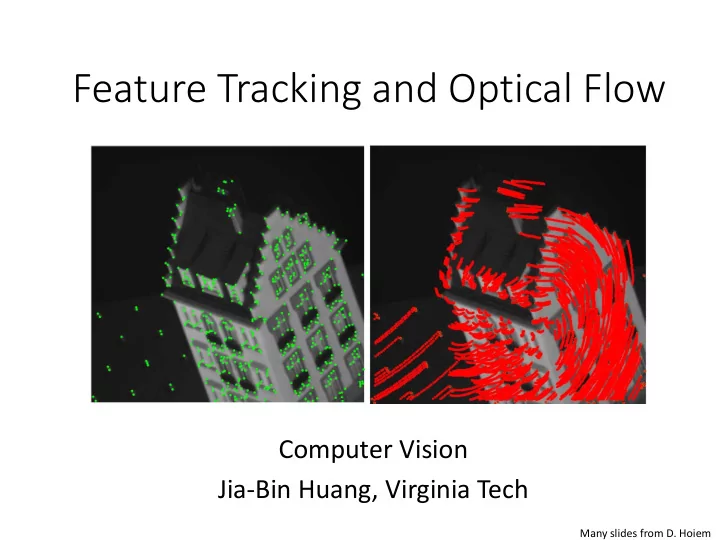
SLIDE 1 Feature Tracking and Optical Flow
Computer Vision Jia-Bin Huang, Virginia Tech
Many slides from D. Hoiem
SLIDE 2 Administrative Stuffs
- HW 1 due 11:55 PM Sept 17
- Submission through Canvas
- HW 1 Competition: Edge Detection
- Submission link
SLIDE 3 Things to remember
- Keypoint detection: repeatable
and distinctive
- Corners, blobs, stable regions
- Harris, DoG
- Descriptors: robust and selective
- spatial histograms of orientation
- SIFT
SLIDE 4 Local Descriptors: SIFT Descriptor
[Lowe, ICCV 1999]
Histogram of oriented gradients
- Captures important texture
information
- Robust to small translations /
affine deformations
SLIDE 5 Details of Lowe’s SIFT algorithm
– Find maxima in location/scale space – Remove edge points
- Find all major orientations
– Bin orientations into 36 bin histogram
- Weight by gradient magnitude
- Weight by distance to center (Gaussian-weighted mean)
– Return orientations within 0.8 of peak
- Use parabola for better orientation fit
- For each (x,y,scale,orientation), create descriptor:
– Sample 16x16 gradient mag. and rel. orientation – Bin 4x4 samples into 4x4 histograms – Threshold values to max of 0.2, divide by L2 norm – Final descriptor: 4x4x8 normalized histograms
Lowe IJCV 2004
SLIDE 6 SIFT Example
sift
868 SIFT features
SLIDE 7 Feature matching
Given a feature in I1, how to find the best match in I2?
- 1. Define distance function that compares two descriptors
- 2. Test all the features in I2, find the one with min distance
SLIDE 8 Feature distance
How to define the difference between two features f1, f2?
- Simple approach: L2 distance, ||f1 - f2 ||
- can give good scores to ambiguous (incorrect) matches
I1 I2
f1 f2
SLIDE 9 f1 f2 f2
'
How to define the difference between two features f1, f2?
- Better approach: ratio distance = ||f1 - f2 || / || f1 - f2’ ||
- f2 is best SSD match to f1 in I2
- f2’ is 2nd best SSD match to f1 in I2
- gives large values for ambiguous matches
I1 I2
Feature distance
SLIDE 10 Feature matching example
51 matches
SLIDE 11 Feature matching example
58 matches
SLIDE 12 Matching SIFT Descriptors
- Nearest neighbor (Euclidean distance)
- Threshold ratio of nearest to 2nd nearest descriptor
Lowe IJCV 2004
SLIDE 13 SIFT Repeatability
Lowe IJCV 2004
SLIDE 14 SIFT Repeatability
Lowe IJCV 2004
SLIDE 15 Local Descriptors: SURF
- K. Grauman, B. Leibe
- Fast approximation of SIFT idea
- Efficient computation by 2D box filters &
integral images ⇒ 6 times faster than SIFT
- Equivalent quality for object
identification
[Bay, ECCV’06], [Cornelis, CVGPU’08]
- GPU implementation available
- Feature extraction @ 200Hz
(detector + descriptor, 640×480 img)
- http://www.vision.ee.ethz.ch/~surf
Many other efficient descriptors are also available
SLIDE 16 Choosing a detector
– Precise localization in x-y: Harris – Good localization in scale: Difference of Gaussian – Flexible region shape: MSER
- Best choice often application dependent
– Harris-/Hessian-Laplace/DoG work well for many natural categories – MSER works well for buildings and printed things
– Get more points with more detectors
- There have been extensive evaluations/comparisons
– [Mikolajczyk et al., IJCV’05, PAMI’05] – All detectors/descriptors shown here work well
SLIDE 17 Comparison of Keypoint Detectors
Tuytelaars Mikolajczyk 2008
SLIDE 18 Choosing a descriptor
- Again, need not stick to one
- For object instance recognition or stitching, SIFT or
variant is a good choice
SLIDE 19 Recent advances in interest points
Features from Accelerated Segment Test, ECCV 06
Binary feature descriptors
- BRIEF: Binary Robust Independent Elementary Features, ECCV 10
- ORB (Oriented FAST and Rotated BRIEF), CVPR 11
- BRISK: Binary robust invariant scalable keypoints, ICCV 11
- Freak: Fast retina keypoint, CVPR 12
- LIFT: Learned Invariant Feature Transform, ECCV 16
SLIDE 20 Previous class
- Interest point/keypoint/feature
detectors
- Harris: detects corners
- DoG: detects peaks/troughs
- Interest point/keypoint/feature
descriptors
- SIFT (do read the paper)
- Feature matching
- Ratio distance = ||f1 - f2 || / || f1 - f2’ ||
- Remove 90% false matches, 5% of true
matches in Lowe’s study
f1 f2 f2
'
I1 I2
SLIDE 21 This class: Recovering motion
- Feature tracking
- Extract visual features (corners, textured areas) and “track” them
- ver multiple frames
- Optical flow
- Recover image motion at each pixel from spatio-temporal image
brightness variations
- B. Lucas and T. Kanade. An iterative image registration technique with an application to
stereo vision. In Proceedings of the International Joint Conference on Artificial Intelligence, 1981.
Two problems, one registration method
SLIDE 22 Feature tracking
- Many problems, such as structure from motion
require matching points
- If motion is small, tracking is an easy way to get
them
SLIDE 23 Feature tracking - Challenges
- Figure out which features can be tracked
- Efficiently track across frames
- Some points may change appearance over time (e.g.,
due to rotation, moving into shadows, etc.)
- Drift: small errors can accumulate as appearance
model is updated
- Points may appear or disappear: need to be able to
add/delete tracked points
SLIDE 24 Feature tracking
- Given two subsequent frames, estimate the point translation
- Key assumptions of Lucas-Kanade Tracker
- Brightness constancy: projection of the same point looks the same in
every frame
- Small motion: points do not move very far
- Spatial coherence: points move like their neighbors
I(x,y,t) I(x,y,t+1)
SLIDE 25 t y x
I v I u I t y x I t v y u x I + ⋅ + ⋅ + ≈ + + + ) , , ( ) 1 , , (
- Brightness Constancy Equation:
) , ( ) , , (
1 , +
+ + =
t
v y u x I t y x I
Take Taylor expansion of I(x+u, y+v, t+1) at (x,y,t) to linearize the right side:
The brightness constancy constraint
I(x,y,t) I(x,y,t+1)
≈ + ⋅ + ⋅
t y x
I v I u I
So:
Image derivative along x
[ ]
I v u I
t T
= + ⋅ ∇ →
t y x
I v I u I t y x I t v y u x I + ⋅ + ⋅ = − + + + ) , , ( ) 1 , , (
Difference over frames
SLIDE 26
- How many equations and unknowns per pixel?
The component of the motion perpendicular to the gradient (i.e., parallel to the edge) cannot be measured
edge (u,v) (u’,v’) gradient (u+u’,v+v’)
If (u, v) satisfies the equation, so does (u+u’, v+v’ ) if
- One equation (this is a scalar equation!), two unknowns (u,v)
[ ]
I v u I
t T
= + ⋅ ∇
[ ]
' v ' u I
T =
⋅ ∇
Can we use this equation to recover image motion (u,v) at each pixel?
The brightness constancy constraint
SLIDE 27
The aperture problem
Actual motion
SLIDE 28
The aperture problem
Perceived motion
SLIDE 29
The barber pole illusion
http://en.wikipedia.org/wiki/Barberpole_illusion
SLIDE 30
The barber pole illusion
http://en.wikipedia.org/wiki/Barberpole_illusion
SLIDE 31 Solving the ambiguity…
- How to get more equations for a pixel?
- Spatial coherence constraint
- Assume the pixel’s neighbors have the same (u,v)
- If we use a 5x5 window, that gives us 25 equations per pixel
- B. Lucas and T. Kanade. An iterative image registration technique with an application to stereo vision.
In Proceedings of the International Joint Conference on Artificial Intelligence, pp. 674–679, 1981.
SLIDE 32
Solving the ambiguity…
SLIDE 33 Matching patches across images
- Overconstrained linear system
The summations are over all pixels in the K x K window
Least squares solution for d given by
SLIDE 34 Conditions for solvability
Optimal (u, v) satisfies Lucas-Kanade equation
Does this remind you of anything?
When is this solvable? I.e., what are good points to track?
- ATA should be invertible
- ATA should not be too small due to noise
– eigenvalues λ1 and λ 2 of ATA should not be too small
- ATA should be well-conditioned
– λ 1/ λ 2 should not be too large (λ 1 = larger eigenvalue)
Criteria for Harris corner detector
SLIDE 35
Low-texture region
– gradients have small magnitude
– small λ1, small λ2
SLIDE 36
Edge
– gradients very large or very small – large λ1, small λ2
SLIDE 37
High-texture region
– gradients are different, large magnitudes
– large λ1, large λ2
SLIDE 38
The aperture problem resolved
Actual motion
SLIDE 39
The aperture problem resolved
Perceived motion
SLIDE 40 Dealing with larger movements: Iterative refinement
1. Initialize (x’,y’) = (x,y) 2. Compute (u,v) by 3. Shift window by (u, v): x’=x’+u; y’=y’+v; 4. Recalculate It 5. Repeat steps 2-4 until small change
- Use interpolation for subpixel values
2nd moment matrix for feature patch in first image displacement It = I(x’, y’, t+1) - I(x, y, t) Original (x,y) position
SLIDE 41 image I image J
Gaussian pyramid of image 1 (t) Gaussian pyramid of image 2 (t+1) image 2 image 1
Dealing with larger movements: coarse-to-fine registration
run iterative L-K run iterative L-K upsample
. . .
SLIDE 42 Shi-Tomasi feature tracker
- Find good features using eigenvalues of second-
moment matrix (e.g., Harris detector or threshold on the smallest eigenvalue)
- Key idea: “good” features to track are the ones whose
motion can be estimated reliably
- Track from frame to frame with Lucas-Kanade
- This amounts to assuming a translation model for frame-to-
frame feature movement
- Check consistency of tracks by affine registration to
the first observed instance of the feature
- Affine model is more accurate for larger displacements
- Comparing to the first frame helps to minimize drift
- J. Shi and C. Tomasi. Good Features to Track. CVPR 1994.
SLIDE 43 Tracking example
- J. Shi and C. Tomasi. Good Features to Track. CVPR 1994.
SLIDE 44 Summary of KLT tracking
- Find a good point to track (harris corner)
- Use intensity second moment matrix and difference
across frames to find displacement
- Iterate and use coarse-to-fine search to deal with larger
movements
- When creating long tracks, check appearance of
registered patch against appearance of initial patch to find points that have drifted
SLIDE 45 Implementation issues
- Window size
- Small window more sensitive to noise and may miss
larger motions (without pyramid)
- Large window more likely to cross an occlusion
boundary (and it’s slower)
- 15x15 to 31x31 seems typical
- Weighting the window
- Common to apply weights so that center matters more
(e.g., with Gaussian)
SLIDE 46 Why not just do local template matching?
- Slow (need to check more locations)
- Does not give subpixel alignment (or becomes
much slower)
- Even pixel alignment may not be good enough to
prevent drift
- May be useful as a step in tracking if there are large
movements
SLIDE 47 The Lucas-Kanade Algorithm
- https://youtu.be/D7r3-fHXvRU?t=1h40m54s
SLIDE 48
Two mins break
SLIDE 49 Picture courtesy of Selim Temizer - Learning and Intelligent Systems (LIS) Group, MIT
Optical flow
Vector field function of the spatio-temporal image brightness variations
SLIDE 50 Motion and perceptual
- rganization
- Even “impoverished” motion data can evoke a
strong percept
- G. Johansson, “Visual Perception of Biological Motion and a Model For Its Analysis",
Perception and Psychophysics 14, 201-211, 1973.
SLIDE 51 Motion and perceptual
- rganization
- Even “impoverished” motion data can evoke a
strong percept
- G. Johansson, “Visual Perception of Biological Motion and a Model For Its Analysis",
Perception and Psychophysics 14, 201-211, 1973.
SLIDE 52 Uses of motion
- Estimating 3D structure
- Segmenting objects based on motion cues
- Learning and tracking dynamical models
- Recognizing events and activities
- Improving video quality (motion stabilization)
SLIDE 53 Motion field
- The motion field is the projection of the 3D scene
motion into the image
What would the motion field of a non-rotating ball moving towards the camera look like?
SLIDE 54 Optical flow
- Definition: optical flow is the apparent motion of
brightness patterns in the image
- Ideally, optical flow would be the same as the
motion field
- Have to be careful: apparent motion can be caused
by lighting changes without any actual motion
- Think of a uniform rotating sphere under fixed lighting
- vs. a stationary sphere under moving illumination
SLIDE 55 Lucas-Kanade Optical Flow
- Same as Lucas-Kanade feature tracking, but for
each pixel
- As we saw, works better for textured pixels
- Operations can be done one frame at a time, rather
than pixel by pixel
SLIDE 56 61
Iterative Refinement
- Iterative Lukas-Kanade Algorithm
- 1. Estimate displacement at each pixel by solving Lucas-
Kanade equations
- 2. Warp I(t) towards I(t+1) using the estimated flow field
- Basically, just interpolation
- 3. Repeat until convergence
* From Khurram Hassan-Shafique CAP5415 Computer Vision 2003
SLIDE 57 image I image J
Gaussian pyramid of image 1 (t) Gaussian pyramid of image 2 (t+1) image 2 image 1
Coarse-to-fine optical flow estimation
run iterative L-K run iterative L-K warp & upsample
. . .
SLIDE 58 Example
* From Khurram Hassan-Shafique CAP5415 Computer Vision 2003
SLIDE 59 Multi-resolution registration
* From Khurram Hassan-Shafique CAP5415 Computer Vision 2003
SLIDE 60 Optical Flow Results
* From Khurram Hassan-Shafique CAP5415 Computer Vision 2003
SLIDE 61 Optical Flow Results
* From Khurram Hassan-Shafique CAP5415 Computer Vision 2003
SLIDE 62 Errors in Lucas-Kanade
- The motion is large
- Possible Fix: Keypoint matching
- A point does not move like its neighbors
- Possible Fix: Region-based matching
- Brightness constancy does not hold
- Possible Fix: Gradient constancy
SLIDE 63 State-of-the-art optical flow
Start with something similar to Lucas-Kanade + gradient constancy + energy minimization with smoothing term + region matching + keypoint matching (long-range)
Large displacement optical flow, Brox et al., CVPR 2009 Region-based +Pixel-based +Keypoint-based
SLIDE 64 Things to remember
- Major contributions from Lucas, Tomasi, Kanade
- Tracking feature points
- Optical flow
- Stereo (later)
- Structure from motion (later)
- Key ideas
- By assuming brightness constancy, truncated Taylor
expansion leads to simple and fast patch matching across frames
- Coarse-to-fine registration
SLIDE 65 Next week
- HW 1 due Monday
- Object/image alignment