Fis ishery ry Data for Stock Assessment Working Group Rep eport - - PDF document

fis ishery ry data for stock assessment
SMART_READER_LITE
LIVE PREVIEW

Fis ishery ry Data for Stock Assessment Working Group Rep eport - - PDF document

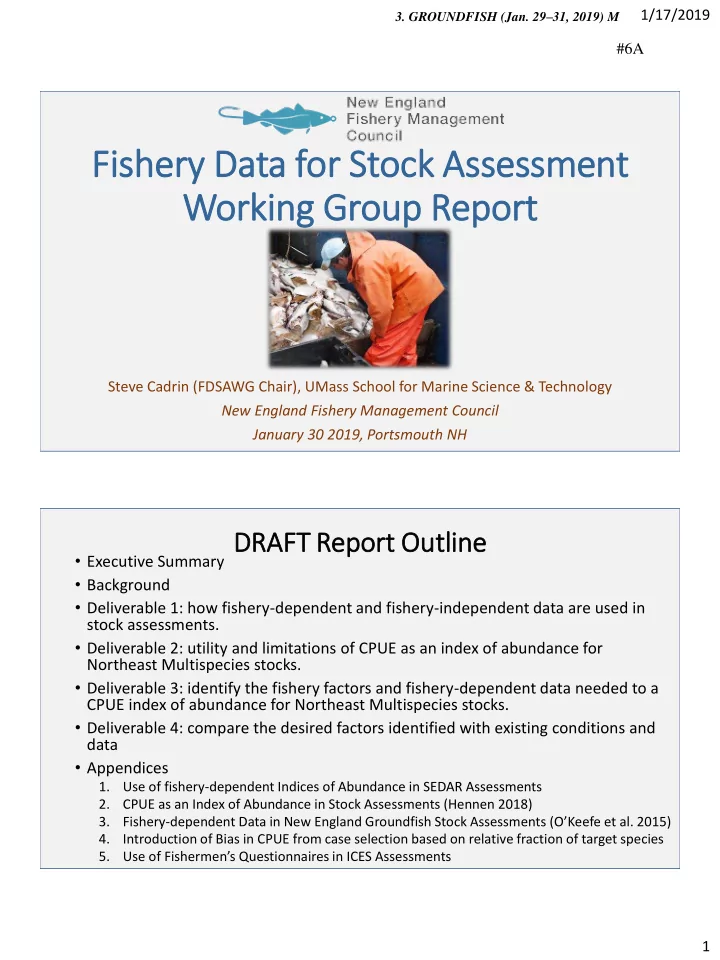
1/17/2019 3. GROUNDFISH (Jan. 29 31, 2019) M #6A Fis ishery ry Data for Stock Assessment Working Group Rep eport Steve Cadrin (FDSAWG Chair), UMass School for Marine Science & Technology New England Fishery Management Council


slide-1
SLIDE 1

1/17/2019 1

Fis ishery ry Data for Stock Assessment Working Group Rep eport

Steve Cadrin (FDSAWG Chair), UMass School for Marine Science & Technology New England Fishery Management Council January 30 2019, Portsmouth NH

DRA RAFT FT Rep eport t Out utli line

  • Executive Summary
  • Background
  • Deliverable 1: how fishery-dependent and fishery-independent data are used in

stock assessments.

  • Deliverable 2: utility and limitations of CPUE as an index of abundance for

Northeast Multispecies stocks.

  • Deliverable 3: identify the fishery factors and fishery-dependent data needed to a

CPUE index of abundance for Northeast Multispecies stocks.

  • Deliverable 4: compare the desired factors identified with existing conditions and

data

  • Appendices

1. Use of fishery-dependent Indices of Abundance in SEDAR Assessments 2. CPUE as an Index of Abundance in Stock Assessments (Hennen 2018) 3. Fishery-dependent Data in New England Groundfish Stock Assessments (O’Keefe et al. 2015) 4. Introduction of Bias in CPUE from case selection based on relative fraction of target species 5. Use of Fishermen’s Questionnaires in ICES Assessments

  • 3. GROUNDFISH (Jan. 29–31, 2019) M

#6A

slide-2
SLIDE 2

1/17/2019 2

Prese esentatio ion Out utli line

  • Background
  • Deliverables
  • 1. how fishery-dependent and fishery-

independent data are used in stock assessments.

  • 2. utility and limitations of CPUE as an index
  • f abundance for Northeast Multispecies

stocks.

  • 3. fishery factors and fishery-dependent data

needed for a reliable CPUE index

  • 4. desired factors and existing conditions
  • Recommendations

Back ackground

  • Amendment 23 to the

Multispecies Fishery Management Plan

  • to implement measures to

improve reliability and accountability of catch reporting and to ensure a precise and accurate representation of catch (landings and discards).

  • www.nefmc.org/library/amendment-23
slide-3
SLIDE 3

1/17/2019 3

Fish Fishery ry Data a for

  • r Stock
  • ck Asse

ssessments

  • The Council formed a working group to discuss the topic of how

fishery-dependent data can be used to inform stock abundance to address four main deliverables:

  • 1. explain how fishery-dependent and fishery-independent data are used in

stock assessments,

  • 2. summarize the utility and limitations of using fishery catch rates (CPUE,

catch per unit effort) as an index of abundance for Northeast Multispecies stocks,

  • 3. identify the fishery factors and fishery-dependent data needed to create a

CPUE that would be a reliable index of abundance for Northeast Multispecies stocks, and

  • 4. compare the desired factors identified with existing conditions and data for

the fishery.

Wor

  • rkin

ing Group

Robin Frede (NEFMC) Emily Keiley (GARFO) Brian Linton (NEFSC) J-J Maguire (SSC) Paul Rago (NEFSC retired) Rich Bell (TNC) Vito Giacalone (NESC) Chad Demarest (NEFSC) Chris Brown (FV Proud Mary) Mark Gibson (RIDEM retired)

slide-4
SLIDE 4

1/17/2019 4

Oth ther Con

  • ntributors

Cate O’Keefe (MADMF) Greg DeCelles (MADMF) Brooke Wright (SMAST) Alex Hansell (SMAST) Chris McGuire (TNC) Dan Hennen (NEFSC)

Wor

  • rkin

ing Group Proc

  • cess
  • Four meetings were held at SMAST (April 26 2018, June 25 2018, August 6 2018,

September 7, 2018) to review the expected deliverables, develop a work plan, review information relevant to deliverables and form recommendations.

  • Recommendations were reviewed on a conference call (November 2, 2018), and

the consensus report was developed by correspondence.

  • Draft report presented to SSC review panel November 30 2018, Providence RI.
slide-5
SLIDE 5

1/17/2019 5

from Dan Salerno, fishery data mapping

Prese esentatio ion Out utli line

  • Background
  • Deliverables
  • 1. how fishery-dependent and fishery-

independent data are used in stock assessments.

  • 2. utility and limitations of CPUE as an index
  • f abundance for Northeast Multispecies

stocks.

  • 3. fishery factors and fishery-dependent data

needed for a reliable CPUE index

  • 4. desired factors and existing conditions
  • Recommendations
slide-6
SLIDE 6

1/17/2019 6

How fi fishery ry-dependent an and fi fishery ry-in independent t da data ar are e use used in n stoc

  • ck ass

assessments

  • Population models are fit to the available fishery and fishery-

independent data to estimate a time series of stock abundance, age structure and fishing mortality.

  • 1. A time series of total fishery removals is derived from several fishery

monitoring programs (commercial landings, commercial discards, recreational landings, and recreational discards)

  • 2. Fishery-independent surveys or fishery catch rates provide indices of

relative stock abundance

  • 3. Size or age composition of the stock and of the fishery

Stoc

  • ck Asse

ssessment t & Fis Fishery ry Man anagement

http://www.st.nmfs.noaa.gov/

slide-7
SLIDE 7

1/17/2019 7

Age or Size Composition of Catch Commercial Catch Recreational Catch Total Removals by stock and fleet

  • Commercial Landings
  • Commercial Discards
  • Recreational Landings
  • Recreational Discards

Commercial Dealer Reports Commercial Logbooks Port Sampling At-Sea Observers Recreational Information Resource Surveys Age or Size Composition of the Stock

STOCK ASSESSMENT

State Landings Canadian Catch Fishery-Independent Indices Abundance Indices Fishery Catch Rates eVTR EM

Ex Exam ample le Stoc

  • ck Asse

ssessment

  • 2013 benchmark stock

assessment of white hake (NEFSC 2013)

  • Relatively recent
  • Relatively non-controversial

(rare for a groundfish stock!)

  • Demonstrates typical data

components and features

  • Appears to be promising for

considering fishery catch rates

slide-8
SLIDE 8

1/17/2019 8

White Hake (NEFSC 2013) NEFSC (2013)

The times series of fishery removals is used in the stock assessment for:

  • 1. minimum stock sizes
  • 2. amount of sustained productivity.

The assessment also accounts for some natural mortality and survival each year based on age composition and stock abundance indices.

Fishery Catch (tons)

slide-9
SLIDE 9

1/17/2019 9 Fishery Age Composition Survey Age Composition

Lower Survival Lower Survival Higher Survival Higher Survival Weaker

Recruitment

Stronger

Recruitment NEFSC (2013) NEFSC (2013)

slide-10
SLIDE 10

1/17/2019 10

NEFSC (2013) NEFSC (2013)

slide-11
SLIDE 11

1/17/2019 11

How fi fishery ry-dependent an and fi fishery ry-in independent t da data ar are e use used in n stoc

  • ck ass

assessments

  • Population models are fit to the available fishery and fishery-

independent data to estimate a time series of stock abundance, age structure and fishing mortality.

  • 1. A time series of total fishery removals is derived from several fishery

monitoring programs (commercial landings, commercial discards, recreational landings, and recreational discards)

  • 2. Fishery-independent surveys or fishery catch rates provide indices of

relative stock abundance

  • 3. Size or age composition of the stock and of the fishery

Prese esentatio ion Out utli line

  • Background
  • Deliverables
  • 1. how fishery-dependent and fishery-

independent data are used in stock assessments.

  • 2. utility and limitations of CPUE as an index
  • f abundance for Northeast Multispecies

stocks.

  • 3. fishery factors and fishery-dependent data

needed for a reliable CPUE index

  • 4. desired factors and existing conditions
  • Recommendations
slide-12
SLIDE 12

1/17/2019 12

Usin sing CPUE E as as an an In Index of

  • f Abu

bundance

  • Fishery catch rates (CPUE) are used in many stock assessment models

as an index of stock abundance.

  • These applications assume that catch rates are proportional to stock

abundance, but this assumption is only valid in some situations.

  • Fisheries are not designed to representatively sample a fish population, so

trends in catch rates may not reflect trends in the stock.

  • Fishery catch rates can be standardized to account for factors like changing

patterns in fishing area, fishing season, or vessel characteristics, but some factors cannot be effectively standardized.

Recreational CPUE 1990 2000 2010 NEFSC 2018

Usin sing CPUE E as as an an In Index of

  • f Abu

bundance

  • Stock assessments of New England

groundfish currently do not use fishery catch rates as an index of abundance in the stock assessment model.

  • Fishery catch rates are used in other

northeast U.S. stock assessments and was previously used in most groundfish assessments before 2008.

  • Several more recent groundfish assessments

considered fishery catch rates but did not include it as an index of abundance.

slide-13
SLIDE 13

1/17/2019 13

Usin sing CPUE E as as an an In Index of

  • f Abu

bundance

  • Despite the limitations of using fishery catch rates as an index of abundance in

some situations, including CPUE in a stock assessment can be informative.

  • Including CPUE as an index of abundance has the potential to improve

performance of groundfish assessments if the index is sufficiently standardized, particularly during periods with changes to survey operations.

Legault & McCurdy 2018

Con

  • nsid

iderin ing CPUE E in a a Stock

  • ck Asse

ssessment

  • Even if it is not used in the stock assessment model, fishery data can

provide information with high spatial and temporal resolution to help to understand fishery dynamics.

  • Including fishery perceptions may also improve the acceptance of stock

assessment results by the fishing industry.

Appendix 6. Fishers’ North Sea Stock Survey

slide-14
SLIDE 14

1/17/2019 14

Prese esentatio ion Out utli line

  • Background
  • Deliverables
  • 1. how fishery-dependent and fishery-

independent data are used in stock assessments.

  • 2. utility and limitations of CPUE as an index
  • f abundance for Northeast Multispecies

stocks.

  • 3. fishery factors and fishery-dependent data

needed for a reliable CPUE index

  • 4. desired factors and existing conditions
  • Recommendations

Req equirements ts for

  • r a

a Relia eliable CPUE E In Index

  • Several aspects of fisheries and data are needed to create a

reliable index of abundance for Northeast Multispecies stocks:

  • Differences in fishing power need to be standardized.
  • Information on target species is helpful to exclude effort that is

avoiding ‘choke stocks’.

  • Catch estimates need to be accurate.
  • An understanding of fishing effort is needed for each type of fishery.
  • Fine-scale temporal and spatial information is helpful for

standardizing fishing effort.

  • Inclusion probabilities of fishery observations (i.e., the chance of

each time/location observation being sampled) should be known.

slide-15
SLIDE 15

1/17/2019 15

Sou

  • utheast Da

Data & Asses essment Revi view (S (SEDAR) Guid idelines

Appendix 1

2013 Whit ite Hak ake Ben enchmark Asse ssessment

  • Fishery catch rate indices were not expected to perform well because of

management changes affecting effort.

International Total Allowable Catch Days at Sea for ‘Optimum Yield’ Input Controls to End Overfishing A C L / S e c t

  • r

Port interviews Logbooks WGOM & Cashes closures

slide-16
SLIDE 16

1/17/2019 16

2013 Whit ite Hak ake Ben enchmark Asse ssessment

  • Several LPUE (Landings per unit effort) indices were developed:
  • Trawl (standardized by statistical area, quarter-year and vessel tonnage)
  • Directed trawl (white hake >40% catch, standardized by statistical area,

quarter-year and vessel tonnage)

  • Sink gillnet (standardized by statistical area, quarter-year and vessel tonnage)

NEFSC (2013)

2013 Whit ite Hak ake Ben enchmark Asse ssessment

NEFSC (2013)

  • Fishery catch rate indices were correlated well with the survey trends, but there

was little interest in using it in the model.

  • Although the LPUE indices were not included in the stock assessment model,

they were more strongly correlated to the stock estimates than survey indices.

slide-17
SLIDE 17

1/17/2019 17

Catch Ra Rates fr from

  • m Directed Fish

Fishin ing Effort

  • Selecting targeted effort helps to remove ‘avoidance’ fishing behavior.
  • Selecting trips that caught a large proportion of the target species increases

the value of LPUE (Appendix 4), and the bias can change over time.

  • An alternative is to collaborate with fishermen to identify criteria (seasons,

areas, gears, …) to define a ‘footprint’ of targeted fishing effort.

Cadrin & Wright 2016

In Indic ices tha that ar are e Not

  • t Proportio

ional l to

  • Abu

bundance

  • Most stock assessments assume that indices are directly proportional to

abundance, but some are not.

  • Hyperstability: fishing effort is concentrated in areas of abundance, and CPUE is not

sensitive to decreased population abundance, only local density

  • Hyperdepletion: CPUE decreases faster than abundance due to patterns of fish behavior
slide-18
SLIDE 18

1/17/2019 18

Prese esentatio ion Out utli line

  • Background
  • Deliverables
  • 1. how fishery-dependent and fishery-

independent data are used in stock assessments.

  • 2. utility and limitations of CPUE as an index
  • f abundance for Northeast Multispecies

stocks.

  • 3. fishery factors and fishery-dependent data

needed for a reliable CPUE index

  • 4. desired factors and existing conditions
  • Recommendations

Desi esired Fac actors an and Ex Exis istin ing Con

  • ndit

itions

  • A large amount of fishery-dependent data is currently collected from fishermen

in the Northeast multispecies fishery, but fishery catch rates are not currently being used in groundfish stock assessment models because of:

  • limitations in the monitoring programs (e.g., data resolution, mis-reporting, observer bias),
  • constraints of the stock assessment process (e.g., increasing scope of assessments with

limited time and resources), and

  • challenges posed by current conditions in the groundfish fishery (e.g., avoidance behavior).
slide-19
SLIDE 19

1/17/2019 19

Log

  • gbooks
  • Vessel Trip Reports (VTRs) do not record fine-scale effort data.
  • Many VTRs report aggregate effort and by statistical fishing areas.
  • The data in VTRs is self-reported but is not verified (e.g., location, discarded catch).
  • Vessel Monitoring System (VMS) information could be used to verify VTR location

information, but such evaluations are rare.

Observer Bias

  • At-sea observer coverage is based on achieving a standard of precision for discard

estimates but does not account for ‘observer bias’ (i.e., observed trips do not represent unobserved trips because of nonrandom sampling of trips and differences in fishing behavior).

Appendix 5. Demarest 2018

slide-20
SLIDE 20

1/17/2019 20

Dea eale ler Rep eports

  • Federally permitted seafood dealers submit weekly electronic reports.
  • Total landings derived from dealer reports are assumed to be a census of

fishery landings, but recent violations document substantial mis-reporting.

  • The magnitude of misreporting and bias in estimates of landings are unknown.

New Tec echnolo logie ies

  • Study fleets and Electronic Monitoring (EM) projects have the potential

to provide greater spatial and temporal resolution of catch and effort.

  • Both systems integrate logbooks with vessel positioning systems, and both

have options for verifiable self-reported data.

  • eVTRs and EM are used to monitor a portion of the groundfish fleet, but the

data are not routinely used to derive CPUE.

EcoTrust Canada

slide-21
SLIDE 21

1/17/2019 21

Prese esentatio ion Out utli line

  • Background
  • Deliverables
  • 1. how fishery-dependent and fishery-

independent data are used in stock assessments.

  • 2. utility and limitations of CPUE as an index
  • f abundance for Northeast Multispecies

stocks.

  • 3. fishery factors and fishery-dependent data

needed for a reliable CPUE index

  • 4. desired factors and existing conditions
  • Recommendations

Rec ecommendatio ions

  • 1. As a routine term of reference, a time series of fishery catch rates should be

evaluated and considered as an index of abundance in all benchmark stock assessments, not necessarily accepted as an index of abundance in the final stock assessment model.

  • 2. For fishery catch rates to be considered as an index of abundance in stock

assessment models, catch rates must be sufficiently standardized to account for changes in vessel efficiency, gear selectivity, targeting/avoidance behavior, inclusion probabilities, spatial aggregation of fish, and hyperstability (e.g., SEDAR checklist, Appendix 1).

  • 3. Identifying best practices for developing a standardized fishery catch rate index

using northeast fishery monitoring data would be an appropriate topic for a research track assessment for all groundfish stocks.

slide-22
SLIDE 22

1/17/2019 22

Rec ecommendatio ions

  • 4. Simulation analysis should be used to evaluate the performance of

alternative approaches to developing standardized fishery catch rate as an index of abundance.

  • 5. Processes for soliciting fishermen’s expertise for understanding

factors of catch rates, fishing patterns, and targeting or avoidance behavior should be included in the stock assessment process such as workshops and questionnaires.

  • 6. Study fleets that have similar gear, vessel size, vessel power and

target species should be considered for the development of fishery catch rate indices.

  • 7. At-sea observer data should be used in the development of fishery

catch rate indices with fine-scale standardization, but ‘observer bias’ should be considered.

Rec ecommendatio ions

  • 8. Advanced technologies (e.g., electronic monitoring systems) should

be considered in the development of fishery catch rate indices with fine-scale standardization.

  • 9. Criteria should be developed to identify targeted fishing effort by

species, including historical, fishery “footprints.” 10.Appropriate units of fishing effort should be developed for each type

  • f fishery (e.g., trawl, gillnet, and hook gears).
slide-23
SLIDE 23

1/17/2019 23

Next xt Step eps

  • Working Group meeting to address technical feedback from SSC review
  • Propose options for implementing recommendations