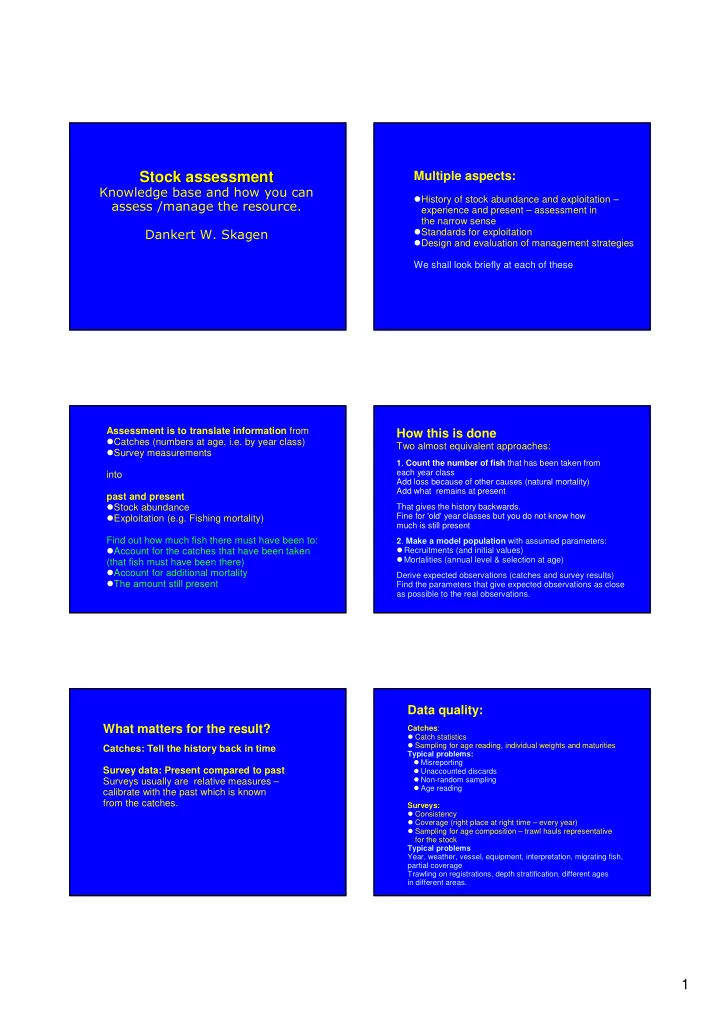
Stock assessment Stock assessment Multiple aspects: K - - PDF document

stock assessment stock assessment
SMART_READER_LITE
LIVE PREVIEW

Stock assessment Stock assessment Multiple aspects: K - - PDF document

Stock assessment Stock assessment Multiple aspects: K History of stock abundance and exploitation


slide-1
SLIDE 1

1

Stock assessment Stock assessment

K

  • Multiple aspects:

History of stock abundance and exploitation – experience and present – assessment in the narrow sense Standards for exploitation Design and evaluation of management strategies We shall look briefly at each of these Assessment is to translate information from Catches (numbers at age, i.e. by year class) Survey measurements into past and present Stock abundance Exploitation (e.g. Fishing mortality) Find out how much fish there must have been to: Account for the catches that have been taken (that fish must have been there) Account for additional mortality The amount still present

How this is done

Two almost equivalent approaches:

  • 1. Count the number of fish that has been taken from

each year class Add loss because of other causes (natural mortality) Add what remains at present That gives the history backwards. Fine for 'old' year classes but you do not know how much is still present

  • 2. Make a model population with assumed parameters:

Recruitments (and initial values) Mortalities (annual level & selection at age) Derive expected observations (catches and survey results) Find the parameters that give expected observations as close as possible to the real observations.

What matters for the result?

Catches: Tell the history back in time Survey data: Present compared to past Surveys usually are relative measures – calibrate with the past which is known from the catches.

Data quality:

Catches: Catch statistics Sampling for age reading, individual weights and maturities Typical problems: Misreporting Unaccounted discards Non-random sampling Age reading Surveys: Consistency Coverage (right place at right time – every year) Sampling for age composition – trawl hauls representative for the stock Typical problems Year, weather, vessel, equipment, interpretation, migrating fish, partial coverage Trawling on registrations, depth stratification, different ages in different areas.

slide-2
SLIDE 2

2

True Last yr 2 yrs ago 4 yrs ago 50 100 150 The effect on the TAC advice of a wrong survey index in one year

Index 50% too high Percent True Last yr 2 yrs ago 4 yrs ago

200 400 600 800 1000 1200 1400

SSB after the TAC is taken

Does it matter?

The effect of one wrong survey measurement on TAC at Fstatus quo and predicted SSB after the TAC is taken. Artificial data, all perfect except for that survey.

<-50

  • 50 - -40
  • 40 - -30
  • 30 - -20
  • 20 - -10
  • 10 - 0

0 - 10 10 - 20 20 - 30 30 - 40 40 - 50 > 50 5 10 15 20 25 30 D_all_Sep D_all_VPA D_even_Sep D_even_VPA

Another example with artificial data - how survey noise propagates to the TAC advice

Perfect catch data Noisy survey data (random noise + year effects) – CV 20% in all years. Different assessment methods Advised increase in TAC – correct is 11%

Standards for exploitation

Two approaches: Equilibrium considerations Yield per recruit and SSB – recruit relation Simulations taking into account variation in Recruitment Growth Maturation

Yield and SSB per recruit:

Long term equilibrium when everything is constant We look at how the yield and the SSB depend on the fishing mortality. Artificial data. For F above F0.1, the curve is almost flat. Some stocks will have a distinct maximum, others not Depends on growth rate, selection at age and natural mortality

Messages from the yield per recruit

Above F0.1, it does not pay much in the long term to increase the fishing mortality. Same yield with more work For some stocks the yield will go down with increasing F – the growth potential is not utilized As F increases, SSB goes down. At some F, SSB will reach a level that leads to impaired recruitment. Often, that is the limiting factor. This is all about long term average, not what you get next year

Stock-recruit functions

How does the recruitment depend on the spawning biomass (SSB)?

Many variants, often difficult to choose Important: The SSB where the recruitment gets impaired What happens if the SSB becomes very large What happens at very low SSB

slide-3
SLIDE 3

3

Combining yield per recruit and stock-recruit and taking the variations in recruitment into account we get a more complete basis for decisions:

Assumed Hockey stick stock recruitment function. Risk is the probability of falling below the break-point.

When discussing long term strategies, keep in mind that the ecosystems are not static. For large pelagic stocks periods with high and low productivity is very common. These are processes in nature, but the fishery has to adapt to that.

The figure shows the annual catch of some important pelagic stocks. The scale is not the same for all the stocks.

Simulation of management rules

Make a test-bench that is a plausible set of artificial populations We apply proposed harvest rules to them, to see how they perform. The harvest rules are applied to a perceived stock, which comes out of assessments.

Population model Observation model Decision rule Implementation Actual removal by the fis hery True s tock Apparent s tock TAC Model seque nce Data flow

To do this kind of study requires:

Very careful consideration on how the population model is conditioned. Insight in the strengths and weaknesses in the data that go into the assessment Interpretation of the management rule - it must be programmable Insight in priorities and preferences Experience in how rules can be made workable. These processes take time. Communication between stakeholders is essential: Explore ideas from all parties – this is a creative process. Mutual understanding Confidence in the process and results

Some final words about management plans

What matters most at the end is the average fishing mortality that the plan leads to. How you get to that level of fishing mortality is a matter of taste For the safety, the plan must allow for sufficient action sufficiently early to cope with unexpected changes in nature. Nature sets limitations to what you can get. Science can tell about that, but it cannot negotiate nature.