Fiscal 2009 First Information Meeting Summary of Questions and - - PDF document

fiscal 2009 first information meeting
SMART_READER_LITE
LIVE PREVIEW

Fiscal 2009 First Information Meeting Summary of Questions and - - PDF document

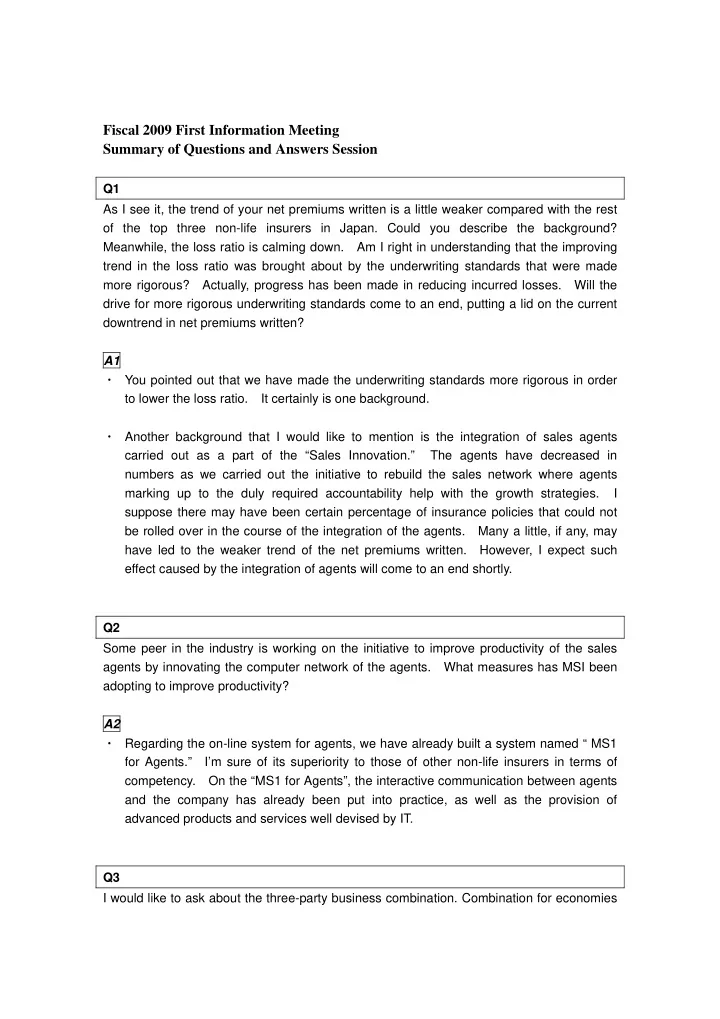
Fiscal 2009 First Information Meeting Summary of Questions and Answers Session Q1 As I see it, the trend of your net premiums written is a little weaker compared with the rest of the top three non-life insurers in Japan. Could you describe the


slide-1
SLIDE 1

Fiscal 2009 First Information Meeting Summary of Questions and Answers Session

Q1 As I see it, the trend of your net premiums written is a little weaker compared with the rest

  • f the top three non-life insurers in Japan. Could you describe the background?

Meanwhile, the loss ratio is calming down. Am I right in understanding that the improving trend in the loss ratio was brought about by the underwriting standards that were made more rigorous? Actually, progress has been made in reducing incurred losses. Will the drive for more rigorous underwriting standards come to an end, putting a lid on the current downtrend in net premiums written? A1 ・ You pointed out that we have made the underwriting standards more rigorous in order to lower the loss ratio. It certainly is one background. ・ Another background that I would like to mention is the integration of sales agents carried out as a part of the “Sales Innovation.” The agents have decreased in numbers as we carried out the initiative to rebuild the sales network where agents marking up to the duly required accountability help with the growth strategies. I suppose there may have been certain percentage of insurance policies that could not be rolled over in the course of the integration of the agents. Many a little, if any, may have led to the weaker trend of the net premiums written. However, I expect such effect caused by the integration of agents will come to an end shortly. Q2 Some peer in the industry is working on the initiative to improve productivity of the sales agents by innovating the computer network of the agents. What measures has MSI been adopting to improve productivity? A2 ・ Regarding the on-line system for agents, we have already built a system named “ MS1 for Agents.” I’m sure of its superiority to those of other non-life insurers in terms of

  • competency. On the “MS1 for Agents”, the interactive communication between agents

and the company has already been put into practice, as well as the provision of advanced products and services well devised by IT. Q3 I would like to ask about the three-party business combination. Combination for economies

slide-2
SLIDE 2
  • f scale would be an understandable reason for this move for medium-sized non-life

insurers, but why does MSIG need it, given that it already has sufficient scale? A3 ・ Our goal is to create a globally operating player. For that reason, economies of scale are necessary to a certain degree. I also believe that the main arena of competition is now shifting from sales to quality in the insurance sector in Japan. Change never stops in this industry, I believe, so our best option is to integrate with Aioi Insurance Co., Ltd. (“AIOI”) and Nissay Dowa General Insurance Co., Ltd.(“NDGI”), to further improve

  • quality. We aim to become a world-leading player in terms of both earnings and quality.

Q4 The new group will be the largest non-life insurer in Japan in terms of sales. If you wish to extend the current portfolio, how would you view the Asian life and non-life insurance markets? A4 ・ I may well discuss this probably along with numerical targets in autumn this year when the Group’s management plan is scheduled to be released. Certainly, the Domestic Non-life Insurance business will be our core business as ever. While we will build up a balanced portfolio, domestically and internationally, consisting also of Life Insurance business, Overseas business and other new businesses. ・ Regarding the Overseas business, Asia is the priority area for us, and since AIOI too has been relatively active in that region, I expect no change in the strategy of prioritizing Asian region even after business combination. We are one of the leading foreign non-life insurers in Asia, and will continue to be active in examining M&As if they are promising deals in non-life sector. In addition, we are currently carrying out researches in life insurance market there, which is our area of interest. Q5 Turning to the domestic life insurance business, what plans do you have for developing the current operation? A5 ・ Regarding MS Kirameki Life Insurance and MS MetLife Insurance, core vehicles in Life Insurance business of MSIG Group, we will continue to nurture them as core vehicles after business combination as well.

slide-3
SLIDE 3

・ We would like MS Kirameki Insurance and Aioi Life to combine with each other as soon as practically possible, as they have business models in common. In reality, though, it is unlikely as we are giving priority to combination in the non-life sector. But we would like to complete combination in life insurance businesses at the earliest possible date. Q6 May I have your view on what is going to happen after April 2010 (in which the business combination by way of a holding company structure is scheduled to take place)? For example, how do you see the prospect of further mergers taking place in the group? A6 ・ We would like to draw a picture as soon as possible on the development after April

  • 2010. As you are aware, as of April 2010, the two non-life insurance entities coexist

under the holding company, that is, MSI and the entity resulting from the merger between AIOI and NDGI. I am going to explain about the reasons why we considered it a best option. ・ Firstly, considering the one-year-odd period from the release of the commencement of discussion up to the scheduled implementation of the business combination, we thought it would not be physically feasible for the three entities with substantial scale to merge during the period. So, we opted for a more realistic way, that is, for AIOI and NDGI to merge. ・ Secondly, taking into account the possibility that non-life insurance entities are allowed to reorganize the group by markets or by functions. Of course, it’s subject to revision

  • f insurance regulations. Anyway, we thought we would be able to cope with the

circumstances more flexibly and strategically if we retain multiple insurance licenses than one.

  • end -
slide-4
SLIDE 4

Mitsui Sumitomo Insurance Group Holdings, Inc. (“MSIGH”) may file a registration statement on Form F-4 (“Form F-4”) with the U.S. Securities and Exchange Commission (the “SEC”) in connection with the proposed business combination among Aioi Insurance Co., Ltd. (“AIOI”), Nissay Dowa General Insurance Company, Limited (“NDGI”) and MSIGH. The Form F-4 (if filed) will contain a prospectus and other documents. If a Form F-4 is filed and declared effective, the prospectus contained in the Form F-4 will be mailed to U.S. shareholders of AIOI prior to the shareholders’ meetings at which the proposed business combination will be voted upon. The Form F-4 and prospectus (if the Form F-4 is filed) will contain important information about AIOI, NDGI, MSIGH, the proposed business combination and related matters. U.S. shareholders of AIOI are urged to read the Form F-4, the prospectus and other documents that may be filed with the SEC in connection with the proposed business combination carefully before they make any decision at the shareholders’ meeting with respect to the proposed business combination. Any documents filed with the SEC in connection with the proposed business combination will be made available when filed, free of charge, on the SEC’s web site at www.sec.gov. Such documents may also be obtained free of charge by directing a request to the contact information as indicated below: Investor Relations Department Mitsui Sumitomo Insurance Group Holdings, Inc. Phone: +81-3-3297-6486 Facsimile: +81-3-3297-6935 e-mail : msi_ir@ms-ins.net http://www.msig.com Note Regarding Forward-looking Statements This document includes “forward-looking statements” that reflect the plans and expectations of AIOI, NDGI and MSIGH in relation to, and the benefits resulting from, their proposed business combination and business alliance described above. To the extent that statements in this press release do not relate to historical or current facts, they constitute forward-looking statements. These forward-looking statements are based on the current assumptions and beliefs of AIOI, NDGI and MSIGH in light of the information currently available to them, and involve known and unknown risks, uncertainties and other factors. Such risks, uncertainties and

  • ther factors may cause the actual results, performance, achievements or financial position of AIOI, NDGI and

MSIGH (or the post-business combination group) to be materially different from any future results, performance, achievements or financial position expressed or implied by these forward-looking statements. AIOI, NDGI and MSIGH undertake no obligation to publicly update any forward-looking statements after the date of this document. Investors are advised to consult any further disclosures by AIOI, NDGI and MSIGH (or the post-business combination group) in their subsequent domestic filings in Japan and filings with the U.S. Securities and Exchange Commission. The risks, uncertainties and other factors referred to above include, but are not limited to: (1) economic conditions in Japan, the United States, Europe and China; (2) the extent of competition faced by AIOI, NDGI and MSIGH (or the post-business combination group) from Japan’s other major non-life insurance companies and new entrants in the Japanese non-life insurance market; (3) the extent of further deregulation of the Japanese insurance industry; (4) occurrence of natural disasters in Japan and elsewhere; (5) occurrence of losses the type or magnitude of which could not be foreseen at the time of writing the insurance policies covering such losses; (6) the price and availability of reinsurance; (7) the performance of their (or the post-business combination group’s) investments; (8) the parties being unable to reach a mutually satisfactory agreement on the detailed terms of the proposed business combination or otherwise unable to complete the transaction; and (9) difficulties in realizing the synergies and benefits of the post-business combination group.