= = h ( t ) ( t kT ) that has the Fourier - - PDF document

h t t kt that has the fourier transform
SMART_READER_LITE
LIVE PREVIEW

= = h ( t ) ( t kT ) that has the Fourier - - PDF document

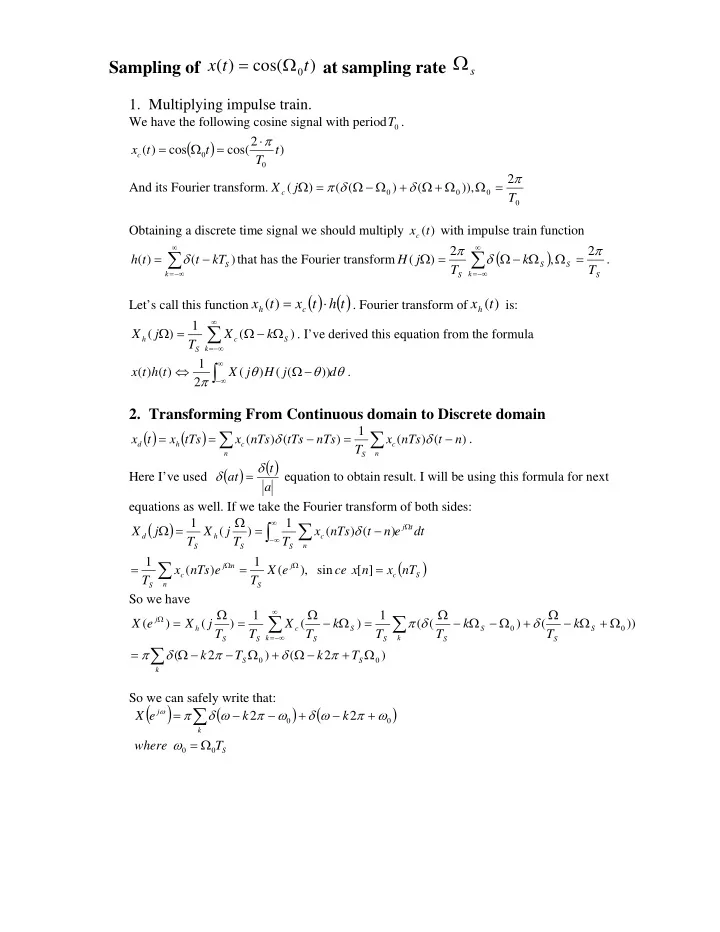
= x ( t ) cos( 0 t ) Sampling of at sampling rate s 1. Multiplying impulse train. We have the following cosine signal with period T . 0 ( ) 2 = = x c ( t ) cos t cos( t ) 0 T 0 2 =


slide-1
SLIDE 1

Sampling of ) cos( ) (

0t

t x Ω = at sampling rate

s

  • 1. Multiplying impulse train.

We have the following cosine signal with period T .

( )

) 2 cos( cos ) ( t T t t xc π ⋅ = Ω = And its Fourier transform. 2 )), ( ) ( ( ) ( T j X c π δ δ π = Ω Ω + Ω + Ω − Ω = Ω Obtaining a discrete time signal we should multiply ) (t xc with impulse train function ) ( ) (

S k

kT t t h − = ∑

∞ −∞ =

δ that has the Fourier transform

( )

S S S k S

T k T j H π δ π 2 , 2 ) ( = Ω Ω − Ω = Ω

∞ −∞ =

. Let’s call this function

( ) ( )

t h t x t x

c h

⋅ = ) (

. Fourier transform of

) (t xh

is: ) ( 1 ) (

S k c S h

k X T j X Ω − Ω = Ω

∞ −∞ =

. I’ve derived this equation from the formula θ θ θ π d j H j X t h t x

∞ ∞ −

− Ω ⇔ )) ( ( ) ( 2 1 ) ( ) ( .

  • 2. Transforming From Continuous domain to Discrete domain

( ) ( )

∑ ∑

− = − = =

n c S n c h d

n t nTs x T nTs tTs nTs x tTs x t x ) ( ) ( 1 ) ( ) ( δ δ . Here I’ve used ( )

( )

a t at δ δ = equation to obtain result. I will be using this formula for next equations as well. If we take the Fourier transform of both sides:

( ) ( )

S c j S n n j c S t j n c S S h S d

nT x n x ce e X T e nTs x T dt e n t nTs x T T j X T j X = = = − = Ω = Ω

Ω Ω Ω ∞ ∞ −

∑ ∫ ∑

] [ sin ), ( 1 ) ( 1 ) ( ) ( 1 ) ( 1 δ So we have ) 2 ( ) 2 ( )) ( ) ( ( 1 ) ( 1 ) ( ) ( Ω + − Ω + Ω − − Ω = Ω + Ω − Ω + Ω − Ω − Ω = Ω − Ω = Ω =

∑ ∑ ∑

∞ −∞ = Ω S S k S S S S k S S S k c S S h j

T k T k k T k T T k T X T T j X e X π δ π δ π δ δ π So we can safely write that:

( )

( ) ( )

S k j

T where k k e X 2 2 Ω = + − + − − = ∑ ω ω π ω δ ω π ω δ π

ω

slide-2
SLIDE 2
  • 3. Transforming From Discrete domain to DFT

DFT is defined for finite extend signals. It is also the samples of DTFT of this finite extended signal. Let’s say DFT size is N. We have the window

  • therwise

n w and N n for n w , ] [ 1 ,..., 1 , , 1 ] [ = − = = And DFT of x[n] for size N is samples of Fourier transform of x[n]*w[n] at k N π ω 2 = So we convolve these functions in frequency domain and sample it.

( )

( )

( )

( ) ( )

( )

( )

( )

( )

( )

( ) ( )

( )( )

( )

( )( )

( )

⎟ ⎟ ⎟ ⎟ ⎠ ⎞ ⎜ ⎜ ⎜ ⎜ ⎝ ⎛ ⎟ ⎠ ⎞ ⎜ ⎝ ⎛ − ⎟ ⎠ ⎞ ⎜ ⎝ ⎛ − + ⎟ ⎠ ⎞ ⎜ ⎝ ⎛ + ⎟ ⎠ ⎞ ⎜ ⎝ ⎛ + = + = ⎟ ⎠ ⎞ ⎜ ⎝ ⎛ + − + − − = = =

− − − − + − + − > < − > < −

∫ ∑ ∫

2 k sin 2 N k sin e 2 k sin 2 N k sin e 2 1 e W e W 2 1 d e W 2 m 2 m 2 1 N 2 where , d e W e X 2 1 ] k [ X

N N 2 1 N k j N N 2 1 N k j k j k j 2 k j m N 2 k j j

N N N N N N

ω ω ω ω ω ω ω ω θ ω π θ δ ω π θ δ π π π ω θ π

ω ω ω ω ω ω ω ω π θ ω π θ ω θ

If we find such a k so that 0 = −ω ω k N then we can see perfect impulse at index k or N- k and zero elsewhere. Otherwise the sinc function affects the shape of DFT; Figures: A Sampling process without aliasing:

2 4 6

  • 1
  • 0.5

0.5 1 t (sec) xc(t)→--,xh(t)→|^,xr(t)→-. Sampling of cos(2*π*0.2*t) at Fs = 2

  • 2
  • 1

1 2 0.5 1 1.5 2 |X

c(jf)|→o,|X h(jf)|→^,|Xr(jf)|→.

f (Hz) Magnitude 5 10

  • 1
  • 0.5

0.5 1 x[n] n Amplitude

  • 4
  • 2

2 4 5 10 |X[k]|,N = 10. Impulse at k = 1 k Magnitude

slide-3
SLIDE 3

Here is the same x[n] sequence but this time from an aliased sampling process.

2 4 6

  • 1
  • 0.5

0.5 1 t (sec) xc(t)→--,xh(t)→|^,xr(t)→-. Sampling of cos(2*π*1.8*t) at Fs = 2

  • 2
  • 1

1 2 0.5 1 1.5 2 |X

c(jf)|→o,|X h(jf)|→^,|Xr(jf)|→.

f (Hz) Magnitude 5 10

  • 1
  • 0.5

0.5 1 x[n] n Amplitude

  • 4
  • 2

2 4 5 10 |X[k]|,N = 10. Impulse at k = 1 k Magnitude

Here is an example where k is not integer…

2 4 6

  • 1
  • 0.5

0.5 1 t (sec) xc(t)→--,xh(t)→|^,xr(t)→-. Sampling of cos(2*π*0.5*t) at Fs = 2

  • 2
  • 1

1 2 0.5 1 1.5 2 |X

c(jf)|→o,|X h(jf)|→^,|Xr(jf)|→.

f (Hz) Magnitude 5 10

  • 1
  • 0.5

0.5 1 x[n] n Amplitude

  • 4
  • 2

2 4 5 10 |X[k]|,N = 10. Impulse at k = 2.5 k Magnitude