HI source finding algorithms Comparing the general purpose Duchamp - - PowerPoint PPT Presentation

hi source finding algorithms
SMART_READER_LITE
LIVE PREVIEW

HI source finding algorithms Comparing the general purpose Duchamp - - PowerPoint PPT Presentation

HI source finding algorithms Comparing the general purpose Duchamp algorithm to a purpose built HI source finding algorithm Wednesday, 5 May 2010 Talk Outline Common elements of source finding algorithms The Duchamp algorithm

slide-1
SLIDE 1

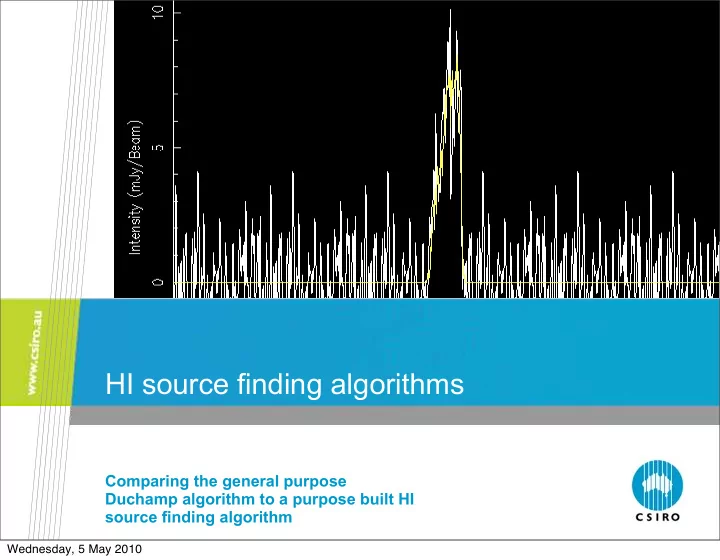
HI source finding algorithms

Comparing the general purpose Duchamp algorithm to a purpose built HI source finding algorithm

Wednesday, 5 May 2010

slide-2
SLIDE 2

Talk Outline

  • Common elements of source finding algorithms
  • The Duchamp algorithm
  • Algorithm
  • Strengths
  • Draw-backs
  • Improvements
  • An alternative HI source finder algorithm
  • Key differences
  • Algorithm
  • Preliminary work
  • Conclusion

Wednesday, 5 May 2010

slide-3
SLIDE 3

Common elements of general source finding algorithms

  • Define/calculate detection and growing criteria
  • Thresholds or False Detection Rate
  • Pre-condition data
  • Scan through data and apply detection criterion
  • Grow detections using growing criterion
  • Merge detections
  • Apply size criterion

Wednesday, 5 May 2010

slide-4
SLIDE 4

The Duchamp Algorithm

Wednesday, 5 May 2010

slide-5
SLIDE 5

Duchamp: Algorithm

  • Pre-condition data (optional)
  • Blank pixel removal
  • Baseline removal using wavelet reconstruction
  • Define channels to ignore
  • Wavelet reconstruction using a’ trous wavelet procedure (priority)

OR

  • Smooth in frequency space

OR

  • Smooth spatially
  • Set detection and growing criteria
  • User specified (priority)

OR

  • FDR or calculated from globally determined mean and rms values

Wednesday, 5 May 2010

slide-6
SLIDE 6

Duchamp: Algorithm

  • Raster scan data
  • Travel along planes or channels and apply detection criterion
  • If a voxel satisfies the detection criterion
  • Flag it
  • Check it’s proximity to all previous detections and merge accordingly
  • Can be turned off for efficiency, but default is ON.
  • Merge detections
  • Apply proximity test (again) to all detections
  • Grow detections
  • Merge detections again
  • Apply size criterion
  • Can be done prior to first round of merging

Wednesday, 5 May 2010

slide-7
SLIDE 7

Depiction of raster scanning

Image credit: Matt Whiting

Wednesday, 5 May 2010

slide-8
SLIDE 8

Depiction of threshold usage

Image credit: Matt Whiting

Wednesday, 5 May 2010

slide-9
SLIDE 9

Duchamp: Strengths

  • A truly general source finding algorithm
  • Makes minimal assumptions
  • Extremely flexible source detection
  • IT EXISTS! and IT WORKS!
  • Output is feature rich

Wednesday, 5 May 2010

slide-10
SLIDE 10

Feature rich output

Image credit: Matt Whiting

Wednesday, 5 May 2010

slide-11
SLIDE 11

Duchamp: Draw-backs

  • Efficiency decreases with the number of detections
  • Searching for faint sources is very inefficient
  • Default is to run a merging routine every time a detection is

made

  • Compared to every! previous detection
  • Merging is carried out multiple times
  • Size criterion is applied at the very end
  • Inefficient but necessary
  • Global detection and growing criteria are used
  • Noise varies throughout the cube
  • Detect ‘crud’ in some regions, miss detections in others
  • Multiple detections of single source
  • Detection threshold doesn’t correspond to source S/N level
  • S/Nvoxel = 2-5 x S/Nsource / √m, where m is the channels covered by

source

Wednesday, 5 May 2010

slide-12
SLIDE 12

Duchamp: Improvements

  • Sub-sample channels when raster scanning
  • Sampling set to size criterion
  • Minimise detections that eventually would fail size criterion
  • Define a data volume to check for previous detections
  • To be used when initial merging not turned off
  • Grow detections, merge (just the once), apply size and

detection threshold criteria

  • Apply growth criterion out to merging distance to fold in initial

merging pass

  • Use a local measure of noise

Wednesday, 5 May 2010

slide-13
SLIDE 13

A purpose built HI source finder algorithm

Wednesday, 5 May 2010

slide-14
SLIDE 14

Key differences

  • Treat datacube as a set of spectra rather than a collection of

voxels

  • Use shape information rather than a detection threshold
  • Can potentially detect faint objects that a detection threshold would

miss

  • Recover ‘true’ extent of source compared to using growth threshold
  • Implicit is the assumption that every detection has a discernible

shape

  • Assume that we have a well defined psf

Wednesday, 5 May 2010

slide-15
SLIDE 15

Key differences

  • Treat datacube as a set of spectra rather than a collection of

voxels

  • Use shape information rather than a detection threshold
  • Can potentially detect faint objects that a detection threshold would

miss

  • Recover ‘true’ extent of source compared to using growth threshold
  • Implicit is the assumption that every detection has a discernible

shape

  • Assume that we have a well defined psf

Wednesday, 5 May 2010

slide-16
SLIDE 16

Key differences

  • Treat datacube as a set of spectra rather than a collection of

voxels

  • Use shape information rather than a detection threshold
  • Can potentially detect faint objects that a detection threshold would

miss

  • Recover ‘true’ extent of source compared to using growth threshold
  • Implicit is the assumption that every detection has a discernible

shape

  • Assume that we have a well defined psf

Wednesday, 5 May 2010

slide-17
SLIDE 17

Key differences

  • Treat datacube as a set of spectra rather than a collection of

voxels

  • Use shape information rather than a detection threshold
  • Can potentially detect faint objects that a detection threshold would

miss

  • Recover ‘true’ extent of source compared to using growth threshold
  • Implicit is the assumption that every detection has a discernible

shape

  • Assume that we have a well defined psf

Wednesday, 5 May 2010

slide-18
SLIDE 18

Specific HI source finding algorithm

  • Divide data cube amongst CPUs
  • Clean side-lobes from data cube
  • Sub-sample the data cube
  • For a given spectrum
  • Pre-condition using iterative median smoothing
  • Use wavelet analysis to construct the noise spectrum + baselines

and remove

  • Detect objects using shape information
  • Cross-correlation?
  • Wavelet analysis?
  • Gamma test? (Even if just for measure of noise in spectrum)

Wednesday, 5 May 2010

slide-19
SLIDE 19

Specific HI source finding algorithm

  • For each detection, scan neighbouring positions in spiral

pattern to determine the volume containing the detection

  • Have a frequency range to process for neighbours
  • Well-known (and SOLVED) mouse navigating a maze problem
  • The solution provides a ‘shrink-wrapped’ volume
  • Merge detections
  • Merge CPU results
  • Apply size criterion
  • May have been incorporated earlier

Wednesday, 5 May 2010

slide-20
SLIDE 20

Preliminary work

  • Prototyping iterative median smoothing as a pre-conditioner
  • Using the WSRT simulated datacube
  • Comparing to performance of Hanning filtering
  • Results
  • Quantitatively, residuals cf. input spectrum are reduced by

~20-40%

  • Comparable to Hanning filtering, but doesn’t add/remove structure

in the cases where Hanning filtering does

Wednesday, 5 May 2010

slide-21
SLIDE 21

Conclusion

  • Duchamp is a great general purpose source finder
  • The efficiency of Duchamp could be improved
  • Proposing to treat datacube as a set of spectra and use shape

information to find HI sources

  • Development underway

Wednesday, 5 May 2010