
SLIDE 1
http://ars.userfriendly.org/cart
- ons/?id=20080627
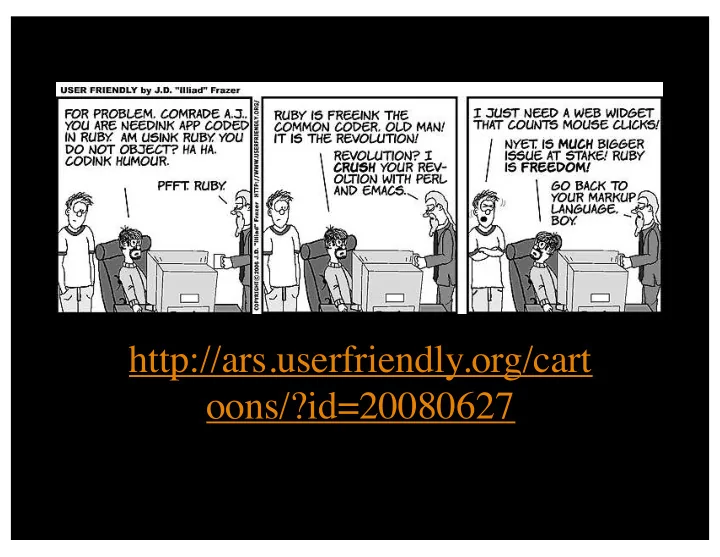
http://ars.userfriendly.org/cart oons/?id=20080627 CS 152: - - PowerPoint PPT Presentation
http://ars.userfriendly.org/cart oons/?id=20080627 CS 152: Programming Language Paradigms Blocks and Message Passing Prof. Tom Austin San Jos State University Smalltalk influences on Ruby Everything is an object Blocks Message
CS 152: Programming Language Paradigms
San José State University
Smalltalk influences on Ruby
File I/O
File I/O with blocks
Creating custom blocks
def with_prob (prob) yield if (Random.rand < prob) end with_prob 0.42 do puts "There is a 42% chance " + "that this code will print" end
Single-line if statements come after the body
def with_prob (prob, &blk) blk.call if (Random.rand < prob) end with_prob 0.42 do puts "There is a 42% chance " + "that this code will print" end
We can explicitly name the block of code Note that there is no '&' here.
def with_prob (prob, &blk) blk.call if (Random.rand < prob) end def half_the_time (&block) with_prob(0.5, &block) end
Explicitly naming the block is useful if we wish to pass it to another method
Writing withProb in JavaScript
JavaScript uses callbacks rather than blocks
What is the difference?
def coin_flip with_prob 0.5 do return "H" end return "T" end function coinFlip() { withProb(0.5, function() { return "H"; }); return "T"; }
JavaScript & prototypes
function Employee(name, salary) { this.name = name; this.salary = salary; } var a = new Employee("Alice", 75000); var b = new Employee("Bob", 50000); b.signingBonus = 2000; console.log(a.signingBonus); console.log(b.signingBonus);
Can we do the same thing in Ruby?
(in-class)
Message passing (object interaction)
class Person attr_accessor :name def initialize(name) @name = name end def method_missing(m) puts "Didn't understand #{m}" end end
Rails ActiveRecord example
Person.find_by(first_name: 'David') Person.find_by_first_name "John" Person.find_by_first_name_and_last_name \ "John", "Doe"
Lab: Ruby Metaprogramming