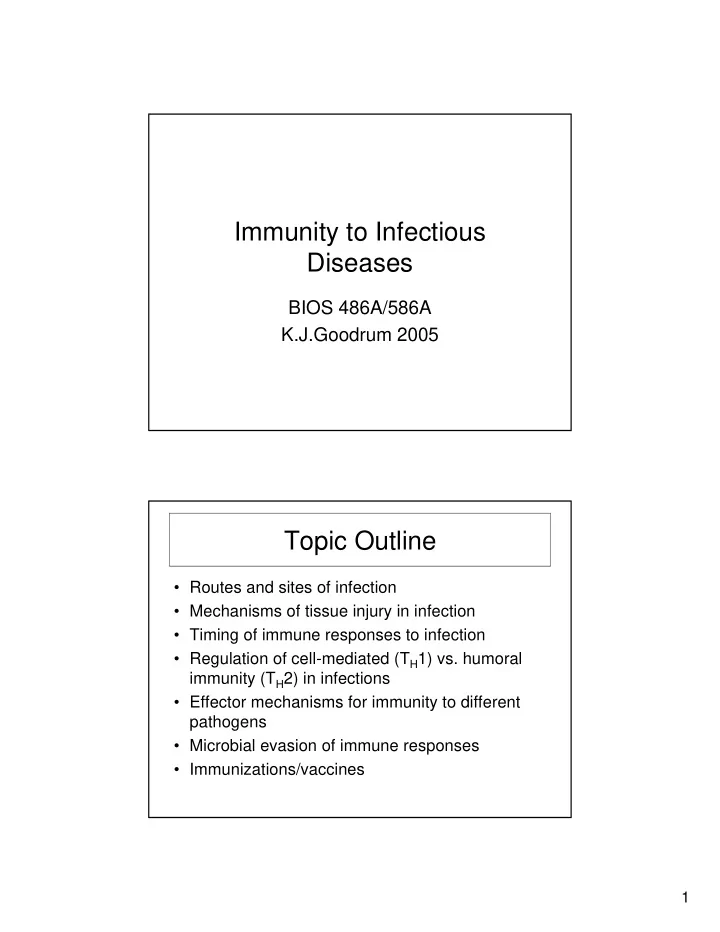
Immunity to Infectious Diseases BIOS 486A/586A K.J.Goodrum 2005 - - PDF document

immunity to infectious diseases
SMART_READER_LITE
LIVE PREVIEW

Immunity to Infectious Diseases BIOS 486A/586A K.J.Goodrum 2005 - - PDF document

Immunity to Infectious Diseases BIOS 486A/586A K.J.Goodrum 2005 Topic Outline Routes and sites of infection Mechanisms of tissue injury in infection Timing of immune responses to infection Regulation of cell-mediated (T H 1)


slide-1
SLIDE 1

1

Immunity to Infectious Diseases

BIOS 486A/586A K.J.Goodrum 2005

Topic Outline

  • Routes and sites of infection
  • Mechanisms of tissue injury in infection
  • Timing of immune responses to infection
  • Regulation of cell-mediated (TH1) vs. humoral

immunity (TH2) in infections

  • Effector mechanisms for immunity to different

pathogens

  • Microbial evasion of immune responses
  • Immunizations/vaccines
slide-2
SLIDE 2

2

Primary Route of Infection: Microbial Adherence and Invasion of epithelial tissues (lung, gut, other) Janeway, Fig. 10.2 Primary Route of Infection: Microbial Adherence and Invasion of epithelial tissues (continued). Janeway, Fig. 10.2

slide-3
SLIDE 3

3

  • Janeway. Fig. 10.4. Infection compartments
  • Janeway. Fig. 10.5. Mechanisms of Pathogen-

induced tissue Damage

slide-4
SLIDE 4

4

  • Janeway. Fig. 10.5. Mechanisms of Pathogen-

induced tissue Damage (continued)

  • Janeway. Fig. 10.1. Time course of immune response

to acute infection.

slide-5
SLIDE 5

5

  • Janeway. Fig.10.9. Infection induced Th1 vs. Th2

responses.

  • Janeway. Fig. 10.17. Protective Effector Mechanisms

against various infectious microbes

slide-6
SLIDE 6

6

  • Janeway. Fig. 10.17. Protective Effector Mechanisms

against various infectious microbes (continued)

  • Janeway. Fig. 10.17. Protective Effector Mechanisms

against various infectious microbes (continued)

slide-7
SLIDE 7

7

  • Janeway. Fig. 10.23. Mucosal γδT cell function.
  • Janeway. Fig. 10.24. Mucosal Secretory IgA function
slide-8
SLIDE 8

8

  • Janeway. Fig. 10.27. Recognition of intracellular

infection by Nod1.

  • Janeway. Fig. 10.27. Recognition of intracellular

infection by Nod1.(continued)

slide-9
SLIDE 9

9

  • Janeway. Fig. 2.5. Innate

recognition of microbes and phagocytosis by macrophages

  • Janeway. Fig. 2.18. Microbial activation of

complement pathways for inflammation.

slide-10
SLIDE 10

10

  • Janeway. Fig. 9.1.

Protective effector mechanisms of antibody.

  • Janeway. Fig. 1.24

Protective effector mechanisms of antibody.

slide-11
SLIDE 11

11

Janeway.

  • Fig. 8.27.

Effector T cell populations and effector mechanisms.

  • Janeway. Fig. 11.1. Immune evasion via multiple

antigenic variants of microbes (serotypes).

slide-12
SLIDE 12

12

Fig.11.1 continued

  • Fig. 11.1

continued

slide-13
SLIDE 13

13

  • Janeway. Fig. 11.2. Immune Evasion via antigen drift/shift.
  • Janeway. Fig. 11.2. Immune Evasion via antigen

drift/shift. (continued)

slide-14
SLIDE 14

14

  • Janeway. Fig.

11.3. Immune evasion via sequential DNA rearrangements

  • f microbial

antigens.

  • Janeway. Fig. 11.3.

Immune evasion via sequential DNA rearrangements of microbial antigens. (continued)

slide-15
SLIDE 15

15

  • Janeway. Fig. 11.5. Immune evasion mechanisms of

herpes viruses.

  • Janeway. Fig. 11.5. Immune evasion mechanisms of

herpes viruses. (continued)

slide-16
SLIDE 16

16

  • Janeway. Fig. 11.5. Immune evasion mechanisms of

herpes viruses. (continued)

  • Janeway. Fig.

11.6. The effect

  • f T helper

subpopulations

  • n leprosy
  • utcome.
slide-17
SLIDE 17

17

  • Janeway. Fig. 11.6. The effect of T helper

subpopulations on leprosy outcome. (continued)

  • Janeway. Fig. 14.21. Childhood vaccination schedule in

USA.

slide-18
SLIDE 18

18

  • Janeway. Fig. 14.23.
  • Janeway. Fig. 14.23.

continued.

slide-19
SLIDE 19

19

Summary

  • Immunity to infection depends on a combination
  • f innate mechanisms (phagocytosis,

complement, etc.) and antigen specific adaptive responses (antibody, effector T lymphocytes).

  • The immune system regulates which specific

responses predominate (humoral vs. cell- mediated) based on the body compartment infected (intracellular vs. extracellular) and on cytokine signals present at initial antigen contact (Th1 vs. Th2 responses).

Summary-continued

  • Disease-causing microbes have virulence

mechanisms that resist or evade innate and/or specific immune effector functions.

  • Recovery from natural infection or artificial

immunization promote specific longterm immunity to re-infection (immunological memory).