
SLIDE 1
Kazumasa KAWATA ICRR, The University of Tokyo For the Tibet ASg Collaboration
1
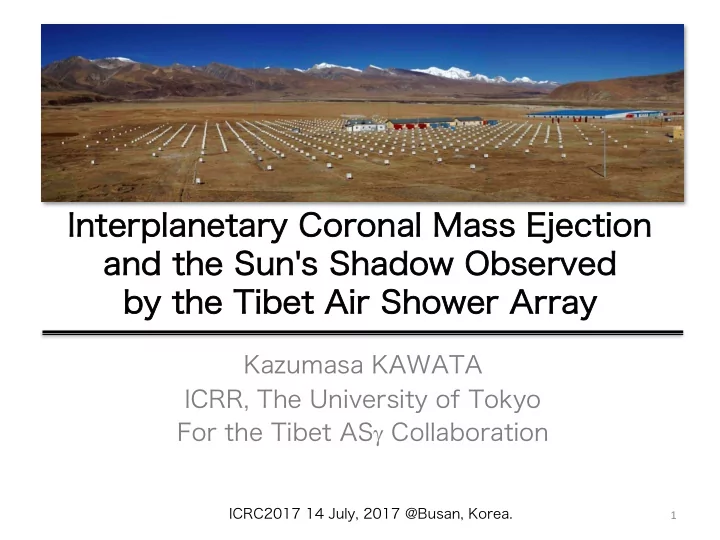
Interplanetary Coronal Mass Ejection and the Sun's Shadow Observed by the Tibet Air Shower Array
ICRC2017 14 July, 2017 @Busan, Korea.
Interplanetary Coronal Mass Ejection and the Sun's Shadow Observed - - PowerPoint PPT Presentation
Kazumasa KAWATA ICRR, The University of Tokyo Interplanetary Coronal Mass Ejection and the Sun's Shadow Observed by the Tibet Air Shower Array ICRC2017 14 July, 2017 @Busan, Korea. For the Tibet AS g Collaboration 1 the Suns Shadow
Kazumasa KAWATA ICRR, The University of Tokyo For the Tibet ASg Collaboration
1
ICRC2017 14 July, 2017 @Busan, Korea.
M.Amenomori(a), X.J.Bi(b), D.Chen(c), T.L.Chen(d), W.Y.Chen(b), S.W.Cui(e), Danzengluobu(d), L.K.Ding(b), C.F.Feng(f), Zhaoyang Feng(b), Z.Y.Feng(g), Q.B.Gou(b), Y.Q.Guo(b), H.H.He(b), Z.T.He(e), K.Hibino(h), N.Hotta(i), HaibingHu(d), H.B.Hu(b), J.Huang(b), H.Y.Jia(g), L.Jiang(b), F.Kajino(j), K.Kasahara(k), Y.Katayose(l), C.Kato(m), K.Kawata(n), M.Kozai(o,m), Labaciren(d), G.M.Le(p), A.F.Li(q,f,b), H.J.Li(d), W.J.Li(b,g), C.Liu(b), J.S.Liu(b), M.Y.Liu(d), H.Lu(b), X.R.Meng(d), T.Miyazaki(m), K.Mizutani(k,r), K.Munakata(m), T.Nakajima(m), Y.Nakamura(m), H.Nanjo(a), M.Nishizawa(s), T.Niwa(m), M.Ohnishi(n), I.Ohta(t), S.Ozawa(k), X.L.Qian(f,b), X.B.Qu(u), T.Saito(v), T.Y.Saito(w), M.Sakata(j), T.K.Sako(x,n), J.Shao(b,f), M.Shibata(l), A.Shiomi(y), T.Shirai(h), H.Sugimoto(z), M.Takita(n), Y.H.Tan(b), N.Tateyama(h), S.Torii(k), H.Tsuchiya(A), S.Udo(h), H.Wang(b), H.R.Wu(b), L.Xue(f), Y.Yamamoto(j), K.Yamauchi(l), Z.Yang(b), A.F.Yuan(d), T.Yuda(n), L.M.Zhai(c), H.M.Zhang(b), J.L.Zhang(b), X.Y.Zhang(f), Y.Zhang(b), YiZhang(b), Ying Zhang(b), Zhaxisangzhu(d) and X.X.Zhou(g)
the Sun’s Shadow Observed by
(b)Key Laboratory of Particle Astrophysics, IHEP, CAS, China (c)National Astronomical Observatories, CAS, China (d)Department of Mathematics and Physics, Tibet Univ., China (e)Department of Physics, Hebei Normal Univ., China (f)Department of Physics, Shandong Univ., China (g)Institute of Modern Physics, SouthWest Jiaotong Univ., China (h)Faculty of Engineering, Kanagawa Univ., Japan (i)Faculty of Education, Utsunomiya Univ., Japan (j)Department of Physics, Konan Univ., Japan (k)Research Institute for Science and Engineering, Waseda Univ., Japan (l)Faculty of Engineering, Yokohama National Univ., Japan (m)Department of Physics, Shinshu Univ., Japan (n)ICRR, The Univ. of Tokyo, Japan (o)ISAS/JAXA, Japan (p)National Center for Space Weather, China Meteorological Administration, China (q)School of Information Science and Engineering, Shandong Agriculture Univ., China (r)Saitama Univ., Japan (s)National Institute of Informatics, Japan (t)Sakushin Gakuin Univ., Japan (u)College of Science, China Univ. of Petroleum, China (v)Tokyo Metropolitan College of Industrial Technology, Japan (w)Max-Planck-Institut fur Physik, Deutschland (x)Escuela de Ciencias Fisicas Nanotechnologia, Yachay Tech, Ecuador (y)College of Industrial Technology, Nihon Univ., Japan (z)Shonan Institute of Technology, Japan (A)Japan Atomic Energy Agency, Japan
Earth TeV proton --> Charged particle Lamor radius ~7.4AU (B=30µG near the earth) ~0.16R☉(B=300mG near the sun) à Probe of the solar MFs ! Sun blocks VHE cosmic rays, and cast the cosmic-ray shadow on the earth.
Sun
Photosphere: Optical observation (Zeeman effect) @1AU Satellite models
3
Sun disk
4
4ox4o Cosmic ray density map centered at the Sun (GSE coordinate) Deficit ratio to B.G. Maximum -4%. Optical disk size(0.26o) Angular resolution(0.9o) In this map, we analyze deficit and location varying in a correlation with the solar magnetic field
20
Moon’s shadow Sun’s shadow Deficit (%)
CSSS Rss=10R CSSS Rss=2.5R PFSS Rss=2.5R
Sunspot number
−1 − − − − − 180 140 100 60 −5 −4 −2 −1 −3 −6
Amenomori et al, PRL, 111, 011101 (2013)
ü Discovery of a clear solar variation of the deficits ü Comparison b/w coronal MF models (PFSS/CSSS)
5
Year
1996 1998 2000 2002 2004 2006 2008 2010 MIN MAX MIN
PFSS model fails!
6
Tibet (90.522oE, 30.102oN) 4300m a.s.l. 15m space 221dets Eenergy >~10TeV
7.5m space 543 dets Energy >~3TeV
High-density
Covering 1 solar cycle Lower energy・high statistics
−2.0 −5.0 −6.0 −1.0 −3.0 −4.0
D (%)
2005 2006 2007 2008 2009 2000 2001 2002 2003 2004 MIN MAX
7
Low Statistics (%)
Similar features at 10 TeV observation
X (solar radius) Z (solar radius) Y (solar radius)
① Air shower simulation in the atmosphere
② Detector simulation, triggered events are shot back to the sun
③ Trace trajectories assuming the solar MFs b/w earth and sun
8
4th order Runge-Kutta
Corona -> Source Surface model (CSSS well reproduces the Tibet-II sun shadows) Derived from the magnetogram measured by Kitt Peak (KPVT / SOLIS) in each C.R. IMF -> Parker spiral model with latitude dependence
Geomag.-> Dipole model
2001 (CR1978) 1996 (CR1910)
9
10
c2 test : c2 / dof = 32.1 / 10 (3.4s) c2 / dof = 46.9 / 10 (4.8s) Data CSSS Rss=2.5R⦿ CSSS Rss=10R⦿ Influence of ICMEs? CSSS does not reproduce well at the solar maximum
*only stat. error
Deficit ratio /0.9°[%]
Expected from optical Sun’s size
Earth Sun CME Plasma
10 20 30 40 50 60 2000 2005 2010 2015 Number of ICMEs Years Total ICMEs
11
http://www.srl.caltech.edu/ACE/ASC/DATA/level3/icmetable2.htm
Analysis period 228 ICMEs
ü Interplanetary Coronal Mass Ejection (ICME)
ü Exclude transit periods of ICMEs from the analysis
Richardson & Cane, Solar Phys (2010)
12
c2 test : c2 / dof = 32.1 / 10 (3.4s) c2 / dof = 46.9 / 10 (4.8s) Data CSSS Rss=2.5R⦿ CSSS Rss=10R⦿
*only stat. error
Influence of CMEs? Deficit ratio /0.9°[%]
Expected from optical Sun’s size
CSSS does not reproduce well at the solar maximum
13
Data CSSS Rss=2.5R⦿ CSSS Rss=10R⦿ c2 test : c2 / dof = 12.2 / 10 (0.6s) c2 / dof = 21.0 / 10 (2.0s)
*only stat. error
Exclude ICMEs à CSSS works Evidence for influence of ICMEs
欠損量[%]
Deficit ratio /0.9°[%]
Expected from optical Sun’s size
14
Data CSSS Rss=2.5R⦿ CSSS Rss=10R⦿ ICME Low statistics c2 test : c2 / dof = 23.9 / 7 (3.0s) c2 / dof = 29.4 / 7 (3.7s) Depth during ICME periods
*only stat. error
Deficit ratio /0.9°[%]
15
16
Latitude (deg.)
Virtanen and Mursula, JGR, 115, A09110 (2010)
17
Step like at the equator Reproduce Ulysses obs.
[T]
[T]
18
Changing Gradually across the equator
19
Data PFSS Rss=2.5R⦿ CSSS Rss=2.5R⦿ CSSS Rss=10R⦿ c2 test : c2 / dof = 29.5 / 10 (3.1s) c2 / dof = 12.2 / 10 (0.6s) c2 / dof = 21.3 / 10 (2.0s)
※only stat. error
Deficit ratio /0.9°[%]
Exclude ICMEs à PFSS fails The source surface model cannot reproduce short-term variation
Expected from optical Sun’s size
20
0.1 10 100 1000 2.94 4.20 6.46 11.4 21.6 45.4
MC
Energy (TeV)/Z Σρ FT
MC Best fit Data
West Displacement (degrees) East
0.1 10 100 1000 2.94 4.20 6.46 11.4 21.6 45.4
Data
South Displacement (degrees) North Energy (TeV)/Z Σρ FT
Data Best fit MC
No E dependence +0.008o ±0.011o Pointing error = ±0.014° Absolute E error = ±12%
Best-fit = -4.5%(±8.6stat.±6.7sys.)%
ü Absolute Energy à East-West position ü Pointing Accuracy à North-South position
E dependence by geomag.
Amenomori et al., ApJ (2009)
月の影(地磁気効果、観測装置の較正、安定性)
月の影(地磁気効果、観測装置の較正、安定性)
月による宇宙線の遮蔽を「月の影」 と呼び、空気シャワー観測装置の ポインティング誤差 イベント毎の到来方向の正確さ や角度分解能の安定性、観測され る一次宇宙線の絶対エネルギーの較正などを監視する役割を担っている。 図 は、シャワーサイズが 最頻エネルギーで 領域に相当 で あるイベントについて、月の影の深さ 空気シャワーイベント数の欠損量 をバックグラ ウンドの揺らぎに対する有意度 で表わしたマップである。月の見かけの方 向を中心に、横軸は東西方向、縦軸は南北方向の偏位を表す 単位: 。 年から 年まで 月から 月の間 の実働期間約 年の観測から、 の統計的有意性で 月の影が観測された。 図 月の影の マップ 。 年から 年までの 月か ら 月までを使用した。 はバックグラウンド・レベルを表す。 図 は、月の影を東西軸、南北軸へ射影したイベント欠損量分布である。東西 南北 方向への射影には、影の中心から南北 東西 方向に角度分解能の大きさ をもつ帯 状の部分のデータを使用した。縦軸のゼロの値はバックグラウンド・レベルを表してお
21
Expected <Dexp> = 4.30% Apparent size of the Moon
19 . ) 111 . ( ) 30 . 4 46 . 4 ( ) (
2 2 2 data 2 expected data sys
= +
+
s s D D
深さの系統誤差 :
%
月の影(地磁気効果、観測装置の較正、安定性)
月の影(地磁気効果、観測装置の較正、安定性)
月による宇宙線の遮蔽を「月の影」 と呼び、空気シャワー観測装置の ポインティング誤差 イベント毎の到来方向の正確さ や角度分解能の安定性、観測され る一次宇宙線の絶対エネルギーの較正などを監視する役割を担っている。 図 は、シャワーサイズが 最頻エネルギーで 領域に相当 で あるイベントについて、月の影の深さ 空気シャワーイベント数の欠損量 をバックグラ ウンドの揺らぎに対する有意度 で表わしたマップである。月の見かけの方 向を中心に、横軸は東西方向、縦軸は南北方向の偏位を表す 単位: 。 年から 年まで 月から 月の間 の実働期間約 年の観測から、 の統計的有意性で 月の影が観測された。 図 月の影の マップ 。 年から 年までの 月か ら 月までを使用した。 はバックグラウンド・レベルを表す。 図 は、月の影を東西軸、南北軸へ射影したイベント欠損量分布である。東西 南北 方向への射影には、影の中心から南北 東西 方向に角度分解能の大きさ をもつ帯 状の部分のデータを使用した。縦軸のゼロの値はバックグラウンド・レベルを表してお
22
Deficit ratio /0.9°[%]
Amenomori+, PRL (2013)
assumes electric currents are negligible in the corona
assumes horizontal electric currents in the corona ˆ ) ( 4 1
2
=
´ Ñ r p B B r GM r p
ú û ù ê ë é ¶ ¶ Y 
¶ Y 
f f q f q h µ ˆ ˆ sin 1 )] ( 1 [ 1
2 2
r r r r J
f f q q q h ˆ sin 1 ˆ 1 ˆ ) ( ¶ Y 
Y 
Y 
r r r r r B
Magnetostatic force balance equation
Laplace Equation à
Zhao & Hoeksema, JGR (1995) Hakamada, Solar Physics (1995)
23
Free parameters a : length scale Rcp : cusp surface Rss : source surface N : Maximum principal index
Xuepu Zhao & Todd Hoeksema, JGR, 100, 19 (1995)
24
25
26
Year All Data Live days Mar.-Sep. Exclude ICME Live days Mar.-Sep. Ratio(%) Exclude/All 2000 94 43 46 2001 203 105 52 2002 148 102 69 2003 192 160 83 2004 70 58 83 2005 175 121 69 2006 28 25 89 2007 159 159 100 2008 198 194 98 2009 159 146 92
27
2001/04/26 1230 CME occurred at solar surface LASCO CME Time ICME boundaries ~4.5days
Interplanetary shock Solar wind proton temperature
28
2001 2002 2003 2004 2005 1996 1997 1998 1999 2000 2006 2007 2008 2009 Low statistics Min Min Max
Tibet 10 TeV Deficit B.G. (%)
−2.0 −5.0 −6.0 −1.0 −3.0 −4.0
D (%)
Amenomori+, PRL (2013)
30
Magnetogram: Kitt Peak Harmonic order N=10
Density map of events hitting the Sun MC takes account of compositions, spectra, detector responses and analysis methods
31
R◉ R◉ R◉
32
In the CSSS model case, more antiparticles move along the open field lines of the ordered coronal magnetic field through the source surface at high latitude. Amenomori+, PRL (2013)
Events hitting the sun form the cosmic ray shadow