
SLIDE 1
Inverse spectral results in Sobolev spaces for the AKNS operator with partial informations on the potentials
- L. Amour∗
, and J. Faupin†
Abstract We consider the AKNS (Ablowitz-Kaup-Newell-Segur) operator on the unit interval with po- tentials belonging to Sobolev spaces in the framework of inverse spectral theory. Precise sets of eigenvalues are given in order that it together with the knowledge of the potentials on the side (a, 1) and partial informations on the potential on (a − ε, a) for some arbitrary small ε > 0 determine the potentials entirely on (0, 1). Naturally, the smaller is a and the more partial informations are known, the less is the number of the needed eigenvalues.
1 Introduction and statement of the result.
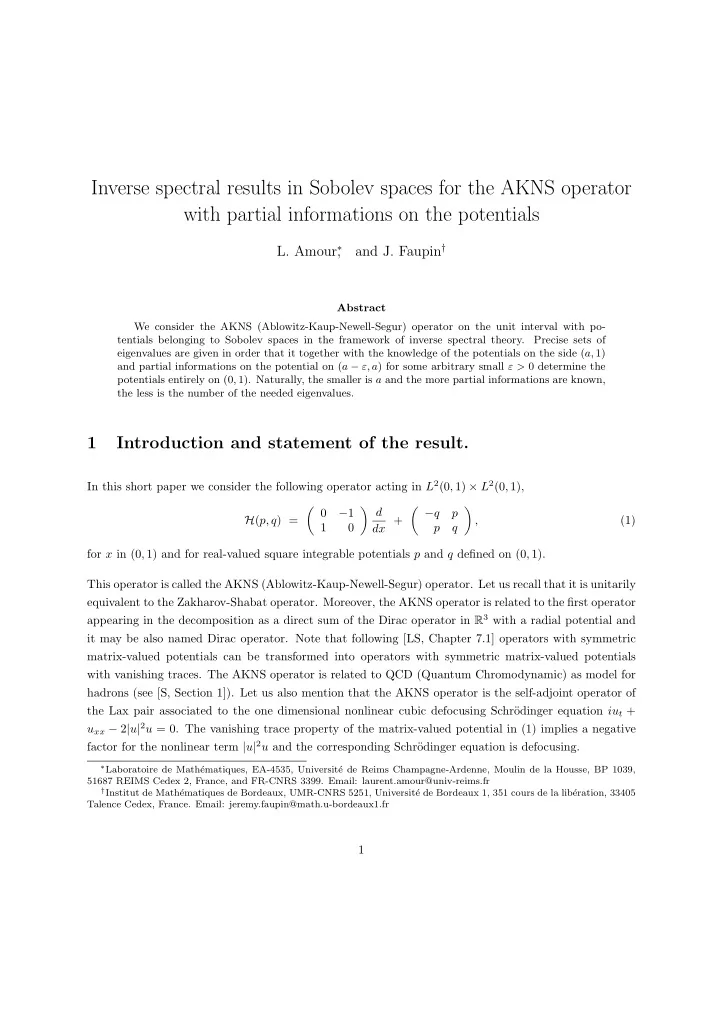
In this short paper we consider the following operator acting in L2(0, 1) × L2(0, 1), H(p, q) =
- −1
1 d dx +
- −q
p p q
- ,
(1) for x in (0, 1) and for real-valued square integrable potentials p and q defined on (0, 1). This operator is called the AKNS (Ablowitz-Kaup-Newell-Segur) operator. Let us recall that it is unitarily equivalent to the Zakharov-Shabat operator. Moreover, the AKNS operator is related to the first operator appearing in the decomposition as a direct sum of the Dirac operator in R3 with a radial potential and it may be also named Dirac operator. Note that following [LS, Chapter 7.1] operators with symmetric matrix-valued potentials can be transformed into operators with symmetric matrix-valued potentials with vanishing traces. The AKNS operator is related to QCD (Quantum Chromodynamic) as model for hadrons (see [S, Section 1]). Let us also mention that the AKNS operator is the self-adjoint operator of the Lax pair associated to the one dimensional nonlinear cubic defocusing Schr¨
- dinger equation iut +
uxx − 2|u|2u = 0. The vanishing trace property of the matrix-valued potential in (1) implies a negative factor for the nonlinear term |u|2u and the corresponding Schr¨
- dinger equation is defocusing.
∗Laboratoire de Math´
ematiques, EA-4535, Universit´ e de Reims Champagne-Ardenne, Moulin de la Housse, BP 1039, 51687 REIMS Cedex 2, France, and FR-CNRS 3399. Email: laurent.amour@univ-reims.fr
†Institut de Math´
ematiques de Bordeaux, UMR-CNRS 5251, Universit´ e de Bordeaux 1, 351 cours de la lib´ eration, 33405 Talence Cedex, France. Email: jeremy.faupin@math.u-bordeaux1.fr