Inves&ga&on of Progressive Collapse and Wireless - - PowerPoint PPT Presentation

inves ga on of progressive collapse and wireless sensor
SMART_READER_LITE
LIVE PREVIEW

Inves&ga&on of Progressive Collapse and Wireless - - PowerPoint PPT Presentation

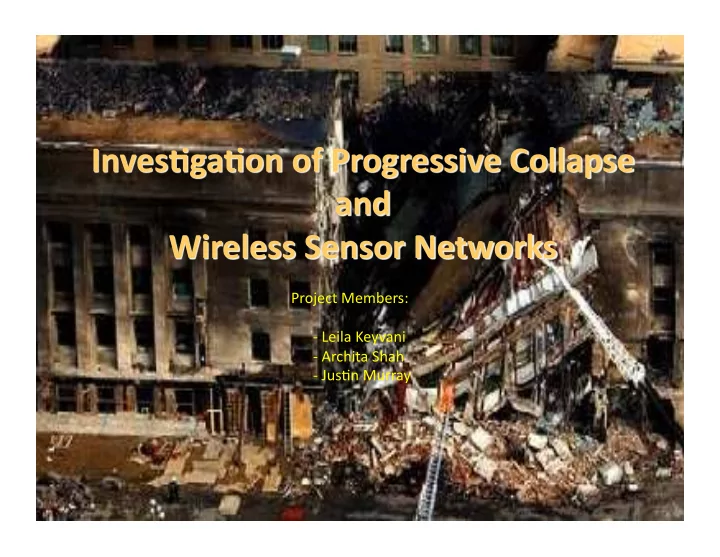
Inves&ga&on of Progressive Collapse and Wireless Sensor Networks Project Members: - Leila Keyvani -


slide-1
SLIDE 1

Inves&ga&on ¡of ¡Progressive ¡Collapse ¡ ¡ and ¡ ¡ Wireless ¡Sensor ¡Networks ¡

Project ¡Members: ¡ ¡ ¡ ¡ ¡ ¡ ¡-­‑ ¡Leila ¡Keyvani ¡ ¡ ¡ ¡ ¡ ¡ ¡-­‑ ¡Archita ¡Shah ¡ ¡ ¡ ¡ ¡ ¡ ¡-­‑ ¡Jus<n ¡Murray ¡

slide-2
SLIDE 2
slide-3
SLIDE 3

3 ¡

Progressive Collapse

First ¡sample ¡of ¡progressive ¡collapse ¡in ¡London1968 ¡

slide-4
SLIDE 4

Samples ¡of ¡Progressive ¡Collapse ¡

  • Alfred P.Murrah Building
  • Oklahoma city
  • Explosion of a truck in front of the building
slide-5
SLIDE 5

5 ¡

What ¡type ¡of ¡loads ¡ini&ates ¡Progressive ¡collapse? ¡

impact impact Explosions

slide-6
SLIDE 6

6 ¡

Site ¡Inves<ga<on ¡ Inves<ga<on ¡of ¡Poten<al ¡for ¡Progressive ¡Collapse ¡ Structural ¡Inves<ga<on ¡ Inves<ga<on ¡of ¡the ¡stability ¡of ¡ ¡ Structures ¡aJer ¡damage ¡

Alternate ¡ Load ¡Path ¡ Method ¡

Explosion ¡

slide-7
SLIDE 7

7 ¡

Na<onal ¡Educa<onal ¡Compe<<on ¡on ¡Predic<ng ¡progressive ¡ collapse ¡resistance ¡of ¡structural ¡systems ¡(2007) ¡

(www.pcrc2007.neu.edu) ¡ Discovery ¡Channel ¡Segment ¡on ¡Progressive ¡Collapse ¡ hTp://www.pcrc2007.neu.edu/discoverybranch.php ¡

slide-8
SLIDE 8

Experimentally ¡and ¡Analy<cally ¡

University of Arkansas Medical Center dormitory by ¡ ¡Sasani, ¡Bazan, ¡and ¡Sagiroglu ¡

  • Sensors ¡are ¡deployed ¡In ¡buildings ¡for ¡

¡experimental ¡data ¡collec<on. ¡

  • Analy<cal ¡models ¡are ¡verified ¡with ¡ ¡

¡experimental ¡data ¡ ¡

  • Verified ¡analy<cal ¡models ¡are ¡evaluated ¡

¡ ¡for ¡further ¡understanding ¡of ¡behavior ¡

slide-9
SLIDE 9

Experimental ¡data ¡acquisi<on ¡system ¡

  • Wired ¡systems ¡: ¡ ¡

1. ¡Cumbersome ¡in ¡installa<on ¡for ¡large ¡scaled ¡building ¡ 2. Cost ¡of ¡maintenance ¡of ¡wired ¡systems ¡ 3. Damages ¡in ¡buildings ¡could ¡lead ¡to ¡loss ¡of ¡data! ¡

  • Wireless ¡systems: ¡

1. Addresses ¡problems ¡with ¡wired ¡systems ¡specially ¡cost ¡and ¡installa<on ¡ 2. Can ¡handle ¡large ¡number ¡of ¡sensing ¡units ¡ ¡ 3. Main ¡objec<ve: ¡to ¡be ¡installed ¡in ¡important ¡buildings ¡ ¡as ¡a ¡real ¡<me ¡data ¡acquisi<on ¡system ¡for ¡predic<ng ¡the ¡possible ¡collapse ¡ ¡

slide-10
SLIDE 10

Ideal ¡Project ¡Characteris<cs ¡

  • Wireless, ¡self-­‑powered ¡sensor ¡network ¡
  • Capable ¡of ¡remaining ¡dormant ¡on ¡baTery ¡power ¡for ¡years ¡
  • Low ¡cost ¡(due ¡to ¡high ¡number ¡of ¡sensors ¡and ¡possible ¡damage ¡to ¡them) ¡
  • Large ¡number ¡of ¡sensors ¡throughout ¡a ¡structure ¡
  • High ¡data ¡rate, ¡in ¡the ¡range ¡of ¡1 ¡kHz ¡per ¡sensor ¡
  • Capable ¡of ¡monitoring ¡various ¡building ¡characteris<cs ¡in ¡real ¡<me ¡
  • Data ¡can ¡be ¡used ¡to ¡predict/warn ¡of ¡progressive ¡collapse ¡
  • Commercially ¡viable ¡to ¡be ¡used ¡in ¡all ¡large-­‑scale ¡structures ¡around ¡the ¡world ¡
  • Informa<on ¡can ¡be ¡read ¡and ¡interpreted ¡remotely ¡at ¡long ¡distances ¡
  • This ¡would ¡be ¡considered ¡an ¡“Alert ¡System” ¡or ¡the ¡Phase ¡3 ¡for ¡our ¡uses ¡of ¡this ¡
  • technology. ¡
slide-11
SLIDE 11

Possible ¡Architectures ¡

  • Small-­‑scale ¡experimenta<on ¡(Phase ¡1) ¡
  • Mid-­‑scale ¡experimenta<on ¡(Phase ¡2) ¡
  • Large ¡scale ¡alert/monitoring ¡system ¡(Phase ¡3) ¡
slide-12
SLIDE 12

Phase ¡1 ¡

  • In-­‑building ¡experiment ¡with ¡small ¡amount ¡of ¡induced ¡damage ¡
  • Small ¡number ¡of ¡sensors ¡concentrated ¡around ¡the ¡damage ¡site ¡
  • Very ¡high ¡sampling ¡rate ¡for ¡detailed ¡analysis ¡
slide-13
SLIDE 13

Phase ¡2 ¡

  • In-­‑building ¡experiment ¡with ¡larger ¡amount ¡of ¡damage ¡than ¡in ¡phase ¡1 ¡
  • Capable ¡of ¡causing ¡significant ¡changes ¡within ¡the ¡structure ¡
  • Data ¡needs ¡to ¡transmit ¡out ¡of ¡the ¡building, ¡as ¡aJer ¡the ¡test, ¡it ¡may ¡be ¡

unsafe ¡to ¡enter ¡

  • High ¡data ¡rate ¡with ¡small ¡number ¡of ¡sensors ¡in ¡various ¡areas ¡of ¡the ¡
  • building. ¡
slide-14
SLIDE 14

Phase ¡3 ¡

  • Large-­‑scale ¡monitoring ¡system, ¡for ¡use ¡during ¡a ¡catastrophic ¡event ¡
  • Large ¡number ¡of ¡sensors ¡monitoring ¡all ¡structural ¡components ¡of ¡the ¡

system ¡

  • Lower ¡sample ¡rate ¡needed ¡to ¡accommodate ¡high ¡traffic ¡on ¡each ¡channel ¡
  • Wi-­‑fi ¡or ¡Ethernet ¡backbone ¡needed ¡to ¡handle ¡high ¡amount ¡of ¡data ¡
  • Data ¡can ¡be ¡interpreted ¡remotely ¡from ¡across ¡the ¡country ¡or ¡globe ¡
slide-15
SLIDE 15

Protocol: ¡ZigBee ¡

  • ZigBee ¡is ¡a ¡specifica<on ¡for ¡a ¡suite ¡of ¡high ¡level ¡communica<on ¡protocols ¡

using ¡small, ¡low-­‑power ¡digital ¡radios ¡based ¡on ¡the ¡IEEE ¡802.15.4-­‑2003 ¡ standard ¡for ¡Low-­‑Rate ¡Wireless ¡Personal ¡Area ¡Networks ¡(LR-­‑WPANs) ¡

  • ZigBee ¡is ¡targeted ¡at ¡radio-­‑frequency(RF) ¡applica<ons ¡that ¡require ¡a ¡low ¡

data ¡rate, ¡long ¡baTery ¡life, ¡and ¡secure ¡networking ¡

slide-16
SLIDE 16

ZigBee ¡Characteris<cs ¡

  • Low-­‑cost ¡
  • Low-­‑power ¡consump<on ¡
  • Capable ¡for ¡mul< ¡hop ¡
  • Maximum ¡data ¡rates ¡allowed ¡are: ¡250 ¡kbps@2.4 ¡GHz, ¡40kbps@915MHz, ¡

20kbps@868MHz ¡

  • Intended ¡for ¡use ¡in ¡embedded ¡applica<ons ¡
  • Fully ¡reliable ¡“hand-­‑shaked” ¡data ¡transfer ¡protocol ¡
  • Frequency: ¡2.4GHz ¡,915MHz ¡and ¡868MHz ¡
  • Channels: ¡16 ¡channels@2.4 ¡GHz, ¡10 ¡channels@915MHz, ¡1 ¡

channel@868MHz ¡ ¡

  • Mul<ple ¡topologies: ¡star, ¡peer-­‑to-­‑peer, ¡mesh ¡ ¡
slide-17
SLIDE 17

Effec<veness ¡of ¡ZigBee ¡ ¡

  • ZigBee ¡channels ¡are ¡capable ¡of ¡suppor<ng ¡the ¡data ¡rates ¡necessary ¡for ¡the ¡

“Phase ¡1” ¡and ¡“Phase ¡2” ¡uses ¡of ¡this ¡sensor ¡system ¡

  • Reliable ¡transmission ¡rates ¡and ¡accuracy ¡
  • Effec<ve ¡over ¡short-­‑to-­‑medium ¡distances ¡(around ¡50 ¡m) ¡
  • Distance ¡requirements ¡in ¡Phase ¡1 ¡and ¡Phase ¡2 ¡are ¡generally ¡short ¡ ¡
  • Several ¡useful ¡channels ¡that ¡do ¡not ¡interfere ¡with ¡Wi-­‑fi ¡
  • Low ¡power ¡consump<on ¡(long ¡baTery ¡life) ¡
slide-18
SLIDE 18

ZigBee ¡Shortcomings ¡

  • Cannot ¡handle ¡long ¡distance ¡transmission ¡
  • Small ¡amount ¡of ¡internal ¡data ¡storage ¡(possible ¡overwriTen ¡data) ¡
  • Cannot ¡transmit ¡through ¡various ¡obstacles, ¡par<cularly ¡concrete ¡floors ¡
  • Cannot ¡provide ¡data ¡rates ¡high ¡enough ¡for ¡use ¡in ¡“Phase ¡3” ¡system ¡

¡ ¡ ¡ ¡ ¡ ¡ ¡ ¡ ¡-­‑ ¡Requires ¡some ¡sort ¡of ¡wi-­‑fi ¡or ¡ethernet ¡backbone ¡

  • Larger ¡buildings ¡present ¡more ¡problems ¡due ¡to ¡congested ¡channels ¡
  • Cannot ¡operate ¡at ¡full ¡speed ¡with ¡other ¡wireless ¡interference ¡present ¡
  • Not ¡all ¡channels ¡are ¡useful ¡due ¡to ¡Wi-­‑fi ¡interference ¡and ¡overlapping ¡of ¡

frequency ¡bands ¡

slide-19
SLIDE 19

In ¡this ¡project ¡… ¡

  • focus ¡on ¡the ¡applica<on ¡of ¡wireless ¡networks ¡to ¡facilitate ¡data ¡

collec<on ¡from ¡sensors ¡installed ¡in ¡buildings ¡under ¡various ¡condi<ons ¡

  • The ¡type ¡of ¡network ¡chosen ¡for ¡this ¡inves<ga<on ¡relies ¡on ¡the ¡IEEE ¡ZigBee ¡

wireless ¡protocol ¡

  • use ¡available ¡features ¡of ¡hardware ¡components ¡for ¡a ¡complete ¡and ¡reliable ¡

system ¡

  • Mul<ple ¡sender ¡and ¡receiver ¡nodes ¡would ¡be ¡handled ¡with ¡appropriate ¡

sensors ¡aTached ¡

  • Running ¡the ¡system ¡on ¡baTeries ¡to ¡simulate ¡the ¡field ¡experimental ¡

condi<on ¡

  • High ¡rate ¡of ¡sampling ¡per ¡sensor ¡(1KHz) ¡almost ¡in ¡the ¡range ¡of ¡channel ¡

capacity ¡

  • Considering ¡transmission ¡in ¡the ¡range ¡of ¡100 ¡feet ¡
  • Using ¡available ¡hardware ¡from ¡TI ¡for ¡communica<on ¡
slide-20
SLIDE 20

Communica<on ¡Characteris<cs ¡ ¡ in ¡Our ¡Project ¡

  • All ¡ZigBee ¡communica<on ¡is ¡single-­‑hop ¡
  • Mul<-­‑hop ¡system ¡would ¡reduce ¡data ¡rate ¡considerably ¡
  • Retransmission: ¡reduces ¡packet ¡loss, ¡limited ¡to ¡3 ¡retransmissions ¡to ¡get ¡

real-­‑<me ¡data ¡

  • Acknowledgement: ¡verifies ¡that ¡the ¡packet ¡is ¡received ¡before ¡sending ¡next ¡

packet ¡

slide-21
SLIDE 21

Equipments ¡and ¡Features ¡Used ¡

1. CC2530 ¡from ¡TI ¡: ¡a ¡“System-­‑on-­‑Chip” ¡ – ZigBee ¡transmiTer/receiver ¡ – eight ¡channel ¡ADC ¡ – 32MHz ¡XOSC ¡system ¡clocks ¡ – Timer1 ¡Channel ¡0 ¡ – DMA ¡ 2. Interfacing ¡with ¡programming ¡soJware ¡on ¡the ¡PC: ¡ ¡ – Evalua<on ¡Board ¡(EB) ¡,BaTery ¡board ¡(BB) ¡ 3. FT232R ¡Breakout ¡from ¡SparkFun ¡ 4. UART ¡ 5. Sensor: ¡Poten<ometer ¡

slide-22
SLIDE 22

Tes<ng ¡with ¡ZigBee ¡

  • Evalua<on ¡of ¡16 ¡available ¡channels ¡for ¡2.4 ¡GHz ¡band ¡in ¡terms ¡of ¡efficiency ¡

(Packet ¡loss, ¡Transmission ¡rate) ¡ ¡

  • No ¡interference ¡(in ¡terms ¡of ¡traffic ¡) ¡with ¡Wi-­‑Fi ¡

0 ¡ 10 ¡ 20 ¡ 30 ¡ 40 ¡ 50 ¡ 60 ¡ 70 ¡ 80 ¡ 90 ¡ 100 ¡ 11 ¡ 12 ¡ 13 ¡ 14 ¡ 15 ¡ 16 ¡ 17 ¡ 18 ¡ 19 ¡ 20 ¡ 21 ¡ 22 ¡ 23 ¡ 24 ¡ 25 ¡ 26 ¡ Packet ¡Loss ¡(%) ¡ Channel ¡Number ¡

slide-23
SLIDE 23

Cont’d…. ¡

  • Evalua<on ¡of ¡combina<on ¡of ¡two ¡channels: ¡

1. Two ¡close ¡channels ¡[25&26] ¡: ¡Caused ¡overlapping ¡problem, ¡50% ¡packet ¡loss ¡ for ¡both ¡ 2. Two ¡far ¡away ¡channels ¡[26&20]: ¡No ¡overlap, ¡66% ¡packet ¡loss ¡in ¡channel ¡20, ¡ ¡5% ¡packet ¡loss ¡for ¡channel ¡26 ¡

  • Used ¡Booster ¡antenna ¡with ¡channel ¡26: ¡ ¡
  • Drop ¡in ¡packet ¡loss ¡rate ¡from ¡10% ¡to ¡1% ¡at ¡the ¡same ¡posi<on ¡
  • No ¡transmission ¡w/o ¡at ¡some ¡par<cular ¡posi<ons ¡ ¡
slide-24
SLIDE 24

Test ¡results ¡for ¡Poten<ometer ¡

slide-25
SLIDE 25

Project ¡Schedule ¡

  • Investigate the potential for using ZigBee wireless devices in

conjunction with sensors to monitor structural behavior in a matter of seconds

  • Configuration of ADC for one analog and single-ended input
  • Receiver code to receive and send over UART
  • Serial reader program at the base PC
  • Evaluation of reliability of received data
  • Increasing the robustness of the sender and receiver code
  • Adjusting sensing time intervals and recording every time step
  • Increasing systems speed in sensing, sending , receiving, and interpreting
  • Using real sensing devices such as potentiometer
  • Increasing systems capacity in sensing data by improving codes and using more sensors
  • Collecting the data from different senders
  • Setting a small-scaled experiment for testing of system in reality
  • Evaluating data based on experiment
  • Use tens of sensors to monitor important data from a structure
  • Use advanced knowledge of structural behavior along with the data from

the sensors to save lives after a significant catastrophic event

6/13/11 ¡

  • Feb. ¡

March ¡ ½ ¡ April ¡ ½ ¡ April ¡

slide-26
SLIDE 26

Conclusion ¡

  • ZigBee ¡channels ¡can ¡provide ¡the ¡data ¡rates ¡and ¡accuracy ¡needed ¡for ¡

structural ¡measurement ¡purposes ¡

  • It ¡is ¡suitable ¡for ¡structural ¡analysis ¡purposes ¡because ¡it ¡is ¡low ¡cost ¡and ¡low ¡

power ¡

  • Due ¡to ¡a ¡limited ¡number ¡of ¡useable ¡channels ¡and ¡range ¡limita<ons, ¡results ¡

are ¡not ¡easily ¡scalable ¡to ¡larger ¡structures ¡

  • Wi-­‑Fi ¡or ¡other ¡high-­‑data ¡rate ¡technology ¡would ¡be ¡needed ¡to ¡coordinate ¡

large ¡amounts ¡of ¡data ¡in ¡full ¡structure ¡

slide-27
SLIDE 27

Future ¡Enhancements ¡

  • Synchronizing ¡sender ¡data ¡for ¡analysis ¡purposes ¡
  • CCA ¡(CSMA/CA): ¡transmiwng ¡data ¡from ¡mul<ple ¡senders ¡on ¡one ¡receiver ¡
  • Using ¡strain ¡gauges ¡with ¡ZigBee ¡
  • Using ¡external ¡temperature ¡sensors ¡ ¡
  • Configuring ¡Wi-­‑Fi/ethernet ¡back ¡bone ¡
  • Using ¡USB ¡Hub ¡to ¡manage ¡many ¡receiver ¡nodes ¡on ¡a ¡single ¡PC ¡
slide-28
SLIDE 28

28 ¡

Ques<ons??? ¡