*........... it would separate some vertices of G inside the cycle - - PDF document

it would separate some vertices of g inside the cycle
SMART_READER_LITE
LIVE PREVIEW

*........... it would separate some vertices of G inside the cycle - - PDF document

Three applications Chapter 11 of Euler's formula .4 graph isplonar if it can be drawn in the plane W2 without crossing edges (or. equivalently, on the 2-dimensional sphere S2). We talk of aplane graph if such a drawing is already given and fixed.


slide-1
SLIDE 1

Three applications

  • f Euler's formula

Chapter 11

.4 graph isplonar if it can be drawn in the plane W2 without crossing edges (or. equivalently, on the 2-dimensional sphere S2). We talk of aplane graph if such a drawing is already given and fixed. Any such drawing decomposes thc plane or spherc into a fnite number of connected regions, including the outer (unbounded) region, which are referred to as faces. Euler's for- mula exhibits a beautiful relation between the number of vertices, edges and faces that is valid for any plane graph. Euler mentioned this result for

1

the first time in a letter to his friend Goldbach in 1750, but he did not have a complete proof at the time. Among the many proofs of Euler's formula, we present a pretty and "self-dual" one that gets by without induction. It can be traced back to von Staudt's book "Geometrie der Lage" from 1847.

7

Euler's formula. If G is a connected

plane graph with n vertices,

e edges and f

faces, then

n - e + f = 2.

  • Proof. Let T c E be the edge set of a spanning tree for G, that is, of a

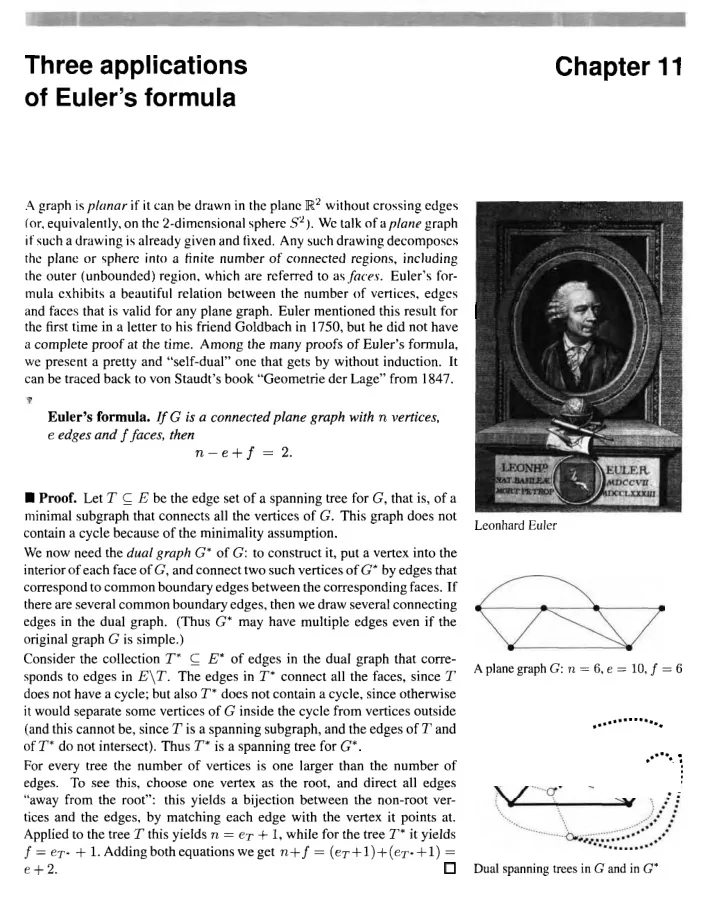
minimal subgraph that connects all the vertices of G. This graph does not Leonhard Euler contain a cycle because of the minimality assumption. We now need the dual graph G* of G: to construct it, put a vertex into the interior of each face of G, and connect two such vertices of G* by edges that correspond to common boundary edges between the corresponding faces. If there are several common boundary edges, then we draw several connecting edges in the dual graph. (Thus G* may have multiple edges even if the

  • riginal graph G is simple.)

Consider the collection T* C

E* of edges in the dual graph that corre-

A plane graph G: n =

6, e = 10, f = 6 sponds to edges in E\T. The edges in T* connect all the faces, since T does not have a cycle; but also T* does not contain a cycle, since otherwise

it would separate some vertices of G inside the cycle from vertices outside

*...........

(and this cannot be, since T is a spanning subgraph, and the edges of T and

a .

  • f T*

do not intersect). Thus T* is a spanning tree for G*.

*.***.

For every tree the number of vertices is one larger than the number of

  • edges. To see this, choose one vertex as the root, and direct all edges

"away from the root": this yields a bijection between the non-root ver- tices and the edges, by matching each edge with the vertex it points at. Applied to the tree T this yields n = eT +

I, while for the tree T*

it yields f

=

e p

+

  • 1. Adding both equations we get n,+

f = (eT+l)+(eT*+l) =

e +

2. Dual spanning trees in G and in G*

slide-2
SLIDE 2

66

Three applications of Euler's formula

The five platonic solids Here the degree is written next to each

  • vertex. Counting the vertices of given

degree yields n

2 =

3, n s = 0, n

4 = 1, n s =

2. The number of sides is written into each

  • region. Counting the faces with a given

number of sides yields fl = 1,

f2 = 3,

f4 = 1, f9 = 1,

and f,

= 0 otherwise. Euler's formula thus produces a strong numerical conclusion from a geo- metric-topological situation: the numbers of vertices, edges, and faces of a finite graph G satisfy n - e +

f =

2 whenever the graph is or can be drawn in the plane or on a sphere. Many well-known and classical consequences can be derived from Euler's

  • formula. Among them are the classification of the regular convex polyhedra

(the platonic solids), thz fact that Kg and K3,3 are not planar (see below), and the five-color theorem that every planar map can be colored with at most five colors such that no two adjacent countries have the same color. But for this we have a much better proof, which does not even need Euler's formula - see Chapter 30. This chapter collects three other beautiful proofs that have Euler's formula at their core. The first two - a proof of the Sylvester-Gallai theorem, and a theorem on two-colored point configurations - use Euler's formula in clever combination with other arithmetic relationships between basic graph

  • parameters. Let us first look at these parameters.

The degree of a vertex is the number of edges that end in the vertex, where loops count double. Let ni denote the number of vertices of degree i in G. Counting the vertices according to their degrees, we obtain On the other hand, every edge has two ends, so it contributes 2 to the sum

  • f all degrees, and we obtain

You may interpret this identity as counting in two ways the ends of the edges, that is, the edge-vertex incidences. The average degree d of the vertices is therefore Next we count the faces of a plane graph according to their number of sides: a k-face is a face that is bounded by k edges (where an edge that on both sides borders the same region has to be counted twice!). Let fk be the number of Ic-faces. Counting all faces we find Counting the edges according to the faces of which they are sides, we get As before, we can interpret this as double-counting of edge-face incidences. Note that the average number of sides of faces is given by

slide-3
SLIDE 3

Three a~nlications

  • f

Euler's formula

67

Let us deduce from this - together with Euler's formula- quickly that the complete graph Kg and the complete bipartite graph K3,3 are not planar.

5

For a hypothetical plane drawing of K5 we calculate n =

5, e = (2) = 10,

  • thus f = e +

2 -

n =

7 and f = =

< 3. But if the average number

  • f sides is smaller than 3, then the embedding would have a face with at

most two sides, which cannot be. Similarly for K3.3 we get n = 6, e = 9, and f = e + 2 -

n = 5, and thus

  • f = 2 =

< 4, which cannot be since

is simple and bipartite, so

drawn with one crossing

f

all its cycles have length at least 4. It is no coincidence, of course, that the equations (3) and (4) for the f,'s look so similar to the equations ( I ) and (2) for the n,'s. They are transformed into each other by the dual graph construction G 4

G*

explained above. From the double counting identities, we get the following important "local" consequences of Euler's formula.

  • Proposition. Let G be any simple plane graph with n > 2 vertices. Then

KW drawn with one crossing

(A) G has a vertex of degree at most 5. (B) G has at most 3n - 6 edges. (C) Ifthe edges of G are mo-colored, then there i

s a vertex of G with at

most two color-changes in the cyclic order of the edges around the vertex.

1

  • Proof. For each of the three statements, we may assume that G is con-

nected. (A) Every face has at least 3 sides (since G is simple), so (3) and (4) yield and thus 2e - 3

f > 0.

Now if each vertex has degree at least 6, then (1) and (2) imply and thus 2e - 6 n > 0, Taking both inequalities together, we get and thus e > n +

f ,

contradicting Euler's formula. (B) As in the first step of part (A), we obtain 2e - 3

f > 0, and thus

from Euler's formula.

slide-4
SLIDE 4

68 Three applications of Euler's formula (C) Let c be the number of corners where color changes occur. Suppose the statement is false, then we have c 2 4 n corners with color changes, since at every vertex there is an even number of changes. Now every face with 2k or 2lc + 1 sides has at most 2k such corners, so we conclude that

b

Arrows point to the corners with color

4n < c < 2 f 3 + 4 f 4 + 4 f 5 + 6 f 6 +6f7 + S f 8 +.

. .

changes.

2 f 3 + 4 f 4 + 6 f 5 + 8 f 6 + 1 0 f 7 + .

. .

  • 2(3f3 +

4f4 + 5 f5 + 6

f 6 +

7f7 +. . .)

  • 4(f3 +

f4 + f5 + f6 +

f7 +

. . .) = 4 e - 4 f

using again (3) and (4). So we have e > n +

f , again contradicting ~

~ l ~ ~ $ ~ formula.

  • 1. The Sylvester-Gallai theorem, revisited

It was first noted by Norman Steenrod, it seems, that part (A) of the propo- sition yields a strikingly simple proof of the Sylvester-Gallai theorem (see Chapter 9).

The Sylvester-Gallai theorem. Given any set of n > 3 points in the plane, not all on one line, there is always a line that contains exactly two of the points.

  • Proof. (Sylvester-Gallai via Euler)

If we embed the plane R2 in R3 near the unit sphere S2 as indicated in

  • ur figure, then every point in R2 corresponds to a pair of antipodal points
  • n S2,

and the lines in IR2 correspond to great circles on S2. Thus the Sylvester-Gallai theorem amounts to the following: Given any set of n > 3 pairs of antipodalpoints on the sphere, not all on one great circle, there is always a great circle that contains exactly two of the antipodal pairs. Now we dualize, replacing each pair of antipodal points by the correspond- ing great circle on the sphere. That is, instead of points f

v E S2

we consider the orthogonal circles given by C, := {x

E S2 : (x,

v) = 0).

(This C, is the equator if we consider v as the north pole of the sphere.) Then the Sylvester-Gallai problem asks us to prove: Given any collection of n > 3 great circles on S2, not all of them passing through one point, there is always a point that is on exactly two of the great circles. But the arrangement of great circles yields a simple plane graph on S2, whose vertices are the intersection points of two of the great circles, which divide the great circles into edges. All the vertex degrees are even, and they are at least 4 - by construction. Thus part (A) of the proposition yields the existence of a vertex of degree 4. That's it!

slide-5
SLIDE 5

Three applications of Euler's formula 69

  • 2. Monochromatic lines

The following proof of a "colorful" relative of the Sylvester-Gallai theorem is due to Don Chakerian.

  • Theorem. Given any jinite conjiguration of "black" and "white " points

in the plane, not all on one line, there is always a "monochromatic" line: a line that contains at least two points of one color and none of the othel:

  • Proof. As for the Sylvester-Gallai problem, we transfer the problem to

the unit sphere and dualize it there. So we must prove: Gi1,en any3nite collection of "black" arzd "white" great circles on the unit sphere, not all passing through one point, there is always an intersection point that lies either only on white great circles, or

  • nlv on black great circles.

Now the (positive) answer is clear from part (C) of the proposition, since in every vertex where great circles of different colors intersect, we always have at least 4 corners with sign changes.

  • 3. Pick's theorem

Pick's theorem from 1899 is a beautiful and surprising result in itself, but it is also a "classical" consequence of Euler's formula. For the following, call a convex polygon P C R2 elementary if its vertices are integral (that is, they lie in the lattice Z2), but if it does not contain any further lattice points.

  • Lemma. Every elementary triangle A =

conv{po,

p, , p,) C

R2 has area

A(A) = i.

P I + P, -Po

  • Proof. Both the parallelogram P with corners po,

p, , p,, pl + p, - po

e

  • e

and the lattice Z2 are symmetric with respect to the map

P 2

a :

x -

p 1 + p 2 - x , which is the reflection with respect to the center of the segment from p, /: PI

:

to p,. Thus the parallelogram P = A U a

( A )

i s elementary as well, and e . .

its integral translates tile the plane. Hence {p, -

po,p2

  • po)

is a basis

po

  • f the lattice z2,

it has determinant *l, P is a parallelogram of area 1, and

A

has area ,

! j .

(For an explanation of these terms see the box on the next page.)

n e x e e * e e

  • Theorem. The area of any (not necessarily convex)

polygon Q C R2 with integral vertices is given by

.

.

1

A(&) = ntnt +

  • n b d -

1,

2

where nint and n b d are the numbers of integral points in the interior respectively on the boundary of Q.

n,,t = 11, n b d =

8, so A = 14

slide-6
SLIDE 6

70

Three applications of Euler's formula

Lattice bases

A basis of Z2 is a pair of linearly independent vectors el, e2 such that

I

Z2 = (A lei + h e 2 :

XI, X2 E Z).

Let el = (;f) and e2 = (3, then the area of the parallelogram spanned by el and e2 is given by A(el,

e2) = I det(el, ez)l =

I det (::)I.

If f

= (

: )

and f 2 = (L) is another basis, then there exists an invertible Z-matrix Q with (ST t) = (: i)

  • Q. Since

QQP1 = (i y ) , and the determinants are integers, it follows that IdetQI = 1, and hence Idet(fl, f2)l = Idet(el,ez)l.

Therefore all basis parallelograms have the same area 1, since A((:),

(y)) =

1.

  • Proof. Every such polygon can be triangulated using all the nint lattice

points in the interior, and all the nbd lattice points on the boundary of Q. (This is not quite obvious, in particular if Q is not required to be convex, but the argument given in Chapter 3

1 on the art gallery problem proves this.)

Now we interpret the triangulation as a plane graph, which subdivides the plane into one unbounded face plus f -

1

triangles of area i, so

1 4 Q ) = i(f -

1).

Every triangle has three sides, where each of the etnt interior edges bounds two triangles, while the ebd boundary edges appear in one single triangle

  • each. So 3(f -

1) =

2eint +ebd

and thus f =

2(e - f)-ebd+3. Also, there

is the same number of boundary edges and vertices, e

b d = nbd. These two

facts together with Euler's formula yield

References

[I] G. D. CHAKERIAN: Sylvester's problem on collinear points and a relative,

  • Amer. Math. Monthly 77 (1970), 164-167.

[2] G. PICK: Geometrisches zur Zahlenlehre, Sitzungsberichte Lotos (Prag), Natur-med. Verein fur Bohmen 19 (1899), 3 11-31!). [3] K. G. C. VON STAUDT: Geometrie der Luge, Verlag der Fr. Korn'schen Buchhandlung, Nurnberg 1847. [4] N. E. STEENROD: Solution 4065/Editorial Note, Amer. Math. Monthly 51 (1944), 170-171.