Landsat Program Status to the National Geospatial Advisory Committee - - PowerPoint PPT Presentation

landsat program status to the national geospatial
SMART_READER_LITE
LIVE PREVIEW

Landsat Program Status to the National Geospatial Advisory Committee - - PowerPoint PPT Presentation

Landsat Program Status to the National Geospatial Advisory Committee Missouri River: Flooding near Hamburg, Iowa Presented by Bruce K. Quirk Land Remote Sensing Program Coordinato r April 18, 2012 U.S. Department of the Interior U.S.


slide-1
SLIDE 1

Landsat Program Status to the National Geospatial Advisory Committee

U.S. Department of the Interior U.S. Geological Survey

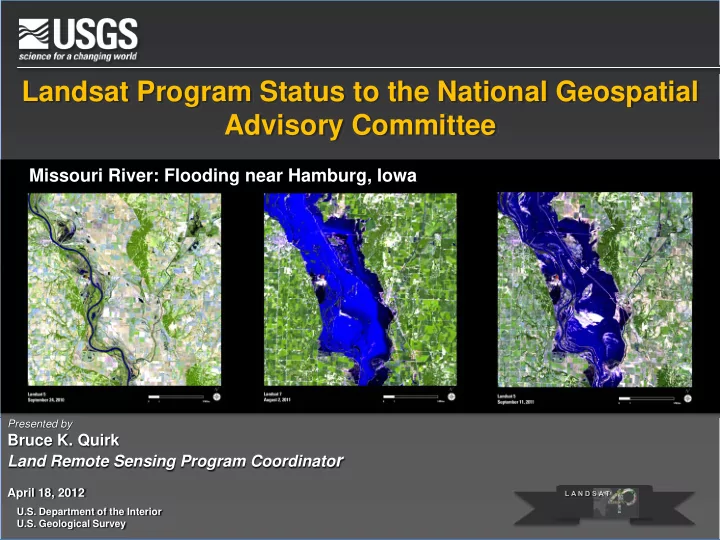
Missouri River: Flooding near Hamburg, Iowa

Presented by

Bruce K. Quirk Land Remote Sensing Program Coordinator

April 18, 2012

slide-2
SLIDE 2

Satellite Remote Sensing at DOI

1966 - Initiated Earth Resources Observation Systems Program

“…the time is now right and urgent to apply space technology towards the solution of many pressing natural resource problems being compounded by population and industrial growth.” Secretary of the Interior Stewart L. Udall, 1966

Landsat 7

Enhanced Thematic Mapper Plus (ETM+) 30/15 meter

Landsat 4 - 5

Multi-Spectral Scanner (MSS) 79 meter Thematic Mapper (TM) 30 meter

Landsat 1 - 3

Multi-Spectral Scanner (MSS) 79 meter Return Beam Vidicon (RBV) 80/40 meter

Landsat 8

Operational Land Imager (OLI) 30/15 meter Thermal Infrared Sensor (TIRS) 120 meter

International Collaboration in Earth Observation

2

slide-3
SLIDE 3

3

The Role of Interior in the U.S. National Space Policy

National Space Policy 2010 Land Remote Sensing

The Secretary of the Interior, through the Director

  • f the United States Geological Survey (USGS),

shall conduct research on natural and human- induced changes to Earth’s land, land cover, and inland surface waters, and manage a global land surface data national archive and its distribution; determine the operational requirements for collection, processing, archiving, and distribution of land surface data to the United States Government and other users; and The Director of the USGS, and the NASA Administrator shall work together in maintaining a program for operational land remote sensing

  • bservations
slide-4
SLIDE 4

The Landsat Revolution

In October 2008, the USGS made the entire Landsat archive,

  • ver 3 million images, available via the Internet at no cost

The opening of the Landsat archive reshaped the future of moderate resolution Earth observations

Mount St. Helens, WA 1983 1992

slide-5
SLIDE 5

1,000,000 2,000,000 3,000,000 4,000,000 5,000,000 6,000,000 7,000,000

1‐Jan‐08 1‐Apr‐08 1‐Jul‐08 1‐Oct‐08 1‐Jan‐09 1‐Apr‐09 1‐Jul‐09 1‐Oct‐09 1‐Jan‐10 1‐Apr‐10 1‐Jul‐10 1‐Oct‐10 1‐Jan‐11 1‐Apr‐11 1‐Jul‐11 Actual Web-enabled Scenes Delivered (Cumulative) Average Scenes Delivered (Based on Best Year of Sales)

Landsat Internet Data Distribution

Total Landsat Scenes Selected By Users Since January 1, 2008

Daily Average = 53 scenes for best year of sales (2001) Daily Average 5,776 scenes of web‐enabled data selected

Based on per day

1M 2M 3M 4M 5M 6M

  • Over 3 million images available today
  • 170% increase in scientific and educational users
  • Data delivered to 186 countries
  • User shift to multi‐year scenes at same location
  • Highly favorable user response
  • Exceeded 8 million scenes downloaded in April, 2012

Scenes Selected

40-year archive of global data provided freely on the Internet

5
slide-6
SLIDE 6

Primary Landsat User Applications

6 419 6549 7127 1342 182 1000 2000 3000 4000 5000 6000 7000 8000

Publications Attributed to Landsat

Agriculture Enviromental Science and Management Land Cover Commercial/Planning and Development

slide-7
SLIDE 7

Need for the Landsat Advisory Group

  • At a crossroads

– Landsats 5 and 7 are well beyond their design lives and could fail at any time – After Landsat 8 launch in 2013, there are no other missions planned/funded – Opening the Landsat archive has revolutionized global change research – President’s Space Policy direction to determine the operational requirements for land surface data and to maintain an operational land remote sensing program

  • Advise the Federal Government on the requirements,
  • bjectives and actions of the Landsat Program working

towards the creation of a program for operational land remote sensing observations

7

slide-8
SLIDE 8

8

Questions?

slide-9
SLIDE 9

Landsat 5

  • Launched by NASA in 1984 (3-year design life), just turned

28!

  • Operated by USGS since 2001
  • November 2011: USGS suspended imaging temporarily

to investigate electronic problem

Landsat 7

  • Launched by NASA in 1999 (5-year design life)
  • Operated by USGS since 2000
  • Acquiring over 350 images/day worldwide
  • Estimated end of mission, based on fuel supply only:

January 2017

9

Landsats 5 and 7

slide-10
SLIDE 10

Mission Characteristics

  • Orbit: Polar, 705km, sun-synchronous

(WRS2), 98.2° inclined, mid-morning, 16-day repeat

  • Launch Date: Jan. 2013; Launch Vehicle:

Atlas V

  • Mission Life: 5 Years (with consumables 10

years)

  • Mission Project Management: NASA/USGS

DOI USGS developed Ground System

  • 4 design elements

Spacecraft

  • Observatory mass of 3085kg
  • Maximum power of 2130W
  • 3Tb Solid State Recorder
  • 384Mbps X-band downlink

10

Thermal Infrared Sensor (TIRS)

  • TIRS in initial design at NASA;

proposed in American Recovery and Investment Act of 2009 Approximately 100m resolution in 2 bands; 185km swath

Operational Land Imager (OLI)

  • 9 spectral bands 30m resolution for

VIS/NIR/SWIR, 15m for PAN

  • 185km swath width
  • Collect 400 WRS-2 scenes/day;

265Mbps

Landsat Data Continuity Mission (LDCM) or Landsat 8

slide-11
SLIDE 11

Landsat 8 Spectral Bands

Operational Land Imager (OLI)

LDCM Wavelength (micrometer) Resolution (meters) Band 8 (pan) .500-.680 15 Band 1 .433-.453 30 Band 2 .450-.515 30 Band 3 .525-.600 30 Band 4 .630-.680 30 Band 5 .845-.885 30 Band 9 1.360-1.390 30 Band 6 1.560-1.660 30 Band 7 2.100-2.300 30 Band 10* 10.3 - 11.3 120 Band 11* 11.5 - 12.5 120

Enhanced Thematic Mapper Plus (ETM+)

Landsat 7 Wavelength (micrometer) Resolution (meters) Band 8 .52-.90 15 Band 1 0.45-0.52 30 Band 2 0.53-0.61 30 Band 3 0.63-0.69 30 Band 4 0.78-0.90 30 Band 5 1.55-1.75 30 Band 7 2.09-2.35 30 Band 6 10.40-12.50 60

11

* Thermal Infrared Sensor (TIRS)

slide-12
SLIDE 12

12

slide-13
SLIDE 13

Landsat 9

  • Landsat 9 and beyond
  • Administration supports converting Landsat to an
  • perational program
  • USGS is working with NASA and the White House Office of

Science and Technology Policy to assess options for Landsat 9 and beyond

  • Landsat Data Continuity Concepts Request for Information - primary
  • bjective is to explore approaches to providing a cost-efficient,

dependable, long-term source for Landsat-like data to follow the Landsat Data Continuity Mission (LDCM, or Landsat 8).

13

slide-14
SLIDE 14

Summary

  • Landsats 5 and 7 are well beyond their design lives and

could fail at any time

  • After Landsat 8 launch in 2013, there are no other

missions funded

  • Opening the Landsat archive has revolutionized global

change research

  • An operational Landsat Program is the first step in

creating an OPERATIONAL LAND IMAGING PROGRAM

14

slide-15
SLIDE 15

Current and future Landsat data, information product definitions, and methods for accessing and distributing these products

15

slide-16
SLIDE 16

Current and Planned Standard Landsat Data and Information Products

16

  • Current
  • Level 1 Terrain corrected (L1T)
  • 3-band full spatial resolution browse (“natural

color” [bands 5,4,3])

  • Thermal image full spatial resolution browse
  • Planned Landsat Data Continuity Mission (LDCM)
  • Level 0 (L0)
  • L1T
  • 3-band and thermal full spatial resolution browse

images

  • Top of Atmosphere Reflectance
  • Normalizing for Earth-Sun distance and

sensor viewing geometries

slide-17
SLIDE 17

Planned Future Landsat Data and Information Products

17

  • Climate Data Records (Under Development…building

blocks for ECV’s)

  • Surface reflectance
  • Surface temperature
  • etc.
  • Essential Climate Variables (Future)
  • Land Cover
  • Leaf area index
  • Surface water extent
  • Burned area
slide-18
SLIDE 18

LRS Program Goal

Landsat Data and Information Products

18

  • Our goal is to progress from providing “data” to providing

information operational starting with CONUS and working towards global

  • Our philosophy is to develop the capability for processing

current acquisitions, extend these back through the archive

  • f ETM+ and TM data, and forward with OLI and TIRS
slide-19
SLIDE 19

Current and Future

Methods for Accessing and Distributing Landsat

19

USGS

  • GloVis -- http://glovis.usgs.gov
  • Earth Explorer -- http://earthexplorer.usgs.gov
  • Web Enabled Landsat Data (WELD) -- http://landsat.usgs.gov/WELD.php
  • Web Map Services (WMS)
  • Cloud

Clients making use of Landsat

  • Change Matters (Esri)
  • Google Earth

Majority over Internet, little physical media Scene to Pixel Tools

slide-20
SLIDE 20

Operation Desert Storm - 1991

20

slide-21
SLIDE 21

Priorities and Communication of the Landsat Program

21

slide-22
SLIDE 22

Current and Future Priorities and Communication

22

  • Facebook
  • Twitter (@USGSLandsat)
  • Image of the Week (http:landsat.usgs.gov)
  • Landsat User Survey (http://www.fort.usgs.gov/landsatsurvey/)
  • NRC Committee study on Operational Land Imaging

(http://sites.nationalacademies.org/SSB/CurrentProjects/SSB_0 65886)

  • Landsat 40th
  • OSTP workshop
slide-23
SLIDE 23

Expanding oil production in Kazakhstan

23

slide-24
SLIDE 24

What are the outcomes/deliverables we want from the LAG in the near term?

24

slide-25
SLIDE 25

Near Term Support

25

  • Determine what is needed operationally
  • Help us in determining the data and information products
  • Help us determine what is the role of the commercial sector
  • Quantify the benefits of Landsat
  • Explain why Landsat is important
  • Help us through advice on how to better communicate the

value of the program

slide-26
SLIDE 26

What does the LAG envision as a set of National capabilities for Landsat?

26

slide-27
SLIDE 27

What would be the impacts of no Landsat 9?

27

slide-28
SLIDE 28

Goksu river dam project, Turkey

28

slide-29
SLIDE 29

Lake Oroumeih, Iran

29

slide-30
SLIDE 30

Ice dynamics of Pine Island Glacier

Landsat Image Mosaic Of Antarctica (LIMA) http://lima.usgs.gov/

30

slide-31
SLIDE 31

1984 2011

Samuel Dam on the Jamari River - Rondonia, Brazil

31

slide-32
SLIDE 32

Mundra Port, India

32

slide-33
SLIDE 33

Cropland in Northwest China

33