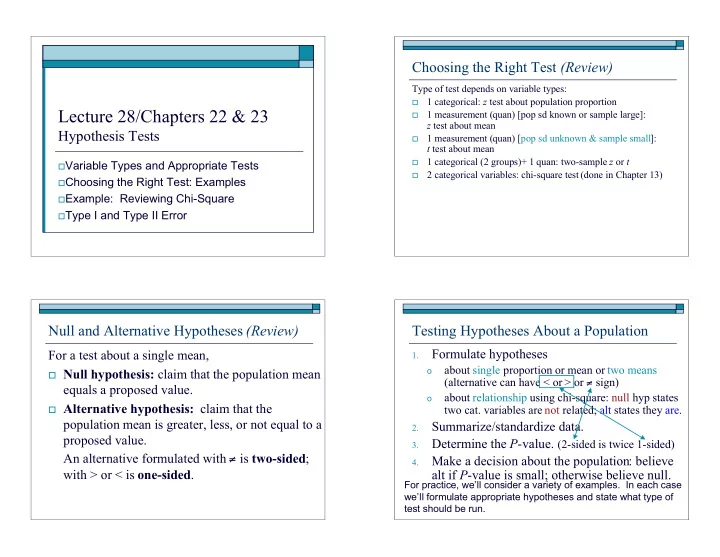
Lecture 28/Chapters 22 & 23 1 measurement (quan) [pop sd known - - PowerPoint PPT Presentation

lecture 28 chapters 22 23
SMART_READER_LITE
LIVE PREVIEW

Lecture 28/Chapters 22 & 23 1 measurement (quan) [pop sd known - - PowerPoint PPT Presentation

Choosing the Right Test (Review) Type of test depends on variable types: 1 categorical: z test about population proportion Lecture 28/Chapters 22 & 23 1 measurement (quan) [pop sd known or sample large]: z test about mean


slide-1
SLIDE 1

Lecture 28/Chapters 22 & 23

Hypothesis Tests

Variable Types and Appropriate Tests Choosing the Right Test: Examples Example: Reviewing Chi-Square Type I and Type II Error

Choosing the Right Test (Review)

Type of test depends on variable types:

  • 1 categorical: z test about population proportion
  • 1 measurement (quan) [pop sd known or sample large]:

z test about mean

  • 1 measurement (quan) [pop sd unknown & sample small]:

t test about mean

  • 1 categorical (2 groups)+ 1 quan: two-sample z or t
  • 2 categorical variables: chi-square test (done in Chapter 13)

Null and Alternative Hypotheses (Review)

For a test about a single mean,

Null hypothesis: claim that the population mean

equals a proposed value.

Alternative hypothesis: claim that the

population mean is greater, less, or not equal to a proposed value. An alternative formulated with is two-sided; with > or < is one-sided.

Testing Hypotheses About a Population

1.

Formulate hypotheses

  • about single proportion or mean or two means

(alternative can have < or > or sign)

  • about relationship using chi-square: null hyp states

two cat. variables are not related; alt states they are.

2.

Summarize/standardize data.

3.

Determine the P-value. (2-sided is twice 1-sided)

4.

Make a decision about the population: believe alt if P-value is small; otherwise believe null.

For practice, we’ll consider a variety of examples. In each case we’ll formulate appropriate hypotheses and state what type of test should be run.

slide-2
SLIDE 2

Example: Smoking and Education (#1 p. 427)

  • Background: Consider years of education for mothers who

smoke compared with those who don’t, in sample of 400 mothers, to decide if one group tends to be more educated.

  • Question: Which of the 5 situations applies?
  • 1. 1 categorical: z test about population proportion
  • 2. 1 measurement (quan) [pop sd known or sample large]:

z test about mean

  • 3. 1 measurement (quan) [pop sd unknown & sample small]:

t test about mean

  • 4. 1 categorical (2 groups) + 1 quan: two-sample z or t
  • 5. 2 categorical variables: chi-square test
  • Response: _____

Example: Test about Smoking and Education

  • Background: Consider years of education for mothers

who smoke compared with those who don’t, in sample

  • f 400 mothers, to decide if one group tends to be more

educated.

  • Question: What hypotheses and test are appropriate?
  • Response:

Null: ___________________________________________________ Alt: ____________________________________________________ Do _______________ [large samples] test to compare ____________ Alternative is___________ because no initial suspicion was expressed about a specific group being better educated.

Example: ESP? (Case Study 22.1 p. 425)

  • Background: A subject in an ESP experiment chooses each time

from 4 targets the one which he/she believes is being “sent” by extrasensory means. Researchers want to determine if the subject performs significantly better than one would by random guessing.

  • Question: Which of the 5 situations applies?
  • 1. 1 categorical: z test about population proportion
  • 2. 1 measurement (quan) [pop sd known or sample large]:

z test about mean

  • 3. 1 measurement (quan) [pop sd unknown & sample small]:

t test about mean

  • 4. 1 categorical (2 groups) + 1 quan: two-sample z or t
  • 5. 2 categorical variables: chi-square test
  • Response: ____

Example: Test about ESP

  • Background: A subject in an ESP experiment chooses

each time from 4 targets the one which he/she believes is being “sent” by extrasensory means. Researchers want to determine if the subject performs significantly better than one would by random guessing.

  • Question: What hypotheses and test are appropriate?
  • Response:

Null: population proportion correct _______ Alt: population proportion correct ________ Do___ test about _____________________

slide-3
SLIDE 3

Example: Calcium for PMS (#3-4 p. 428)

  • Background: We want to compare change in severity of PMS

symptoms (before minus after, measured quantitatively) for 231 women taking calcium vs. 235 on placebo to see if calcium helps.

  • Question: Which of the 5 situations applies?
  • 1. 1 categorical: z test about population proportion
  • 2. 1 measurement (quan) [pop sd known or sample large]:

z test about mean

  • 3. 1 measurement (quan) [pop sd unknown & sample small]:

t test about mean

  • 4. 1 categorical (2 groups) + 1 quan: two-sample z or t
  • 5. 2 categorical variables: chi-square test
  • Response: ____

Example: Test about Calcium for PMS

  • Background: We want to compare change in severity
  • f PMS symptoms (before minus after, measured

quantitatively) for 231 women taking calcium vs. 235

  • n placebo to see if calcium helps.
  • Question: What hypotheses and test are appropriate?
  • Response:

Null: mean symptom change (calc)__mean symptom change (placebo) Alt: mean symptom change (calc)__mean symptom change (placebo) Do _____________ [large samples] test to compare means Alternative is__________ because we hope or suspect that the calcium group will show more symptom improvement. As always, our hypotheses refer to the___________, not the________

Example: Incubators, Claustrophobia (6b p.428)

  • Background: We want to see if placing babies in an incubator

during infancy can lead to claustrophobia in adult life.

  • Question: Which of the 5 situations applies?
  • 1. 1 categorical: z test about population proportion
  • 2. 1 measurement (quan) [pop sd known or sample large]:

z test about mean

  • 3. 1 measurement (quan) [pop sd unknown & sample small]:

t test about mean

  • 4. 1 categorical (2 groups) + 1 quan: two-sample z or t
  • 5. 2 categorical variables: chi-square test
  • Response: ____

Example: Test about Incubators, Claustrophobia

  • Background: We want to see if placing babies in an

incubator during infancy can lead to claustrophobia in adult life.

  • Question: What hypotheses and test are appropriate?
  • Response:

Null: there is___relationship between incubation and claustrophobia Alt: there is___relationship between incubation and claustrophobia Do ____________test. Alternative is general (2-sided) because __________doesn’t let us specify our initial suspicions in a particular direction.

slide-4
SLIDE 4

Example: Training Program, Scores (#7 p.446)

  • Background: We want to see if a training program helps raise

students’ scores. For each student, researchers record the increase (or decrease) in the scores, from pre-test to post-test.

  • Question: Which of the 5 situations applies?
  • 1. 1 categorical: z test about population proportion
  • 2. 1 measurement (quan) [pop sd known or sample large]:

z test about mean

  • 3. 1 measurement (quan) [pop sd unknown & sample small]:

t test about mean

  • 4. 1 categorical (2 groups) + 1 quan: two-sample z or t
  • 5. 2 categorical variables: chi-square test
  • Response: ___________________________________________

Note: 2-sample design would be better, to avoid placebo effect.

Example: Test about Training Program, Scores

  • Background: We want to see if a training program

helps raise students scores. For each student, researchers record the increase (or decrease) in the scores, from pre-test to post-test.

  • Question: What hypotheses and test are appropriate?
  • Response:

Null: population mean increase___ Alt: population mean increase___ Call it a ______________ (not sure if sample is large enough to use z) based on a matched-pairs design (see page 88). Alternative is__________ because the training program is supposed to help.

Note: As always, our hypotheses refer to population values. It’s not enough to simply exhibit an increase in sample scores; the increase must be statistically significant.

Example: Terrorists’ Religion: Discrimination?

  • Background: We want to see if Catholics were discriminated

against, based on a table of religion and acquittals for persons charged with terrorist offenses in Northern Ireland in 1991.

  • Question: Which of the 5 situations applies?
  • 1. 1 categorical: z test about population proportion
  • 2. 1 measurement (quan) [pop sd known or sample large]:

z test about mean

  • 3. 1 measurement (quan) [pop sd unknown & sample small]:

t test about mean

  • 4. 1 categorical (2 groups) + 1 quan: two-sample z or t
  • 5. 2 categorical variables: chi-square test
  • Response: ____

Chi-Square Test (Review)

We learned to use chi-square to test for a relationship between two categorical variables.

1.

Null hypothesis: the two variables are not related alternative hypothesis: the two variables are related

2.

Test stat = chi-sq = sum of (observed count-expected count)

3.

P-value= probability of chi-square this large, assuming the two variables are not related. For a 2-by-2 table, chi-square > 3.84 P-value < 0.05.

4.

If the P-value is small, conclude the variables are related. Otherwise, we have no convincing evidence of a relationship. Note: Next lecture we’ll do another example of a chi-square test. expected count

2

slide-5
SLIDE 5

Example: Chi-Square Review: Discrimination?

  • Background: Table for religion and trial outcome:
  • Question: What do we conclude?
  • Response: First formulate hypotheses.

Null: there is___relationship between religion and trial outcome Alt: there is___relationship between religion and trial outcome 80 45 35

Total

65 38 27

Catholic

15 7 8

Protestant Total Convicted Acquitted Observed

Are Variables in a 22 Table Related?

1.

Compute each expected count =

2.

Calculate each

3.

Find

4.

If chi-square > 3.84, there is a statistically significant

  • relationship. Otherwise, we don’t have evidence of a

relationship.

Column total Row total Table total

Example: Religion & Acquittal Related?

  • Background: Two-way table for religion and trial outcome:
  • Question: What counts would we expect if there were no

relationship?

  • Response: Expect…
  • ______________________ Protestants to be acquitted
  • ______________________ Catholics to be acquitted
  • ______________________ Protestants to be convicted
  • ______________________ Catholics to be convicted

80 45 35

Total

65 38 27

Catholic

15 7 8

Protestant Total Convicted Acquitted Observed

Example: Religion & Acquittal (continued)

  • Background: Observed and Expected Tables:
  • Question: Find components & chi-square; conclude?
  • Response: chi-square =

The relationship is ____________________________ We _____ have convincing evidence of a relationship (discrimination).

80 45 35 Total 65 38 27 Cath 15 7 8 Prot Total Convicted Acquitted Obs 80 45 35 Total 65 36.56 28.44 Cath 15 8.44 6.56 Prot Total Convicted Acquitted Exp

=0.32 + 0.25 + 0.07 + 0.06 = 0.70

slide-6
SLIDE 6

Example: HIV Test (Review)

Background: In a certain population, the probability

  • f HIV is 0.001. The probability of testing positive is

0.98 if you have HIV, 0.05 if you don’t.

Questions: What is the probability of having HIV

and testing positive? Overall prob of testing positive? Probability of having HIV, given you test positive?

Response: To complete the tree diagram, note that

probability of not having HIV is 0.999. The probability of testing negative is 0.02 if you have HIV, 0.95 if you don’t.

Example: HIV Test (Review)

Possible correct conclusions:

  • positive test when someone has HIV
  • negative test when someone does not have HIV

Possible incorrect conclusions:

  • positive test when someone does not have HIV
  • negative test when someone does.

HIV 0.001 no HIV pos 0.98 neg 0.02 0.999 neg 0.95 pos 0.05

Two Types of Error

Correct (prob=sensitivity=0.98) Incorrect: false negative= Type II Error (prob=0.02) Diseased (alt hyp true) Incorrect: false positive= Type I Error (prob=0.05) Correct (prob= specificity=0.95) Healthy (null hyp true) Diseased (reject null hyp) Healthy (don’t reject null hyp) Decision Actuality If we decide in advance to use 0.05 as our cut-off for a small P-value, then 0.05 will be our probability of a Type I Error. The probability of a Type II Error can be specified only if we happen to know what is true in actuality (observed in the long run?).