
SLIDE 1
Revised December 5, 2019 Information Theoretic Security
Lecture 4
Matthieu Bloch
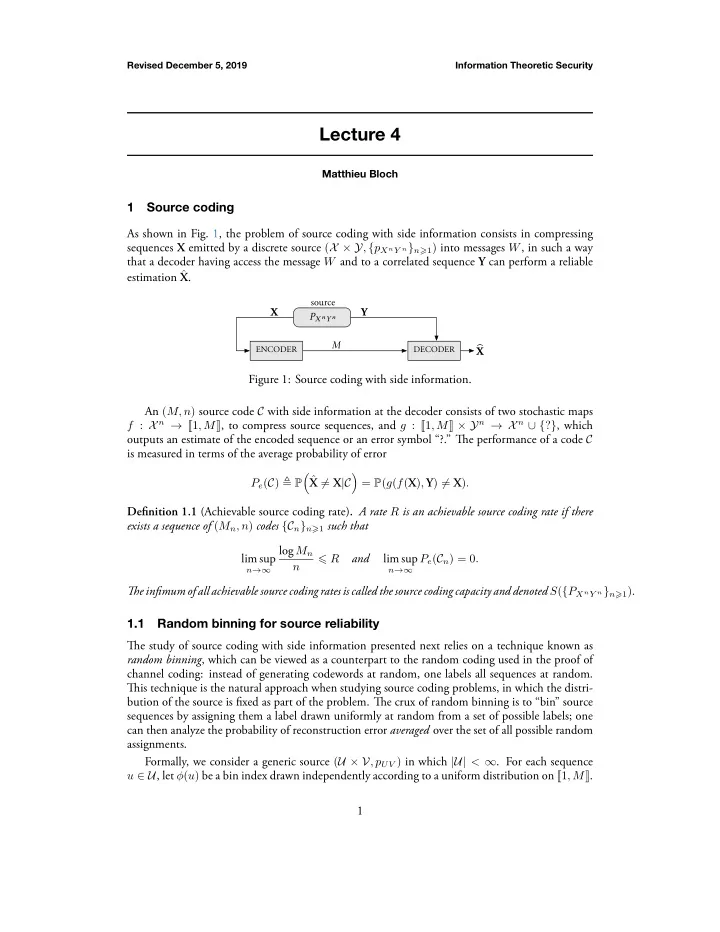
1 Source coding As shown in Fig. 1, the problem of source coding with side information consists in compressing sequences X emitted by a discrete source (X × Y, {pXnY n}n⩾1) into messages W, in such a way that a decoder having access the message W and to a correlated sequence Y can perform a reliable estimation ˆ X.
DECODER ENCODER
! M ! PX nY n
- !
source
Figure 1: Source coding with side information. An (M, n) source code C with side information at the decoder consists of two stochastic maps f : X n → 1, M, to compress source sequences, and g : 1, M × Yn → X n ∪ {?}, which
- utputs an estimate of the encoded sequence or an error symbol “?.” Tie performance of a code C
is measured in terms of the average probability of error Pe(C) ≜ P ( ˆ X = X|C ) = P(g(f(X), Y) = X). Definition 1.1 (Achievable source coding rate). A rate R is an achievable source coding rate if there exists a sequence of (Mn, n) codes {Cn}n⩾1 such that lim sup
n→∞
log Mn n ⩽ R and lim sup
n→∞