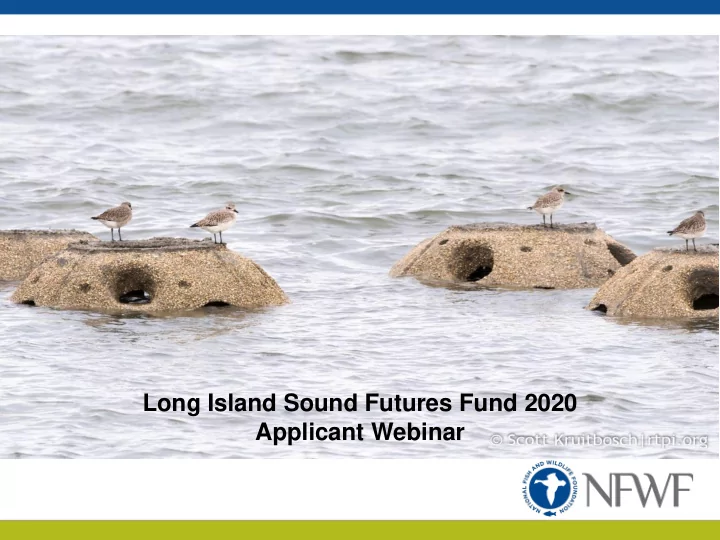
SLIDE 1
Long Island Sound Futures Fund 2020 Applicant Webinar
SLIDE 2
Welcome and Introductions
SLIDE 3 Webinar Instructions
Erin.Lewis@nfwf.org PROBLEMS? Type it into the “Enter a question for staff.” We will try to resolve it during the webinar.
+1 (415) 655-0052 454-605-366 42
If you’re already on the call, press #42#
SLIDE 4
We will succeed - and that success will belong to every one of us. We should take comfort that while we may have more still to endure, better days will return: we will be with our friends again; we will be with our families again; we will meet again.
SLIDE 5
Agenda Welcome Long Island Sound Futures Fund (LISFF) Overview Application Guidance
nfwf.org/lisff
SLIDE 6 Purpose
Restoration and protection of the health and living resources of Long Island Sound. Themes: Clean Waters and Healthy Watersheds Thriving Habitats and Abundant Wildlife Educating to Engage Sustainable & Resilient Communities Sound Science and Inclusive Management TIP! In the “Problem” and/or “Solution” section of the proposal narrative
reference relevant parts of the Long Island Sound Comprehensive Conservation and Management Plan (CCMP) Update: longislandsoundstudy.net/2015/09/2015-comprehensive-conservation-and- management-plan/
SLIDE 7
Sources & Amount of Available Funding
~ $3 million from:
SLIDE 8
Boundary in CT & NY
SLIDE 9
Coastal Boundary in CT & NY
SLIDE 10 Program Priorities
Clean Waters and Healthy Watersheds. Improve water quality by reducing nutrients, combined sewer overflows, stormwater runoff, and point and nonpoint source loading into Long Island Sound through:
- Projects that result in quantifiable pollutant prevention or reduction.
- Planning that sets-the-stage for implementation of such projects.
SLIDE 11 Program Priorities
Thriving Habitats and Abundant Wildlife. Restore coastal habitats to maintain resilience and function and to support populations of fish, birds and wildlife through:
- Restoring quantifiable acres of coastal habitat restored.
- Planning to set-the-stage for implementation of such projects.
- Fostering diverse, balanced and abundant populations of fish, birds
and wildlife. When preparing a proposal: TIP! Apply the Habitat Restoration Guidelines 2017 (link in RFP) TIP! Use the Important Habitat Types (link in RFP)
SLIDE 12 Program Priorities
Sustainable and Resilient Communities: Support vibrant, informed, and engaged communities that use, appreciate, and help protect and sustain the Sound; and sustain its ecological balance in a healthy, productive, and resilient state for the benefit of both people and the natural environment through:
- Public engagement, knowledge and stewardship.
- Coastal projects that enhance community resilience and sustainability.
- Planning and design that set-the-stage for implementation of
resilience projects.
SLIDE 13 Program Priorities
Sound Science and Inclusive Management: Manage the Sound using science that is inclusive, adaptive, innovative and accountable through:
- Citizen science.
- Data management and integration.
SLIDE 14
QUESTIONS?
SLIDE 15 Grant Types & Amounts
1) Implementation Grants. $20,000 to $300,000 for projects that result in “quantifiable” pollutant reductions
- r measureable gains in habitat restored.
2) Design/Planning Grants. $20,000 to $200,000 for watershed planning, & planning and design projects that set the stage for on-the-ground implementation of water quality or habitat restoration projects.
SLIDE 16
Project Types
SLIDE 17 Grant Types & Amounts (contd.)
3) Citizen Science and Water Quality Monitoring Grants: $20,000 to $75,000 to improve identification & source tracking in near-shore areas. 4) Public Participation & Education Grants: $5,000 to $75,000 for public participation and education projects.
- $5000-$10,000 (small grants)
- > $10,000 (large grants)
SLIDE 18 Largest Impact Grants
5) NEW! Up to $500,000 awarded to support the highest- impact projects:
- Must address the challenges and solutions described in the
CCMP Themes and have a particularly high environmental benefit relative to cost
- Large-scale water quality, habitat restoration, coastal
resilience, education/engagement and/or
- Demonstrate, influence, pilot, innovate, provide proof of
concept to accelerate water quality improvement, habitat restoration, coastal resilience, or community & public
SLIDE 19
QUESTIONS?
SLIDE 20 Grant Guidelines
Project Performance Period:
- Defined as all project activities completed, all funds
expended, all match deployed.
- Start within six months of notification of award (11/2020)
- Completed within 12-18 months after notification.
- High Impact Projects completed w/in 24 months after
notification.
- Project start dates may not be before October 1, 2020.
Projects selected may be subject to requirements under the National Environmental Policy Act, Endangered Species Act, and National Historic Preservation Act. NFWF will provide guidance if you are granted funds.
SLIDE 21 Quality Assurance Project Plans
Project types requiring submission & approval of a Quality Assurance Project Plan (QAPP):
- New data collection.
- Existing data use (new use for data collected for a different
purpose, whether by the same or different groups).
- Data collection associated with design and planning.
- Water or other environmental media monitoring.
- Model development or use etc.
Tip! Review QAPP GUIDANCE! www.nfwf.org/lisff/Pages/quality- assurance.aspx Questions? Erin.Lewis@nfwf.org
SLIDE 22 Grant Guidelines
Match:
- Required minimum: 50% of the total project cost e.g., cash,
in-kind, nonfederal
- Preference will be given to projects that exceed the
minimum match. Tip! Register in the System for Award Management (SAM)
- Consider registering now to save time later if you should
receive a grant: www.sam.gov/SAM/
SLIDE 23 Ineligible uses of Grant Funds
- Projects that have received funding for three
consecutive years.
- Acquisition
- Stand-alone public access or signs.
- Research.
- New educational curriculum.
- Marketing to promote an organization.
- Food, t-shirts/promotional items,
- Political advocacy/fundraising, lobbying/litigation;
compliance w/ legal requirements including permit conditions, mitigation, settlements.
SLIDE 24
QUESTIONS?
SLIDE 25
Parts of a LISFF Proposal
SLIDE 26
Easygrants
SLIDE 27
Your Easygrants Home Page
SLIDE 28
Parts of the LISFF Easygrants Application
SLIDE 29
Project Information Page
SLIDE 30
Project Map Page
SLIDE 31
- Uploads. Tip! Collect Documents Early
SLIDE 32 Narrative is in Uploads
Problem statement, solution, technical merit (methods/workplan), qualifications, communication/transferrability, past performance. 12 page limit.
- Project Theme: Check one category that describes the primary theme of the
proposal: ( ) Clean Waters and Healthy Watersheds; ( ) Thriving Habitats and Abundant Wildlife; ( ) Sustainable and Resilient Communities; or ( ) Sound Science Inclusive Management
- Project Type: Check one category that describes the primary activities/outcome
- f the proposal: ( ) Planning or Design ( ); Implementation ( ); Monitoring; or (
) Education/Awareness
- ( ) Check if you want your proposal to fall in the category of Highest Impact
Project
- ( ) Check if your project proposes to collect data. (Remember to add time and
resources to prepare the QAPP in the project timeline).
SLIDE 33
See Tips nfwf.org/lisff under “Application Information”
SLIDE 34
See Tips @ www.nfwf.org /lisff under “Application Information”
SLIDE 35
Metrics
SLIDE 36 Project Budget
TIP! “Total Costs” on BUDGET page MUST = “Requested Amount”
INFORMATION page
Indirect Cost Policy: nfwf.org/apply- grant/application- information/indirect- cost-policy
SLIDE 37 Examples in Budget
Tip! Fill out every box including those without asterisks!
SLIDE 38 Discussion of Budget Narrative
- Tip! You must ALWAYS enter a budget narrative. Thank
You
SLIDE 39
Match
SLIDE 40
Project Permits and Approvals
SLIDE 41
Submitting the Full Proposal
SLIDE 42 QUESTIONS?
Easygrants 101 “Parts” of a LISFF Proposal
SLIDE 43 Important Dates
IMPORTANT DATES (subject to change). Please check the LISFF of the website for the most current dates and information at www.nfwf.org/lisff
6/2/2020 11:59pm ET
Summer/Fall 2020
Early November 2020
SLIDE 44
Help and Feedback?
Erin.Lewis@nfwf.org, 202-857-0166 Traffic control for your requests!
SLIDE 45
Good Luck! Stay Healthy!