
SLIDE 1
Lydia Bodnar-Balahutrak
Virtual Art Guest Speaker Series September 23, 2020 O’Kane Gallery University of Houston-Downtown
Lydia Bodnar-Balahutrak Virtual Art Guest Speaker Series September - - PowerPoint PPT Presentation
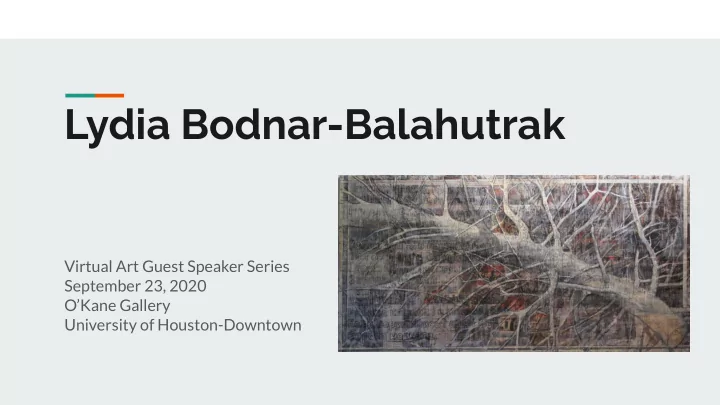
Lydia Bodnar-Balahutrak Virtual Art Guest Speaker Series September 23, 2020 OKane Gallery University of Houston-Downtown On Introduction panel And Europe Was Silent , 48 x 96 inches, print media collage, oil, chalks / distressed canvas,
Virtual Art Guest Speaker Series September 23, 2020 O’Kane Gallery University of Houston-Downtown
On Introduction panel And Europe Was Silent, 48 x 96 inches, print media collage, oil, chalks / distressed canvas, 2015 As soon as the Olympic Games ended in Russia, Putin put his land-grab plan into action and annexed Crimea, at the same time moving Russian troops to the Eastern Ukrainian border and then across the border in an invasion of Ukraine. Europe and the West undertook virtually no action to prevent these events and protect Ukraine's territorial integrity and
Stalin-orchestrated famine-genocide in Ukraine, the Ukrainian poet Oleksandr Oles' wrote "Remembrance", lamenting the deaths in Ukraine and pleading for help. I copied his poem onto the surface of accrued collaged reports of the latest Russian aggressions. Each stanza ends with the refrain "And Europe was silent", mournfully echoing Ukraine's plight today.
Map of Ukraine I am Ukrainian-American, a child of World War II refugees from
that of my displaced Ukrainian family, and that of the U.S.A where I was born, raised, and continue to live and work. Two trips to Ukraine were pivotal turning points for me in my creative work and world view.
and Kyiv, the capital, I saw the destructive vestiges of the Soviet regime, but also witnessed the beginnings of a national reclamation . By the end of 1991, the Soviet Union had dissolved and Ukraine declared independence. Since then, I have been inspired to “bear witness” to historic and current global events that deeply concern Ukraine and the U.S.A.
power of regeneration and healing after the 1986 nuclear
curtains of trees, have become recurring visual metaphors in my work. The map serves to locate Ukraine, the largest country in Europe, and to point out her neighboring countries and her vast geographic range, including the peninsula of Crimea in the Black Sea and the East Ukrainian cities that have been (still are) invaded by Russia.
52 x 144 inches print media collage, charcoal, pastel / paper 2020
Pandemic Lamentations, Part II, 52 x 144 inches, print media collage, charcoal, pastel / paper, 2020 This work is the second of my 3-part elegy recounting the pandemic as it unfolds - the loss of lives, the social, political, and economic upheavals. Part II centers on May 2020, marking the then incalculable human toll of 100,000 deaths in the U.S. from the
worked into the portrayed hazy, fragile terrain.
Close-up view - right-hand section of Pandemic Lamentations, Part II I've collaged newspaper articles, headlines, and photos that carry the story of the pandemic, and have drawn flickering flames
and nick at our consciousness. T. S. Eliot's words evoke hopefulness: "And all shall be well, and all manner of thing shall be well.”
48 x 96 inches print media collage,
2014
Will the Grass Grow Over It? 48 x 96 inches, print media collage, oil, wax / linen, 2014 This is an elegy for all the victims of
images of Stalin's 1932-33 Holodomor in Ukraine is overgrown with blades of grass and shielded with the words of writer Vassily Grossman, a Holodomor witness. He asks: "Can it really be that no one will ever answer for everything that has happened? That all will be forgotten...? That the grass will grow over it?"
Close-up view of Will the Grass Grow Over It? Holodomor is the Ukrainian name given to the tragic 1932-33 famine-genocide orchestrated by Josef Stalin onto Soviet Ukraine. It means “death by starvation”. 7-10 million Ukrainians died of starvation in an artificial famine, victims to Stalin’s Soviet collectivization policies. Stalin wanted to deal a “crushing blow” to the backbone of Ukraine, her rural population. Denial of the Holodomor by Soviet authorities was echoed at the time by many prominent Western journalists, like Walter Duranty of The New York
denied that there was any famine. Journalists Malcolm Muggeridge and Gareth Jones were among the few who reported the truth of this genocide. A recent film directed by Agnieszka Holland, Mr. Jones, addresses the lies and coverups.
50.5 x 65 inches print media collage, oil, wax / canvas 2015
Hearts-a-bustin’ , 50.5 x 65 inches, print media collage, oil, wax / canvas, 2015 My visit to the Chornobyl Zone in 1996, ten years after the nuclear explosion, left me struck by nature's power of reclamation. I saw nature spreading her healing mantle over the dust and
through broken windows, saplings were breaking through concrete floors and taking root. Those images of nature have become visual motifs in my work, metaphors for healing and renewal, as in this work that speaks of death and war games. The poet Gerard Manley Hopkins wrote: "And for all this, nature is never spent; there lives the dearest freshness deep down things..." Despite everything, in the face of destruction and loss, our human instinct for truth and beauty arises from deep down things, regenerates and creates anew.
97 x 152 inches (diptych)
print media collage, charcoal 2016
Thorns and Falling Idols 97 x 152 in. (diptych), print media collage, charcoal, pastel / canvas, 2016 This large diptych brings together some pivotal recent events in Ukraine since the country's declaration of independence in
post-Soviet news reports and photos, watched over by hovering idols, those icons
statues don't look so threatening now. They're ghostly, foggy images. But they are not gone, still present in Ukraine and other former Soviet republics, glimpsed through a scrim of prickly thorns and branches.
Close-up view of Thorns and Falling Idols A closer view shows the drawing marks made with charcoal and pastels over the collaged ground of print news.
Collection: The Art Museum of South Texas, Corpus Christi, Texas 105 x 65 inches print media collage, charcoal, pastel / canvas 2013
Barren Fruit, 105 x 65 inches, print media collage, charcoal, pastel / canvas, 2013 Collection: The Art Museum of South Texas, Corpus Christi, Texas This work is my meditation on the 2004 Orange Revolution in Ukraine and its 2010 aftermath. The collaged ground of print news, text, and photos, supports my drawing of a metaphoric tree with expansive trunk and limbs, soaring crown, and vestigial round fruit. Years after the dissolution of the Soviet Union, this peaceful activist action protesting a rigged election and calling for free and independent elections grew into a strong movement. There was hope and potential for democratic reform. But by the 2010 election, it had been corrupted and co-opted. Nonetheless, despite the barren fruit, the calls for democratic reform still reverberate.
9 x 9 inches charcoal, Russian ruble coin / paper 2019
You Are What You Are Fed (Nests series), 9 x 9 inches, charcoal, Russian ruble coin / paper, 2019 This is one of my ongoing “Nests” series, in which I incorporate a fable-like language in which a menagerie of animals act as stand-ins for very human dramas. Here a nestling opens her beak to receive a Russian ruble coin, her body already drawn over Russian currency. As the title suggests, you become what you are fed, but only if you choose to ingest it. We must be vigilant and question the information we are fed.
Solo exhibition, 2016, at The Galveston Arts Center, TX from 133 x 83 inches to 30 x 28 inches all work: print media collage, mixed media / canvas
Discourse solo exhibition, 2016, at The Galveston Arts Center, TX from 133 x 83 inches to 30 x 28 inches, all work: print media collage, mixed media / canvas The title “Discourse" underscores what is at the heart
strive to visually evoke - not just document - the stories of pivotal world events. Each piece begins as an extensive collage of clipped newspaper articles, headlines, and photos, arranged in a sort of self-perpetuating dialogue, over which I apply charcoal, paint, and wax. The work is layered in time and materials, oscillating between found text and rendered imagery. Some elements are concealed,
written word as well as the general nature of disseminated information. Each exhibition is an
viewer to assess what is actually revealed and what is disguised.