MANAGEMENT OF SLEEP APNEA: EVIDENCE BASED APPROACH NEIL S. FREEDMAN, - - PDF document

management of sleep apnea evidence based approach neil s
SMART_READER_LITE
LIVE PREVIEW

MANAGEMENT OF SLEEP APNEA: EVIDENCE BASED APPROACH NEIL S. FREEDMAN, - - PDF document

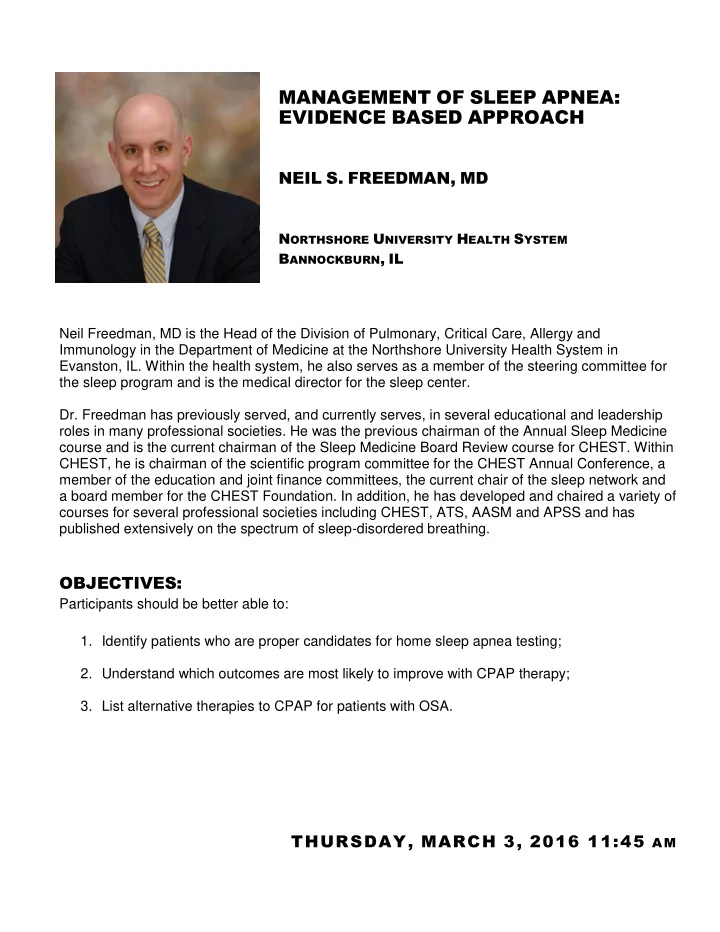
MANAGEMENT OF SLEEP APNEA: EVIDENCE BASED APPROACH NEIL S. FREEDMAN, MD N ORTHSHORE U NIVERSITY H EALTH S YSTEM B ANNOCKBURN , IL Neil Freedman, MD is the Head of the Division of Pulmonary, Critical Care, Allergy and Immunology in the Department


slide-1
SLIDE 1

MANAGEMENT OF SLEEP APNEA: EVIDENCE BASED APPROACH

NEIL S. FREEDMAN, MD

NORTHSHORE UNIVERSITY HEALTH SYSTEM BANNOCKBURN, IL Neil Freedman, MD is the Head of the Division of Pulmonary, Critical Care, Allergy and Immunology in the Department of Medicine at the Northshore University Health System in Evanston, IL. Within the health system, he also serves as a member of the steering committee for the sleep program and is the medical director for the sleep center.

  • Dr. Freedman has previously served, and currently serves, in several educational and leadership

roles in many professional societies. He was the previous chairman of the Annual Sleep Medicine course and is the current chairman of the Sleep Medicine Board Review course for CHEST. Within CHEST, he is chairman of the scientific program committee for the CHEST Annual Conference, a member of the education and joint finance committees, the current chair of the sleep network and a board member for the CHEST Foundation. In addition, he has developed and chaired a variety of courses for several professional societies including CHEST, ATS, AASM and APSS and has published extensively on the spectrum of sleep-disordered breathing.

OBJECTIVES:

Participants should be better able to:

  • 1. Identify patients who are proper candidates for home sleep apnea testing;
  • 2. Understand which outcomes are most likely to improve with CPAP therapy;
  • 3. List alternative therapies to CPAP for patients with OSA.

THURSDAY, MARCH 3, 2016 11:45 AM

slide-2
SLIDE 2

3/8/2016 1

OSA Management: Evidence Based Approach

Neil Freedman, MD

  • Dr. Freedman has declared no

conflicts of interest related to the content of his presentation.

slide-3
SLIDE 3

3/8/2016 2

Lecture Outline

  • HST for the diagnosis of OSA
  • Treatment of OSA:

– PAP – Oral appliances – Surgery – Weight loss – Alternative therapies

Who is an Appropriate Candidate for Home Sleep Apnea Testing?

  • Patients with a high clinical suspicion of moderate to severe

OSA

– Overweight or obese with snoring, witnessed apneas, daytime sleepiness +/- cardiovascular disease

  • Contraindications based on AASM recommendations:

– Low risk of moderate to severe OSA – Comorbid diseases

  • CHF, hypoventilation syndromes, neuromuscular disease, chronic lung

disease, history of stroke

– Comorbid sleep disorders

  • Insurance and sleep benefit management companies may

have their own policies

Collop, N et al. J Clin Sleep Med 2007;3:737-47

slide-4
SLIDE 4

3/8/2016 3

PSG Gravy Train is Over

HST Devices Valid for the Diagnosis of OSA

  • WatchPAT is adequate for diagnosing OSA

– Best supporting data of all devices (3 IA and 4 IIA studies)

  • Devices that measure nasal pressure plus effort are

adequate to diagnose OSA

– Embletta and Stardust II

  • Devices that measure nasal pressure without effort are

adequate to diagnose OSA

– Apnea link (1 IA) and ARES (2 IA and 1 IIA studies)

  • Thermal sensing device alone without effort

measurement is inadequate for diagnosing OSA

Collop, N et al. J Clin Sleep Med 2011;7:531-548

slide-5
SLIDE 5

3/8/2016 4

RCTs Outcomes Data Supporting HST for OSA

Study N HST Device Treatment Similar Outcomes Mulgrew 2007 68 Overnight

  • ximetry

In lab CPAP vs CPAP set via APAP ESS, SAQLI, AHI *Better compliance with APAP Berry 2008 106 WatchPAT In lab CPAP vs CPAP set via APAP ESS, FOSQ, Compliance Skomro 2010 102 Embletta In lab CPAP vs CPAP set via APAP ESS, SF-36, PSQI, SAQLI, BP, Compliance Kuna 2011 213 Embletta In lab CPAP vs CPAP set via APAP ESS, FOSQ, PVT, SF-12, Compliance Rosen 2012 197 Embletta In lab CPAP vs CPAP set via APAP ESS, FOSQ, SF-36, SAQLI compliance, * Nightly use > APAP Berry 2014 156 Embletta In lab CPAP vs APAP ESS, FOQS, AHI, Compliance, PAP satisfaction scores

HST for OSA is Here to Stay

  • Data supports it in the proper patient populations

– High clinical suspicion of moderate to severe OSA

  • Payers want it
  • Patients will demand it
  • Technology will improve to continue to expand

diagnostic options

  • Sleep community should embrace and

champion this approach

slide-6
SLIDE 6

3/8/2016 5

Continuous Positive Airway Pressure (CPAP)

  • Initially described by Sullivan in 1981
  • Currently the mainstay of therapy for OSAS

Does CPAP Treatment Make A Difference?

slide-7
SLIDE 7

3/8/2016 6

Perceived CPAP Benefits: Reality or Wishful Thinking?

AHI Sleep Architecture Subjective Sleepiness Objective Sleepiness Neurocognitive and Mood Quality of Life Cardiovascular Disease

+ + + + + + +

Question

Which one of the following outcomes is most likely to improve with CPAP treatment? A) Hypertension B) Daytime sleepiness C) Obesity D) Depression

slide-8
SLIDE 8

3/8/2016 7

QUESTION Which one of the following outcomes is most likely to improve with CPAP treatment?

  • A. Hypertension
  • B. Daytime sleepiness
  • C. Obesity
  • D. Depression
A. B. C. D.

24% 7% 0% 69%

CPAP Outcomes Summary: Patients with Daytime Symptoms

AHI Sleep Architecture Subjective Sleepiness Objective Sleepiness Neuro- cognitive and Mood Quality

  • f Life

Cardiovascular Risk Reduction Severe/M

  • derate

OSAS

+ +/- + +/- +/- +/- +/-

Mild OSAS

+ +/- +/-

  • +/-

NA

slide-9
SLIDE 9

3/8/2016 8 The Effect of CPAP Treatment on Blood Pressure:

A Systematic Review and Meta-Analysis of Randomized Controlled Trials

  • CPAP improved:
  • Diurnal SBP -2.58 mm Hg

– (95% CI −3.57 to −1.59 mm Hg)

  • Diurnal DBP −2.01 mm Hg

– (95% CI −2.84 to −1.18 mm Hg)

  • Similar improvements in nocturnal

BP

  • Improvements associated with:
  • More severe disease
  • Daytime sleepiness
  • Greater PAP adherence
  • Younger age
  • Improvements predicted by:
  • Baseline BP and Epworth
  • Conclusions:
  • CPAP is associated with modest,

but significant, improvements in BP Montesi, S et al. J Clin Sleep Med 2012;8:587-596

Improvements in Less Severe Disease Inconsistent & Debatable

Study N Severity Intervention Main Findings APPLES 2012 1105

  • Mild 14%
  • Moderate 31%
  • Severe 55%

CPAP vs Sham CPAP x 6 months

  • Transient improvement in working

memory at 2 months

  • No improvements in neurocognitive

function across spectrum of dx at 6 months

  • Improved MWT and Epworth in severe

dx at 6 months

  • Improved Epworth in moderate &

severe dx at 2 & 6 months

  • Mild dx without improvement in

MWT/Epworth at 2 & 6 months

CATNAP 2012 223

  • Mild (63%)
  • Moderate

(37%)

  • Epworth > 10

CPAP vs Sham CPAP x 8 weeks

  • CPAP significantly improved

FOSQ vs sham CPAP

  • CPAP improved ESS better than

sham (baseline ESS = 15)

  • CPAP  mean ESS by 2.6
  • Sham  ESS by 0.5 (NS)

Kushida, C et al. SLEEP 2012;35(12):1593-1602 Weaver, T et al. Amer J Respir Crit Care Med 2012;186:677-683

*** APPLES used 3% or arousal hypopnea definition *** CAPTNAP used 3% hypopnea definition

slide-10
SLIDE 10

3/8/2016 9

CPAP Effects on BP in NonSleepy Severe OSA with HTN Limited and Delayed

Barbe, F et al. AJRCCM 2010;181:718-726

Adjusted Mean BP (mm Hg)

Adjusted Mean Differences (95% CI) CPAP vs Control

SBP DBP SBP DBP

3 Months 12 Months

*P = 0.0021 P = 0.2008 P = 0.2852 P = 0.1275

Overall, CPAP Does Not Reduce the Incidence of HTN

  • r CV Disease in OSA without Daytime Sleepiness

Barbe, F et al. JAMA 2012;307:2161-2168

slide-11
SLIDE 11

3/8/2016 10

  • CPAP may reduce cardiovascular mortality
  • Prospective observational studies
  • CPAP can reduce blood pressure, but reductions in BP are small and

results are inconsistent across studies

  • EDS and uncontrolled HTN may predict a more robust BP response
  • Better adherence = Better BP response
  • Antihypertensive medication better than CPAP
  • CPAP may improve BP in patients with resistant HTN and OSA
  • CPAP better than oxygen in patients with CV disease or CV risk factors
  • CPAP does not reduce the incidence of HTN or cardiovascular

diseases in patients with OSA and no daytime sleepiness

  • Limited data for reductions of arrhythmias with CPAP
  • CPAP improves LVEF in patients with CHF with systolic dysfunction

and OSAS

  • Minimal to no data concerning:
  • Mild OSAS
  • Long-term RCTs on other cardiovascular outcomes

OSA, CV Disease and Treatment (CPAP): The Bottom Line: Data is Inconclusive

  • CPAP use associated with reductions in motor vehicle accidents
  • CPAP use not associated with weight loss
  • May be associated with mild weight gain
  • CPAP use may improve lipid profile
  • Reduction in total cholesterol and LDL
  • Increase in HDL
  • No affect on triglycerides
  • Improvements in DM and metabolic syndrome debatable
  • Weight loss better than CPAP for improving these outcomes
  • CPAP can improved daytime sleepiness in patients with REM

related OSA

  • No data on other outcomes in this group
  • Benefits for patients without symptoms not clear across

spectrum of disease severity

Other CPAP Outcomes

slide-12
SLIDE 12

3/8/2016 11

  • CPAP Indications (Standards):
  • Treatment of moderate - severe OSAS
  • Improving subjective sleepiness
  • CPAP Recommendations (Options):
  • Treatment of mild OSAS
  • Improving quality of life
  • As an adjunctive anti-hypertensive therapy

AASM Practice Parameter and Clinical Guideline Recommendations Still Supported by the Data

Kushida, C et al. Sleep 2006; 29:375-380 Gay, P et al. Sleep 2006;29:381- 401 Epstein, L et al. J Clin Sleep Med 2009;5:263-276

How Much CPAP is Enough?

slide-13
SLIDE 13

3/8/2016 12

More CPAP = Less Sleepiness

Weaver, T et al. Sleep 2007;30:711-19

  • Depends on the outcome
  • Depends on the individual
  • Not all individuals will demonstrate improvements

in all outcomes

  • Some CPAP use is good, more is probably better

How Much CPAP is Enough?

Weaver, T et al. Sleep 2007;30:711-19 Antic, N et al. Sleep 2011;24:111-19

slide-14
SLIDE 14

3/8/2016 13

  • AASM recommends full-night in-lab titration (Guideline)
  • AASM 2008 Guidelines for manual titration
  • Goal CPAP pressure
  • Minimal pressure required to resolve:
  • All apneas, hypopneas, snoring and arousals related to these events
  • In all stages of sleep
  • In all positions
  • Repeat titration only for new symptoms or significant

weight change

Determining CPAP Prescription

Kushida, C et al. Sleep 2005; 28:499-521 Kushida, C et al. Sleep 2006; 29:375-80 Kushida, C et al. Jl of Clin Sleep Med 2008;4:157-71 Epstein, L et al. J Clin Sleep Med 2009;5:263-276

  • Indications:
  • An AHI of > 40 events per hour during the initial 2 hours of the

PSG; and

  • At least 3 hours to conduct an adequate CPAP titration
  • Consider for:
  • AHI of 20 to 40 events/hour during the initial 2 hours of a sleep

study

  • Data less supportive
  • Disadvantages:
  • Sub-optimal CPAP titrations

Split-night Studies

Kushida, C et al. Sleep 2005; 28:499-521 Kushida, C et al. Sleep 2006; 29:375-80

slide-15
SLIDE 15

3/8/2016 14

Many Patients May Not Achieve an Optimal CPAP Titration

  • Quality of Titration:
  • Optimal:
  • AHI < 5 with supine REM
  • Good:
  • AHI < 10 with supine

REM

  • Adequate:
  • AHI < 75% of baseline or
  • No supine REM
  • Inadequate: Other

Su CS, et al. J Clin Sleep Med 2012;8:243-247

Percent of Titrations (%)

Insurance Companies Will Dictate Out of Center OSA Treatment as well as Diagnosis

  • United Healthcare is “excited” to inform you about the proactive

approach we are taking for our enrollees with possible and confirmed OSA. United Healthcare is working with our provider network to help our members get tested for OSA more comfortably in their own homes, when appropriate.

  • Preauthorization required for all sleep studies as of 10/1/11
  • Requests for in-laboratory polysomnography will be denied if the

patient is eligible for home sleep testing.

– Contracted with IDTF VirtuOx to perform home sleep testing nationwide as of 1/1/12

  • Home sleep testing followed by the use of APAP (auto-

adjusting positive airway pressure) devices in the self- adjusting mode for unattended treatment is an alternative to in- laboratory titration of CPAP (continuous positive airway pressure).

United Healthcare Network Bulletin July 2011- Vol 44

slide-16
SLIDE 16

3/8/2016 15

AutoCPAP (APAP): What is it?

  • Aka: Automatic, automated, autotitrating,

autoadjusting, selftitrating

  • Detects and responds to changes in upper

airway flow or resistance patterns

  • Potential applications:

– Diagnosis

  • No Data
  • Not Recommended

– Treatment:

  • In place of, or as an adjunct to, conventional CPAP

APAP Devices and Technologies

Company Device Snore FL Hypopnea Apnea Flow Based FOT

Resmed

Autoset S8 S9 S10

+ +

Phillips Respironics

Remstar Auto M Series Auto

+

Fisher Paykel

Icon Auto Sleepstyle 254 Auto

+

DeVilbiss

Sleepcube Auto

+

Weiman

Somnosmart

+

Parameters Detected Technology

slide-17
SLIDE 17

3/8/2016 16 Which of the following OSA patients would be the most appropriate candidate for APAP therapy?

A) 55 year old male with congestive heart failure and an AHI = 30 events/hour. B) 60 year old male with COPD and an AHI = 40 events/hour. C) 35 year old male with BMI = 35 and an AHI = 35 events/ hour. D) 32 year old male with obesity hypoventilation syndrome and AHI = 43 events/hour.

Question

QUESTION Which of the following OSA patients would be the most appropriate candidate for APAP therapy?

A. 55 year old male with congestive heart failure and an AHI = 30 events/hour. B. 60 year old male with COPD and an AHI = 40 events/hour. C. 35 year old male with BMI = 35 and an AHI = 35 events/hour. D. 32 year old male with obesity hypoventilation syndrome and AHI = 43 events/hour.

A. B. C. D.

17% 17% 53% 14%

slide-18
SLIDE 18

3/8/2016 17

Who is a Potential Candidate for APAP?

  • Clear Candidates

– Uncomplicated moderate to severe OSAS

  • Unclear Groups

– REM-related OSAS – Position dependent – High pressures (>10) – CPAP intolerant

  • Not APAP Candidates

(AASM Standard)

– Congestive heart failure – COPD and chronic lung disease – Obesity Hypoventilation Syndrome – Other hypoventilation syndromes – Lack of snoring

Morganthaler, TI et al. Sleep 2008;31:141-47

How does APAP Compare to Conventional CPAP for the Treatment of OSAS?

slide-19
SLIDE 19

3/8/2016 18

APAP vs CPAP Conclusions

  • Lower mean pressures with APAP
  • Similar outcomes to CPAP:

– Adherence – AHI – Subjective sleepiness (EPWORTH) – Note: No outcomes data on BP with APAP

  • APAP is as effective as CPAP for

uncomplicated moderate to severe OSA Unattended APAP P95/P90 to Determine Fixed CPAP: APAP Outcomes = PSG Determined CPAP

Study n Device Duration (wks) Similar Outcomes

West 2006 98 Resmed Autoset Spirit 26 ESS, OSLER, SF-36, SAQLI, Compliance, AHI Cross 2006 204 Resmed Autoset Spirit 12 ESS, OSLER, SF-36, FOSQ, Compliance Mulgrew 2007 68 Resmed Autoset Spirit 12 ESS, SAQLI, AHI *Better compliance with APAP P95 Berry 2008 106 Resmed Autoset Vantage 6 ESS, FOSQ, Compliance Skomro 2010 102 Resmed Autoset 4 ESS, PSQI, SAQLI, SF-36, BP, Compliance Kuna 2011 213 Philips Respironics RemStar Auto 12 ESS, FOSQ, PVT, SF-12, Compliance Rosen 2012 197 Philips Respironics RemStar Auto Pro 12 ESS, FOSQ, SF-36, SAQLI Adherence, * Nightly use > APAP

slide-20
SLIDE 20

3/8/2016 19

RCTs of Unattended APAP: APAP = CPAP

Study n Device Duration (wks) Similar Outcomes

Planes 2003 35 SEFAM REM+ Auto 52 AHI, ESS, Compliance Hukins 2004 58 Resmed Autoset T 16 ESS, SF-36, Compliance Masa 2004 360 Resmed Autoset T 12 AHI, ESS, QOL, Pressure, Compliance Nussbaumer 2006 34 Philips Respironics REMstar 8 AHI, ESS, OSLER, SF-36, Compliance West 2006 98 Resmed Autoset Spirit 26 AHI, ESS, OSLER, SF-36, SAQLI, Compliance Douglas 2010 181 Resmed Autoset Spirit 12 ESS, Osler, PVT, SF-36, Side effects, Compliance Berry 2014 156 Philips Respironics REMstart Auto 6-8 AHI, ESS, FOSQ, Compliance, PAP satisfaction

APAP Modifications Don’t Improve Outcomes

  • APAP with AFLEX =

CPAP at 6 months

  • Similar:

– Compliance – AHI, Epworth – QOL, BP

  • APAP w/ SensAwake =

APAP w/o SensAwake

(Fisher & Paykel)

  • Similar

– AHI – P90 – Mean pressure – Sleep architecture

Kushida, C et al. Sleep 2011;34:1083-92 Dungan, G et al. Jl Clin Sleep Med 2011;7:261-7

slide-21
SLIDE 21

3/8/2016 20

APAP for OSA: The Bottom Line

  • Recommended for the treatment of patients

with moderate to severe uncomplicated OSA

– As stand alone therapy or to set a fixed CPAP setting – Should be considered as first line therapy

  • Not recommended for:

– OSA with comorbidities:

  • CHF, hypoventilation syndromes, COPD
  • Non-snorers or s/p UPPP

– OSA diagnosis or split-night studies

  • Similar outcomes to CPAP
  • Should be considered as first line therapy

PAP Adherence

  • Definition: > 4 hours per night on 70% of the
  • bserved nights

Objective Measurement of Patterns of Nasal CPAP Use by Patients with Obstructive Sleep Apnea

Nancy Barone Kribbs, Allan I. Pack, Lewis R. Kline, Philip L. Smith, Alan R. Schwartz, Norman M. Schubert, Susan Redline, John N. Henry, Joanne E. Getsy, and David F. Dinges American Review of Respiratory Disease, Vol. 147, No. 4 (1993), pp. 887-895

slide-22
SLIDE 22

3/8/2016 21

CPAP Adherence

  • Subjective adherence 60% to 90%
  • Objective adherence 40% – 84%
  • Patients tend to overestimate adherence

– ≈ 60 minutes per night – Pattern observed in CPAP naïve and long term users

  • Adherence patterns determined early

Question

Which one of the following has been associated with lower adherence to PAP therapy? A) Severe OSA (AHI > 30) B) Excessive daytime symptoms C) Pressures < 12 cm H2O D) Lower socioeconomic status

slide-23
SLIDE 23

3/8/2016 22

QUESTION Which one of the following has been associated with lower adherence to PAP therapy?

  • A. Severe OSA (AHI > 30)
  • B. Excessive daytime symptoms
  • C. Pressures < 12 cm H2O
  • D. Lower socioeconomic status

A. B. C. D.

0% 86% 11% 3%

Predictors of Adherence Inconsistent: The Bottom Line

  • Possibly daytime sleepiness and more severe

disease associated with improved adherence

  • African American race and/or lower

socioeconomic class associated with lower adherence

  • Pressure level not predictive
slide-24
SLIDE 24

3/8/2016 23

Question

Which one of the following interventions has been associated with improved PAP adherence? A) AutoPAP B) Education C) Nasal steroids D) PSG titration QUESTION Which one of the following interventions has been associated with improved PAP adherence?

  • A. AutoPAP
  • B. Education
  • C. Nasal steroids
  • D. PSG titration
A. B. C. D.

14% 3% 3% 81%

slide-25
SLIDE 25

3/8/2016 24

  • Interventions to Improve Adherence:
  • Heated humidification (Standard)
  • Education (Standard)
  • Follow up:
  • CPAP usage should be objectively monitored

(Standard)

  • Initial follow up in first few weeks (Standard)
  • Yearly and as needed follow-up thereafter (Option)

AASM Practice Parameters and Clinical Guideline Adherence Recommendations

Kushida, C et al. Sleep 2006; 29:375-80 Gay, P et al. Sleep 2006;29:381- 401 Epstein, L et al. J Clin Sleep Med 2009;5:263-276

Therapy Interventions Evidence Quality Mean Improvements in Nightly CPAP Adherence Supportive

  • Increased practical support
  • Encouragement
  • Telemedicine
  • Relaxation prior to CPAP

Low to moderate .85 hours Education

  • Video
  • Face-to-face sessions
  • Group sessions
  • Written material
  • Phone calls
  • Home follow up

Low to moderate .6 hours Behavioral Therapies

  • Motivational interviewing
  • Written feedback
  • CBT with education

Very low to low 1.44 hours

Impact of Supportive, Educational and Behavioral Therapies on CPAP Compliance

Wozniak D et al. Cochrane Database Review 2014

slide-26
SLIDE 26

3/8/2016 25

Heated Humidification May Improve Adherence for Some Patients

  • AASM Practice

Parameters and Clinical Practice Guidelines (Standard) – Improved compliance – More effective for:

  • Nasal complaints
  • Rhinitis
  • Role of heated tubing

unclear

– Limited data suggests no improvement in adherence

Haniffa, M et al. Cochrane Databases of Syst. Rev. 2004 Kushida, C et al. Sleep 2006; 29:375-80 Gay, P et al. Sleep 2006;29:381- 401 Epstein, L et al. J Clin Sleep Med 2009;5:263-276

Data on Heated Humidification and PAP Adherence: Inconsistent and Not Very Strong

Study N Interventions Outcomes Massie 1999 38

  • CPAP with heated, cold pass and

no humidification

  • Duration: 3 weeks
  • Heated humidification improved

adherence

  • No difference in adherence with cold

pass or no humidification

  • Reduced upper airway dryness with HH
  • No differences in Epworth between groups

Neill 2003 42

  • CPAP with and without heated

humidification

  • Duration: 3 weeks
  • Small increase in adherence
  • Reduced upper airway symptoms
  • No change in sleepiness or satisfaction

Mador 2005 98

  • CPAP with and without heated

humidification

  • Durations: 12 months
  • No differences in adherence
  • No differences in daytime sleepiness, QOL
  • Reduced upper airway dryness with HH

Salgado 2008 39

  • APAP with and without heated

humidification

  • Durations: 30 days
  • No differences in adherence
  • No differences in nasal symptoms

Worsnop 2010 54

  • Heated vs no humidification
  • Durations: 12 weeks
  • No differences on adherence
  • Reduced nasal symptoms

Salgado S et al. J Bras Pneumol. 2008;34:690-4 Worsnop C et al. Intern Med J 2010;40:650-656 Massie C et al. Chest. 1999;116:403-8 Neill A et al. Eur Respir J. 2003 Aug;22(2):258-62 Mador M et al. Chest 2005;128:2151-8

slide-27
SLIDE 27

3/8/2016 26

Optimum form of CPAP delivery interface remains unclear

Cochrane Database Syst Rev. 2006 Oct 18(4):CD005308 Gay, P et al. Sleep 2006;29:381-401

The best mask is the one the patient will wear

slide-28
SLIDE 28

3/8/2016 27

Changing Mask Type May Change Therapeutic CPAP Pressure

  • 4
  • 2

2 4 6 Number of Patients Change in Pressure (Full – Nasal cm H2O)

Teo, M et al. Sleep 2011;34:951-5

Intervention Outcomes Comments

Education/Supportive Care Beneficial

  • Various interventions helpful in most patients
  • Best intervention, or combination, not clear

Behavioral Therapies Beneficial

  • Various interventions improve adherence
  • Low quality supporting data data

Heated humidification Inconsistent/Co ntroversial

  • Some, but not the majority of data support

improved adherence

  • Nasal congestion or rhinitis may be associated

with improved adherence with heated humidification

Advanced PAP (Flex, Bilevel and APAP) No benefit

  • Not associated with improved adherence or
  • ther outcomes
  • Biflex, may be the exception, in CPAP

nonadherent

Nasal Steroids No Benefit

  • Not associated with improved adherence or

nasal symptoms

Adherence Interventions and Outcomes Summary: The Bottom Line

slide-29
SLIDE 29

3/8/2016 28

Intervention Outcomes Comments

Mask Type Unclear

  • Best mask type is not clear and is patient

dependent

  • Changing mask type may alter effective

PAP pressure

Hypnotics Controversial

  • Eszopiclone may improve PAP titration

efficacy and 6 month adherence

  • Data do not support other hypnotics

Telemedicine Unclear

  • Limited data suggest benefit, other not

supportive

  • More data required

Compliance Monitoring Unclear

  • No clear data to guide therapy or

determine which patients may benefit from this intervention

Sleep Specialist Care Unclear

  • Observational studies support
  • RCTs show mixed results in

uncomplicated moderate/severe OSA

Adherence Interventions and Outcomes Summary: The Bottom Line

What is the Best Follow-up Strategy?

  • Short term:

– AASM recommends initial follow up in first few weeks (Standard) – Most payers require office follow up between 31 and 91 days – Not clear if either strategy improves adherence

  • Long term:

– AASM recommends annual follow up and as needed (Option) – Some payers will require annual follow up – Recent data suggest little objective benefit from face-to-face

  • ffice follow up in patients without subjective complaints
  • Without subjective complaints, the likelihood of a therapeutic

intervention was 0.07 (95% CI = 0.03-0.15, p < 0.001)

  • Conclusion: The value and optimal timing of routine follow up

for all patients with OSA is yet to be determined

Nannapaneni S et al. J Clin Sleep Med 2014;10:919-924

slide-30
SLIDE 30

3/8/2016 29

Oral Appliances for OSA

Oral Appliance Mechanisms of Action

  • Mandibular

advancement and/or

  • Maintains tongue in a

more anterior position

slide-31
SLIDE 31

3/8/2016 30

Indications for Oral Appliance (OA)Therapy for OSA

  • 2006 AASM Practice Parameters

– Indicated for use in mild to moderate OSA (Guideline) in patients who:

  • Prefer OAs to CPAP
  • Do not respond to CPAP
  • Are not appropriate CPAP candidates
  • Fail CPAP or behavioral measures
  • 2014 AADSM Definition of an Effective Oral Appliance

– Work best for mild to moderate OSA – May be used in patients with severe OSA who do not respond to, or are unwilling or unable to, tolerate CPAP therapy

Kushida, C et al. Sleep 2006:29:240-43 JDSM April 2014

Predictors of Success

  • Less severe disease
  • Supine dependent OSA
  • Younger age
  • Female gender
  • Lower BMI
  • Smaller neck circumference
  • CPAP failures with lower pressure requirements
  • Problem:
  • Ability to accurately predict success prior to initiating

therapy is only approximately 50%

slide-32
SLIDE 32

3/8/2016 31

Advances in OA Titration: Remote Controlled In-lab Titration

  • Remotely titrates oral appliance during a

full night PSG

MATRx

Remmers J et al. Sleep 2013;36:1517-25

MATRx May Predict Outcomes with OA Therapy

  • Success definition:

– AHI <10/hr and ≥ 50% reduction in baseline AHI

  • Able to predict:

– Success in 87% – Failure in 83%

  • Overall PPV = 87%

Remmers J et al. Sleep 2013;36:1517-25

slide-33
SLIDE 33

3/8/2016 32

Do Oral Appliances Improve Important Patient Outcomes and Which Patient Groups Benefit the Most? Oral Appliance AASM Practice Parameters Summary

  • OAs indicated for mild-to-moderate OSA

(Guideline)

  • Severe OSA should have initial trial with

CPAP (Guideline)

  • CPAP more effective for reducing AHI and

improving oxygenation

  • OAs = CPAP for improving sleepiness

Kushida, C et al. Sleep 2006;29:240-43 Ferguson, K et al. Sleep 2006;29:244-62 Sutherland K et al. J Clin Sleep Med 2014;10(2):215-227

slide-34
SLIDE 34

3/8/2016 33 Effect of Oral Appliances on Blood Pressure in OSA: A Systematic review and Meta-analysis

  • 7 studies with n = 399 (2 RCTs, n = 146)
  • Results:
  • Conclusions: Pooled estimates suggest a favorable effect on

many parameters of BP

  • Limitations: Most studies observational. More RCT data

needed

Iftikhar I et al. J Clin Sleep Med 2013;9:165-174

Overall Mean Changes BP mm Hg (95% CI) P Value Mean Changes Nocturnal BP mm Hg (95% CI) P Value SBP

  • 2.7

(0.8 to -4.8) 0.04

  • 2.0

(1.1 to -5.3) 0.212 DBP

  • 2.7

(-0.9 to -4.6) 0.004

  • 1.7

(-0.1 to -3.2) 0.03 MAP

  • 2.4

(-.08 to -4.01) 0.003

  • 1.9

(1.3 to -5.1) 0.255

Surgery for OSA

Surgery for OSA

Bariatric Upper Airway HGNS

slide-35
SLIDE 35

3/8/2016 34

AASM Practice Parameters Upper Airway Surgery for OSA: All Recommended as Options

  • Tracheostomy:

– Effective single intervention to treat OSA. Should be considered only when other options do not exist, have failed, or when this operation is deemed clinically urgent

  • Maxillomandibular advancement (MMA):

– Indicated for surgical treatment of severe OSA in patients who cannot tolerate or who are unwilling to use other treatments

  • UPPP:

– Should only be offered when PAP or OA are not tolerated or effective

  • Multi-level or stepwise surgery (MLS):

– Acceptable in patients with narrowing of multiple sites in the upper airway, particularly if they have failed UPPP as a sole treatment

  • Radio frequency ablation (RFA):

– Considered in mild to moderate OSA who cannot tolerate or who are unwilling to adhere to CPAP or OA therapy

  • Palatal implants:

– May be effective in mild OSA who cannot tolerate or who are unwilling to adhere to CPAP or OA therapy

Aurora, R et al. SLEEP 2010;33(10):1408-1413

Upper Airway Surgery for OSA

  • Typically not first line therapy for OSA
  • Little rigorous data to support most upper airway

surgical procedures:

– Data are inconsistent or incomplete – Difficult to predict success prior to surgery – Laser assisted uvuloplasty (LAUP) not recommended

  • Upper airway surgical options supported by best

data/outcomes:

– Maxillomandibular advancement (MMA) for adults – Adenotonsillectomy for pediatric population

Aurora, R et al. SLEEP 2010;33(10):1408-1413

slide-36
SLIDE 36

3/8/2016 35

Weight Loss for OSA: Can Work but Seldom Achieved

“What a glorious day to begin a short-lived diet and exercise program.”

Weight Loss Improves OSA: Best Data Based on Bariatric Surgery

  • BMI improves

– 55.3 to 37.7 Kg/m2

  • AHI improves

– 54.7 to 15.8

  • Residual disease in majority

– AHI < 10 in 44% – AHI < 5 in 25%

  • Objective testing

recommended after weight loss to determine ongoing need for treatment

Greenburg et al. Am J Med. 2009;122(6):535-42

slide-37
SLIDE 37

3/8/2016 36

Surgical vs Conventional Therapy for Weight Loss Treatment of Obstructive Sleep Apnea

  • RCT of 60 obese patients (BMI > 35 and < 55)
  • Recently diagnosed OSA AHI ≥ 20 on CPAP

therapy

  • Randomized to:

– Conventional weight loss program with regular counseling and very low calorie diet – Bariatric surgery: Adjustable gastric banding

  • Follow up: 2 years
  • Outcomes:

– Primary: Change in AHI – Secondary: Change in weight, CPAP adherence and functional status

Dixon et al. JAMA. 2012;308(11):1142-1149

Surgical vs Conventional Weight Loss for OSA

  • Results:

– Bariatric surgery patients lost more weight compared to conventional weight loss

  • 27.8 kg vs 5.1 kg (p < 0.001)

– Bariatric surgery led to a non-significant reduction in the AHI compared to conventional weight loss

  • 25.5 vs 14.0 (p = 0.18)
  • Most patients had residual severe OSA
  • Mild OSA (AHI < 15) achieved by minority of patients

– No difference in PAP adherence between groups

  • Only 60% to 66% adherence in both groups at 2 year follow up
  • Conclusions:

– Bariatric surgery (adjustable gastric banding) does not lead to greater reductions in AHI despite greater reductions in weight

Dixon et al. JAMA. 2012;308(11):1142-1149

slide-38
SLIDE 38

3/8/2016 37

Hypoglossal Nerve Stimulation Devices

Strollo P et al. NEJM 2014;370:139-149 Kezirian E et al.J Sleep Res 2014;23:77-83

Hypoglossal Nerve Stimulation for OSA

  • Relatively recently approved by the FDA (May 1, 2014)
  • Exclusions:

– BMI > 32 kg/m2, AHI < 20 or > 50, central apneas, concentric upper airway collapse on DISE

  • Current supporting data:

– Overweight and mildly obese (BMI < 32 kg/m2) patients with moderate to severe OSA who are CPAP intolerant – Improved OSA, daytime sleepiness and QOL with up to a year follow up

  • Mean 68% reduction in AHI over a year (AHI 29.3 to 9)

– Low complication rate: < 2%

  • Role in OSA therapy yet to be determined

– Cost will be the major barrier

  • All data specific to the INSPIRE device

Strollo P et al. NEJM 2014;370:139-149

slide-39
SLIDE 39

3/8/2016 38

HGNS Therapy Effective Over 1 Year

5 10 15 20 25 30 35 Baseline Month 12 Randomized Therapy Withdrawal Trial Therapy Maintenance Group (n = 23) Therapy Withdrawal Group (n= 23) AHI (Events per Hour)

** P < 0.001 **

Strollo P et al. NEJM 2014;370:139-149

Up to 33% of Patients Do Not Respond to INSPIRE Therapy

Strollo P et al. NEJM 2014;370:139-149 Supplemental Appendix page 11

Responder Definition:

  • AHI < 20

AND

  • ≥ 50% reduction in

AHI from baseline

  • 53% with AHI < 10
  • 63% with AHI < 15
slide-40
SLIDE 40

3/8/2016 39 Not All Patients Will Respond to INSPIRE HGNS Treatment: 18 Month Data

19 of 83 (23%) responders at 12 months were non-responders at 18 months Strollo P et al. SLEEP 2015;38:1593-1598

Alternatively, Some Non-responders at 12 Months Were Responders at 18 Months

  • Of the 43 non-responders at 12

months

  • 16 of the 43 (37%) met criteria for

response at 18 months

  • Overall response rate similar at 12

and 18 months

Strollo P et al. SLEEP 2015;38:1593-1598

slide-41
SLIDE 41

3/8/2016 40

Real World Observations

  • Most patients won’t be candidates for HGNS

– Mostly BMI and AHI related

  • Many patients won’t want to undergo implantation
  • Many patients can be made PAP adherent with

some education and attention to details

  • Major barrier to therapy = Cost and payers

– Device cost to institution ≈$21,000 – Having a multidisciplinary team approach in an integrated system may facilitate approval for procedures

Other Alternative Therapies

  • Nasal EPAP and oral negative pressure therapy

– May have a role for patients with less severe disease – Residual OSA common – Typically not covered by insurance

  • Positional therapy

– Definition of positional OSA not standardized – Data mostly from small, uncontrolled, short term studies – Long term adherence typically poor – Recommended as a secondary or supplemental treatment

Berry R et al. Sleep 2011;34:479-85 Kryger M et al. Jl Clin Sleep Med 2011;7:449-53 Colrain I et al. Sleep Medicine 2013;14:830-37

slide-42
SLIDE 42

3/8/2016 41

  • Cardiovascular risk related to OSA is dependent on severity (AHI)

and degree of oxygen desaturation

  • CV risk tied more to degree of oxygen desaturation than AHI
  • Oxygen therapy for COPD:
  • Improves survival in patients with resting hypoxemia (PaO2 < 60 mm Hg)
  • More (duration) = Better outcomes
  • JCSM systematic review and meta-analysis 2013:
  • No long terms outcomes data
  • Oxygen improves oxygen saturation similar to CPAP
  • CPAP improves AHI > oxygen
  • Oxygen may increase the duration of apneas and hypopneas
  • CPAP is better than oxygen for reducing BP
  • Oxygen not recommended as a primary therapy for OSA

Oxygen Treatment for OSA

Mehta V et al JCSM 2013;9:271-79 Gottlieb D et al. NEJM 2014;370:2276-2285

Not Ready for Prime Time Interventions

  • Medications

– Increase upper airway tone – Affect arousal threshold

  • Genetic and biomarker testing
  • Upper airway muscle exercises/training
  • Telemedicine
slide-43
SLIDE 43

3/8/2016 42

Summary

  • HST and APAP should be the first line management

approach for patients with uncomplicated OSA

  • CPAP is indicated for the treatment of the spectrum of

OSA severity

– Best data for patients with moderate to severe OSA – Subjective sleepiness responds best to PAP therapy – PAP can improve BP, but improvements tend to be small – The role of PAP for other cardiovascular outcomes is not clear – Role in mild OSA and in those without daytime sleepiness is not clear

  • Oral appliances best for patients with mild to moderate

disease

– Effects on BP not clear

Summary: Other Therapies for OSA

  • Upper airway surgery:

– Typically not first line therapy – MMA may be best choice for adults

  • Weight loss

– Can reduce AHI – Significant residual OSA typical – Bariatric surgery does not lead to greater reductions in AHI despite greater reductions in weight

  • Nasal EPAP and oral negative pressure therapy

– May have a role in mild to moderate disease – Residual OSA common

slide-44
SLIDE 44

3/8/2016 43

Summary: Other Therapies for OSA

  • Hypoglossal nerve stimulation

– Role in the management of OSA yet to be determined – Up to 1/3 of patients non-responders

  • Positional therapy:

– Typically second line therapy

  • Oxygen:

– No role as a primary therapy – CPAP better for decreasing blood pressure

  • Medications:

– None currently approved as primary therapies

Thank You