
SLIDE 1
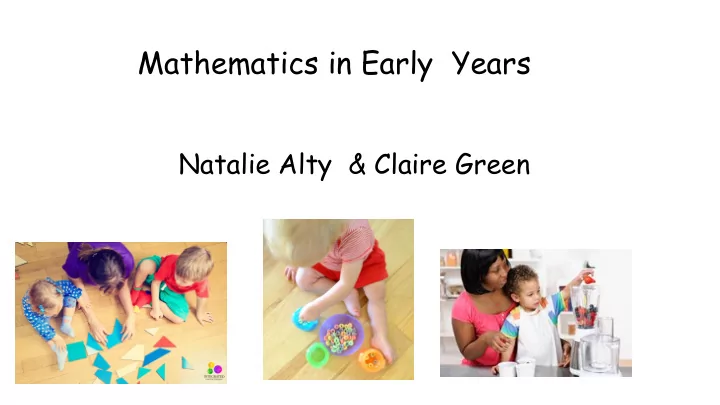
Mathematics in Early Years
Natalie Alty & Claire Green
Mathematics in Early Years Natalie Alty & Claire Green What - - PowerPoint PPT Presentation
Mathematics in Early Years Natalie Alty & Claire Green What is early mathematics? What are the key priorities for our children in Early Years? Discuss with your colleagues. What is early mathematics? The world is a mathematical
Mathematics in Early Years
Natalie Alty & Claire Green
What is early mathematics? What are the key priorities for
Discuss with your colleagues.
What is early mathematics?
‘The world is a mathematical place. For young children who are naturally curious there are
shapes, numbers, moving objects and patterns to behold, things to count and investigations to be undertaken. It is a creative, challenging and wonderous way of looking at life and exploring the world. Maths is an inherent part of being human. Framing the world through maths helps us make sense of what is happening and how it affects us’. J Robertson 2017
Problem – solving Making connections Real world scripts Language and reasoning Pictures and symbols
Expectations for number by the end of the EYFS.
Number ELG Children count reliably with numbers from one to 20, place them in
Using quantities and objects, they add and subtract two single-digit numbers and count on or back to find the answer. They solve problems, including doubling, halving and sharing. What have been the difficulties or problems with this Early Learning Goal? Discuss with your colleagues.
Challenges include:
number facts within them
there is so much knowledge to teach
successful in understanding numbers to 10, however this isn’t recognised in data collection.
different areas of the curriculum so that pupils can make real life connections in their learning.
Mathematics Educational Programme Developing a strong grounding in number is essential for providing children with the platform to excel mathematically. Children should develop a deep conceptual understanding of the numbers to 10, the relationships between them and the patterns therein. By providing frequent and varied opportunities to build and apply this understanding, children will develop a secure base of knowledge from which mathematical mastery is built. ELG Number: Children at the expected level of development will:
their position in the counting order;
partitioning facts. ELG Numerical Patterns: Children at the expected level of development will:
This year the DfE is piloting a new Early Years Foundation Stage Profile.
What is maths mastery?
vocabulary)
Connect memory: verbal, visual and spatial
the variety of ways into a particular concept
what the children should be able to do in relation to a particular concept
A sense of the size of a number Rounding Estimating
Use an empty number line to assess understanding of a range of numbers
Number sense
Estimation How many in the jar?
The basis of mathematics is… Pattern
generalise
reasoning and working systematically
essential first step in developing comprehension of pattern. Therefore must be linked to daily routines, songs, stories, movement. Numicon 2014
Pupils need to have a good understanding
have some element of repetition or symmetry.
Growing Patterns
Important skill to have acquired is seeing the odd
explain what is same or difference between objects? This also supports the development of reasoning skills.
Counting
Gelman & Gallistel 1978 Pupils need everyday opportunities to hear and use the language of number.
Use pictures and storybooks to discuss positional number, addition and subtraction stories as well as same, different and positional language.
Numicon is… Sensory Visual Weighted Whole class teaching
Numicon – explore
Number blocks - ncetm.org
helps children to develop:
When learning to subitize children progress from: Linear Circular Scrambled
‘Children need concrete experience of physically manipulating groups of objects into sub-groups and combining small groups to make a larger group. After these essential experiences more static materials such as 'dot cards' become very useful.’
Why do we use them?
numbers and recombine them in a useful way
which is vital for our number system
… What else do I know? Relationships True or false
How does this then support to bridge through 10?
Pupils can then begin to record their understanding.
5 = 2 + 3 5 = 3 + 2 3 + ? = 5 2 + ? = 5 ? + 3 = 5
What is the same and what is different? 17 and 71
Mathematics 30-50mths Numbers Beginning to represent numbers using fingers, marks on paper or pictures. Sometimes matches numeral and quantity correctly. 40-60mths Recognises numerals 1 to 10 Counts objects to 10, and beginning to count beyond 10. Selects the correct numeral to represent 1 to 5. Finds the total number of items in two groups by counting all of them. In practical activities and discussion, beginning to use the vocabulary involved in adding. Find missing numbers – use the part, part, whole method to develop reasoning skills as to how they find the missing number. Introduce the equal sign, how do you write it, where do you see it and what does it mean? How can they record their own addition number sentences using pictorial representation. Transfer from pictorial to using numerals with the pictures.
Planning for mathematics.
Plan for differentiation through questioning, resources, depth of mastery dependent on understanding. We do same day interventions as well as those over time for pupils with specific targets.
Creative What? making wood rubbings/printing poppies with small bottle tops. Why? Children explore variety of different wood/bark and make rubbings. Questioning: what does the wood feel like? Encourage different descriptive words – rough, smooth, bumpy etc. Introduce the word texture. Malleable/Messy What? Red/Green play dough – making poppies, exploring textures. Why? Sensory play & use to mould into poppy shapes (encourage Tom, Jane and Paul) Talk Table What? Pictures of poppies, wreaths etc Why? Children to think how they feel when they look at the pictures. (KS to support Jennifer & Alice for language intervention) Exploration/Investigation – Tuff spot. What? Different red objects to feel. Why? Develop language of how objects feel. Encourage pupils to link their sentences together to extend speaking. Can children imagine what the objects are? Could be made into? Mark Making What? Design a medal. Why? Using the children’s creative ideas to design a medal. Discuss why people get medals and the pictures that could be drawn on. Book/Story Telling What? Books about the war / transport used e.g. airplanes / tanks. Why? Encourage pupils to talk about their own understanding of this special event. Role Play – to be changed Thursday What? PSED & CLL – working together to listen to each other’s ideas and take responsibility for the area in which they are playing. Why? Currently a castle, vote as a class and change to what the children would like it to be. Mathematics: What? Balance scales, numicon, equals signs, boards, pegs. Why? Develop & reinforce pupils understanding of = through continuous provision. (Extend EXC pupils to use = on both sides – Dan, Jake, Charlotte, Sam) ICT: What? Draw and colour a poppy picture Why? Drawing and painting skills. https://www.purplemash.com/#app/pap/nature/poppy - purple mash – draw a poppy Music What? Drums, beaters, rhythm cards. Why? Develop co-ordination between beats and physical movement (JM for physical development group with Aron, Charlie & Tilly) Physical (fine/gross) What? Paper patterns Why? Use scissors for fine motor skills (CG to work with Billy, James, Ravi)
How do you plan for mathematics in your setting, are there any difficulties or challenges with this?
Mathematics in our learning environment.
Make number stories with puppets. Organise the numbers in order but different presentations. Use the children as
pictures of pupils in different
the same number and then sort the pictures to match the same number. Use different types of
sort and find many ways of making the same number.
conversation with their children
children in mathematics
classroom
Story books for mathematics
https://www.mathlearningcenter.org/web-apps/number-frames/ Use to model how to make each number.
Online resources and games
http://illuminations.nctm.org/activity.aspx?id=3565 Use to play each of the games described in the beginning. http://www.fuelthebrain.com/games/number-flash/ Very good practice for subitizing. https://www.coolmath4kids.com/manipulatives/ten-frame As above but you can change the counters to different pictures. https://www-k6.thinkcentral.com/content/hsp/math/hspmath/na/common/itools_int_9780547584997_/main.html Lots of different counters to organise for subitizing and tens frames to explore. http://www.glencoe.com/sites/common_assets/mathematics/ebook_assets/vmf/VMF-Interface.html A huge range of manipulatives and storyboards https://www.bbc.co.uk/cbeebies/curations/numberblocks-songs A song to introduce each number.