Mental Health in Iraq Iraqis very low access to mental health - - PDF document

mental health in iraq
SMART_READER_LITE
LIVE PREVIEW

Mental Health in Iraq Iraqis very low access to mental health - - PDF document

22/06/2016 EMDR Europe 2016 Den Hague, Netherlands Trauma Capacity Building Projects: Myanmar, Cambodia & Iraq Dr Derek Farrell University of Worcester Institute of Health & Society Chartered Psychologist, Principal Lecturer in


slide-1
SLIDE 1

22/06/2016 1

EMDR Europe 2016 Den Hague, Netherlands

Trauma Capacity Building Projects: Myanmar, Cambodia & Iraq

Dr Derek Farrell

University of Worcester – Institute of Health & Society Chartered Psychologist, Principal Lecturer in Psychology EMDR Europe Accredited Trainer and Consultant BABCP Accredited Cognitive Behavioural Psychotherapist Vice-President EMDR Europe President Trauma Aid Europe

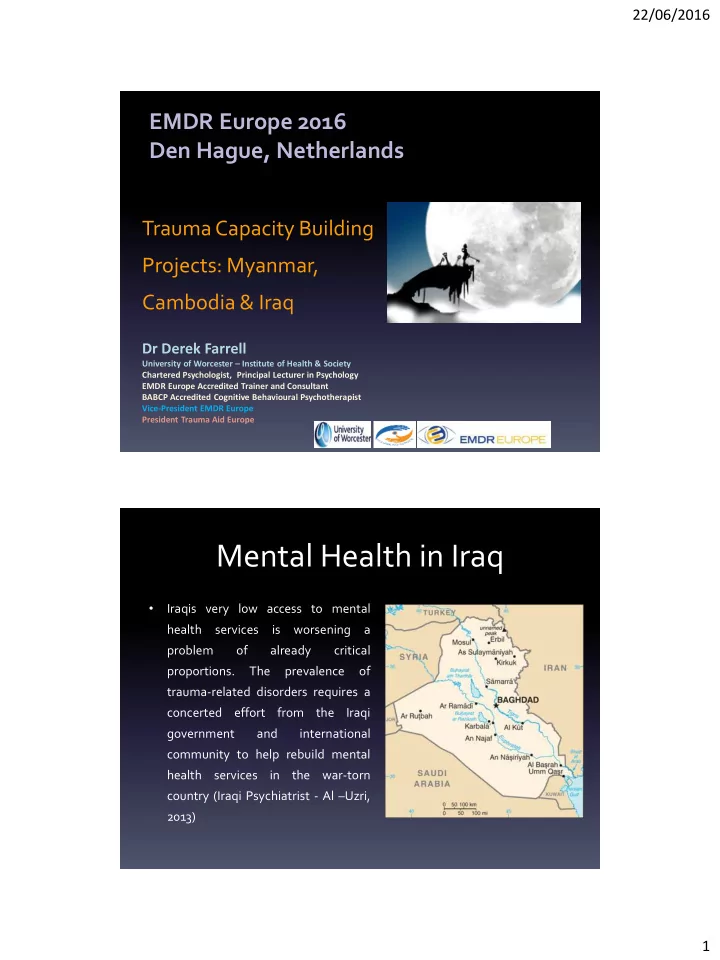
Mental Health in Iraq

  • Iraqis very low access to mental

health services is worsening a problem

  • f

already critical proportions. The prevalence

  • f

trauma-related disorders requires a concerted effort from the Iraqi government and international community to help rebuild mental health services in the war-torn country (Iraqi Psychiatrist - Al –Uzri, 2013)

slide-2
SLIDE 2

22/06/2016 2

Trauma Capacity Building

  • 1. Individual, Family and Community centered
  • 2. Community based
  • 3. Culturally sensitive and culturally competent
  • 4. Developmentally appropriate.
  • 5. Participants as partners with staff
  • 6. Empowerment and strengths based approaches

7. Trauma competence

Trauma Capacity

Trauma = EMDR Therapy

  • EMDR Therapy is the

predominant paradigm underpinned by the Adaptive Information Processing (AIP) Framework

Trauma > EMDR Therapy

  • AIP is more comprehensive
  • EMDR Therapy is part

paradigm alongside other interventions

  • Capacity building
  • Task shifting
slide-3
SLIDE 3

22/06/2016 3

TRAUMA MENTAL HEALTH CAPACITY BUILDING IN MYANMAR (BURMA)

Humanitarian Assistance Project

Myanmar

  • Myanmar (Burma), was long

considered a pariah state, isolated from the rest of the world with an appalling human rights record.

  • From 1962 to 2011, the country was

ruled by a military junta that suppressed almost all dissent and wielded absolute power in the face

  • f international condemnation and

sanctions.

slide-4
SLIDE 4

22/06/2016 4

Myanmar

  • 1962 – 2013 Military Rule
  • Once one of Asia’s

wealthiest nations – now

  • ne of the poorest
  • This is despite having an

abundance of natural resources: oil, gas, hydropower etc.

Myanmar

  • Country which contains significant ethnic

tensions and separatist rebellions

  • Conflict between Buddhist and Islamic groups
  • One of the least economically developed

countries in the world – suffered stagnation, isolation and mismanagement

slide-5
SLIDE 5

22/06/2016 5

Ethnic Groups in Myanmar Myanmar Exports

  • Teak (world’s largest exporter)
  • Sapphires, Pearls, Jade, Rubies
  • Heroine
slide-6
SLIDE 6

22/06/2016 6

Health Expenditure [% GDP] (World Bank, 2014)

Country % GDP Afghanistan 8.3 Austria 11.0 Brazil 9.5 Canada 10.7 France 11.7 Germany 11.3 Iraq 5.2 Myanmar 1.8 United Kingdom 9.1 United States of America 17.1

Health Expenditure [% GDP] (World Bank, 2014)

Country % GDP Afghanistan 8.3 Austria 11.0 Brazil 9.5 Canada 10.7 France 11.7 Germany 11.3 Iraq 5.2 Myanmar 1.8 United Kingdom 9.1 United States of America 17.1

slide-7
SLIDE 7

22/06/2016 7

Health Expenditure [% GDP] (World Bank, 2014)

Country % GDP Afghanistan 8.3 Austria 11.0 Brazil 9.5 Canada 10.7 France 11.7 Germany 11.3 Iraq 5.2 Myanmar 1.8 United Kingdom 9.1 United States of America 17.1

Myanmar’s Health System

  • Dramatic shift politically since 2010

– Constitution – Liberalisation of some political systems – Democratic elections (?) – Overall Healthcare System Performance – 190/190 (WHO, 2014)

slide-8
SLIDE 8

22/06/2016 8

Healthcare Issues - Myanmar

  • Malaria & Drug Resistant Malaria
  • Tuberculosis (TB) and Drug Resistant TB

– 18.4% Over-weight – 48% Smoke – 51% Chew Tabaco – 19% Heavy episodic drinkers

  • Trauma accounts for 27% Non-communicable Diseases (NCD)

– Cardiovascular disease, cancer, diabetes, chronic lung disease

  • Between age 30 – 70 – Probability of death = 24%
  • USA = 14%
  • UK = 12%

WHO (2014) Non Communicable Diseases [NCD] Profile

50 100 150 200 250 300 350 UK -2000 UK - 2012 US - 2000 US - 2012 Myanmar 2000 Myanmar 2012 Axis Title

Age-standardized Death Rates

Diabetes Chronic Respiratory Disease Cancer Cardiovascular Disease

slide-9
SLIDE 9

22/06/2016 9

Mental Health & Myanmar (WHO-AIMS Report – 2006)

  • Mental Health expenditure approximately 0.3% of total

healthcare expenditure

  • Hospitals take approximately 87%
  • 25 Outpatient units
  • 17 community based psychiatric inpatient units
  • Human resources

– 89 psychiatrists – 4 Psychologists

Most common Treatment Approaches

  • Antipsychotics
  • Antidepressants
  • Mood stabilisers
  • Anxiolytics
  • Anti-epileptics
slide-10
SLIDE 10

22/06/2016 10

Mental Health Training

  • 1% training for medical doctors relates to

mental health

  • Refresher trainers consist of 2 days - 1/3

– Pharmacology – Psychosocial – Child and Adolescent

Mental Health Care in Myanmar

  • Natural Disasters: Cyclones,

Floods, Tsunami, Landslides

– Cyclone Nagis (2008)

  • 140,000 died
  • 2.4 million affected
  • Human Disasters: War on

minority groups (50 years), Massacres, Violence, Crime, RTC, HIV, etc.

  • Corruption & Mismanagement
slide-11
SLIDE 11

22/06/2016 11

Developing Mekong Project II

  • Establishment of Trauma Capacity Building

Services from Myanmar & Cambodia

  • Aim: Mental Health (Trauma) Focussed

capacity building

  • History Mekong Project I

– Thailand, Indonesia, Cambodia,

slide-12
SLIDE 12

22/06/2016 12

Field Visit – Yangon (2012)

  • Government representatives, NGO
  • rganisations, Academics
  • Screening/ Assessment Tool –

Children’s PTSD Checklist [N=400 children] Mekong II Field Study Data – Youth Self-Report (YSR) & Child Behaviour Checklist (CBCL) Field Data [N=400]

Sub-scales % Anxious/ Depressed 56 Withdrawn/ Depressed 46 Somatic Complaints 16 Social Problems 45 Thought Problems 15 Attention Problems 16 Rule-breaking Problems 6 Aggressive Behaviours 18 Internalising 73 Externalising 28 TOTAL 53

slide-13
SLIDE 13

22/06/2016 13

Project Details

  • Application submitted to Terre des Hommes Deutschland =

€1.2 million

  • Project – March 2015 – March 2017
  • Myanmar – Cambodia
  • Demonstration on impact
  • Host Country – Thailand & Cambodia
  • 32 Participants (Myanmar)

– >50% employed by Mekong Project II

Project Stakeholders

  • Trauma Aid Germany
  • University of Worcester (UK)
  • Trauma Aid Europe (formerly EMDR Europe HAP)
  • EMDR National Associations

– Thailand, Indonesia, Cambodia

slide-14
SLIDE 14

22/06/2016 14

Mekong Project II - Training Team

  • Ute Sodemann & Peter Bumke - Project & Logistics Co-ordinators
  • Derek Farrell – Chief Trainer (Europe)
  • 2 EMDR Asia Trainers – EMDRIA & EMDR Europe
  • 1 EMDR Asia Trainer in Training
  • 4 EMDR Asia Consultants in Training (Senior)
  • 12 EMDR Asia Consultants in Training (Junior)
  • 1 Researcher
  • 2 PhD Projects

– Students (University of Worcester)

Mekong Project II Goals

  • 1. To make the non-Asian aspects of the training

redundant as effectively and efficiently as possible

  • 2. EMDR Trainings within Trainings
  • Trainers in Training, Consultants, Facilitators,

Practitioners

  • EMDR Europe Accreditation Criteria
  • 3. European Evidence
  • – National Trainer + Association = Sustainable Growth
slide-15
SLIDE 15

22/06/2016 15

Outline of the Training Programme Mekong Project II Myanmar

Foundation Skills Training – 8 Days

  • Psychological First Aid
  • Basic Psychotherapeutic/ Counselling

Interventions and Skills

  • Assessment in Mental Health
  • Theory in Psychotherapeutic Practice
  • Introduction to Psychological Trauma
  • Introduction to EMDR Therapy / AIP

Model

  • Stabilisation, Resourcing & Self-Care

Techniques

EMDR Therapy Modified Level 1 Training - 6 Days

  • 50/50 Theory - Practice

Field Visit – Myanmar

  • Site visits
  • Clinical Supervision
  • Case Consultation

Two Field Visits – Myanmar

  • Site visits
  • Clinical Supervision
  • Case Consultation

EMDR Therapy Modified Level 2 Training - 6 Days

  • 50/50 Theory - Practice

Field Visit – Myanmar

  • Site visits
  • Clinical Supervision
  • Case Consultation

EMDR Therapy Modified Level 3 Training - 6 Days

  • 50/50 Theory - Practice

Outline of the Training Schedule

  • Morning – Theory (Simultaneous translation)
  • Afternoon – Practice
  • Late Afternoon – PODS (Points of Discussion)
  • Evening – Two independent meetings

– Training Team Meeting (Trainers & Facilitators) – Myanmar Participants Meeting (Own Language)

  • Revision of next days teaching and learning

Daily Feedback

slide-16
SLIDE 16

22/06/2016 16

EMDR Therapy Trainings within Trainings

EMDR Therapy Participants Training EMDR Therapy Facilitator Training EMDR Therapy Consultant Training EMDR Therapy Trainers in Training

Points of Discussion (PODS)

  • Groups of 4 with 1(2) Facilitators
  • Open discussion in indigenous language
  • Generate questions
  • Enhance reflection
  • Consider specific training needs
slide-17
SLIDE 17

22/06/2016 17

Participant Centred Training – POD Focussed

Day 1 Day 2 Day 3 Day 4 Day 5 Day 6 Day 7

Primary Objective of the Training Programme

  • Adapting the Training to meet the

participants teaching and learning needs

slide-18
SLIDE 18

22/06/2016 18

Teaching & Learning of EMDR Therapy within a Humanitarian Context

Our expectations of the participants

  • Making a commitment
  • Getting as much as possible from the experience
  • Networking with fellow Asian and international colleagues
  • Expectation to practice (bono fide = 20 hours)
  • Contribute to on-going research and evaluation
  • Making a difference in Myanmar
  • Playing no small part in making the world a ‘safer place’
slide-19
SLIDE 19

22/06/2016 19

Participant Objectives

  • Daily Reflective Diary

– Description – Feelings – Evaluation – Analysis – Conclusion – Action Plan

Gibbs Reflective Cycle (1988)

Challenges

  • Extremely labour intensive – long days
  • Active use of facilitators as integral members of the teaching & learning

experience

  • Language
  • Teaching and Learning style
  • Previous training experience – medical model
  • Status & hierarchy – asking questions
  • Reflection process
  • Teaching & learning content material
  • Diversity with the participant group
slide-20
SLIDE 20

22/06/2016 20

THE CASE OF THE YEZIDI

Kurdistan – Northern Iraq

Health Expenditure [% GDP] (World Bank, 2014)

Country % GDP Afghanistan 8.3 Austria 11.0 Brazil 9.5 Canada 10.7 France 11.7 Germany 11.3 Iraq 5.2 Myanmar 1.8 United Kingdom 9.1 United States of America 17.1

slide-21
SLIDE 21

22/06/2016 21

Iraq

100 200 300 400 500 600 700 UK -2000 UK - 2012 US - 2000 US - 2012 Myanmar 2000 Myanmar 2012 Iraq 2000 Iraq 2012 Diabetes Chronic Respiratory Disease Cancer Cardiovascular Disease

EMDR Therapy Training in Kurdistan. Northern Iraq

  • Collaborative project

– Terres des Homme, Jiyan Foundation, Free Yezidi Foundation, University of Worcester, Trauma Aid Germany, Trauma Aid Europe

  • Funding

– $150,000 GUCCI – €50,000 Terres des Homme

  • Timeline

– Free Yezidi Foundation Centre – Khanke Camp – EMDR Therapy Training commences in November 2015 – Jiyan Foundation – 24 staff from Jiyan Foundation – Already trained in psycho-traumatology

slide-22
SLIDE 22

22/06/2016 22

Conventional EMDR Therapy Training – Humanitarian Context

  • Jiyan Foundation – covers ALL trauma populations – all over

Iraq

  • Modified Level 1, 2 & 3 (6 Days ) – 5 months apart
  • Clinical Supervision & Consultation
  • Collaborative Partnership: Free Yezidi Foundation Centres
  • Project commenced November 2015
  • PhD Study set up within the project

What implications does this create regarding the teaching and learning of EMDR Therapy?

  • The conflict with Islamic State
  • Two Treatment Models

– German External Model [€94 million] – Internal Model – Trauma/ Mental Health Capacity Building

slide-23
SLIDE 23

22/06/2016 23

Trauma Capacity Building

  • More research publications about Trauma

Capacity Building

  • Template WHO (2013) Guideline on Stress
  • Reinvention of the wheel

Contact Details

  • Dr Derek Farrell

University of Worcester Institute of Health & Society Email: d.farrell@worc.ac.uk