Modeling Wind Shielding for FPSO Tandem Offloading using CFD Bob - PowerPoint PPT Presentation
Modeling Wind Shielding for FPSO Tandem Offloading using CFD Bob Gordon, Granherne Satpreet Nanda, CD-adapco Presentation Outline FPSO Tandem Offloading Examples of Shielding in Offshore Applications Wind Tunnel Tests for Tandem
Modeling Wind Shielding for FPSO Tandem Offloading using CFD Bob Gordon, Granherne Satpreet Nanda, CD-adapco
Presentation Outline • FPSO Tandem Offloading • Examples of Shielding in Offshore Applications • Wind Tunnel Tests for Tandem Offloading • Preliminary CFD Results • Summary 2
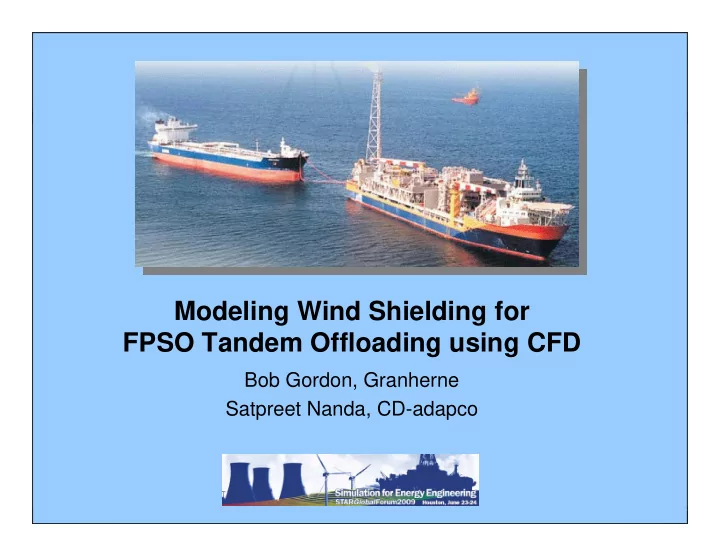
FPSO Tandem Offloading • FPSO can be spread or turret moored – If turret moored, FPS orients into wind, wave and current • Tanker approaches under its own power and moors (with work boat assistance) to FPSO using hawsers • FPSO & Tanker are in close proximity during offloading and both Turret Moored change draft FPSO 3
Effects of Shielding • FPSO shields tanker from environment – Impacts tanker’s maneuverability during approach – Impacts separation distance while connected • Relative headings of the vessels can vary significantly during offloading due to shielding, Spread Moored FPSO effects of current, or fish-tailing 4
Collisions and Near Misses During Tandem Offloading in North Sea 1996-2000 Source: UK HSE Offshore Technology Report 2000/086 5
Examples of Shielding in Offshore Applications Multiple Riser Towers Grouped Single Line Risers Truss Spar Platform 6
Velocity Reduction due to Shielding 7 From van Walree and Willemsen, 1988
Wind Tunnel Tests • Part of MARIN’s Offloading Operability JIP • Tests performed at DNW in 2003 • Model scale was 1:250 • Barge-shaped FPSO model and shuttle tanker • Measurement of unshielded wind and current forces • Measurement of wind velocities behind the FPSO • Measurement of shielded forces for validation of shielding model 8
Use of CFD to Model Wind Tunnel Tests • Collaborative effort between MARIN, Granherne/KBR and CD-adapco • Surface geometry models prepared by MARIN • MARIN using in-house code and Granherne using STAR-CCM+ • Granherne calculations performed in the blind • Comparisons will be made against model test data and between CFD codes • Goal is to present joint paper at OMAE 2010 9
Vessel Characteristics 10 450 m
Position of Vessels Relative to Incident Wind & Velocity Profile Wind Velocity Profile Z/Z10 V/V10 11
Surface Mesh 12
Volume Mesh 13 SST k-omega turbulence 1.44 Million Cells y+ wall treatment model
Speed Contours in Horizontal Plane B Z=5m A A Z=30m A A B 14
Speed Contours in Vertical Plane A A B B 15
Streamlines 16
Pressure Contour 17
Drag and Lift on Tanker LIFT DRAG Tandem Arrangement (450 m separation) Shuttle Tanker Only Wind Tunnel Measurement OCIMF 18
Summary • Tandem offloading operations are sensitive to weather conditions • Accurate simulation of tandem offloading is difficult due to wind shielding • Wind loads on the shuttle tanker vary with relative wind direction, distance from FPSO and orientation relative to FPSO • Wind tunnel testing is limited due to relatively small number of configurations that can be tested • Preliminary CFD results indicate good agreement with wind tunnel data (but little shielding for case investigated) • CFD can provide a suitable means to augment wind tunnel test data 19
Acknowledgement • Thanks to Dr. Arjen Koop of MARIN for collaborating in this endeavor and for providing the vessel geometry models 20
Recommend
More recommend
Explore More Topics
Stay informed with curated content and fresh updates.