Myopia ICBO Sydney 2006 Edwin R Howell BScOptom MSc PhD FVCO - - PDF document

myopia
SMART_READER_LITE
LIVE PREVIEW

Myopia ICBO Sydney 2006 Edwin R Howell BScOptom MSc PhD FVCO - - PDF document

Myopia ICBO Sydney 2006 Edwin R Howell BScOptom MSc PhD FVCO FACBO FCOVD Adjunct Assoc Professor, School of Optometry, UNSW, Sydney, and Private Practice, Heathmont, I warned you about going to that short-sighted doctor Melbourne,


slide-1
SLIDE 1

1

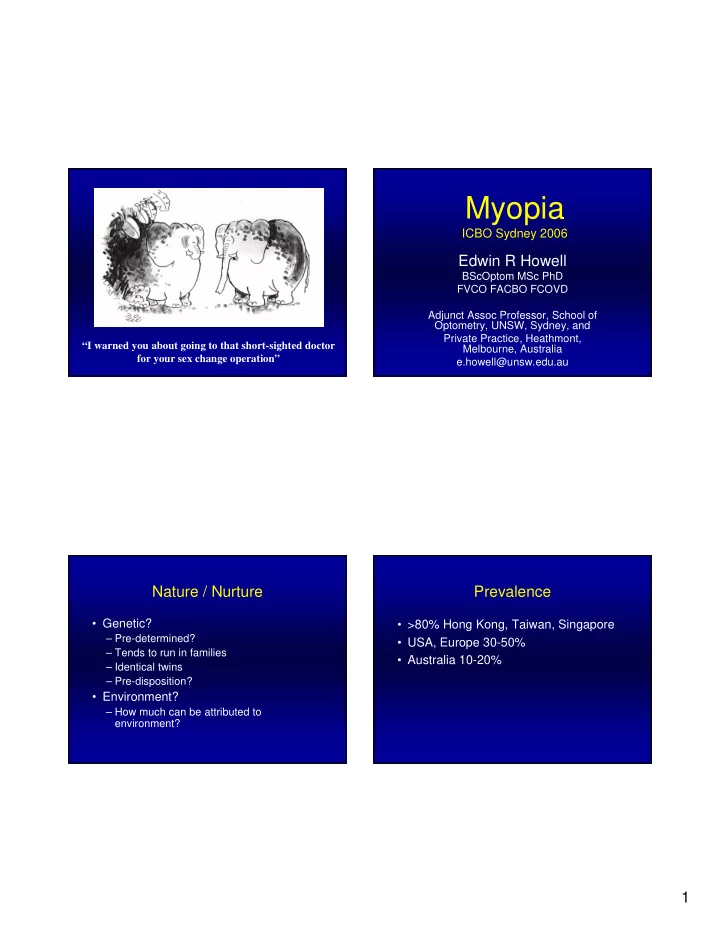
“I warned you about going to that short-sighted doctor for your sex change operation”

Myopia

ICBO Sydney 2006

Edwin R Howell

BScOptom MSc PhD FVCO FACBO FCOVD Adjunct Assoc Professor, School of Optometry, UNSW, Sydney, and Private Practice, Heathmont, Melbourne, Australia e.howell@unsw.edu.au

Nature / Nurture

  • Genetic?

– Pre-determined? – Tends to run in families – Identical twins – Pre-disposition?

  • Environment?

– How much can be attributed to environment?

Prevalence

  • >80% Hong Kong, Taiwan, Singapore
  • USA, Europe 30-50%
  • Australia 10-20%
slide-2
SLIDE 2

2 Prevalence in East Asia

  • >80% Hong Kong, Taiwan, Singapore
  • 5% in rural uneducated groups
  • Grandparents Hong Kong 5% (Lam

1994)

  • Rural Mongolia 5.8% (Morgan et al

2006)

Myopia: Genetics

  • The recent rapid increase in prevalence suggests

environmental factors rather than genetic factors are responsible for common myopia

  • Ian Morgan ANU considering school myopia

concludes “most of the evidence suggests that powerful environmental effects are responsible for the rapid changes in prevalence…”. Previous twin studies have confounded shared genes with shared environments and he concludes that genetic factors are not important in the common

  • myopias. (Morgan & Rose 2004)
  • (Some rare early onset “pathological” myopias are

probably genetic)

Conclusion: Nature/Nurture

  • Not primarily genetic!
  • Environment!
  • At least 80% of humankind have the

potential ability to go myopic!

Environment

  • Sustained near task?
  • Restricted visual space?
  • Diet?
  • Stress?
slide-3
SLIDE 3

3 Intelligence & Personality

  • In Western societies a possible genetic factor

may be the “intelligence” and “personality” to concentrate for long periods of time on near tasks.

– Environmental expression of a latent gene? (Mak et al 2006)

  • In Asian societies external pressures &

expectations from family & peers may result in the same prolonged concentration on near tasks

– Stress?

Stress & Myopia

Leon Davies, James Wolffsohn et al 2004 Aston

  • Accom ability during cognitive stress (number

sorting) in myopes & emmetropes. Shin-Nippon auto-refractor, Badal lens, piezo-electric heart rate pulse transducer, Fast Fourier Transform of cardiovascular function to separate parasympathetic from sympathetic. Both groups showed increased accom lag with increased cognitive demand attributed to decreased parasympathetic activity. Myopes showed higher lag than emmetropes. Myopes showed a greater increase in sympathetic nervous system activity.

Environment

  • Diet?

–Exacerbated by deficiencies? –Toxins? –Ameliorated by supplements?

Environment & Diet

  • Jewish ultra-Orthodox boys in the same

community in Israel have a higher prevalence (70%) & degree of myopia compared to girls and secular school children (30%) (Ben-Simon et al

2004)

  • All have similar general environment and diet

but the boys have a higher near-task demand

  • Task demand more important than ambient

environment and diet

slide-4
SLIDE 4

4 Possible Near-task Factors (Asia)

  • Sustained near task from an early age

– Schooling from 3 years of age – Long school hours plus homework – Computers and computer games – Learning Chinese or Japanese

  • Restricted Spatial Environment

– Restricted ambient horizon for ‘zero’ setting of distance? – Small school rooms, small living rooms in high-rise buildings, small playgrounds

Sustained Near-task

  • Accommodation?
  • Convergence?
  • Lid posture & blink pattern?

Further Questions

  • What is Emmetropisation?
  • What is the difference between a

hyperope and a myope?

  • If accommodation dysfunction causes

myopia, then why don’t hyperopes & emmetropes go myopic as they usually have significant accommodation dysfunction?!?

Accommodation in Myopes, Hyperopes & Emmetropes

  • Most myopes have accommodation dysfunction
  • Most hyperopes have accommodation

dysfunction

  • A lot of emmetropes have accommodation

dysfunction

  • The pattern of accommodation dysfunction is

similar for all

  • Accom lag, lead, infacility, tonic shifts, proximal,

hysteresis not consistently & characteristically different in emmetropes that become myopes (Harb et al 2006)

slide-5
SLIDE 5

5 Animal Studies

Chick, Tree shrew, Monkey

  • Active emmetropisation mechanism regulates

eye growth from birth

  • Degraded optical image quality on the retina

induces axial elongation myopia

– Form deprivation (translucent occluder)

  • Minus lenses (hyperopic blur) induce axial

elongation myopia

  • Plus lens (myopic blur) stop axial elongation

and may induce hyperopia during the growth period (choroid swells and axial growth slows)

Animal Studies

  • A relatively short period of clear vision

each day inhibits the axial elongation and stabilises the refraction

  • Total darkness freezes the refractive

state

Isolated Retina can go Myopic

Chicks

Ciliary Nerve section:

  • Responses to positive & negative lenses

NOT affected Optic nerve section:

  • Does NOT stop axial elongation to Form

deprivation or the differential response to plus and minus lenses

Ref: Wildsoet et al. Vis Res 35: 1175-1194 1995; 1996

Peripheral Retina is Sufficient

Earl Smith 2004 Optometry Houston. Monkeys

  • Form deprivation can induce myopia in adult

monkeys as well as infants.

  • The minus lens (-3D) or diffuser needs to be

maintained 24 hrs/day. 4 X 15 min periods free of lens eliminated myopic effect.

  • Diffuser in periphery alone adequate to induce

elongation in the foveal region. (Annular diffuser leaving foveal image clear).

  • Laser foveal lesion still get emmetropic recovery

with hyperopic shift.

  • Conclusion. Peripheral retina guides

emmetropisation and the fovea is NOT necessary.

slide-6
SLIDE 6

6

Eye Shape and Refraction

‘Simple’ Schematic Eye Spherical retinal image surface Similar refraction in the periphery

Eye Shape and Refraction

‘Simple’ Schematic Eye Spherical retinal image surface Similar refraction in the periphery Hyperope & Emmetrope. Oblate shape Relatively myopic in the periphery -1D

Eye Shape and Refraction

‘Ideal’ Schematic Eye

Spherical retinal image surface Similar refraction in the periphery

Myope. More Prolate shape Some less oblate, some spherical Relatively hyperopic periphery About +1D Hyperope & Emmetrope.

Oblate shape Relatively myopic in the periphery -1D

Emmetropic Oblate Shape is Stable & Functional Periphery more myopic (-1 D)

  • When the fovea is clear in

the distance, peripheral

  • bjects that are nearer will

also be clear

  • When the periphery is

clear in the distance, the fovea is slightly hyperopic so ensuring good far distance vision

  • These clear sharp images
  • n the peripheral retina

ensure a stable non- myopic refraction

slide-7
SLIDE 7

7

Prolate Retina Drives Myopia. Periphery more hyperopic

  • If the fovea is clear in the

distance, the peripheral retina is constantly blurry. This blur will stimulate axial elongation until the peripheral retina comes clear. At this point the fovea will have myopic blur

  • Correction with a spherical lens

(bottom) restores hyperopic periphery and restarts the axial elongation myopia cycle

From Atchison et al 2005

Eye Shape & Peripheral Retina

Eye shape measurements

  • Partial Coherence Interferometry

– eg Zeiss IOL Master

  • 3-D MRI
  • A-scan ultrasound (Not as accurate)

References

– Stone et al Ann Acad Med Sing 2004 – Stone et al IOVS 2004 – Logan et al OPO 2004 – Atchison et al IOVS 2004, IOVS 2005

Peripheral Refraction

  • Free-space autorefractors with

peripheral fixation targets

– Shin Nippon free-space auto refractor can measure out to 20-30 degrees nasal & temporal. – Can also objectively measure accommodation at near, dark focus & proximal factors using pin-holes in infra-red filters

Shin-Nippon NVISION-K 5001

slide-8
SLIDE 8

8

Peripheral Refraction Factors

‘Ideal’ Schematic Eye

Spherical retinal image surface Similar refraction in the periphery

‘Real’ Eye

Peripheral refraction will be different to foveal refraction. Peripheral cornea,

  • blique lens, peripheral retina.

Accommodation efforts may have a different effect on peripheral image quality than subjectively perceived

  • n the fovea.

‘Blur’ on the fovea may be clear in the periphery and ‘clear’ on the fovea may be blurry in the periphery

Eye Shape and Accommodation

Exaggerated & Diagrammatic Howell

‘Ideal’ Schematic Eye Accommodation

Ciliary muscle insertion pulls on the sclera & choroid Retina more prolate in shape

(Walker & Mutti 2002)

Cornea higher central power? Cornea more prolate? Increased on-axis aberrations Increased peripheral aberrations?

Monochromatic Wave-front Aberrations.

Each can be Plus or Minus

  • First order: Prism
  • Second order: Spherical & Astigmatic error

“Higher order”

  • Third order: Coma
  • Fourth order: Spherical aberration
  • Field distortion etc
  • Usually measured on foveal axis
  • Also chromatic aberration
  • Aberrations increase the depth of focus of the normal

emmetropic eye. Normal eye is ‘multi-focal’ & probably beneficial

  • All aberrations are higher in myopic eyes & not

necessarily beneficial

  • Down gaze posture reduces

palpebral aperture. Lid distorts epithelium

  • Induces higher aberrations

Beuhren et al 2001, 2003

Effect of lid pressure on corneal topography during 1 hr reading

slide-9
SLIDE 9

9

Lid induced Aberrations

  • Positive coma &

negative trefoil add to produce a “wave-like” distortion

  • Worse with

“squinting”? (Myopes!)

  • Worse in Asian

eyes? (Genetic factor in Asian myopia prevalence?) Beuhren et al 2003

Summary

  • Axial elongation is triggered by ‘hyperopic’ blur
  • n the peripheral retina persisting over a 24

hour period

  • ‘Blur’ on the fovea may not be as important as

blur on the peripheral retina

  • Periods of ‘clear’ vision on the fovea, either in

the distance or near may not be sufficient to stop the axial elongation

  • The peripheral ‘blur’ may be a combination of

spherical, astigmatic, third order coma & fourth

  • rder spherical aberrations
  • This image degradation could be

caused by sustained accommodation while maintaining protracted concentration on near tasks

  • May be worse in down-gaze
  • May be worse in restricted space

environments

A Model for Myopia

Howell 2006

  • Hyperopic & emmetropic eyes are oblate. This

provides a stable refractive structure

  • ‘Blur’ on the peripheral retina sustained for all

waking hours will initiate axial elongation of the posterior pole

  • A hyperopic eye will emmetropise to the plane
  • f the furthest clear image on the peripheral
  • retina. A restricted environment will produce a

more myopic eye

  • NORMAL ciliary m., EOM, & lid muscle activity

causes blur and aberrations on the peripheral

  • retina. This blur may take time to resolve after a

sustained near task.

slide-10
SLIDE 10

10 A Model for Myopia II

Howell 2006

  • If the near-task & post-task blur is maintained

all day then axial elongation myopia will be triggered

  • This axial elongation will change the oblate

eye shape in a prolate direction. If the eye becomes prolate then the only stable state is a clear image on the peripheral retina & myopic blur on the fovea

  • Correction with minus spheres will destabilise

this & precipitate more elongation

  • ‘Squinting’ to clear the foveal myopic blur may

blur the periphery & initiate myopic elongation

Myopia Management

Drugs

  • Atropine & pirenzepine are very effective in

controlling myopia progression.

  • Probably act directly on the retina-choroid-

sclera as well as accommodation

  • Probably need to be maintained throughout

myopia risk period. Long-term side effects?

Surgery

  • Lasik corneal reshaping

– Aspheric wave-front aberration guided?

  • Implants?

– Intra-corneal, Anterior chamber

Contact Lenses

RGP

  • Mould & maintain corneal surface profile
  • Protect from lid distortions?
  • Ortho-K central flattening & peripheral

steepening Soft lenses

  • Concentric multi-focal contact lenses could

correct peripheral hyperopia as well as assist accommodation

  • Aspheric design could correct undesirable

higher order aberrations

slide-11
SLIDE 11

11

Lens Prescribing for Myopia Distance Correction

  • Over minus in the distance may stimulate

further myopia

  • Significant under correction in the distance

may stimulate further myopia (Chung et al 2002, expt’l group kept at worse than 6/12 acuity). This blur may initiate ‘squinting’ that results in increased myopia

  • ‘Slight’ under correction may stabilise the

refraction?

Refraction & Myopes

  • Myopes tend to “ask” for greater minus

than necessary for good acuity (Radhakrishnan et al 2004 attribute this to higher minus 4 th order spherical aberrations in myopes)

  • This is particularly observed in auto-

refractors, phoropters and for low light levels

Blur Function

(Howell)

2 4 6 8 10 12

  • 3
  • 2
  • 1

1 2 3 4 5 Lens Power D Visual Acuity LinearMAR min Emmetrope

BVS Ret +6/6 .

6/6 6/60

Blur Function

2 4 6 8 10 12 14

  • 3
  • 2
  • 1

1 2 3 4 5 Lens Power D VA MAR

min

"Myope" "Hyperope"

BVS Ret +6/6 . BVS Ret +6/6 .

6/60 6/6

slide-12
SLIDE 12

12 Multi-focals and Myopia

  • Multi-focals significantly reduce the

progression of myopia

  • Effect is greater for esophoric myopes with

accommodation insufficiency at near

  • Multi-focals provide plus ‘correction’ of the

peripheral hyperopia in the lower field

  • Multi-focals may assist with asthenopia &

fatigue independent of myopia progression

Multi-focal Clinical Trials:

Leung & Brown (Optometry & Vision Science 76 June 1999)

Hong Kong Polytechnic University Group No. Sphere Incr. Axial Length Single Vision 32

  • 1.23

+ 0.74mm ADD +1.50 22

  • 0.76

+ 0.49mm ADD +2.00 14

  • 0.66

+ 0.41mm

After two years, the mean spherical increase in myopia and axial length measured:

Multi-focal Clinical Trials: COMET Study USA

Gwiazda et al IOVS 2003, 2004, Arch Ophthalmol 2005

  • 469 children, 234 SV, 235 PAL
  • Change over 3 years: Statistically significantly

less myopia progression with PAL lenses

  • PAL’s showed the greatest ethnic effect in Asian

children (reducing the progression by 0.39D over 3 years)

  • Esophores with accommodation lag showed the

greatest benefit with PAL lenses

  • COMET2 has been announced to further

investigate the esophoria group

  • Greatest rate of myopia progression in 6-7 year
  • ld age group

COMET Trial

Myopia progression over 3 years

Group PAL SV PAL Benefit Whole

  • 1.28D
  • 1.48D

0.20D Asian

  • 1.22D
  • 1.61D

0.39D Esophore

  • 1.08D
  • 1.72D

0.64D

slide-13
SLIDE 13

13 Myopia Prescribing

  • Myopes that are progressing and/or have

accommodation dysfunction should be prescribed a near add

  • The myopes with esophoria at near and

accommodation dysfunction may respond better to treatment than those with exophoria

  • The near add should firstly improve the

accommodation and convergence control resulting in less asthenopia and fatigue. Secondly, the progression of the myopia may be reduced.

Prism and Myopia

  • Single vision spectacle lenses can have significant

induced prism for directions of gaze away from the optical axis Vertical prism

  • Typically the distance line of sight is above datum in a

spectacle frame. This would induce Base Up prism in each eye for minus lenses.

  • Most people find Base Up yoked prism more “Stressful”

and uncomfortable whereas most people find small amounts of Base Down prism tolerable and sometimes relaxing.

  • Base Down will tend to lift the eyes and widen the

palpebral aperture

  • High power single vision lenses should fitted on distance

height rather on the frame datum.

  • Multi-focal lenses correctly fitted for height do not have

this problem.

Final Spectacle Prescription for Myopia

  • Prescribe the distance refraction that is just

acceptable or slightly blurry in the distance.

  • Preferably the balanced plus-to-first-blur (6/6,

20/20, 1.0) if the patient is prepared to accept that value.

  • If not acceptable, then prescribe the minimum

minus that is acceptable. Do not prescribe excessive minus as it may make accommodation worse and increase the myopia progression.

  • Plus add +1.50D (eg SOLA MC Myopia Control

lens)

  • Consider Base Down yoked prism component.

(<3 PD OU)

General Reference & Review

Josh Wallman & Jonathan Winawer 2004 Neuron 43: 447- 468 Homeostasis of Eye Growth and the Question of Myopia

slide-14
SLIDE 14

14

Ayers Rock Central Australia