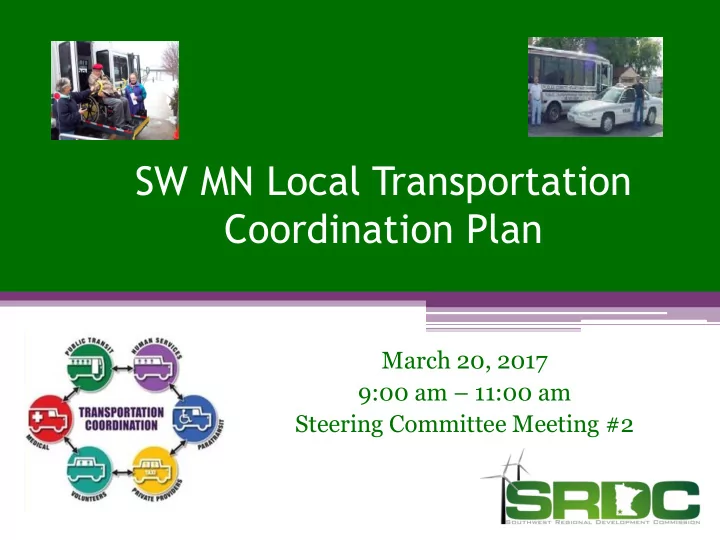
SW MN Local Transportation Coordination Plan March 20, 2017 9:00 am - - PowerPoint PPT Presentation

sw mn local transportation coordination plan
SMART_READER_LITE
LIVE PREVIEW

SW MN Local Transportation Coordination Plan March 20, 2017 9:00 am - - PowerPoint PPT Presentation

SW MN Local Transportation Coordination Plan March 20, 2017 9:00 am 11:00 am Steering Committee Meeting #2 Todays Agenda Monday March 20, 2017 @ 9:00 am to 11 am SRDC 2401 Broadway Ave., Slayton, MN 56172 Join by Telephone:


slide-1
SLIDE 1

SW MN Local Transportation Coordination Plan

March 20, 2017 9:00 am – 11:00 am Steering Committee Meeting #2

slide-2
SLIDE 2

Today’s Agenda

Agenda 1. Introductions (5 minutes)

  • 2. Background with Data & Demographics (30 minutes)
  • 3. Presentation of Data collected (60 minutes)
  • 4. Questions / Discussion (15 minutes)
  • 5. Discussion of Planning Workshop Agenda (10 minutes)
  • 6. Conclusion of Meeting

Monday March 20, 2017 @ 9:00 am to 11 am SRDC– 2401 Broadway Ave., Slayton, MN 56172 Join by Telephone: 507-836-1660 the Meeting ID: 1642#

slide-3
SLIDE 3

Plan Purpose

A locally developed, coordinated human services – public transportation coordination plan identifies the transportation needs of individuals with disabilities, older adults, and people with low incomes, provides strategies for meeting those local needs, and prioritizes transportation services for funding and implementation.

slide-4
SLIDE 4

4 Required elements of a Coordinated Plan

1) Assessment of available services that identifies current transportation providers 2) Assessment of current transportation needs for persons with disabilities, older adults and people with low incomes 3) Strategies, activities, and/or projects to address the identified gaps between current services and needs, as well as opportunities to improve efficiencies in service delivery 4) Priorities for implementation based on resources

slide-5
SLIDE 5

Plan Timeline

Dec 2016 Identify Steering Committee Jan 6, 2017 1st Steering Committee meeting Jan-Feb Public Input, focus groups, surveys March 20th 2nd Steering Committee meeting March 30th Planning workshop (am) and 3rd Steering Committee meeting (pm) Mid April MnDOT Review May 3rd 4th Steering Committee meeting Early May MCOTA review period begins May 11 SRDC draft Plan Presentation, 3 week public comment begins June 8, 2017 SRDC adoption

slide-6
SLIDE 6

Identified Target Populations

Elderly Disabled

Low Income

Region 8

slide-7
SLIDE 7

Outcomes from 2011/2012 Plan

  • Created best Practices for Public-Private Partnerships
  • Nonprofits, Agencies, and other organizations (CAP, DAC,

etc..) serving elderly and/or disabled were eligible to apply for funds for needed or replacement 5310 (accessible) vehicles

  • Regional Ride Council was funded and started
  • Coordination beyond service area boundaries
  • Updated the regional transit brochure
slide-8
SLIDE 8
slide-9
SLIDE 9

Jobs Density - 2013

Source: 2017 Greater MN Transit Investment Plan

slide-10
SLIDE 10

Transit Density - 2013

Source: 2017 Greater MN Transit Investment Plan

slide-11
SLIDE 11

2015 MNDOT Travel Pattern Map

Where we are going in SW MN

slide-12
SLIDE 12

SW MN Private Transit – Jefferson Lines

From To Cost per person Travel Time Departure(s)

Marshall Worthington $45 4hr 20min 4:30pm Worthington Marshall No trip available Worthington Sioux Falls $26 1 Hour 4:30pm Sioux Falls Worthington $26 I Hour 7:50pm Marshall Sioux Falls $37 1 hr 55 min 4:30pm Sioux Falls Marshall $37 1 hr 55 min 10:30am Marshall Minneapolis $55 4 hr 35 min 12:25pm Minneapolis Marshall $55 4hr 29min – 6hr 15m 10:15am - 12:01pm Worthington Minneapolis $55 3hr 45 min 8:50pm Minneapolis Worthington $55-$93 3hr 55 min – 9hr 35min 6:00am – 11:15am

slide-13
SLIDE 13

SW Travel Service Map – Public Transit

Public transit (bus) providers in 2014 Public transit (bus) providers in 2017

slide-14
SLIDE 14

SW MN Public Transit– Prairieland Transit

Worthington Taxi Service

Private Transportation $5.00 anywhere in Worthington city limits $3.00 discounted fare available

if scheduled through Central Dispatch

Taxi Service Hours: Mon – Fri 6:00am – 10:00pm Sat – Sun 10:00am – 4:00pm Prairieland Dispatch hours: 7:00am – 6:00pm

Prairieland’s bus service is available via dial-a-ride as needed in Worthington.

Public-Private Partnership

slide-15
SLIDE 15

SW MN Public Transit – Community Transit

slide-16
SLIDE 16

SW MN Public Transit – Community Transit

slide-17
SLIDE 17

SW MN Public Transit – Community Transit

slide-18
SLIDE 18

SW MN Private Transit – Marshall Taxi

Marshall Taxi Services:

In-Town ride services See diagram Out of Town Ride Services Prices vary from $50 to $400 round trip Non Emergency Medical Transportation Call for pricing Weekend Mall of America shuttle $55 one-way or $95 round-trip Friday Departure time is 3:45 P.M.

slide-19
SLIDE 19
slide-20
SLIDE 20

Current population 2013

Source: 2017 Greater MN Transit Investment Plan

slide-21
SLIDE 21

Projected population change 2010-2035

slide-22
SLIDE 22

65+ as a projected % of the total population 2035

slide-23
SLIDE 23

Change in the distribution of people of color 1990-2010

slide-24
SLIDE 24

Estimated % of non-english speaking 2011-2015

Source: MN Demographic Center

slide-25
SLIDE 25

Minorities as a projected % of the total population 2035

slide-26
SLIDE 26
slide-27
SLIDE 27

Gaps identified in meetings & conversations

  • After hours transportation services for wheel chair

accessible needs

▫ Return rides from ER, Clinic Appointments, etc.

  • Lack of accessible and 5310 vehicles in Region
  • Volunteer Driver decreased numbers and recruitment
  • Medicaid insurance transportation reimbursement
  • Workforce transportation

▫ (some employers currently providing)

slide-28
SLIDE 28

Gaps identified in meetings & conversations

  • Access to Funding

▫ Increase staffing ▫ Software technology – online scheduling & coordinate across sectors ▫ Increase vehicles

  • Vehicle Insurance coverage costly for private transit to

partner with public transit

▫ Most will not allow vehicle share ▫ NonProfit Insurance Trust – must be in network

slide-29
SLIDE 29

Region 8 Health & Human Services – Service Area Maps

slide-30
SLIDE 30

DHS 2014 HHS GAPS Analysis Study

Capacity of current transportation options (mix of private, nonprofit, and publicly-provided

  • r publicly-subsidized transportation) to meet needs:

DVHHS NCHHS SWHHS Medical Transportation

Available, falls short of demand Meets Demand Available, falls short of demand

Non-Medical transportation

Available, falls short of demand Available, falls short of demand Available, falls short of demand

Make emergency medical and mental health visits

Available, falls short of demand Available, falls short of demand Is not available

Make non-emergency medical and mental health visits

Available, falls short of demand Available, falls short of demand Available, falls short of demand

Errands & Social/Spiritual/ Recreational activities

Available, falls short of demand Available, falls short of demand Available, falls short of demand

Get to work or school

Available, falls short of demand Available, falls short of demand Available, falls short of demand

slide-31
SLIDE 31

DHS 2014 HHS GAPS Analysis Study

Priority 1 Priority 2 Priority 3 DVHHS

Availability at specific times/days – Evenings and weekends Availability of last minute or unplanned transportation Out of city and county transportation

  • ptions

NCHHS

Assisted/Escorted service Availability of last minute or unplanned transportation Lower cost

SWHHS

Assisted/Escorted service Availability of last minute or unplanned transportation Tailored, customized transportation option to meet medical and/or social need: In our rural areas each individual is different with limited providers it is hard to tailor to meet those needs.

HHS agencies’ top 3 priorities related to transportation needed to help people remain in their homes or communities:

slide-32
SLIDE 32

DHS 2014 HHS GAPS Analysis Study

Analysis of comments:

  • Lack of knowledge of available services in region
  • Terminology across sectors
  • Provider reimbursement rates,
  • Funding and how it can be used
  • Inconsistent demand for service
  • Distance due to locations in rural area
  • Crossing state lines
  • Out-of-state providers not being paid
  • Restrictions for provider payments
  • Reimbursement rates for travel time for Personal Care Attendants
slide-33
SLIDE 33

MNRAA Service Area

slide-34
SLIDE 34

MNRAA 2015 GAPS Analysis Study

Population Studied

It is important to note that the majority of data from these studies was obtained from beneficiary utilization of Medical Assistance, Elderly Waiver Program, and/or Alternative Care Grant funded services or from lead agencies charged with conducting assessments and developing care plans primarily for these same service recipients.

slide-35
SLIDE 35

MNRAA 2015 GAPS Analysis Study

Key Findings

  • Geographic location as well as transportation were identified as the

main service access barriers.

  • Transportation and assisted transportation services will increase in

demand as an increasing number of older adults give up driving.

  • There is an increased interest in assisted transportation especially

in communities where public transit exists.

  • Funding for Transportation and Assisted Transportation accounts

for 30.5% of MNRAAA’s Title III-B funds awarded in 2016.

slide-36
SLIDE 36

Top Services identified as “Available, Short of Demand” or “Not Available: #3 Non-Medical Transportation Most Significant Gaps: #2 Medical Transportation (21%) #3 Non-Medical Transportation (16%) Reason for Gaps in Non-Medical Transportation: 43% Provider reimbursement rates 43% Funding 43% Inconsistent / insufficient demand for service 43% Inability to retain/ recruit staff 14% Shortage of other trained providers 14% Inability to retain/ recruit providers

MNRAA 2015 GAPS Analysis Study

slide-37
SLIDE 37

MNRAA 2015 GAPS Analysis Study

Barrier Percent of respondents identifying "Barrier" as one

  • f top 3 to accessing services

Access to transportation 63% Geographic location of providers/distance to service 53% Long waiting times for services/providers 26% Requirements to prove eligibility 26% Costs of service 21% Capacity to access service/navigate system 21% Lack of service availability on short notice or during crisis 21% Lack of awareness of available services 16% Eligibility restrictions 16% Inconvenient service hours 16% Stigma 11% Lack of interest in available services 5% Lack of housing 5%

Barriers to Access

Agencies were given the list of barriers from which they were instructed to identify the top three barriers in accessing services. Below are the results for the MNRAAA PSA.

slide-38
SLIDE 38

Greater MN Transit Investment Plan

Community Engagement Themes

  • Longer Weekday Service Hours
  • Expand Saturday service and Provide Sunday service
  • Improved transit marketing and education
  • Improved reliability
  • Regional service expansion
slide-39
SLIDE 39

Greater MN Transit Investment Plan

Strategic Direction for Greater MN Goal #1: Enhance transit service to be an attractive and viable transportation

  • ption for Greater MN.

Goal #2: Improve coordination of services to meet transportation needs Goal #3: Increase transit usage across the transportation network Goal #4: Ensure fiscal responsibility as a transit funding agency Goal #5: Support the Minnesota Go vision for an integrated multimodal transportation system Goal #6: Elevate public information and outreach

Chapter 6 - Pages 62 -66

slide-40
SLIDE 40

Greater MN Transit Investment Plan

Performance Measurement for Greater MN Measurement #1: Ridership

  • performance target meet 90% of transit need by 2025

Measurement #2: Fleet Condition

  • 90% of fleet be within their “useful” life

Measurement #3: Span of Service

  • Minnesota Olmstead Plan
  • 90% of municipalities will have transit service according

to their municipal service population by 2025 Measurement #4: Transit On-time Performance

  • 90% of trips will be picked up within the appropriate time

window by 2025

Chapter 7 - Pages 70 -79

slide-41
SLIDE 41

Greater MN Transit Investment Plan

Service Plan To Meet The Need For Public Transit for Greater MN

Chapter 8 - Pages 86-95

Baseline Span of Service – to meet this need in Greater MN, MNDOT developed a service plan that establishes a baseline span of service for municipalities based on their population. This concept suggests the level of transit services for each municipality size.

slide-42
SLIDE 42

Greater MN Transit Investment Plan

How Baseline Span of Service affects our Region

Peer Group: Small Urban A = 7,000-49,999 pop; Small Urban B = 2,500-6,999; Rural = County Seat Town * = as demand warrants based on individual system performance policies ** = County Seat County County Subdivision Total population Peer Group Baseline Services Improvements by 2025 Weekday Hours Saturday Hours Sunday Hours* Lyon Marshall ** 13680 Small Urban A 12 9 9 Nobles Worthington ** 12764 Small Urban A 12 9 9 Redwood Redwood Falls ** 5254 Small Urban B 9 9

  • Rock County

Luverne ** 4745 Small Urban B 9 9

  • Cottonwood

Windom ** 4646 Small Urban B 9 9

  • Pipestone

Pipestone ** 4317 Small Urban B 9 9

  • Jackson

Jackson ** 3299 Small Urban B 9 9

  • Murray

Slayton ** 2153 Rural 8 (3 d/wk)

  • Lincoln

Ivanhoe ** 559 Rural 8 (3 d/wk)

slide-43
SLIDE 43

Jan 19 – Feb 24, 2017

slide-44
SLIDE 44

Where we went - Surveys

Providers (n=49)

  • Taxi Services
  • Community Transit Providers
  • UCAP – Community Transit
  • Prairieland Transit
  • Pipestone County Transit
  • Private Charter Bus
  • School Bus Services
  • Ambulance Services
  • Special Transportation Services Providers (STS)
  • Assisted Living Facilities
  • Nursing Homes Facilities
  • Development Achievement Centers
  • Many more….
slide-45
SLIDE 45

Where we went - Surveys

Users / Riders (n=450)

  • Human Services office locations (DVHHS, NCHHS, SWHHS)
  • UCAP / SMOC locations
  • Development Achievement Centers
  • Open Door Health Center locations within Region 8
  • Early Childhood Family Education / Head Start
  • Adult Basic Education
  • Public Schools
  • Literacy Volunteers of SW MN
  • SR Activity Centers / ACE / MNRAA
  • Nursing Homes / Assisted livings Facilities
  • Newspapers
  • Many more….
slide-46
SLIDE 46

Where we went – Focus Groups

SW Center for Independent Living – Marshall United Community Action Partnership – Marshall JBS Employee Leadership Team – Worthington Chamber Career Working Group – Worthington Community Services Program Team – Marshall Hmong Community Residents - Walnut Grove SRDC Full Commission Meeting - Slayton

slide-47
SLIDE 47

N=49

slide-48
SLIDE 48

What We Heard – Provider Surveys

Public 17 Private for- Profit 5 Prive non- profit 26

Type of Organization Public Transit within all counties Owned Vehicles:

  • Sedans
  • Minivans
  • Small and Medium busses
  • Large buses

Shared vehicles Personal use vehicles

slide-49
SLIDE 49

What We Heard – Provider Surveys

Transportation Provider 9 Other 40

Primary Purpose of organization

Others include: Public School 5 Employment services 2 Employment Service - Adults w/Disabilities 7 Nursing Home / Assisted Living 13 Housing w/Services 3 Veteran Services 1 Health & Human Services 1 Ambulance Services 2 Community mental health 1 Municpal Government 1

slide-50
SLIDE 50

What We Heard – Provider Surveys

No- Does Neither 24 Provide Transportaiton Services 17 Provide funding Only 6 Provide funding & transportaiton services 2

Agency provides funding or transportation services

slide-51
SLIDE 51

What We Heard – Provider Surveys

3 2 9 13 18 4 5 10 15 20

Car seats or booster seats Interpreters Personal care attendants Escorts Discounted service W/C Assessible

Passenger Needs

slide-52
SLIDE 52

What We Heard – Provider Surveys

17 18 25 2 1 6 1 5 10 15 20 25 30

General Public Individuals w/Disabilities Elderly Low Income/ unemployed/ dislocated Workers Mentally Ill / Chemically Dependent K-12 Veterans

Populations Served

slide-53
SLIDE 53

What We Heard – Provider Surveys

Provides Transportation Service Needs Transportation Services

Start End Weekends Start End Weekends Public Transit*

5:45 am 9:00 pm 8:00 am – 7:00 pm

School

6:30 am - 7:45 am 3:30pm – 5:00pm NA

6:45 am 4:15 pm No DT&H

7:45am – 8:00am 2:45pm – 8:00pm Varies / many No

6:00 am – 8:00 am 4:00 pm – 9:oo pm 6:00 am – 9:00 pm NH / AL

As needed / No specific hours

5:30 am – 8:00 am 9:00pm 7:00 am -6:00 pm Private

6:00 am 10:00 pm 10:00 am - 4:00pm

Head Start Other

As needed / No specific hours No

6:00 am 9:00 pm 7:30am – 9:00 pm STS**

5:00am - 8:00 am 5:00 pm -- 8:00 pm Case by case / 10:00am- 5:00pm

*Varies by county (2 of 3 providers reported) **Weekends: Blue Mound is case by case, HandiVan operates 10am – 5:00pm, Peoples Express – limited with prior arrangement

slide-54
SLIDE 54

What We Heard – Provider Surveys

Provided Service Type Needed Stop to Stop 11 Curb to Curb 6 3 Door to Door 7 6 Door through Door 9 Eligibility for Service 11 Client of Organization 1 Age 2 MA / Insurance / Individual Cost

slide-55
SLIDE 55

What We Heard – Provider Surveys

Coordinates w/Organizations: #

Public Transit Providers 22 County Human Service Agency or MNET 11 Does not Coordinate transportation services 8 HMO or PMAP 7 Churches 5 Private Regional Shuttles 4 STS Providers 3 Head Start 3 Educational Institutions 3 Hospital / NH / AL 2 Elder Day Care 1 Intercity Carrier Providers 1 Airports 1 Day Training & Habilitation Providers 1 Volunteer Drivers 1 Private Providers (i.e. Taxi, SW Transportation) 1

Ranking of issues related to coordination of services*

Cost 4 Staff Time Requirements 4 Scheduling Conflicts 4 Limited Service Boundaries 4 Limited Service Hour Availability 4 Billing and Payment 5 Insurance 5 Driver Qualification 6 Passenger security 7 *On a scale of 1 (highest) to 10 (lowest)

slide-56
SLIDE 56

What we heard – Provider Survey

Region 8 Vehicle Inventory

Number Type Lift / Ramp Wheelchair Assessable STS Certified* 5310 Vehicles

4 Sedans 1 98 MiniVans 41 20 Small bus/vans 9 44 Small Light Duty Bus 38 4 - 5 (1 or 2 - UCAP) 8 Medium Light Duty Bus 7 11 2 16 Medium Duty Bus 12 Large Heavy Duty Bus Notes: *3 STS providers responded to survey = total count of vehicles with those providers

slide-57
SLIDE 57

N=450

slide-58
SLIDE 58

What We Heard – Rider Surveys

I live in the rural county of ______

1% 2% 2% 9% 4% 46% 5% 1% 3% 26%

0% 10% 20% 30% 40% 50% 60%

Cottonwood Jackson Lincoln Lyon Murray Nobles Pipestone Redwood Rock Not Listed

slide-59
SLIDE 59

What We Heard – Rider Surveys

19% 19% 25% 15% 8% 6% 7%

0% 5% 10% 15% 20% 25% 30%

Under 18 18-24 25-34 35-44 45-54 55-64 65 or older

Age

slide-60
SLIDE 60

What We Heard – Rider Surveys

Male 32% Female 68%

Gender

slide-61
SLIDE 61

What We Heard – Rider Surveys

African/ African American 5% Asian 13% Hispanic/Latino 42% White 36% Native American 1% Mixed/ Other 1%

Race / Ethnicity

slide-62
SLIDE 62

What We Heard – Rider Surveys

Yes 57% No 43%

Other means of transportation available

Yes 55% No 45%

Has a Driver's License

slide-63
SLIDE 63

What We Heard – Rider Surveys

27% 29%

0% 10% 20% 30% 40% 50%

Yes No

Access to transportation ride services

slide-64
SLIDE 64

What We Heard – Rider Surveys

Work 18% School / College 38% Shopping / Errands 15% Medical 18% Social 6% Events 6%

Why people use transportion services

slide-65
SLIDE 65

What We Heard – Rider Surveys

42% 30% 9% 9% 5% 6%

0% 10% 20% 30% 40% 50%

Very Satisified (1) Satisified (2) Somewhat Satisified (3) Somewhat Dissatisified (4) Dissatisified (5) Very Dissatisified (6)

Satisfaction with Service

slide-66
SLIDE 66

What We Heard – Rider Surveys

16% 8% 1% 0% 1% 2% 1% 1% 0% 5% 2% 45% 19%

0% 10% 20% 30% 40% 50%

Sioux Falls Twin Cities Rochester Brookings Montevideo Mankato Slayton Luverene Pipestone To Worthington To Marshall In Worthngton Other Counties/ Cities

Additional service needed locations

slide-67
SLIDE 67

What We Heard – Rider Surveys

Almost every day 18% A few days per week 21% Once or twice a week 15% A few days per month 9% Once a month

  • r less

14% Very rarely/ not at all 23%

How often riders would use the new service destination.

slide-68
SLIDE 68

What We Heard – Rider Surveys

26% 24% 8% 10% 8% 14% 10% 6%

0% 10% 20% 30%

Reliability Longer Svs Hours Better Information Better Driver Courtesy More Comfortable / Cleaner vehicle Lower cost / Fare Shorter Travel Time Other:

Improvements wanted by riders

slide-69
SLIDE 69

6 focus groups held

slide-70
SLIDE 70

What We Heard –Strengths/Weaknesses

Strengths

  • Set routes (Marshall)
  • Community Transit (regionally)
  • Prairieland Transit
  • and future in town bus route

(Worthington)

  • Taxi services in larger communities
  • Spin Zone
  • STS providers – People’s Express, etc…
  • Three (3) bus shelters (Marshall)
  • SW Transportation has a Karen speaking

driver (Marshall)

  • Coordination of Community Transit across 8

counties in Region (regionally)

  • Jefferson Lines (regionally)
  • Volunteer driver services (regionally)

Weaknesses

  • People with MA have to confirm rides with

Blue Ride – time consuming

  • Lack of non-medical out of town transportation
  • Wait time for taxis (Worthington) and buses

routes (Marshall)

  • Return Rides – scheduling return rides difficult

and drivers do not wait.

  • Lack of Service options available
  • Volunteer drivers are declining
  • Lack of wheelchair accessible vehicles in region
  • Scheduling ends at 7pm (Marshall)
  • Consumer education of available services
  • Reliability of Volunteer drivers
  • No after hours transit
  • Cross County services is difficult to navigate
slide-71
SLIDE 71

What We Heard - Challenges

Region Wide

  • Language
  • Affordability
  • Consumer awareness
  • Return rides
  • Limited STS providers
  • Reimbursement issues
  • Volunteer drivers
  • PCAs
  • Senior population
slide-72
SLIDE 72

What We Heard - Challenges

Worthington

  • Lack of after school transportation options
  • Taxi is too expensive too use frequently
  • Service times w/taxi are too limiting
  • No route(s) to unsafe hard to walk areas in community
  • Longer scheduling hours
  • Language options for scheduling
  • Difficulty in understanding public transit system (taxi & bus system)
  • System “Ease of Use” responses – many do not use system due to these reasons:
  • Very easy = 0 / Easy = 0 / Neutral = 2
  • Hard = 1 (long wait times for taxi)
  • Very Hard = 4 (no one knows the system or how to access it / language barriers)
slide-73
SLIDE 73

What We Heard - Challenges

Marshall

  • Expansion of current routes to industrial areas (where the jobs are)
  • Service times are too limiting
  • Increase Red Route to 9pm M-F / Increase Sat & Sun hours
  • Longer scheduling hours
  • Language options for telephone scheduling
slide-74
SLIDE 74
slide-75
SLIDE 75

Suggested Improvements – Out of the Box Ideas

  • SW MN Light Rail System
  • Bike Share to supplement Bus Routes in communities
  • Partner with Daycares Providers to use public transit buses
  • Partner with Employers to cover cost of bus route for

employees

  • Partner with local businesses to discount ride costs
  • Partner with DAC agencies to create companion riders as a job
slide-76
SLIDE 76

Suggested Improvements - Regionally

Expansion Wanted:

  • City-to City / County-to-County transportation services
  • Transportation to work and medical locations
  • Increase weekday service hours
  • Increase weekends options
  • Increase number of vehicles available to meet service needs (WC Assessable)
  • Funding to expand
  • Daily services to Sioux Falls, SD

Monday - Friday Weekend Time of Day # of Dots Time of Day # of Dots 6:00 am – 10:am 23 6:00am – 10:00am 11 3:00pm – 8:00pm 13 Noon 8 5:00pm – 8:00pm 7

Additional Service Times Wanted – non-hub towns

Times represent inter-city connected & local in-town transportation

slide-77
SLIDE 77

Suggested Improvements - Regionally

Improvements suggested:

  • Centralized “Hub” for transportation w/longer scheduling hours
  • Language options for scheduling and riding
  • After Hours medical transportation options
  • Return rides
  • utilize driver in area while waiting for return ride
  • Improve regulations
  • (Insurance/Medical Insurance – does not allow to

subcontract)

slide-78
SLIDE 78

Suggested Improvements - Worthington

Monday - Friday Weekend Time of Day # of Dots Time of Day # of Dots Noon – 6:00pm 7 Noon – 6:00pm 6 Midnight - 6:00am 5 6:00am - noon 5 6:00pm - Midnight 4 6:00pm - Midnight 4 6:00am - noon 3 Midnight - 6:00am 1

Additional Service Times Wanted

Note:

  • Make it Affordable – “our children would be using it a lot as our shifts make it difficult for us to get them to their activities.”
  • Willing to walk 2-3 blocks from bus stop to location – except for when they would need to cross major traffic areas

In Town Destinations Wanted:

Walmart HyVee Downtown Churches Soccer Fields Apartment Buildings Clinic JBS Skating Rink New Movie Theatre being built Community Center/ALC YMCA/College High School Hospital

slide-79
SLIDE 79

Suggested Improvements - Marshall

Expansion Wanted:

  • City-to City / County-to-County transportation services
  • Fast food/laundry mats/work locations not currently on the $1 routes
  • Expand route into Industrial Park
  • Increase weekday service hours
  • Increase weekends options

Improvements Suggested:

  • Longer scheduling hours
  • After hours medical transportation options
  • Return rides – utilize driver in area while waiting for return ride
  • Companion Riders to teach people to ride system (especially for non-

English speakers, disabled, and elderly)

Additional Service Times Wanted

Monday - Friday Weekends Red or Blue route go until 9pm Expand hours and service options

slide-80
SLIDE 80
slide-81
SLIDE 81

Top Gaps/Needs

Accessibility (regionally)

  • Marketing - Easy to understand information
  • Languages
  • Flexibility
  • Volunteer Drivers
  • Improved Ride service options
  • Hours and days of service
  • Routes (for work)
  • Event / entertainment destinations
  • Access to County seats and medical destinations
slide-82
SLIDE 82

Top Gaps/Needs

Technology (regionally)

  • Improve ride scheduling (phone app, phone,
  • nline options)
  • Integration of scheduling systems
  • Software Technology for Volunteer Scheduling

Infrastructure (regionally)

  • Scheduling – software, staff, language, hours, STS
  • Increase connectivity
  • Increase the # of vehicles
slide-83
SLIDE 83

Top Gaps/Needs

Funding / Affordability

  • Cost effective options (regionally)
  • Private provider most costly
  • Provider insurance requirements
  • Delayed/no payments
  • Affordable private pay options (dialysis, chemo)
  • $$$ - to implement
slide-84
SLIDE 84
slide-85
SLIDE 85

Thursday March 30th 8:45 am – 3:30 pm

slide-86
SLIDE 86

Planning Workshop – Agenda

8:45 am Check-In & Refreshments 9:00 am Welcome and Introductions

  • Workshop Welcome and Purpose
  • Participant Introductions

9:20 am Opening Presentation

  • Background and Planning Process
  • 2011/2012 Plan Update

9:50 am Review of 2016/2017 Data

  • Summary of Data
  • Questions and Answers
  • Small Group Instructions - strength &

weakness activity 10:30 am Break – 10 minutes 10:40 am Small Group Discussion

  • Identify strength or weakness
  • Place identified gaps/needs in coordination

category 12:00pm Small Group Report & Matrix Placement

  • Small Group Reports
  • Summary of Strategies Presentation
  • Placement of strategies on Matrix

12:30pm Lunch - provided 1:00 pm Matrix Prioritization Activity 1:20 pm Small Group Session

  • Strategy Planning and Prioritization

2:20 pm Small Group Reports & Prioritize Strategies 3:20 pm Next Steps and Evaluation

  • Role of Steering Committee & next meeting date
  • Timeline for Completion of Coordination Plan
  • Workshop Evaluation Form

3:30 pm Workshop Adjournment

slide-87
SLIDE 87

Plan – Categories for Strategies & Projects

  • Coordinate and Consolidate Transportation

Services and Resources

  • Mobility
  • Communication, Training, and

Organizational Support

slide-88
SLIDE 88

Plan - Needs Assessment Categories

Needs/Gaps

  • Service Limitations, Gaps and Unmet Needs
  • Centralized Information
  • Spatial Limitations
  • Temporal Limitations
  • Program Eligibility and Trip Purpose Limitations
  • Service Quality and Miscellaneous Issues
slide-89
SLIDE 89

Planning Workshop – Matrix

Difficult to do/Minor impact projects Difficult to do/Major impact projects Easy to do/Minor impact projects Easy to do/Major impact projects

slide-90
SLIDE 90

Future Work – Strategies & Projects

Title Category Addressed Strategy wording should come directly from Coordination Category. Needs / Gap Addressed Project Overview What is the objective of the project? This should always start with a verb (e.g. work with, provide, partner) Population Served Please describe who will use the project such as seniors/elders, residents with disabilities, low income residents, etc. These should be general terms, not specific individuals. Communities Served Please list all the communities here. Action(s) Responsible Entities What kind of agency or agencies will be required to help implement this project? Keep this generic: public transit, disability advocate, etc. Timeframe to Implement

slide-91
SLIDE 91

Judy Elling Przybilla, LGSW Development Planner Southwest Regional Development Commission judyp@swrdc.org 507-836-1642

slide-92
SLIDE 92

Data Resources

  • 2016 MNDOT Greater MN Transit Investment Plan
  • MN DHS Gaps Analysis Study, 2013-2014
  • Rural Reality: City transit, rural transit – MN Center for Rural

policy and development

  • Regional Gaps Analysis Synthesis Report – MNRAA / DHS biennial

Gaps Analysis Study 2015

  • Greater MN OnBoard Survey – 2016 MNDOT
  • 2017 SW MN LTCP Organizational Questionnaires
  • 2017 SW MN LTCP Rider Surveys
  • 2017 SW MN LTCP Focus Groups
  • MN Demographers Office
  • US Census Bureau