northern MI lakes Thomas R. Raffel, Ph.D. Department of Biological - - PowerPoint PPT Presentation

northern mi lakes
SMART_READER_LITE
LIVE PREVIEW

northern MI lakes Thomas R. Raffel, Ph.D. Department of Biological - - PowerPoint PPT Presentation

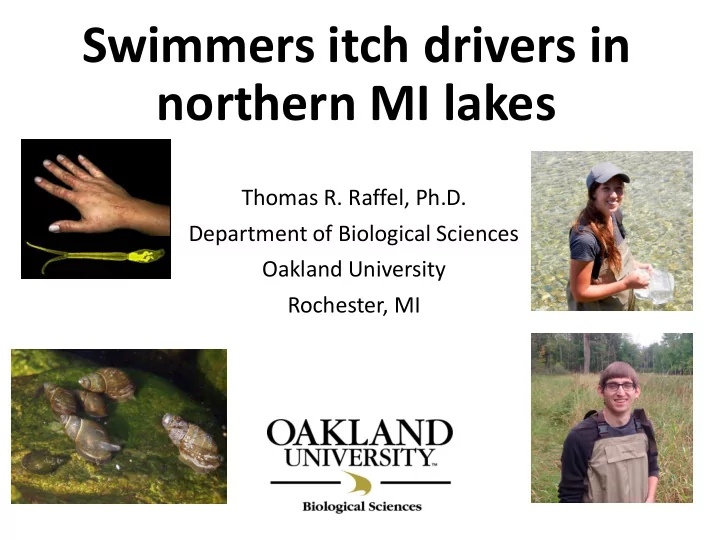
Swimmers itch drivers in northern MI lakes Thomas R. Raffel, Ph.D. Department of Biological Sciences Oakland University Rochester, MI Schistosomiasis: 2-host life cycle (SNAILS) Exposure in water Human schistosomes (3 spp) 2 nd

slide-1
SLIDE 1

Swimmers itch drivers in northern MI lakes

Thomas R. Raffel, Ph.D. Department of Biological Sciences Oakland University Rochester, MI

slide-2
SLIDE 2

Schistosomiasis:

  • 2-host life cycle (SNAILS)
  • Exposure in water
  • Human schistosomes (3 spp)
  • 2nd most important tropical disease worldwide
  • 200-300 million people infected/yr; 800,000 deaths
  • Avian schistosomes (12-15 spp)
  • Trying to infect birds
  • Itchy bumps 1-2 days post-exposure
  • Gradually fade over ~1 week

Adult worms (in blood vessel)

Trichobilharzia cercaria penetrating skin

slide-3
SLIDE 3
  • Trichobilharzia spp.
  • First described by Cort in

Douglas Lake (1928 )

Michigan: home of swimmer’s itch!

Physa integra Stagnicola catescopium* (= Stagnicola emarginata)

slide-4
SLIDE 4

Research Goals

  • 1. Temporal dynamics
  • Generate daily field data for cercaria

abundance

  • Test predictions for potential warning

systems

  • 2. Spatial distribution
  • Identify landscape-level predictors of

snail and parasite abundance

  • Inform management decisions
slide-5
SLIDE 5
  • High day to day variation reported, but no daily

field data available for cercaria abundance

  • Trematode biology is temperature-dependent
  • Snail growth & reproductive rates
  • Cercaria production rate
  • Most studies ignore temperature fluctuations
  • I. Temporal dynamics: Gaps in Knowledge

19 20 21 22 23 24 25 26 6/1 6/8 6/15 6/22 6/29 7/6 7/13 7/20 7/27

Temperature, Celsius Date

slide-6
SLIDE 6

Thermal Stress Hypothesis (Paull et al 2015)

  • Proposed that high temperatures are energetically

stressful to snails, depleting energy stores (e.g., fat reserves) during long warm periods.

  • Depleted host energy limits cercaria production

by trematode parasites

  • I. Temporal dynamics:
slide-7
SLIDE 7
  • I. Temporal dynamics: Thermal Stress Hypothesis

Warm Temperatures Metabolism (reaction rates) Energy budget of snail (fat reserve)

Cercaria

Immediate Effect Delayed Effect

slide-8
SLIDE 8

Higher levels when current water temperature is high Lower levels following multiple days of warm temperatures

  • I. Temporal dynamics: Thermal Stress Hypothesis

Predictions:

slide-9
SLIDE 9

Summer 2015 – Madelyn Messner

  • Needed a large number of daily cercaria samples from

natural sites during peak swimmer’s itch season

slide-10
SLIDE 10

Citizen scientists!

  • Volunteer recruitment & training
  • Daily samples: July 6 – August 2
slide-11
SLIDE 11

Temporal dynamics: July 6 – August 2, 2015

Daily samples- filter 50L water Hourly temperature & light

slide-12
SLIDE 12

Sample Processing

Collect filter sample Extract DNA qPCR to estimate cercaria abundance

slide-13
SLIDE 13
  • 378 individual sample tubes
  • DNA extraction from dried sample

− 1 mL lysis buffer + 10 uL proteinase K

  • qPCR – DNA quantification

− TaqMan Assay (Jothikumar et al 2015) − Target itch-causing schistosomes − Singlicate reactions w/reruns for inhibited reactions

  • IPC measures reaction inhibition (reduces

measurement bias)

  • Singlicate reactions (low precision for

individual measurements)

Temporal dynamics: sample processing

slide-14
SLIDE 14

Temporal dynamics: statistical analysis

Response variable: Cercaria/ 50L Substantial day to day variation Random effects:

  • Location
  • Snail population
  • Snail infection levels
  • Bird visitation
  • Water currents

Log cercaria/ 50L Min Daily Temp

slide-15
SLIDE 15

EXAMPLE: (Hypothetical)

  • Pirate attacks correlate

with ocean wind speed

  • Can we conclude increased

wind speed caused the increase in pirate attacks through time?

Temporal dynamics: temporal confoundment

YEAR

1790 1755 1780 1785 1750

Pirate attacks Ocean wind speed

Problem:

  • THOUSANDS of possibly relevant variables increased or decreased

during this time period, making this a potentially CONFOUNDED predictor variable

  • Poor evidence for causality (temporally confounded analysis)
slide-16
SLIDE 16

Standard method – account for long-term trend first, before testing for relationships Method 1:

  • “Detrend” cercaria data

using deviations from a spline curve fit to data

Temporal dynamics: temporal confoundment

*Method 2:

  • Use past cercaria levels (over 3, 5, or 7 days) as a covariate in the
  • analysis. Past levels predict current levels.

 AFTER accounting for the long-term trend, we tested for effects of current & past daily temperatures on cercaria abundance

  • Better evidence for a meaningful relationship
slide-17
SLIDE 17

Random variation…. (singlicate analyses) Best model according to AIC: 3 predictors 1. Higher cercaria levels in past 5 days → higher cercaria levels today 2. Current temps positive trend 3. Past temps significant negative effect

Predictor variable Coefficient χ2 p-value Log cercaria prev 5 days 1.94 23.9 <0.001 Min daily water temp 0.24 2.66 0.10 Previous 5 day water temp

  • 0.69

14.0 <0.001

Temporal dynamics: Results

slide-18
SLIDE 18

Temporal dynamics: Conclusions

  • Field evidence for

Thermal Stress Hypothesis

  • Positive effect of current temps
  • Widely cited in literature
  • Weaker (non-significant) effect in
  • ur analysis

 Negative effect of past temps

  • Novel finding; highly significant

and predictive

  • Higher-precision assays might help

improve predictions in the future

slide-19
SLIDE 19

Research Goals

  • 1. Temporal dynamics
  • Generate daily field data for cercaria

abundance

  • Test predictions for potential warning

systems

  • 2. Spatial distribution
  • Identify landscape-level predictors of

snail and parasite abundance

  • Inform management decisions
slide-20
SLIDE 20
  • II. Large-Scale Spatial Survey (16 lakes; 38 sites)

Maddie & Jenna Jason & Ryan Aleena & Alex

  • >50 volunteers trained
  • >1040 cercaria samples collected
  • >3000 miles driven
  • >2500 qPCR assays run

What determines patterns of schistosome cercariae abundance across a broad landscape?

slide-21
SLIDE 21

What determines swimmer’s itch at a particular SITE?

Snail population density Percent snails infected Cercariae produced per snail Bird infection? Temperature? Algal growth?

Cercariae in water

SWIMMER’S ITCH!

Wind/Waves?

Possible environmental drivers…..

slide-22
SLIDE 22

Land Use

  • Urbanization
  • Agriculture
  • Vegetation
  • Development

Physical charateristics

  • Wave action
  • Lake size/depth
  • Substrate type
  • Temperature

Cercariae in water Herbicide runoff Zebra mussels Insecticide runoff Nutrient pollution (N, P) Snail density Arthropod predators (crayfish) Attached algae Water clarity

− − − Hypothesized drivers:

Bird visitation

Water clarity hypotheses*:

  • 1. Clear water lets light penetrate to bottom of lake
  • 2. Algal periphyton is often light-limited, especially in deeper water
  • 3. Snail populations are often limited by periphyton (food) abundance
  • 4. Trematode abundance often limited by abundance of host snails

Infected snails Temperature

slide-23
SLIDE 23

Continuous/Daily monitoring:

  • Cercaria density - daily filtered-water samples (volunteers + qPCR)
  • Wind speed & direction (volunteers)
  • Water temperature & light penetration (HOBO loggers)
  • Bird visitation

Weekly surveys:

  • Snail quadrat sampling & collection (identification, size distribution)
  • Turbidity & zebra mussel densities (quadrats)
  • Crayfish trapping
  • Zooplankton sampling (density, composition)

Site-level measurements:

  • Attached algae (periphyton) growth & composition
  • Zebra mussel settling rates
  • Water chemistry (nitrates+nitrites+ammonia, organophosphate)
  • Pesticides (2,4-D; glyphosate)
  • Sediment cores (Phosphorus, Organic carbon)
  • Substrate & shoreline characteristics; fetch; slope

Lake-level characteristics:

  • Land use in watershed & near shore
  • Lake size & depth

2016 survey parameters (>60 possible predictors….):

slide-24
SLIDE 24

Results Part 1: Snails responded to water clarity

  • Supported a core prediction of our water clarity hypotheses….
slide-25
SLIDE 25

HOWEVER: Snails were dominated by Pleurocera…

slide-26
SLIDE 26

Pleurocera drove the Turbidity pattern…

slide-27
SLIDE 27

… and Pleurocera are NON-HOST snails.

Characteristics:

  • Thick-walled shells
  • Operculate
  • Common in larger rivers
  • MI is northern edge of

known distribution Not known to host Trichobilharzia sp. parasites

Encyclopedia of Life: Pleurocera collection records

slide-28
SLIDE 28

Results 2: Cercariae responded to Stagnicola

  • No added predictive power by adding other snail species

to the analysis

slide-29
SLIDE 29

Cercaria levels versus Stagnicola density:

slide-30
SLIDE 30

Comparing 2015 & 2016 datasets:

slide-31
SLIDE 31

“Stagnicola” snails:

Encyclopedia of Life: Stagnicola collection records

Characteristics:

 Known hosts for Trichobilharzia spp. parasites

  • Non-Operculate
  • ARCTIC taxon – rare south of MI
  • Eat algal periphyton & macrophytes
  • Lives in deep water (up to 30 feet for
  • L. catascopium)
  • Prefer solid substrates
  • Regulation by fish predators…?

“Stagnicola” snails:

Stagnicola catascopium/emarginata/elodes

slide-32
SLIDE 32

“Stagnicola” snails:

Stagnicola catascopium/emarginata/elodes

slide-33
SLIDE 33

Some sites had cercariae despite no Stagnicola….

  • Might indicate influx of

cercariae from offsite via water currents

  • Can we account for any of this variation in our analysis?
slide-34
SLIDE 34

F1,35 = 7.0; P = 0.012

Sites with few or no Stagnicola snails

How could submerged vegetation reduce the influx of cercariae from

  • ther sites?

Results 3: Submerged vegetation reduced cercariae

(after accounting for snail density)

slide-35
SLIDE 35

Plants as physical barriers? Plants as accidental “hosts”?

Hedychia coronarium (mariposa) (Warren & Peters 1968) Floating water plants (Christensen 1979)

How could submerged vegetation reduce the influx of cercariae from other sites?

slide-36
SLIDE 36

Bladderwort (Utricularia spp.)

  • Carnivorous water plant
  • Known to eat cercariae!
  • Widespread in MI
  • Sometimes mistaken for milfoil

Eurasian milfoil Bladderwort

Gibson & Warren 1970 Cercariae

slide-37
SLIDE 37

Cercariae Submerged vegetation Stagnicola Maximum Lake Depth Deciduous trees

Summary – Swimmer’s itch apparent risk factors

slide-38
SLIDE 38

Shallow Lake: Deep Lake:

HIGH Risk LOW Risk Medium Risk Medium Risk

Summary – Swimmer’s itch apparent risk factors

slide-39
SLIDE 39

THANK YOU!!!

Funds & Lodging (still compiling names for 2016…):

RAFFEL LAB: Mad adelyn Mess essner* Jas ason Sckr Sckrabulis* Ryan McW cWhinnie* Jenna a McBr cBride* Ale Alex Bag ageris Ale Aleena a Haj ajek Karie Altman

Collaborators: Pieter Johnson, Sara Paull, Bryan LaFonte, Curt Blankespoor, Ronald Reimink, David Szlag Oakland University Support:

Doug Wendell (chair), Arik Dvir, Cathy Starnes, Sheryl Hugger, Jan Bills, Kathy Lesich, Shawn Rasanen

Oakland Undergraduate researchers:

Fieldwork: R. McWhinnie, J. McBride, A. Hajek, A. Bageris; qPCR: J. McBride, S. Trotter, G. Everett, J. Willis; Invertebrate counts: Melissa Ostrowski, James Willis, Rima Stepanian, Aman Singh

Oakland University Startup Al Flory & Monika Schultz Chimney Corners Resort Platte Lake Improvement Assn Glen Lake Association Lake Leelanau Lake Assn Leelanau Clean Water Walloon Lake Association Lime Lake Association Higgins Lake Property Owners Assn SICON LLC Twin Lakes Property Owners Assn Elk-Skegemog Lake Assn Crystal Lake & Watershed Org. Lake Margrethe Foundation Fund Hamlin Lake Preservation Society Portage Lake Watershed Forever Intermediate Lake Association

ALL OUR CITIZEN SCIENTIST VOLUNTEERS! (NEXT SLIDE)

slide-40
SLIDE 40
  • (Crystal Lake) Al Flory & Monica Schultz; Ted & Barb Fischer; Pat & Sherry Grant
  • (Glen Lake) Mike & Sara Litch; Rob Karner; John DePuy; John Kassarjian
  • (Lake Leelanau) John Lutchko; Dave Hunter; John Popa; Wayne Swallow
  • (Platte Lake) Bob & Mason Blank; Wilfred Swieki
  • (Little Traverse Lake) Len Allgaier
  • (Lime Lake) Dean Manikas
  • (Walloon Lake) Russ Kittleson
  • (Higgins Lake) Ron Reimink; Curt Blankespoor
  • (Crystal Lake) Al Flory & Monica Schultz; Ted Fischer; Jana Way; Joel Buzzell; Shary Grant
  • (Deer Lake) Todd Sorenson; Alec Sherman
  • (Douglas Lake) Curt Blankespoor; Kira Surber
  • (Elk Lake) Bob & Bryce Kingon; Dean Ginther; Ruth Bay
  • (Glen Lake) John Kassarjian; Mike Litch; Denny Becker; Bill Meserve; Jack Laitala; Chris Dorsey Shugart
  • (Hamlin Lake) Ginny Hluchan; Linda & Ted Leibole; Judi Cartier & Ed Franckowiak; Paula & Mike Veronie; Denny Lavis; Joe

Muzzo; Mara DeChene; Gail Hanna; Kathy Grossenbacher; Jim Gallie

  • (Higgins Lake) Jim Vondale; Charlene Cornell; Richard Weadock; John & Susan Osler; Anne Grein; Ken Dennings; Greg Douglas;

Rebekah Gibson; Sue Gederbloom

  • (Intermediate Lake) Steve & Kathy Young; Jim & Karen Gilleylen; Scott Zimmerman; Marcia Collins; Claude & Joyce Gilkerson;

Sheridan & Bob Haack

  • (Lake Leelanau) David Hunter; John Popa; John Lutchko; Nick Fleezanis; Page Sikes
  • (Lime Lake) Dean Manikas
  • (Little Traverse Lake) Len Allgaier and Kristin Race
  • (Lake Margrethe) Sandra & Ken Michalik; Mike Ravesi; Lisa Jaenicke; Nancy Atchison
  • (Platte Lake) Wilfred J. Swiecki; Bob Blank; Tom & Christian Inman; Jackie & John Randall
  • (Portage Lake) Al Taylor; Mary Reed; Tammy Messner; Ted Lawrence
  • (Lake Skegemog) Dave Hauser; Kathi Gober
  • (Walloon Lake) Christine Wedge; Russ & Kathy Kittleson; John Markewitz; Megan Muller-Girard

2015 survey volunteers (8 lakes) 2016 survey volunteers (16 lakes)

slide-41
SLIDE 41
slide-42
SLIDE 42

What does thermal stress predict through time?

Cold to Warm: initial increase in parasite production followed by steady decline Constant Warm: parasite production declines longer it is held at warm temps

Paull et al 2015

slide-43
SLIDE 43
  • I. Large-Scale Survey (16 lakes; 38 sites)
slide-44
SLIDE 44

Primary drivers of Pleurocera:

slide-45
SLIDE 45

D45L D90 D45R

Effective Fetch (Lf )

𝐹𝑔𝑔𝑓𝑑𝑢𝑗𝑤𝑓 𝐺𝑓𝑢𝑑ℎ = σ 𝐸𝑗 × 𝑑𝑝𝑡 𝛿𝑗 σ 𝑑𝑝𝑡 𝛿𝑗

  • Distance wind can blow over water
  • more wave action (in theory)
  • Correlates with lake size & depth

𝑁𝑝𝑒𝑗𝑔𝑗𝑓𝑒 𝐹𝑔𝑔𝑓𝑑𝑢𝑗𝑤𝑓 𝐺𝑓𝑢𝑑ℎ = 𝐸45𝑀𝑑𝑝𝑡 45° + 𝐸90𝑑𝑝𝑡 90° + 𝐸45𝑆𝑑𝑝𝑡 45° 𝑑𝑝𝑡 45° + 𝑑𝑝𝑡 90° + 𝑑𝑝𝑡 45°

  • But why are Pleurocerid snails more abundant at

high-Fetch sites? Possible hypothesis:

  • Adapted for shallow water & high wave action
slide-46
SLIDE 46

Drivers of water clarity:

slide-47
SLIDE 47

Drivers of mussel abundance:

slide-48
SLIDE 48

Conifers – effects on turbidity, snails, & mussels?

slide-49
SLIDE 49

Conifers – effects on turbidity, snails, & mussels?

  • Conifers release terpenes (“turpentine”)
  • Toxic to algae? (few studies)
  • Less algae → lower turbidity
  • Less food for mussels
  • More food for snails
slide-50
SLIDE 50

D45L D90 D45R

Water clarity Pleurocera (Dominant snail) Fetch Temperature Mussels Alkalinity Gravel Conifers

Summary – factors affecting snail (Pleurocera) abundance