Nursery Neuroscience: Why You Matter How services grow brains Dr. - - PDF document

nursery neuroscience why you matter
SMART_READER_LITE
LIVE PREVIEW

Nursery Neuroscience: Why You Matter How services grow brains Dr. - - PDF document

Nursery Neuroscience: Why You Matter How services grow brains Dr. Suzanne Zeedyk Dr. Suzanne Zeedyk School of Psychology School of Psychology University of Dundee University of Dundee East Lothian Early Years Conference East Lothian Early


slide-1
SLIDE 1

Nursery Neuroscience:

How services grow brains

  • Dr. Suzanne Zeedyk

School of Psychology University of Dundee

East Lothian Early Years Conference March 2011

Why You Matter

  • Dr. Suzanne Zeedyk

School of Psychology University of Dundee

East Lothian Early Years Conference March 2011

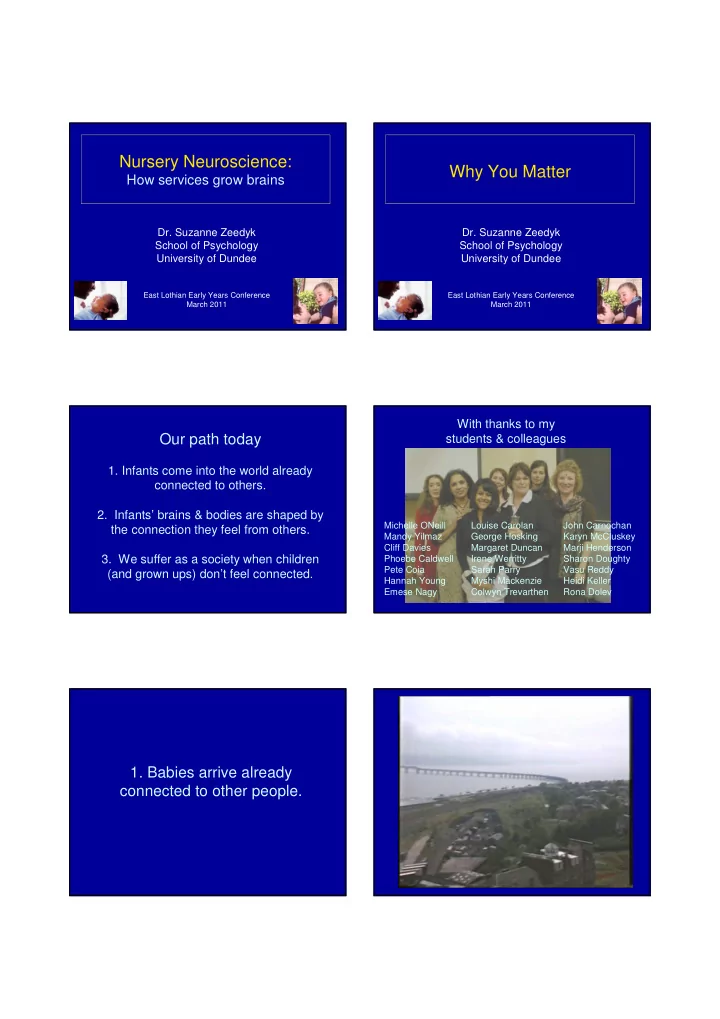
Our path today

  • 1. Infants come into the world already

connected to others.

  • 2. Infants’ brains & bodies are shaped by

the connection they feel from others.

  • 3. We suffer as a society when children

(and grown ups) don’t feel connected. With thanks to my students & colleagues

Michelle ONeill Louise Carolan John Carnochan Mandy Yilmaz George Hosking Karyn McCluskey Cliff Davies Margaret Duncan Marji Henderson Phoebe Caldwell Irene Werritty Sharon Doughty Pete Coia Sarah Parry Vasu Reddy Hannah Young Myshi Mackenzie Heidi Keller Emese Nagy Colwyn Trevarthen Rona Dolev

  • 1. Babies arrive already

connected to other people.

slide-2
SLIDE 2

DeCasper, A. J., & Spence, M. J. (1986). Prenatal maternal speech influences newborns' perception of speech sounds. Infant Behavior and Development, 9, 133-150. Hepper, P.G. (1988) Fetal soap addiction. Lancet. 1347-1348.

slide-3
SLIDE 3

If you want more of this sort of stuff ! Film: The Connected Baby Website & Research Updates m.s.zeedyk@dundee.ac.uk

slide-4
SLIDE 4
  • 2. The development of children’s

brains and bodies is shaped by that social connectedness.

  • Birth.

15 months. 2 years.

All human infants are born ‘premature’ = Neoteny

Brain as transport system…

slide-5
SLIDE 5

…built for a particular weather system…

…we all suffer if others create storms.

(Which they will do if that’s what’s familiar for them.)

Construct system: Birth – 3 yrs

  • Embed system: Primary Years
  • Rewire system: Adolescence
  • Predictability !

vs. U n p r e d i c t a b i l i t y !

slide-6
SLIDE 6

Empathy

Birth Birth – – 2 yrs 2 yrs

Attunement FROM

  • thers

Attunement TO

  • thers
  • KOTALUK BOOK

The effect of environmental deprivation to a baby is just as physical as a blow on the head.

(pg. xi)

Cortisol

The fear hormone = Stress Cortisol puts a brake on other body systems:

  • relaxation
  • immune system
  • learning

because the body believes it is in crisis.

Cortisol

The fear hormone = Stress Cortisol puts a brake on other body systems:

  • relaxation
  • immune system
  • learning

because the body believes it is in crisis.

S t r e s s ! ! “The human baby is incomplete. It arrives ready to be programmed by adults.”

2005

Oxytocin

The love hormone = Relax Oxytocin relaxes all body systems:

  • more receptive to others
  • more welcoming to others
  • calmer physiological system

because the body feels safe.

slide-7
SLIDE 7

Oxytocin

The love hormone = Relax Oxytocin relaxes all body systems:

  • more receptive to others
  • more welcoming to others
  • calmer physiological system

because the body feels safe.

Cuddles!!

Tapping the Hormone of Calm, Love, and Healing

“Oxytocin is likely to lie at the heart of human empathy.”

2003

The

Oxytocin

Factor

Tapping the Hormone of Calm, Love, and Healing

“Oxytocin is likely to lie at the heart of human empathy.”

2003

The

Oxytocin

Factor

Cuddle Circles in Dundee nurseries

  • 3. We suffer as a society when

infants – and grown ups – don’t feel connected.

£ £

  • Police

Violence Reduction Unit, Strathclyde Police www.actiononviolence.co.uk 2005

slide-8
SLIDE 8

Care System – Fostering & Adoption

Two young brothers have appeared in court accused of torturing and attempting to kill two boys in a horrific case which has shocked the UK. There was no sign of the boys' mum and dad in court, although their foster parents were in attendance.

Nursery - Childminding

“That small children need to have secondary attachments during any non-parental care is a biological imperative that is not universally understood and which does not always sit comfortably with our political, financial or social

  • aspirations. I fear that

stress in daycare with “strangers” has become a contributing factor to the educational, behavioural and mental health problems of many troubled children.”

Special Needs Special Needs A baby’s day…

slide-9
SLIDE 9

Mealtimes Reading Television Sleeping Arrangements

2010 2010

Separating babies from mothers at night – An ‘unusual’ cultural practice! (pg. 162)

slide-10
SLIDE 10

Baby Buggies

!! "

Was there a difference in infant vocalisations?:

  • No. infants who laughed

p<.05

Infant laughter

2 4 6 8 10 12 Aw ay Tow ard

  • No. of infants laughing during

journey

Was there a difference in infant sleeping?:

  • No. infants who fell asleep

p=.09

Infant Sleeping

2 4 6 8 10 Aw ay Tow ard

  • No. of infants falling asleep

Children’s toys teach ‘normality’

1960 2000

Car Seats

“Always place the harness lock at armpit level.” www.edmunds.com/advice/womenfamilies “The ‘level indicator’

  • n the side will tell you if

the seat is at the proper 45-degree angle.”

Going to Nursery

slide-11
SLIDE 11

And when most of the babies in your culture have similar days… And when most of the babies in your culture have similar days…

“Whatever’s normal around here...”

What kind of brains are we asking

  • ur children to develop --

through the days we create for them?

£ £

  • Mental well being in UK

2007 Britain ranks at bottom of 21 European countries for child well-being 2009 For children, economic prosperity

  • f the last 50 yrs has brought

increased emotional problems

slide-12
SLIDE 12

Source: J Heckman & D Source: J Heckman & D Masterov Masterov (2005) , (2005) , New Wealth for Old Nations: Scotland New Wealth for Old Nations: Scotland’ ’s Economic Prospects s Economic Prospects

Early Years Investment: Savings Ratio of 1 - 10

Source: J Heckman & D Source: J Heckman & D Masterov Masterov (2005) , (2005) , New Wealth for Old Nations: Scotland New Wealth for Old Nations: Scotland’ ’s Economic Prospects s Economic Prospects

Spending

Westminster Parliament

Graham Allen

Testimony: Autumn 2010 Recommended programmes: Jan 2011 Financial implications: Spring 2011

Scottish Parliament

Preventative Spending Enquiry

Finance Committee!!

Testimony: August 2011 Report: January 2011 Conference: 4 March 2011

http://www.holyrood.tv/art.asp

Susan Deacon’s Report

March 2011

Learning & Teaching Scotland

December 2010

slide-13
SLIDE 13

Longitudinal Studies -- Violence

Dunedin Study 1972 – present Age 3 predicts greater likelihood of violence in early 20’s

http://dunedinstudy.otago.ac.nz/ news/childhd.html

Language

  • !"
  • #

!$ # !% #

& '"

(( (( ((

  • Achievement Tests

Heckman, J. (2011). The American Family in Black and White: A post-racial strategy for improving skills to promote equality. IZA DP No. 5495

£ £

  • Invest now

Save later Invest now Save now Save later

slide-14
SLIDE 14

“Probably the most unexpected thing that I got from PALS was keeping my son. That doesn’t sound nice, but I honestly think if PALS hadn’t been there, I probably would have given up....It's now three years down the line, and it's working perfect.”

Programme: Parents Altogether Lending Support 6 weeks £200 / participant

Source: Zeedyk et al., 2007 Source: Zeedyk et al., 2007

In conclusion...

Nursery Neuroscience:

How services grow brains

  • Dr. Suzanne Zeedyk

School of Psychology University of Dundee

East Lothian Early Years Conference March 2011

I hereby pronounce you qualified Nursery Neuroscientists

  • Your First Assignment

What kind of brains are we asking our children to develop -- through the services we provide to them?

Your First Assignment

Children don’t want services. They want love.

slide-15
SLIDE 15

Thank you.

m.s.zeedyk@dundee.ac.uk