
SLIDE 1
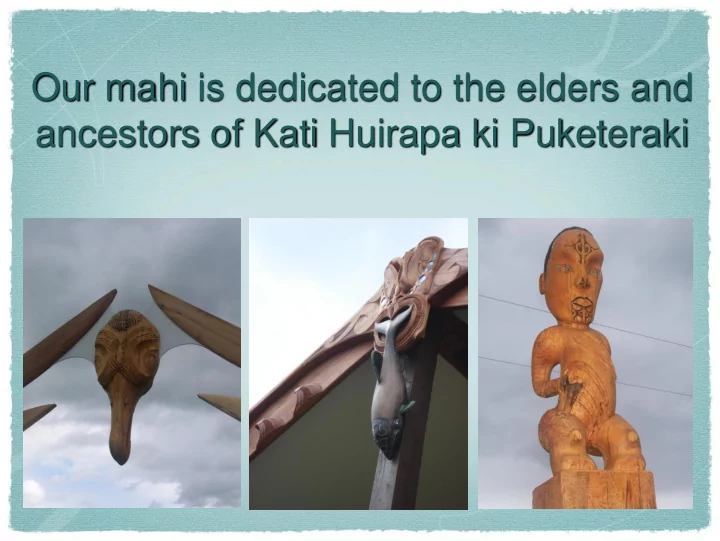
Our mahi is dedicated to the elders and ancestors of Kati Huirapa ki - - PowerPoint PPT Presentation
Our mahi is dedicated to the elders and ancestors of Kati Huirapa ki Puketeraki Ki Uta ki Tai From the mountains to the sea, Holistic approaches to fisheries management. Outline Fisheries today and in the past Taiapure History of the East
From the mountains to the sea, Holistic approaches to fisheries management.
Fisheries today and in the past Taiapure History of the East Otago Taiapure Threats facing habitats and fisheries in the taiapure Kaitiakitanga and ecology What we are trying to do Facing fisheries problems with new and old approaches Visions for the future
Traditional fisheries management Treaty of Waitangi/Tiriti o Waitangi Quota Management System Taiapure and Mataitai Trying to manage local, shared fisheries now Depletion, habitat destruction, fishing pressure, single species management systems
Treaty obligations Coastal waters Special significance to iwi or hapu Non-commercial and commercial fishing Shared fishery with customary, recreational, commercial and other interest groups Management committee can recommend regulations
Over 800 years of habitation and use Applied for in 1992 in response to concerns of elders of Kati Huirapa ki Puketeraki for diminishing paua stock Established in 1999 and committee formed in 2001 First regulation in 2007 (set net restriction) Proposed suite of regulations in 2009
Guiding principle, to maintain and enhance fisheries and habitats for future generations Include, local knowledge, Matauranga Maori and relevant science in management
Utu Mauri Tangaroa Papatuanuku
Fisheries should be seen as a garden rather than a resource (re-seeding, stock rotation) Gaining an understanding of the variability of coastal fisheries stock managed at scales relevant to the stock e.g. reef-by-reef management Fisheries ecosystems Considering the connection between land and sea
Consent applications Riparian Planting Project next generation Support for scientific research Education and public liaison Conservative customary take Fisheries plans Submissions (e.g. quota change, new fisheries)
to ecosystem fisheries with local scale management
within their region and need to be empowered to manage their own resources
effectively manage local fisheries
Reduced bag limits
paua (10 to 5) Kina (50 to 10) Tuaki/cockles (150-50) Maximum combined shellfish 150-50 Finfish 30 to 10
Temporary Closure
2 year closure of Huriawa (Karitane Peninsula) to fishing for paua
No expansion of commercial tuaki fishing
Clear mandate and authority Common cause Set objectives Good leadership Right people Trust and confidence Clout Bravery Local knowledge guiding scientific research Robust discussion/debate Full participation in local and central government consultation
Better chance of maintaining or enhancing the biodiversity of the fishery Better chance of informed decision making about catch limits, recovery times Better chance of adequate habitat for feeding grounds, breeding grounds Better chance for resilience of the marine ecosystem
More confident of food security – future proofing local food source Satisfaction in knowing we are making an effort to improve the health of our local fisheries Building environmental, social and cultural capital Building a sense of stewardship
Nga Tipuna, nga tini mate, haere koutou. Nga kaumatua, te hapu; Kati Huirapa ki Puketeraki tena
Waikouaiti & Karitane. Thank you to everyone who has helped out over the last few years especially, former and current students and staff at Botany and Marine Science Departments, members of Te Tiaki Mahinga Kai, supervisors and the local community around the East Otago Taiapure. Thank you to our whanau and friends for your support with this kaupapa. Chris Hepburn, Anne-Marie Jackson and Ani Kainamu are funded by Foundation for Research Science and Technology Te Tipu Puataio Fellowships. Brendan Flack was supported by Te Runanga o Ngai Tahu to attend this conference. Patti Vanderburg was supported by the Foundation for Research, Science and Technology Te Tipu Putaiao Fund to attend this conference.